NUS Show Lab 寿政教授:打通自回归与离散扩散,打造下一代具身大模型底座|ECCV 2026
Ranking
Overall
78
Content
90
Popularity
N/A
No observed public metrics; popularity remains neutral/archived.
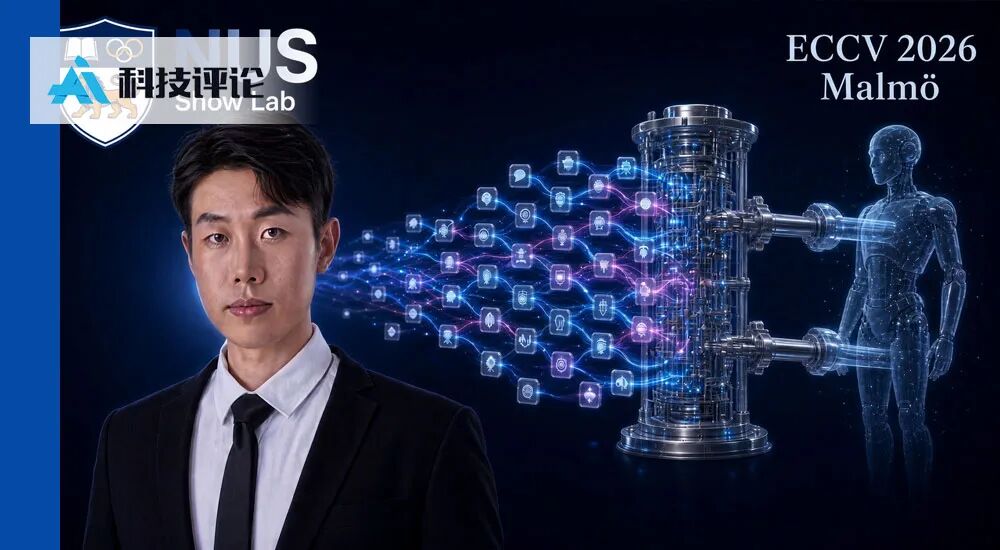
Merged summary
TL;DR - NUS Show Lab presented its Show-o/Show-2 unified multimodal architecture, which combines autoregressive language modeling and discrete diffusion-based visual generation within one Transformer. The work extends unified understanding and generation toward video and low-latency robotic control.
- Show-o uses autoregression for text and mask-and-predict discrete diffusion for visual tokens, enabling flexible multimodal input and output without attaching a separate continuous diffusion model.
- Show-2 adds a shared 3D tokenizer and bidirectional spatiotemporal attention to improve video continuity, while separate understanding and generation paths balance semantic representation against pixel-level detail.
- Cycle-consistency supervision creates a self-supervised loop—observe, describe, and reconstruct—to learn from domain-specific images or unlabeled videos where annotations are scarce.
- For embodied AI, the team combines cloud-based planning with faster local VLA and world-action models, aiming to jointly predict robot actions and their future visual consequences.
Sources (1)
NUS Show Lab 寿政教授:打通自回归与离散扩散,打造下一代具身大模型底座|ECCV 2026
Public signals
N/A
TL;DR - NUS Show Lab presented its Show-o/Show-2 unified multimodal architecture, which combines autoregressive language modeling and discrete diffusion-based visual generation within one Transformer. The work extends unified understanding and generation toward video and low-latency robotic control.
- Show-o uses autoregression for text and mask-and-predict discrete diffusion for visual tokens, enabling flexible multimodal input and output without attaching a separate continuous diffusion model.
- Show-2 adds a shared 3D tokenizer and bidirectional spatiotemporal attention to improve video continuity, while separate understanding and generation paths balance semantic representation against pixel-level detail.
- Cycle-consistency supervision creates a self-supervised loop—observe, describe, and reconstruct—to learn from domain-specific images or unlabeled videos where annotations are scarce.
- For embodied AI, the team combines cloud-based planning with faster local VLA and world-action models, aiming to jointly predict robot actions and their future visual consequences.