横扫四榜,DM0.5 凭什么面面俱到?
Ranking
No observed public metrics; popularity remains neutral/archived.
Merged summary
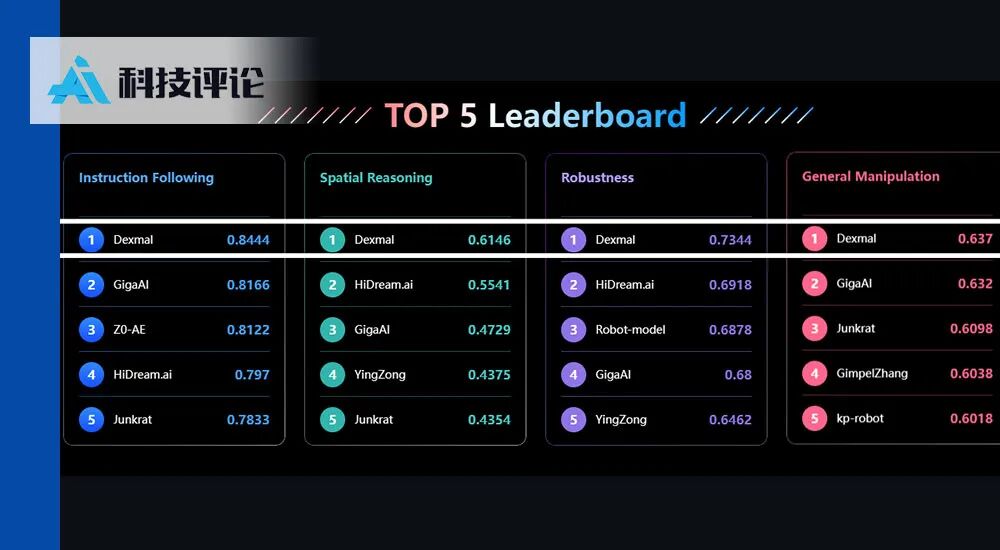
TL;DR - ForceMinds’ open-source DM0.5 embodied foundation model ranked first across all four RoboColiseum categories, suggesting unusually balanced instruction-following, spatial-reasoning, robustness, and manipulation capabilities. The results matter because they span complementary benchmarks and are supported by reported real-robot deployments.
- RoboColiseum reports DM0.5 scores of 0.8444 for instruction following, 0.6146 for spatial understanding, 0.7344 for disturbance adaptation, and 0.6370 for general manipulation.
- Its design combines embodied chain-of-thought pretraining, 100,000 hours of egocentric video, 3D geometric representations, and a native 60-second memory.
- TensorRT, FP8, FlexAttention, Triton kernels, and CUDA Graph optimizations reportedly reduced core inference latency from 534 ms to 57.49 ms, with LIBERO success nearly unchanged at 98.40%.
- Model weights, training infrastructure, and several downstream workflows are being open-sourced, while warehouse and manufacturing trials provide early evidence beyond simulation benchmarks.
Sources (1)
横扫四榜,DM0.5 凭什么面面俱到?
TL;DR - ForceMinds’ open-source DM0.5 embodied foundation model ranked first across all four RoboColiseum categories, suggesting unusually balanced instruction-following, spatial-reasoning, robustness, and manipulation capabilities. The results matter because they span complementary benchmarks and are supported by reported real-robot deployments.
- RoboColiseum reports DM0.5 scores of 0.8444 for instruction following, 0.6146 for spatial understanding, 0.7344 for disturbance adaptation, and 0.6370 for general manipulation.
- Its design combines embodied chain-of-thought pretraining, 100,000 hours of egocentric video, 3D geometric representations, and a native 60-second memory.
- TensorRT, FP8, FlexAttention, Triton kernels, and CUDA Graph optimizations reportedly reduced core inference latency from 534 ms to 57.49 ms, with LIBERO success nearly unchanged at 98.40%.
- Model weights, training infrastructure, and several downstream workflows are being open-sourced, while warehouse and manufacturing trials provide early evidence beyond simulation benchmarks.