被英伟达点名的杭州团队,补上了AI for Science的「最后一公里」
Ranking
Overall
71
Content
80
Popularity
N/A
No observed public metrics; popularity remains neutral/archived.
Merged summary
TL;DR - Hangzhou-based protein design company Lévin released Lévin Harness, an agentic workspace that connects scientific models, analysis tools, compute, data, and reusable workflows. It aims to close the AI-for-science loop from research planning and protein design through result analysis and experimental feedback.
- General-purpose LLMs plan tasks and interpret natural-language requests, while specialized tools handle protein structure prediction, sequence design, and candidate evaluation.
- A plugin system standardizes model installation, inputs, outputs, and execution, while supporting local workstations and remote GPU servers.
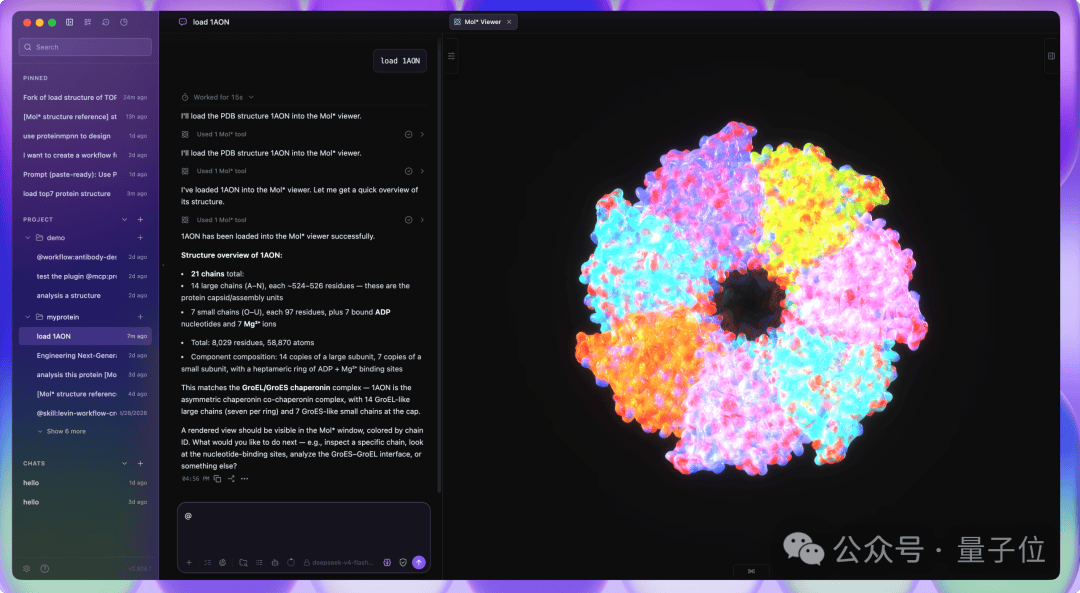
- Integrated 3D molecular visualization gives the agent structural context, including selected residues and spatial regions referenced during conversation.
- Workflows preserve tools, parameters, decision steps, and experimental feedback for iterative reuse; project data, conversations, settings, and API keys remain on the user’s machine.
Sources (1)
被英伟达点名的杭州团队,补上了AI for Science的「最后一公里」
Public signals
N/A
TL;DR - Hangzhou-based protein design company Lévin released Lévin Harness, an agentic workspace that connects scientific models, analysis tools, compute, data, and reusable workflows. It aims to close the AI-for-science loop from research planning and protein design through result analysis and experimental feedback.
- General-purpose LLMs plan tasks and interpret natural-language requests, while specialized tools handle protein structure prediction, sequence design, and candidate evaluation.
- A plugin system standardizes model installation, inputs, outputs, and execution, while supporting local workstations and remote GPU servers.
- Integrated 3D molecular visualization gives the agent structural context, including selected residues and spatial regions referenced during conversation.
- Workflows preserve tools, parameters, decision steps, and experimental feedback for iterative reuse; project data, conversations, settings, and API keys remain on the user’s machine.