刚刚,唐杰发布智谱RSI首个成果
Ranking
No observed public metrics; popularity remains neutral/archived.
Merged summary
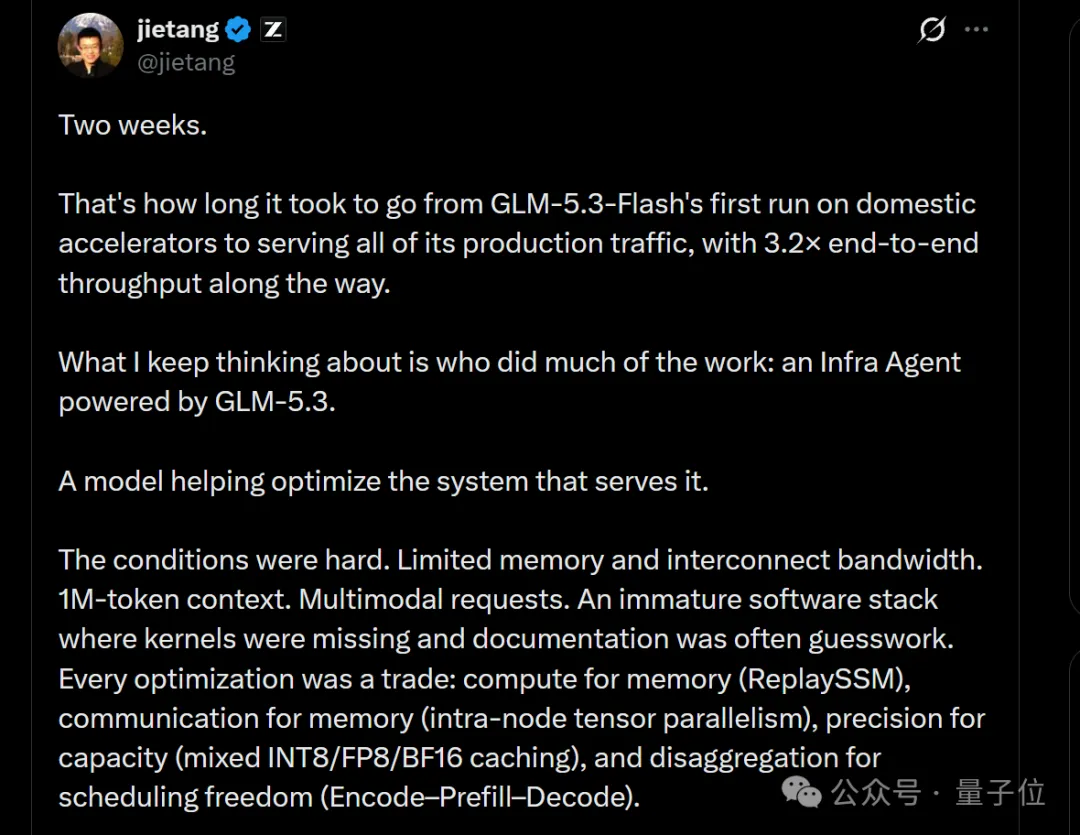
TL;DR - Zhipu reports that a GLM-5.3-powered infrastructure agent helped build and optimize the production inference stack for GLM-5.3-Flash on a cluster of more than 100,000 domestic accelerators, raising end-to-end throughput to 3.2 times the initial baseline in under two weeks. The company frames this as an early, human-supervised form of recursive self-improvement—not autonomous RSI.
- The agent used “dense feedback” from correctness tests, traces, runtime events, microbenchmarks, and service metrics to form hypotheses, modify code, and iteratively validate results.
- It identified a Python GIL bottleneck that prevented KV-transfer work from overlapping with DeepEP operations, reducing the Prefill-plus-transfer overhead from over 20% to below 1%.
- It fixed accumulated numerical errors in a context-parallel KDA path by using higher-precision
tf32x3operations. - By reorganizing repeated normalization and gating computations in a KDA Decode kernel, the agent achieved a 1.71× kernel-level speedup.
Sources (1)
刚刚,唐杰发布智谱RSI首个成果
TL;DR - Zhipu reports that a GLM-5.3-powered infrastructure agent helped build and optimize the production inference stack for GLM-5.3-Flash on a cluster of more than 100,000 domestic accelerators, raising end-to-end throughput to 3.2 times the initial baseline in under two weeks. The company frames this as an early, human-supervised form of recursive self-improvement—not autonomous RSI.
- The agent used “dense feedback” from correctness tests, traces, runtime events, microbenchmarks, and service metrics to form hypotheses, modify code, and iteratively validate results.
- It identified a Python GIL bottleneck that prevented KV-transfer work from overlapping with DeepEP operations, reducing the Prefill-plus-transfer overhead from over 20% to below 1%.
- It fixed accumulated numerical errors in a context-parallel KDA path by using higher-precision
tf32x3operations. - By reorganizing repeated normalization and gating computations in a KDA Decode kernel, the agent achieved a 1.71× kernel-level speedup.