🛰️ Daily AI Frontier
37 works · 2 categories · 10 topics · blog 12 arxiv 15 journal 10 generated 2026-09-17 14:33:56 UTC
Top highlights — Research

LLM Agents 8

Reimagining research papers as interactive and reliable AI agents

Rank 91 · Content 100 · Popularity 71

TL;DR - Paper2Agent converts research papers and their associated code and data into interactive, tool-using AI agents. This could make published work easier to reproduce, query and extend through agent-driven scientific collaboration.

  • Uses the Model Context Protocol to expose research artifacts as callable tools.
  • Incorporates manuscripts, code and data into the agent’s context.
  • Aims to reproduce original results and answer new scientific questions.
  • Supports collaboration between paper-derived agents to generate novel insights.
Representative image for ProgramDistill: From Interactive Web Apps to Verifiable Reference-Guided SWE Tasks

ProgramDistill: From Interactive Web Apps to Verifiable Reference-Guided SWE Tasks

Rank 90 · Content 100 · Popularity 66

TL;DR - ProgramDistill is a benchmark for testing whether coding agents can reconstruct web-app features by interacting with working reference applications rather than following explicit specifications. It offers scalable, automatically generated tasks with controlled difficulty and replay-based verification.

  • The mine-craft-patch pipeline discovered 1,975 replay-verified behaviors across 26 applications and generated 4,063 tasks without human intervention.
  • Tasks factor applications into features of varying granularity, each paired with replayable behavior executable through a gold patch.
  • In full-application reconstruction, GPT-6 Astra and Claude Opus 5 achieved 49.2% and 28.8% success, respectively, on cumulative workflows.
  • Partial reconstruction performance declined sharply as restoration depth increased from 1 to 8, indicating substantial difficulty in recovering longer feature sequences.

ScienceIDE: Turning World's Scientific Codebase into Agent Learnable Environments

Rank 88 · Content 95 · Popularity 71

TL;DR - ScienceIDE converts scientific code repositories into executable, verifiable environments for training and evaluating AI agents. Models trained on verified scientific interaction trajectories improved on held-out code repair and selected broader benchmarks, suggesting positive transfer.

  • Expert-defined cases and acceptance criteria guide repository transformation, task generation, execution, and scientific verification.
  • The environments support supervised fine-tuning, reinforcement learning, and evaluation through verified agent trajectories.
  • The authors trained PhAI-IDE models at 72B, 9B, and 4B parameter scales.
  • Reported gains span held-out scientific-code repair and selected general-purpose code, reasoning, and knowledge benchmarks.
Representative image for In-Context Robot Learning with VLM Agents

In-Context Robot Learning with VLM Agents

Rank 85 · Content 95 · Popularity 62

TL;DR - GPT-Policy is a framework that uses vision-language model agents to learn robot tasks from deployment-time context without gradient updates. Real-robot experiments suggest that human videos improve task completion, while aligned action references provide additional gains for contact-sensitive tasks.

  • A context compiler preserves task-relevant visual transitions from demonstrations, examples, and interaction feedback.
  • A VLM proposes robot-tool actions, while a constrained controller verifies and executes them and reports outcomes.
  • The study evaluates task success, efficiency, model differences, and the effects of removing context components.
  • Human demonstrations can help even without robot action labels, indicating a path toward more adaptable general-purpose robotic policies.

Turning scientific research papers into interactive AI agents

Rank 81 · Content 95 · Popularity 48

TL;DR - Paper2Agent is an automated framework that converts static scientific papers into interactive AI agents capable of answering questions and applying published methods to new data. It could make research more reproducible, reusable, and extensible.

  • Each agent acts as a “virtual corresponding author” for its source paper.
  • Agents can explain the paper and operationalize its methods on new datasets.
  • Multiple paper agents can collaborate, enabling research workflows that combine knowledge and methods across publications.
  • The framework shifts scientific literature from passive documents toward executable, interactive resources.
Representative image for Affora: A Design System for Agent-Friendly Interfaces

Affora: A Design System for Agent-Friendly Interfaces

Rank 78 · Content 95 · Popularity 39

TL;DR - Affora is a design system for interfaces that remain familiar to humans while making actions and task state legible to computer-use agents. It matters because agent usability can improve without sacrificing visual flexibility or creating separate agent-only interfaces.

  • Three controlled studies examine component implementations, visual variation, and interaction-design principles.
  • Agent performance depends on preserving interaction meaning in the interface representation, even when visual designs vary substantially.
  • Evaluations show gains when Affora addresses existing interface deficits, but limited impact when deficits are absent or beyond its scope.
  • The system provides reusable implementations and executable checks, with preliminary workflow evidence of reduced interaction cost.

ASLEval: Measuring Privacy Exposure Displacement in LLM Agent Sessions

Rank 78 · Content 95 · Popularity 39

TL;DR - ASLEval is an authorization-aware framework for measuring privacy exposure across all visible exits in multi-step LLM agent sessions. It shows that evaluations focused on a single expected output can substantially underestimate leakage.

  • Expected-outlet-only evaluation missed 46.9% of exposure captured by the union of visible exits.
  • Attacker self-reports exhibited both omissions and high false-discovery rates, making them unreliable privacy proxies.
  • Schema-aligned internal evidence generally appeared before visible exposure at the request or probe level, helping diagnose leakage paths.
  • Restricting model-visible tool returns altered exposure pathways but could also eliminate successful completion of legitimate tasks, highlighting a privacy–utility tradeoff.

AI tool turns any paper into an ‘agent’ that can collaborate and answer complex queries

Rank 78 · Content 90 · Popularity 49

TL;DR - Paper2Agent is an AI system that turns research papers into interactive agents capable of answering complex questions and supporting collaboration. Its authors say it could help researchers reproduce published work and navigate unfamiliar fields.

  • The system converts papers into agents rather than treating them only as static documents.
  • It is designed to answer complex queries about the represented research.
  • Its proposed benefits include easier paper reproduction and faster understanding of unfamiliar work.
  • The provided description does not specify the system’s architecture, evaluation methods, or measured results.

Medical/Healthcare AI 6

Evidence-Grounded Agentic Formulation Development in an Autonomous Laboratory

Rank 82 · Content 100 · Popularity 39

TL;DR - Andromeda 2 is an evidence-grounded agentic system that autonomously designs and tests drug formulations using computational tools and a miniaturized laboratory. For paclitaxel delivery, it substantially outperformed probabilistic optimization and design-of-experiments baselines under a matched budget.

  • Achieved a 50% high-performance formulation hit rate, versus 17% for Andromeda 1 and 2% for wet-lab DoE.
  • Identified 12 formulations satisfying all four target product profile objectives, compared with 6 and 0 for the baselines.
  • Its median paclitaxel AUC was 70.1 mg·min/mL, versus 12.0 and 3.5 mg·min/mL.
  • Structured in-house experimental evidence raised mean AUC by 34% in a controlled ablation, highlighting the value of evidence-grounded agentic reasoning.

Identification of broadly tumour-reactive γδ TCRs from multiple myeloma

Rank 81 · Content 95 · Popularity 49

TL;DR - Nature reports PreGame, a machine-learning algorithm that identifies broadly tumour-reactive γδ T cells in multiple myeloma from single-cell CITE-seq data. Expansion of this T-cell population may provide a biomarker of therapeutic response.

  • PreGame analyzes combined single-cell transcriptomic and surface-protein measurements.
  • The method focuses on γδ T-cell receptors with broad tumour reactivity.
  • Changes in the identified cell population could help monitor treatment response in multiple myeloma.

Developmental xenocortication using human-derived organoids in mice

Rank 81 · Content 85 · Popularity 71

TL;DR - This Nature study develops “xenocortication,” using human-derived neural organoids to introduce human neurons into developing mouse cortical circuits. The approach enables circuit- and behaviour-level investigation of human neurodevelopment in vivo.

  • Human-derived organoids provide the neurons used for xenocortication in mice.
  • The model connects cellular neurodevelopment with circuit- and behavioural analysis.
  • The supplied abstract does not specify experimental outcomes, disease applications, or quantitative results.
Representative image for EviGen: Predictive Evidence Scaffolding for Verifiable Clinical Rationale Generation

EviGen: Predictive Evidence Scaffolding for Verifiable Clinical Rationale Generation

Rank 78 · Content 95 · Popularity 39

TL;DR - EviGen is a three-layer framework that retrieves outcome-predictive evidence from longitudinal health records, uses it to scaffold clinical rationale generation, and verifies claims step by step. It improves predictive performance and rationale faithfulness while reducing omissions and hallucinations associated with full-context LLM and standard RAG approaches.

  • A patient-conditioned retriever uses learnable queries to identify evidence predictive of clinical outcomes, ranking spans by attribution scores rather than textual relevance alone.
  • An LLM generates clinical rationales grounded in the ranked evidence scaffold.
  • A process-supervised verifier evaluates individual reasoning steps and flags unreliable claims.
  • Across three medical prediction datasets, EviGen outperformed full-context LLM and RAG baselines and was preferred by clinical reviewers in a usability evaluation.

Evolution and heterogeneity of lethal metastatic bladder cancer subtypes

Rank 78 · Content 90 · Popularity 49

TL;DR - A Nature study uses a rapid autopsy programme to investigate the molecular and genetic evolution of lethal metastatic bladder cancer. The resource may clarify how aggressive histological subtypes become heterogeneous and develop treatment resistance.

  • Examines metastatic bladder cancer across its temporal evolution.
  • Focuses on aggressive histological subtypes and tumour heterogeneity.
  • Supports detailed molecular and genetic analyses of therapy resistance.
  • The provided abstract does not report specific methods or findings.

Rapid patient-specific neural networks for X-ray to volume registration

Rank 78 · Content 90 · Popularity 49

TL;DR - A Nature paper introduces xvr, a rapid patient-specific neural-network approach for rigidly registering 2D X-rays with 3D volumes. It aims to make this capability available across anatomical regions to broader clinical and research communities.

  • Performs patient-specific 2D/3D X-ray-to-volume registration.
  • Targets rigid alignment across multiple anatomical regions.
  • Emphasizes rapid operation and broad accessibility.
  • The provided excerpt does not include quantitative results or methodological details.

Bioinformatics AI 2

Scalable near-real-time Bayesian phylogenetics for outbreaks with Delphy

Rank 78 · Content 90 · Popularity 49

TL;DR - Delphy is a scalable Bayesian phylogenetics method for analyzing expanding viral outbreaks in near real time. It aims to give public health organizations state-of-the-art analysis of their own outbreak data with minimal operational friction.

  • Designed to scale as viral outbreak datasets grow.
  • Supports near-real-time Bayesian phylogenetic analysis.
  • Intended to help public health bodies analyze local data and respond rapidly.
  • The provided excerpt does not include benchmarks, implementation details, or specific accuracy results.

Mitochondrial fission factor senses and governs ferroptosis

Rank 78 · Content 90 · Popularity 49

TL;DR - A Nature study identifies mitochondrial fission factor (MFF) as a selective promoter of ferroptosis and introduces MFF–SPARK, a sensor for studying and screening this cell-death pathway. The platform could accelerate discovery of ferroptosis-sensitizing compounds and upstream MFF regulators.

  • MFF is a mitochondrial–peroxisomal fission adaptor with a newly identified pro-ferroptotic role.
  • MFF–SPARK enables high-content screening of compounds that sensitize cells to ferroptosis.
  • The sensor can also help identify upstream biological regulators of MFF.

LLMs & Foundation Models 4

Rethinking Critic Learning in PPO: Understanding and Mitigating Value Flattening

Rank 83 · Content 90 · Popularity 67

TL;DR - This paper identifies “Value Flattening,” a PPO failure mode where critics produce overly uniform predictions despite sharp changes in Monte Carlo state values. It proposes sparse critic supervision that improves learned policies while using only three supervised states per response.

  • Value Flattening appears in both LLM reinforcement learning and controlled FrozenLake experiments, worsening as the state space grows.
  • The authors link it to an implicit variance penalty in the critic loss and redundant updates from temporally correlated states with similar gradients.
  • Their SParse Proximal Policy Optimization (SP³O) method applies value loss only to a few well-separated states in each response.
  • Experiments on Qwen3-Base report consistent policy improvements across model sizes and evaluation suites.
Representative image for Monitoring and Discovering Reward Hacking with Internal Representations during LLM Evaluations

Monitoring and Discovering Reward Hacking with Internal Representations during LLM Evaluations

Rank 82 · Content 100 · Popularity 39

TL;DR - This paper shows that simple difference-of-means vectors derived from LLM internal representations can detect reward hacking nearly as effectively as costly LLM monitors. The approach could enable inexpensive, real-time monitoring before a model takes undesirable actions.

  • Reward hacking appeared in 57.2% of GLM 5.2 rollouts on DeepSWE and 73% on SWE-bench.
  • The representation vectors generalized across behaviors and were interpretable in Kimi K3, GLM 5.2, and Qwen 3.8 Max.
  • At matched false-positive rates on DeepSWE, the vectors caught 3.1% more hacks for Kimi K3 and 7.9% fewer for GLM 5.2 than LLM monitors.
  • Applying the vectors to chain-of-thought predicted subsequent reward-hacking actions and uncovered undesirable behaviors missed by LLM monitors.

Preventing Model Collapse: A Fisher-Rao Perspective on the Dynamics of Training with Synthetic Data

Rank 82 · Content 100 · Popularity 39

TL;DR - This paper uses Fisher-Rao information geometry to derive theoretical guarantees for the minimum proportion of fresh human data needed to prevent model collapse during recursive training on synthetic data. Its bounds remain meaningful in high-dimensional categorical distributions, unlike prior Euclidean analyses.

  • Models recursively trained on synthetic data can progressively lose fidelity to the underlying real-data distribution.
  • The analysis models training dynamics on the probability simplex using the Fisher-Rao metric.
  • It derives quantitative contraction and invariance bounds that do not become trivial as dimensionality increases.
  • The results indicate that the human-to-synthetic data ratio required for stable training differs from previous estimates.
Representative image for Objective vs. Search: Decomposing What Makes a Good Tokeniser

Objective vs. Search: Decomposing What Makes a Good Tokeniser

Rank 78 · Content 95 · Popularity 39

TL;DR - This paper disentangles tokeniser optimization objectives from search procedures using a controlled 2×2 comparison. Bottom-up search generally produces language models with better compression efficiency, while neither design choice consistently improves grammatical performance.

  • Introduces BottomUpLL and TopDownComp to complement BPE and UnigramLM across objective and search dimensions.
  • Tests tokenisers across model sizes, vocabulary sizes, and English-only versus multilingual domains.
  • Bottom-up tokenisers consistently achieve lower bits-per-byte in most settings, indicating search procedure matters more than objective.
  • BLiMP results show no consistent relationship between tokeniser design and grammatical performance.

Multimodal & Generative 2

Representative image for PointZero: 3D Point Track Completion for Learning Transferable 3D Dynamics

PointZero: 3D Point Track Completion for Learning Transferable 3D Dynamics

Rank 83 · Content 100 · Popularity 43

TL;DR - PointZero learns transferable 3D dynamics by completing point trajectories from RGB-D observations and sparse partial tracks, avoiding the need for robot action labels during pre-training. This enables broader data use and improves downstream 3D prediction and robot manipulation.

  • Pre-training uses 2.9 million synthetic frames spanning deformable, articulated, and rigid objects.
  • A transformer predicts future 3D trajectories for all observed points from a single RGB-D frame and sparse tracks.
  • After action-conditioned fine-tuning, PointZero outperforms baselines on the PGND 3D dynamics benchmark.
  • For imitation learning, it matches or exceeds baselines on 6 of 7 simulated and real-world manipulation tasks.
Representative image for Decodable but Misrouted: Sparse Features Uncover a Readout Gap in Vision-Language Models for Harmful Meme Detection

Decodable but Misrouted: Sparse Features Uncover a Readout Gap in Vision-Language Models for Harmful Meme Detection

Rank 82 · Content 95 · Popularity N/A

TL;DR - Sparse autoencoder analysis suggests vision-language models often encode evidence needed to detect harmful memes but fail to route it into their final predictions. Improved calibration and targeted LoRA adaptation can recover much of this readout gap.

  • Sparse probes substantially outperformed native macro-F1 across six binary benchmarks: 0.740 vs. 0.432 for Qwen and 0.714 vs. 0.532 for Gemma.
  • Causal ablation and feature-patching experiments distinguished internally represented “silent” evidence from evidence already routed toward model outputs.
  • Calibration-only routing recovered 93.3% of the mean performance gap, while probe-distilled LoRA also improved native predictions; shared multi-task adaptation caused negative transfer.
  • Tests in Spanish and Hindi-English code-mixed settings indicated that the signal extends beyond English, requires paired visual evidence, and is not solely explained by OCR.

Efficiency & Systems 2

How Model Growth, Recursion, and Boundary Operators Influence Scaling Exponents

Rank 84 · Content 95 · Popularity 59

TL;DR - This paper shows that transformer model growth, recursive depth, and boundary operators can improve pre-training scaling exponents rather than merely deliver fixed efficiency gains. A 7.4B growth architecture matches GPT-3 13B on CORE with roughly 20× less compute, with gains increasing at larger scales.

  • Growing models during training, with or without shared weights, produces the largest changes in scaling exponents.
  • Boundary operators that normalize and inject an earlier block also yield increasing compute-efficiency gains, though smaller than model growth.
  • In data-constrained multi-epoch training, looping acts as a regularizer, and the compute-optimal loop count increases with scale.
  • The results suggest that increasing usable computational depth within a fixed compute budget can improve scaling behavior.
Representative image for rMuscle: Robotic Muscle Memory for Efficient Vision-Language-Action Model Inference

rMuscle: Robotic Muscle Memory for Efficient Vision-Language-Action Model Inference

Rank 82 · Content 95 · Popularity N/A

TL;DR - rMuscle accelerates Vision-Language-Action model inference by caching reusable visual-token outputs and neuron activation patterns across repetitive robot executions. It improves responsiveness by 1.29–1.42× without reducing real-world task success rates.

  • A Context Cache reuses visual-token outputs to avoid redundant computation.
  • An Action Cache reuses activation patterns to reduce model-weight accesses.
  • Online recomputation, sliding-window retrieval, and shared masks limit cache memory and access overhead.
  • Evaluations span RTX 4090 and Jetson Thor hardware, LIBERO, RoboTwin, and physical manipulation tasks.

Molecular Self-Assembly 1

Molecular-level observation of the self-assembly of a virus-like particle

Rank 77 · Content 80 · Popularity 69

TL;DR - Researchers combined mass photometry with single-molecule trapping to monitor individual virus-like particles assembling in real time at molecular resolution. The approach enables direct measurement of self-assembly pathways and dynamics.

  • Tracks the assembly of individual virus-like particles rather than ensemble averages.
  • Combines mass-sensitive measurements with single-molecule trapping.
  • Enables real-time observation and quantification of intermediate assembly states.
  • Provides a tool for studying the molecular mechanisms and kinetics of viral-particle self-assembly.
Top highlights — Industry & News

LLM Agents 7

Representative image for 刚刚,唐杰发布智谱RSI首个成果

刚刚,唐杰发布智谱RSI首个成果

Rank 82 · Content 95 · Popularity N/A

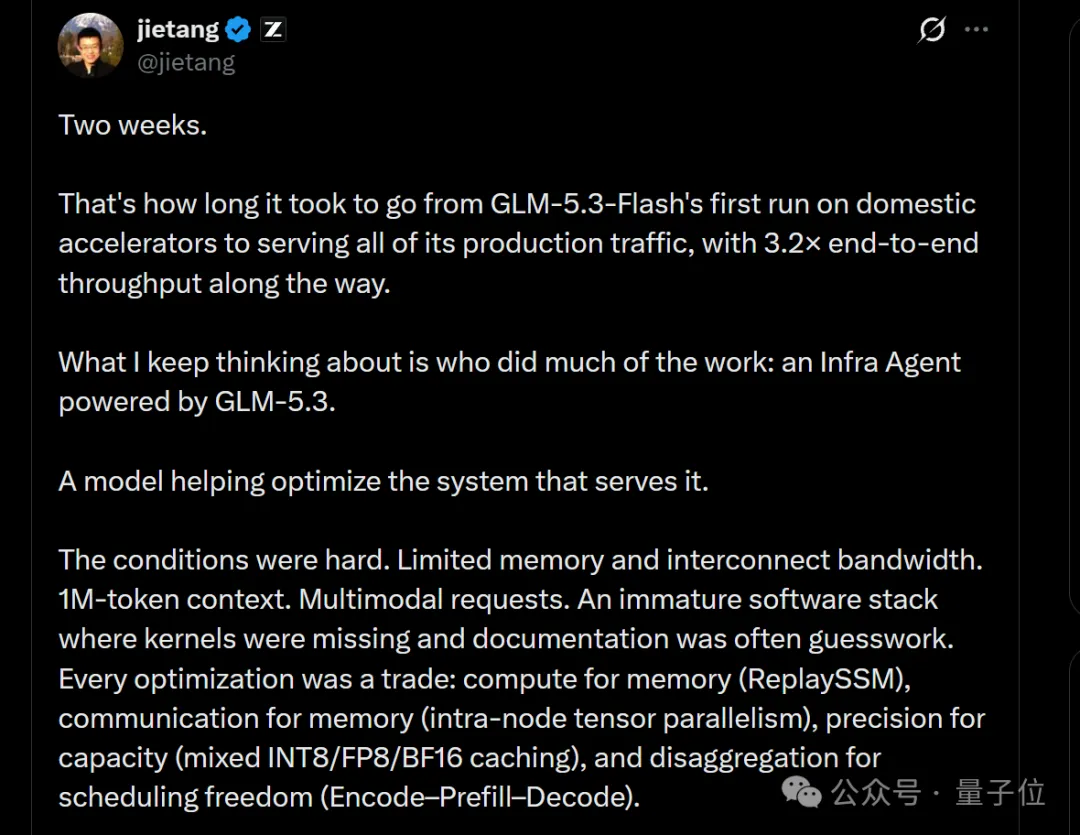
TL;DR - Zhipu reports that a GLM-5.3-powered infrastructure agent helped build and optimize the production inference stack for GLM-5.3-Flash on a cluster of more than 100,000 domestic accelerators, raising end-to-end throughput to 3.2 times the initial baseline in under two weeks. The company frames this as an early, human-supervised form of recursive self-improvement—not autonomous RSI.

  • The agent used “dense feedback” from correctness tests, traces, runtime events, microbenchmarks, and service metrics to form hypotheses, modify code, and iteratively validate results.
  • It identified a Python GIL bottleneck that prevented KV-transfer work from overlapping with DeepEP operations, reducing the Prefill-plus-transfer overhead from over 20% to below 1%.
  • It fixed accumulated numerical errors in a context-parallel KDA path by using higher-precision tf32x3 operations.
  • By reorganizing repeated normalization and gating computations in a KDA Decode kernel, the agent achieved a 1.71× kernel-level speedup.
Representative image for 国产RSI模型交卷!Flash模型靠它反打旗舰

国产RSI模型交卷!Flash模型靠它反打旗舰

Rank 71 · Content 80 · Popularity N/A

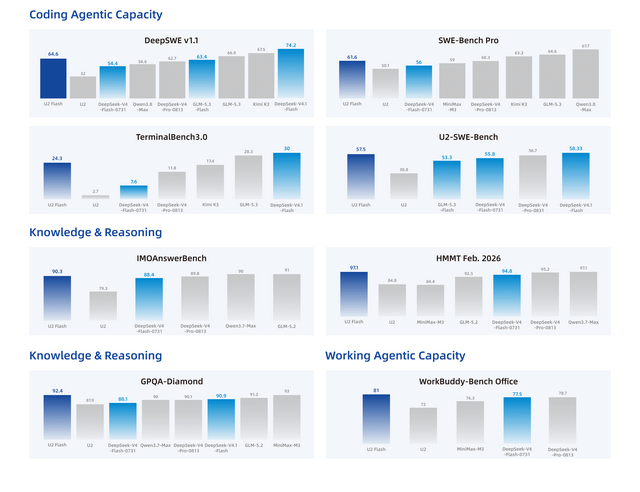
TL;DR - Unisound launched U2-Flash, a sparse-MoE model whose post-training loop uses the model to generate tasks, analyze agent trajectories, and help maintain training infrastructure. It matters because the company reports higher coding and agent performance than its larger predecessor while reducing inference cost, latency, and token use.

  • U2-Flash has 266B total parameters but activates about 10B per inference; versus U2, generation is reportedly 2.1× faster, agent tasks finish 35% sooner, and steps and token consumption fall 20–30%.
  • Reported scores include 64.6 on DeepSWE v1.1, 24.3 on TerminalBench 3.0, and 61.6 on SWE-Bench Pro.
  • Its post-training system combines nearly 100,000 autonomously generated software-engineering tasks, asynchronous agent reinforcement learning, and multi-teacher online policy distillation.
  • The model supports a 512K context window and OpenAI- and Anthropic-compatible APIs; the article’s hands-on tests covered autonomous bug fixing, recovery from misleading documentation, and synthesis across 14 files.

Your Agent Aced the Task. Will It Do It Again?

Rank 71 · Content 80 · Popularity N/A

TL;DR - This Hugging Face/IBM Research post appears to examine whether an AI agent can consistently repeat successful task performance. With no article content provided, specific methods or results cannot be verified.

  • The title highlights repeatability as distinct from one-time task success.
  • The subject likely concerns reliability and consistency in agent evaluation.
  • No quantitative findings, benchmarks, or implementation details are available in the provided content.
Representative image for 折叠屏还在比大小,努比亚已经在抢另一个入口

折叠屏还在比大小,努比亚已经在抢另一个入口

Rank 68 · Content 75 · Popularity N/A

TL;DR - Nubia launched the NaviX Ultra smartphone with the consumer version of Doubao’s mobile assistant, positioning system-level AI agents as a new interface for completing multi-app tasks. The product matters because it shifts smartphone competition from hardware specifications toward reliable, permission-aware task execution.

  • The assistant can interpret natural-language goals, then coordinate actions across recordings, documents, calendars, contacts, messaging, travel, and other apps.
  • Agent reliability depends on handling logins, pop-ups, interface changes, network disruptions, and failed steps—not merely automating taps.
  • User trust is central: high-risk actions such as payments, deletions, and sending messages require confirmation or manual takeover, with a fingerprint-enabled AI button supporting authentication.
  • The phone’s large battery, enhanced connectivity, camera, and dedicated AI button are designed around persistent agent operation, but real-world task success rates and intervention frequency remain unproven.

How Fyxer built an AI executive assistant people trust

Rank 68 · Content 75 · Popularity N/A

TL;DR - Fyxer built an AI executive assistant using OpenAI models to organize inboxes and draft personalized emails. Its approach emphasizes user trust through fine-tuning, memory, and feedback from real users.

  • Organizes users’ inboxes and assists with email drafting.
  • Uses fine-tuning to adapt the system to its application.
  • Incorporates memory to draft emails in each user’s voice.
  • Uses real user feedback to improve assistant behavior.
Representative image for 央企做了个通用Agent,直接杀进IDC实测前三!

央企做了个通用Agent,直接杀进IDC实测前三!

Rank 64 · Content 70 · Popularity N/A

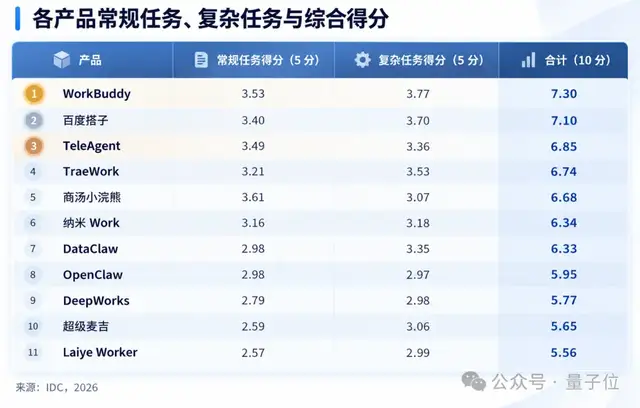
TL;DR - China Telecom’s enterprise-focused TeleAgent ranked third in IDC China’s evaluation of general-purpose agents, scoring highly on real-world task completion and leading in cost efficiency. Its performance highlights how agent harness engineering—not just the underlying model—drives reliability, affordability, and safety in complex workflows.

  • IDC evaluated nearly 100 private office tasks, including cleaning 3,755 rows of data and turning roughly 30,000 Chinese characters into an 11-slide presentation; TeleAgent scored 3.49 on routine tasks and 3.36 on complex tasks.
  • Its agent harness uses tiered context pruning and compression, a context window exceeding 400K, and autoDream long-term memory to support lengthy and cross-session work.
  • A ModelRouter assigns requests to lightweight, balanced, or flagship models, reportedly reducing inference costs by about 40%; the system also uses prefill/decode separation, KV caching, and load-aware scheduling.
  • Enterprise safeguards include skill scanning, separated short- and long-term memory, restricted file access, high-risk command monitoring, and isolated execution; TeleAgent reached nearly 1.2 million users shortly after its July 2026 public launch.
Representative image for 从“会回答”到“会办事”,vivo如何解AI手机这道题?

从“会回答”到“会办事”,vivo如何解AI手机这道题?

Rank 61 · Content 65 · Popularity N/A

TL;DR - vivo unveiled an agent-oriented AI phone architecture combining a device-cloud model matrix with a system-level Harness to turn user intent into cross-app, cross-device actions. The approach matters because it shifts differentiation from model benchmarks toward personalized context, orchestration, privacy-aware memory, and reliable execution.

  • BlueLM-Nano handles on-device perception and memory, while BlueLM-Realtime supports speech; cloud models BlueLM-Flash and BlueLM-Pro cover fast task execution and complex reasoning.
  • The Harness provides shared perception, memory, planning, and execution layers, connecting agents and services through 6,000+ system tools, MCP, A2A, CLI, and unified APIs.
  • With user authorization, the system learns from behavior and task outcomes, using idle-device reflection to retain execution experience and improve future workflows.
  • Partnerships with Alipay, Meituan, Amap, and JD.com demonstrate agent-driven flows spanning local services, travel, navigation, shopping, and payments.

Multimodal & Generative 1

Representative image for 几何的「反攻」!港科大谭平:从局部先验到全局一致,3D 几何如何增强视觉大模型 | ECCV 2026

几何的「反攻」!港科大谭平:从局部先验到全局一致,3D 几何如何增强视觉大模型 | ECCV 2026

Rank 75 · Content 85 · Popularity N/A

TL;DR - HKUST professor Tan Ping presents a hybrid approach to scalable 3D reconstruction and scene generation: learned models supply strong local visual priors, while explicit geometry and global optimization enforce consistency across views and long camera trajectories.

  • For large-scale structure-from-motion, sampled keyframes and token compression form a lightweight neural scene representation, reducing Transformer memory demands while localizing additional frames.
  • Global 3R combines feed-forward predictions with pose averaging and bundle adjustment; on reported tests, geometric optimization raised the share of relative rotations within 1° from roughly 70% to over 90%.
  • ControlRoom and SpatialGen use explicit 3D layouts and multimodal, multi-view diffusion to improve object placement and spatial consistency; the SpatialGen dataset includes 57,000 rooms and about five million multimodal renderings.
  • SpatialCraft infers a coarse 3D proxy from one image, converts it into a 3D Gaussian representation, and applies video diffusion refinement to support more stable long-range scene navigation.

Efficiency & Systems 1

Representative image for 从百美元到数千美元,AI互联为什么越卖越贵?

从百美元到数千美元,AI互联为什么越卖越贵?

Rank 75 · Content 85 · Popularity N/A

TL;DR - Astera Labs argues that high-speed interconnects are becoming a core determinant of AI system performance and per-token cost as clusters scale to thousands of GPUs. Its strategy is expanding from PCIe retimers into higher-value switching, memory, copper, and optical connectivity products.

  • Interconnect design is increasingly governed by bandwidth, GPU scale, power, latency, and total token economics—not physical distance alone.
  • Copper should remain cost-effective around 200G per lane, while optical links are expected to penetrate racks more deeply at 400G per lane and larger GPU scales.
  • Astera expects near-package optics in scale-up systems around 2027, while broad co-packaged-optics deployment may not occur until 2029–2030 or later.
  • Larger scale-up domains could reduce traffic through higher-latency scale-out networks; meanwhile, inference growth and increasingly customized AI systems should diversify connectivity requirements.

AI Chips 1

Representative image for 独家解读丨国产GPU四份半年报出炉,赚钱后才发现二级市场「难哄」

独家解读丨国产GPU四份半年报出炉,赚钱后才发现二级市场「难哄」

Rank 64 · Content 70 · Popularity N/A

TL;DR - Half-year reports from four Chinese GPU makers show improving revenue and headline profits, but non-operating gains and accounting changes obscure core performance. Investors are shifting attention from near-term profitability to sustainable revenue, order quality, supply capacity, and expectations already priced into valuations.

  • Biren remained loss-making despite nearly 20-fold revenue growth, while MetaX, Iluvatar CoreX, and Moore Threads showed gaps between headline and adjusted profitability.
  • Iluvatar’s profit was driven mainly by a ¥760 million equity revaluation gain; MetaX and Moore Threads remained unprofitable after excluding non-recurring items.
  • Analysts prioritize revenue durability, customer quality, orders, wafer and HBM availability, and delivery capacity over temporary profit milestones.
  • As more domestic GPU companies list, scarcity premiums are weakening and share prices increasingly reflect the gap between realized results and expectations already embedded in valuations.

AI Safety 1

Our framework for reporting model misalignment

Rank 78 · Content 90 · Popularity N/A

TL;DR - OpenAI introduced a framework for tracking, investigating, and disclosing model misalignment. It matters because it establishes a structured approach to documenting concerning model behavior and is accompanied by six real-world reports.

  • The framework covers the lifecycle from identifying misalignment through investigation and disclosure.
  • OpenAI published six reports describing unexpected or concerning model behavior.
  • The provided summary does not specify the behaviors, findings, or technical evaluation methods.

Autonomous Driving AI 1

Representative image for 九识建成首个L4万卡集群,无人驾驶进入多模态大模型新范式

九识建成首个L4万卡集群,无人驾驶进入多模态大模型新范式

Rank 64 · Content 70 · Popularity N/A

TL;DR - Jiushi says it has built the L4 autonomous-driving industry’s first 10,000-plus-accelerator cluster, totaling nearly 15,000 cards, to scale its APEX multimodal foundation model toward 100 billion parameters. The system combines fleet data, cloud models, onboard VLA models, and a safety-agent fallback to improve long-tail urban driving.

  • APEX trains on data from more than 30,000 vehicles operating across 300-plus cities, including 270 million kilometers of real-world L4 driving.
  • Its multimodal training blends driving data with language, video, traffic knowledge, and human decisions to support prediction, planning, simulation, and cross-city generalization.
  • Jiushi’s architecture assigns routine driving to onboard models, uses cloud VLA assistance for harder low-speed conditions, and invokes a safety agent for extreme 0–5 km/h scenarios.
  • Improved foundation models are distilled back into lighter vehicle models, creating a feedback loop between fleet operations, cloud training, evaluation, and deployment.