国产RSI模型交卷!Flash模型靠它反打旗舰
Ranking
No observed public metrics; popularity remains neutral/archived.
Merged summary
TL;DR - Unisound launched U2-Flash, a sparse-MoE model whose post-training loop uses the model to generate tasks, analyze agent trajectories, and help maintain training infrastructure. It matters because the company reports higher coding and agent performance than its larger predecessor while reducing inference cost, latency, and token use.
- U2-Flash has 266B total parameters but activates about 10B per inference; versus U2, generation is reportedly 2.1× faster, agent tasks finish 35% sooner, and steps and token consumption fall 20–30%.
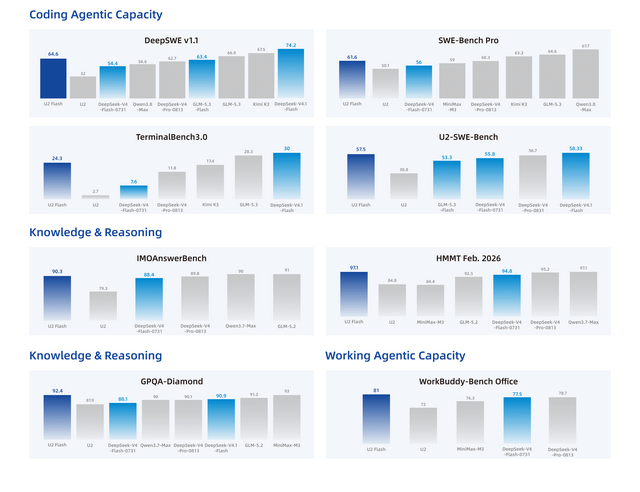
- Reported scores include 64.6 on DeepSWE v1.1, 24.3 on TerminalBench 3.0, and 61.6 on SWE-Bench Pro.
- Its post-training system combines nearly 100,000 autonomously generated software-engineering tasks, asynchronous agent reinforcement learning, and multi-teacher online policy distillation.
- The model supports a 512K context window and OpenAI- and Anthropic-compatible APIs; the article’s hands-on tests covered autonomous bug fixing, recovery from misleading documentation, and synthesis across 14 files.
Sources (1)
国产RSI模型交卷!Flash模型靠它反打旗舰
TL;DR - Unisound launched U2-Flash, a sparse-MoE model whose post-training loop uses the model to generate tasks, analyze agent trajectories, and help maintain training infrastructure. It matters because the company reports higher coding and agent performance than its larger predecessor while reducing inference cost, latency, and token use.
- U2-Flash has 266B total parameters but activates about 10B per inference; versus U2, generation is reportedly 2.1× faster, agent tasks finish 35% sooner, and steps and token consumption fall 20–30%.
- Reported scores include 64.6 on DeepSWE v1.1, 24.3 on TerminalBench 3.0, and 61.6 on SWE-Bench Pro.
- Its post-training system combines nearly 100,000 autonomously generated software-engineering tasks, asynchronous agent reinforcement learning, and multi-teacher online policy distillation.
- The model supports a 512K context window and OpenAI- and Anthropic-compatible APIs; the article’s hands-on tests covered autonomous bug fixing, recovery from misleading documentation, and synthesis across 14 files.