Yann LeCun 万字演讲:「预测像素」是伪命题,JEPA 也并非凭空而来 | ECCV 2026
Ranking
Overall
78
Content
90
Popularity
N/A
No observed public metrics; popularity remains neutral/archived.
Merged summary
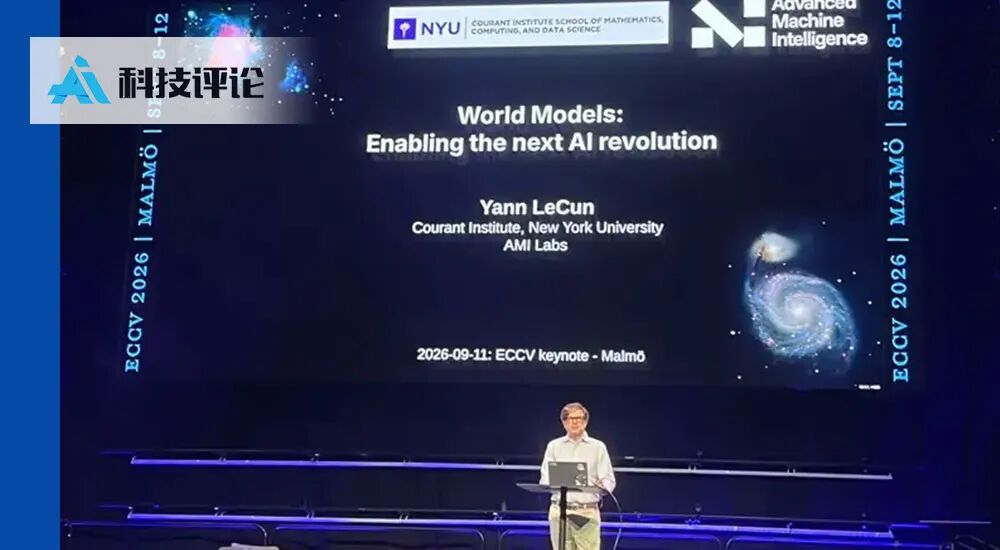
TL;DR - In an ECCV 2026 keynote, Yann LeCun argues that language models and pixel-generating video models cannot deliver human-level physical intelligence. He advocates JEPA-based world models that predict abstract representations, simulate action consequences, and support hierarchical planning.
- Pixel prediction is fundamentally underdetermined because future frames depend on unobserved events; JEPA instead discards unpredictable details and predicts in representation space.
- LeCun characterizes current LLM inference as reactive token generation, contrasting it with energy-based search and optimization over candidate actions.
- His proposed architecture combines learned world models, objective functions, and safety guardrails to plan actions through model-predictive control.
- He identifies hierarchical world models and planning—from abstract goals down to low-level actions—as a central challenge for embodied AI.
Sources (1)
Yann LeCun 万字演讲:「预测像素」是伪命题,JEPA 也并非凭空而来 | ECCV 2026
Public signals
N/A
TL;DR - In an ECCV 2026 keynote, Yann LeCun argues that language models and pixel-generating video models cannot deliver human-level physical intelligence. He advocates JEPA-based world models that predict abstract representations, simulate action consequences, and support hierarchical planning.
- Pixel prediction is fundamentally underdetermined because future frames depend on unobserved events; JEPA instead discards unpredictable details and predicts in representation space.
- LeCun characterizes current LLM inference as reactive token generation, contrasting it with energy-based search and optimization over candidate actions.
- His proposed architecture combines learned world models, objective functions, and safety guardrails to plan actions through model-predictive control.
- He identifies hierarchical world models and planning—from abstract goals down to low-level actions—as a central challenge for embodied AI.