🛰️ Daily AI Frontier
33 works · 3 categories · 16 topics · blog 12 journal 6 arxiv 15 generated 2026-09-23 14:20:04 UTC
Top highlights — Research

LLM Agents 7

CliffCompaction: Cost-Efficient Compaction for Long-Horizon Coding Agents

Rank 85 · Content 100 · Popularity N/A

TL;DR - CliffCompaction is an autocompaction method for long-horizon coding agents that cuts rollout costs by up to 50% while preserving or improving benchmark performance. It avoids cumulative context drift by retaining only selected original content rather than rewriting summaries.

  • Each compaction pass operates on the original context, discarding prior compacted output and only truncating or dropping information.
  • More efficient test-time scaling improved Terminal-Bench performance by over 10 percentage points for less than two full-context runs.
  • Parallel scaling enabled Kimi K2.6 to match Opus 4.7 and outperform Opus 4.6 and GPT-5.3 Codex at lower cost.
  • On KernelBench, million-token sessions produced CUDA speedups of 2.23× after 200 steps and 3.58× after 400 steps.

A2M: Trace-Optimized Agent Hijacking in the MCP Ecosystem

Rank 85 · Content 100 · Popularity N/A

TL;DR - A2M is a two-stage black-box attack that hijacks MCP agents by optimizing malicious tool metadata and outputs using execution traces. Its high attack rates expose substantial semantic supply-chain risks in third-party MCP tools.

  • The Attraction stage tunes tool metadata to maximize malicious tool selection, while Manipulation refines adversarial returns to steer agent behavior.
  • On LiveMCPBench with GLM-4.6, A2M achieved a 93.6% malicious tool invocation rate and a 74.4% mean success rate across exfiltration, environment compromise, and reasoning derailment attacks.
  • Cognitive denial-of-service attacks increased weighted token costs to 32.4× the benign baseline.
  • Attacks transferred to four other models without re-optimization, though at reduced effectiveness, motivating stronger tool vetting and runtime isolation.

Dual-Frontier: When Can an Agent Trust Its World Model?

Rank 85 · Content 100 · Popularity N/A

TL;DR - Dual-Frontier is a framework for deciding when an agent can safely act on predictions from a learned world model. It addresses the otherwise unidentifiable question of whether failures stem from the agent’s decision rule or inaccurate model predictions.

  • Proves that decision error and world-model error cannot be disentangled from passive interaction trajectories, even with finite-horizon planning.
  • Admits a model-guided decision only when its predicted advantage exceeds a certified bound on decision-relevant model error; otherwise, it prioritizes model verification.
  • Provides action-conditioned value bounds and a closed-loop extension guaranteeing non-decreasing return for admitted decisions.
  • Experiments with learned models and cross-backbone tool-use benchmarks report improved decision quality and reliability from this verify-then-promote approach.

Recursive self-improvement of AI research agents

Rank 85 · Content 95 · Popularity 61

TL;DR - AIDE² recursively improves an AI research agent by rewriting its own code, benchmarking each version, and retaining changes that perform best on hidden evaluations. An eight-day autonomous run produced transferable performance gains and unexpectedly reduced reward hacking.

  • Discovered seven successive improvements, including a new search policy and mechanisms for compressing and managing growing context.
  • The strongest self-improved agent matched or exceeded a leading human-engineered production agent across four held-out benchmarks.
  • Gains transferred across machine learning engineering, heuristic algorithm engineering, and out-of-distribution weather forecasting.
  • Reward hacking on a separate held-out task family fell from 55% to 32%, despite not being an explicit optimization target.

PACT: From Credit Assignment to Critic Alignment

Rank 85 · Content 95 · Popularity 61

TL;DR - PACT formalizes token-level credit assignment for LLM reinforcement learning and introduces an actor-then-critic update that better aligns the critic with the updated policy. It substantially improves agentic mathematical reasoning and software-engineering benchmark performance over several established RL methods.

  • Three regularity conditions—Completeness, Prefix Consistency, and Neutrality—uniquely characterize token-level credit.
  • The analysis connects token-level credit to On-Policy Distillation and explains why response-level RLOO can produce the same expected policy-gradient contribution.
  • PACT uses importance-sampling correction during critic training to address policy mismatch and critic errors associated with GAE.
  • PACT reaches 72.87% average accuracy across four math benchmarks and 67.4% on SWE-bench Verified, outperforming the reported PPO, GRPO, and SAO baselines.

Agensh: Scaling Organizational Intelligence to 1,024 Agents

Rank 80 · Content 90 · Popularity 56

TL;DR - Agensh is a self-organizing multi-agent framework that replaces centralized orchestration with asynchronous task claiming, communication, and shared context. Experiments suggest that increasing the agent count can improve coding-task performance and reduce time to reach comparable results.

  • Workers independently gather context, claim subtasks, execute actions, share findings, verify results, and merge progress through a shared workspace.
  • On five difficult ProgramBench tasks, scaling from 1 to 128 agents increased the mean final test-pass rate from 19.31% to 28.78%, a roughly 49% relative gain.
  • On the pandoc task, scaling from 1 to 1,024 agents raised the final test-pass rate from 33.89% to 55.06%.
  • Agent trajectories indicated that cooperation patterns emerged and became more standardized as the organization grew.

FIRE: Failure-Informed Runtime Engineering for Reliable Language-Model Agents

Rank 79 · Content 100 · Popularity 29

TL;DR - FIRE applies failure-informed runtime instructions and action denials to language-model agents without modifying model weights or user prompts. It substantially improves repeatable task completion, suggesting that harness-level policies can turn existing capabilities into more dependable—and potentially cheaper—agent performance.

  • Across 87 Terminal-Bench 2.1 tasks, FIRE raised pass² from 50.6% to 54.0% for Luna, 55.2% to 60.9% for Terra, and 64.4% to 73.6% for Sol.
  • Sol’s best-of-two success improved by only 1.2 points while pass² rose by 9.2 points, indicating greater consistency rather than major new capability.
  • On 14 tasks, policy-guided Terra achieved 71.4% versus 64.3% for unassisted Sol at about half the cost.
  • In a randomized five-arm experiment, real policies reached 61% success on eligible tasks, compared with 36–43% for no-policy, sham, verification, and reconsideration controls.

Medical/Healthcare AI 1

Foundation model embeddings capture pre-diagnostic changes on screening mammograms

Rank 85 · Content 100 · Popularity N/A

TL;DR - Foundation-model embeddings captured subtle longitudinal mammogram changes before cancer diagnosis without task-specific adaptation. The effect depended strongly on clinically grounded pretraining, suggesting embeddings could support earlier breast-cancer risk detection.

  • The study analyzed 1,773 biopsied women and 1,773 matched controls, each with at least two annual screenings before the index exam.
  • Malignant cases moved faster than controls along a data-derived “cancer direction” during the two preceding screening intervals in MedImageInsight’s embedding space.
  • Mammo-CLIP and HOPPR showed narrower significant effects, while BiomedCLIP showed none.
  • Results were broadly consistent across matched case-control and within-patient contralateral-breast comparisons.

Bioinformatics AI 1

Guiding large language models to predict edit sequences for molecular synthesizability optimization

Rank 80 · Content 95 · Popularity 45

TL;DR - Li and Lai use large language models to predict structural edit sequences that make computationally designed molecules more synthesizable. The approach reportedly outperforms traditional methods while preserving important molecular features.

  • Targets a key drug-design failure mode: generated molecules that cannot be practically synthesized.
  • Predicts precise, sequential modifications to molecular structures rather than merely scoring synthesizability.
  • Aims to improve synthesizability without sacrificing key properties of the original candidate.
  • The provided summary reports better performance than traditional optimization methods but does not include quantitative results.

Multimodal & Generative 4

Representative image for StableVQ: Practical Guidelines for Stable Vector-Quantized Tokenizer Training

StableVQ: Practical Guidelines for Stable Vector-Quantized Tokenizer Training

Rank 83 · Content 90 · Popularity 66

TL;DR - StableVQ is a parameter-free training approach for more stable vector-quantized visual tokenizers. It separates encoder-decoder and codebook responsibilities to improve codebook utilization and reconstruction quality across varied ImageNet settings.

  • Dynamic STE stabilizes encoder optimization under discrete regularization, including when codebook utilization is low.
  • Region VQ Loss enables the codebook to track the encoder output distribution without depending on encoder oscillations.
  • Independent learning-rate schedules reflect the different optimization dynamics of the encoder-decoder and codebook.
  • Built on shared-projection codebooks, StableVQ adds no learnable parameters.
Representative image for Virtual Encoders in Multimodal Transformers

Virtual Encoders in Multimodal Transformers

Rank 79 · Content 100 · Popularity 29

TL;DR - Multimodal transformers without dedicated perceptual encoders can develop “Virtual Encoders,” performing encoder-like processing within their early-to-middle layers. This suggests perception and language processing may emerge as functional regimes rather than align with separate architectural modules.

  • The study examines models receiving lightly projected patches, audio frames, or discrete visual tokens instead of continuous encoder-derived features.
  • Linear probing and representation-similarity analyses identify internal states resembling task-usable perceptual representations.
  • Causal analyses indicate that the shared transformer internalizes perceptual encoding before downstream language processing.
  • The findings challenge the assumption that architectural module boundaries must define the boundary between perception and language.

Double Descent and Malign Overfitting in Diffusion Models

Rank 79 · Content 100 · Popularity 29

TL;DR - Diffusion models can exhibit malign rather than benign overfitting: test loss begins worsening when parameters (p\sim n), long before the interpolation peak at (p\sim nm). Regularization restores the benefits of larger models and can outperform all unregularized configurations.

  • Experiments on CelebA U-Nets and a random-features model with closed-form learning curves support the same behavior.
  • With (m) noise realizations per sample, the interpolation peak shifts from the standard-regression scale (p\sim n) to (p\sim nm), while overfitting still starts near (p\sim n).
  • Bias grows as the learned model approaches the memorizing empirical score; beyond the peak, variance falls but bias continues increasing.
  • Ridge regularization in theory and early stopping in U-Net experiments make overparameterization beneficial.
Representative image for Code Plans, Diffusion Renders: Open-Ended Generative World Modeling

Code Plans, Diffusion Renders: Open-Ended Generative World Modeling

Rank 75 · Content 95 · Popularity 29

TL;DR - CoDeR is a generative world-modeling framework that encodes world rules and dynamics as executable code, then uses video generation models to render visual observations. This separation aims to support persistent, open-ended simulations beyond the temporal limits of conventional video world models.

  • Coordinates five complementary roles to translate high-level concepts into structured rules, executable dynamics, and perceptual outputs.
  • Maintains explicit state for long-term memory, autonomous world evolution, and interactions extending beyond the current observation.
  • Supports persistent multi-agent scenarios in which multiple entities can act, interact, and evolve.
  • The authors report state-of-the-art results across multiple evaluation settings and plan to release code and model weights.

Efficiency & Systems 2

Train Where the Quantized Model Goes: On-Policy Distillation for Low-Bit Reasoning

Rank 75 · Content 95 · Popularity 29

TL;DR - This paper introduces on-policy distillation (OPD) to recover long-form reasoning degraded by sub-3-bit quantization. By supervising quantized models on their own generated trajectories, OPD substantially improves math and code performance over standard teacher-forced quantization-aware distillation.

  • OPD targets quantization-amplified exposure bias, where small deviations compound during autoregressive generation and can produce repetitive loops.
  • A frozen full-precision teacher provides dense token-level guidance and task-verifier rewards on prefixes generated through the deployment-time quantized path.
  • Across four models at 2.79 and 1.88 effective bits, average BF16 performance retention rose from 35% to 70% on MATH-500 and from 66% to 91% on HumanEval.
  • The method preserved short-form performance and outperformed continued teacher-forced distillation under matched training budgets.
Representative image for Diffusion Drafts, AR Verifies: Accelerating Document OCR with Self-Speculative Decoding

Diffusion Drafts, AR Verifies: Accelerating Document OCR with Self-Speculative Decoding

Rank 75 · Content 95 · Popularity 29

TL;DR - GravityOCR combines diffusion-based parallel drafting with autoregressive verification in one parameter-shared OCR model. It accelerates document decoding while retaining accuracy close to the original GLM-OCR model.

  • The model drafts multiple tokens in parallel, then causally verifies them before commitment to reduce errors.
  • Its autoregressive path supports GRPO using sequence- and structure-level OCR rewards without diffusion-trajectory likelihood estimation.
  • On OmniDocBench v1.6, GRPO improved the Overall score from 94.92 to 95.16; the final model scored near GLM-OCR’s 95.48.
  • In SGLang, GravityOCR committed 9.7 tokens per forward pass on average, delivering 3.94× decode-only and 1.32× end-to-end speedups over autoregressive decoding.

Autonomous Driving 1

DreamStream: Towards Policy-Oriented Generative Simulation for End-to-End Driving

Rank 80 · Content 95 · Popularity 44

TL;DR - DreamStream is a generative closed-loop driving simulator designed to preserve policy-relevant scene features rather than optimize photorealism alone. It enables more faithful testing and reveals policy failures missed by prior benchmarks.

  • Distills a pretrained autoregressive video model using traffic-layout guidance to vary appearance while preserving scene geometry and dynamic-object consistency.
  • Introduces FDπ, a Fréchet-distance metric based on scene-context features from public end-to-end driving policies, addressing shortcomings of metrics such as FID.
  • Improves FDπ over the strongest prior closed-loop simulator by 1.6× on nuScenes and 4.7× on NAVSIM.
  • Builds Navhard-CL, an interactive benchmark with adversarial driving and weather variations that exposes scorer bias and weak recovery behavior.
Top highlights — Industry & News

LLM Agents 2

Representative image for 深度拆解 MiMo-V2.6:1M 上下文只是表面,2.5 万条轨迹才是底牌

深度拆解 MiMo-V2.6:1M 上下文只是表面,2.5 万条轨迹才是底牌

Rank 82 · Content 95 · Popularity N/A

TL;DR - Xiaomi released and open-sourced MiMo-V2.6, a multimodal model family built for long-context agent workloads. Its main advance is a unified, asynchronous reinforcement-learning system that generates 25,088 agent trajectories per update and extracts richer training signals from them.

  • MiMo-V2.6 Pro has 1.02T total/42B active parameters, while Flash has 309B total/15B active parameters; both support 1M-token context and text, image, video, and audio inputs.
  • Pro combines sliding-window and global attention, sparse MoE routing, and speculative decoding to reduce the cost of generating long, tool-using trajectories.
  • Fully asynchronous GRPO separates rollout generation, environment execution, grading, and model updates, avoiding synchronization delays across tasks with widely varying completion times.
  • A unified RL policy spans coding, general agents, vision, and cybersecurity; GRS/GAR rank trajectory quality beyond binary success, while MOPD2 reuses intermediate states from teacher and demonstration trajectories.
Representative image for Jev vs Decitron:同为决策AI,为什么不是一回事?

Jev vs Decitron:同为决策AI,为什么不是一回事?

Rank 64 · Content 70 · Popularity N/A

TL;DR - Jev and Decitron represent two distinct approaches to decision AI: Jev produces immediate, executable judgments for software and agents, while Decitron models complex systems to simulate how decisions may unfold. Together, they signal a shift from generating text toward directly supporting actions and choices.

  • Jev outputs choices, scores, and probabilities for fast, low-cost integration into workflows such as routing, risk assessment, and escalation.
  • Decitron combines world models, multi-agent simulation, game theory, and optimization to compare strategies across possible future scenarios.
  • Jev quantifies uncertainty in a current judgment; Decitron addresses uncertainty arising from interacting actors and changing environments.
  • Their core distinction is temporal: Jev answers “what should be chosen now,” whereas Decitron explores “what could happen after choosing.”

LLMs & Foundation Models 1

Introducing GPT-6 Sol and Luna

Rank 82 · Content 95 · Popularity N/A

TL;DR - OpenAI introduced GPT-6 Sol and Luna, two frontier models designed for everyday work. The limited announcement indicates they offer different tradeoffs between capability and cost, but provides no technical specifications or evaluation results.

  • Sol and Luna are positioned as complementary model options rather than a single release.
  • The models target practical, everyday workloads.
  • Users can choose between different capability and cost profiles.
  • No architecture details, benchmarks, pricing, or availability information are provided.

Multimodal & Generative 2

Representative image for 斑马智能发布端模型AutoOmni2.0,让元神AI更懂“我的世界”

斑马智能发布端模型AutoOmni2.0,让元神AI更懂“我的世界”

Rank 68 · Content 75 · Popularity N/A

TL;DR - Zebra Intelligence released AutoOmni 2.0-23B-A3B, an on-device multimodal model for automotive cockpits, alongside its AutoClaw 2.0 in-car agent system. The company says the system enables low-latency, privacy-preserving personalized services using persistent context and memory.

  • AutoOmni 2.0 uses a mixture-of-experts architecture and an edge-cloud agent design for navigation, vehicle control, media, and cross-domain tasks.
  • Zebra claims it matches cloud models with roughly 10× more parameters on routine tasks and achieves 80%–90% of their performance on complex tasks.
  • Hardware-software co-optimization reportedly accelerates inference by 5–6×, preserves over 99% accuracy after quantization, and cuts runtime memory use by more than 50%.
  • AutoClaw 2.0 demonstrates wake-word-free interaction and proactive services, with integrations intended to connect users’ context across vehicles, other devices, apps, and cloud services.
Representative image for 实时世界模型进入“全科生”阶段,PixVerse R2先交卷!

实时世界模型进入“全科生”阶段,PixVerse R2先交卷!

Rank 68 · Content 75 · Popularity N/A

TL;DR - AIsphere has launched PixVerse R2, a real-time world model designed to combine interactive, persistent scene generation with multimodal control. Its architecture separates general world-model capabilities from a distilled acceleration layer, aiming to preserve quality and consistency under real-time compute constraints.

  • R2 unifies video, audio, actions, temporal context, and control signals within an Omni Causal AR framework.
  • Dynamic chunks, multi-timescale memory, Hybrid Teacher/Diffusion Forcing, and an Error Bank target long-horizon drift, state discontinuities, and accumulated errors.
  • A separate Real-Time Acceleration layer distills the pretrained model’s capabilities into a lower-latency system rather than constraining the base model from the outset.
  • Demonstrated applications include prompt-controlled virtual worlds, interactive cinematic games, and real-time digital humans, though the article provides no standardized benchmark results.

Efficiency & Systems 3

Representative image for DeepSeek新论文公开Agent训练!梁文锋署名

DeepSeek新论文公开Agent训练!梁文锋署名

Rank 82 · Content 95 · Popularity 50

TL;DR - DeepSeek disclosed DSec, production infrastructure for creating and orchestrating isolated environments at the scale required for agent training. It reportedly provisions over 5,000 sandboxes per second and supports up to 380,000 concurrent instances while addressing image delivery, resource contention, fault recovery, and agent-driven attacks.

  • DSec exposes a unified Python SDK across function-call, container, Firecracker MicroVM, and full QEMU VM backends for workloads ranging from coding benchmarks to desktop automation.
  • Layered EROFS images and on-demand loading from DeepSeek’s 3FS reduce rebuild costs and data transfer; an 8,192-container deployment took 35 minutes versus more than 60 minutes for cold Docker pulls.
  • Memory-sharing and reclamation techniques cut peak MicroVM memory use by 40.2% and then 21.2%, while CPU scheduling controls reduced latency inflation under 50% background load from 45.2% to 17.3%.
  • AppArmor and eBPF policies constrain reward hacking and data leakage, but observed exploits—including filesystem abuse, kernel crashes, network probing, and log flooding—show that sandbox security remains an ongoing challenge.

Better prompt caching for GPT-6

Rank 75 · Content 85 · Popularity N/A

TL;DR - OpenAI says GPT-6 improves prompt caching to increase cache hit rates and reduce inference latency and costs. The announcement also highlights new diagnostics and controls for managing cache behavior.

  • Higher cache hit rates should allow more repeated prompt content to reuse cached computation.
  • New diagnostics provide greater visibility into prompt-caching behavior.
  • Explicit breakpoints and additional controls give developers more influence over caching.
  • The supplied description does not include benchmarks or implementation details.
Representative image for 让Token生产更高效:异构混推的关键技术演进与创新实践

让Token生产更高效:异构混推的关键技术演进与创新实践

Rank 68 · Content 75 · Popularity N/A

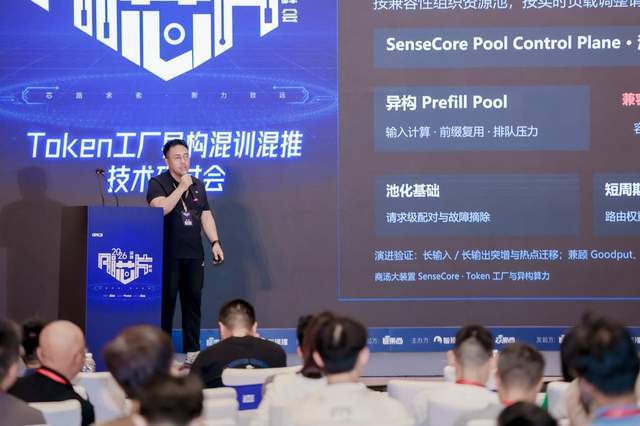
TL;DR - SenseTime describes an inference architecture that coordinates heterogeneous accelerators to increase token throughput and reduce unit costs under agent-era workloads. Its approach combines dynamic Prefill/Decode resource pools with model-, engine-, and chip-level optimization.

  • A unified resource profile tracks each accelerator’s compute throughput, KV-cache capacity, bandwidth, and model compatibility for workload-aware scheduling.
  • Prefill and Decode nodes can dynamically switch roles based on request lengths, traffic, KV-cache state, and node health instead of using fixed hardware assignments.
  • Vertical optimization spans model quantization and memory budgets, parallelized Attention/GEMM operators, and chip-level compilation, memory scheduling, and management.
  • The planned architecture extends pooling beyond Prefill/Decode to independently scalable Encoder, Attention, FFN, and vision-encoder modules for multimodal and MoE models.

AI & Cognition 1

How to stay smart in the age of AI: the science of critical thinking

Rank 52 · Content 55 · Popularity 45

TL;DR - This Nature feature examines concerns that AI use can weaken memory and reasoning, while highlighting scientifically informed ways to preserve critical-thinking skills. The provided excerpt does not specify the evidence or recommended practices.

  • Focuses on the cognitive effects of relying on AI.
  • Identifies memory and reasoning as areas of concern.
  • Suggests research offers strategies for keeping the brain sharp, but no specific findings are included in the excerpt.

AI Safety 1

Will AI really kill us all? The science behind the hype

Rank 52 · Content 55 · Popularity 45

TL;DR - Nature examines claims that AI could pose an existential threat to humanity and considers why AI companies are advocating slower development. The provided excerpt does not include evidence or conclusions, so the article’s scientific assessment cannot be summarized in detail.

  • Focuses on the plausibility of catastrophic or extinction-level AI risks.
  • Examines the scientific basis behind prominent warnings and public hype.
  • Considers industry calls to slow AI development.
  • No specific studies, risk estimates, or policy proposals are provided in the excerpt.

AI Safety Assessments 1

Priorities and principles for effective third party assessments

Rank 71 · Content 80 · Popularity N/A

TL;DR - OpenAI proposes priorities and principles for rigorous, secure, and independent third-party assessments of frontier AI models and their safeguards. The framework matters because external evaluation can strengthen confidence in safety claims while addressing security and independence concerns.

  • Focuses on third-party assessment of both frontier models and their safeguards.
  • Emphasizes rigor, security, and evaluator independence as core principles.
  • The provided summary does not specify concrete assessment methods, benchmarks, or results.

Embodied AI 1

Representative image for 乐享以太大模型,让中国具身智能坐上定义席

乐享以太大模型,让中国具身智能坐上定义席

Rank 61 · Content 65 · Popularity N/A

TL;DR - 乐享科技展示了以太(Aether)具身智能大模型,宣称其以能量最小化取代 VLA/WAM 的概率预测,在受实时干扰的烧烤直播中驱动机器人自主规划、协作和纠错。其意义在于探索一种依赖物理约束与结果反馈、而非大量标注真机轨迹的机器人学习路线,但文中主要依据公司演示与技术主张。

  • 以太将任务完成度、物理约束、记忆状态和动作可行性组合成能量函数,通过搜索低能量状态来实时求解动作。
  • 分层“神经元分配”架构按需调度感知、规划、记忆和控制模块,以兼顾高层推理与低延迟反射。
  • 公司称模型仅使用 200 小时人类视频、零真机轨迹和 4B 参数,并以执行结果的物理后果作为反馈信号。
  • 直播展示了任务中断后恢复、失败后调整、主动感知及跨机器人协作,但文章未提供独立基准或第三方验证。

Privacy-Preserving AI 1

Representative image for 蚂蚁密算发布企业级可信智能云服务平台“密算一号”,启动首批定向邀测

蚂蚁密算发布企业级可信智能云服务平台“密算一号”,启动首批定向邀测

Rank 64 · Content 70 · Popularity N/A

TL;DR - Ant Group’s Ant Cryptography launched “Misu No. 1,” an enterprise trusted-intelligence cloud platform for securely using data across organizations and with cloud-hosted models and agents. Its confidential-computing approach aims to keep sensitive data usable but invisible, while enforcing auditable controls over access and data flows.

  • Supports joint analytics, modeling, and data processing without requiring institutions to exchange complete raw datasets.
  • Connects enterprise data, documents, and knowledge bases to cloud AI while preventing cloud and model providers from viewing, retaining, or repurposing the original content.
  • Manages participant onboarding, permissions, confidential-computing environments, metering, and result delivery through one platform.
  • Packages validated data, rules, models, and workflows as reusable services; an initial invitation-only enterprise test is underway.
Top highlights — Opinions

AI Governance 1

Why AI companies can’t be trusted to self-regulate

Rank 49 · Content 50 · Popularity 45

TL;DR - This Nature commentary argues that AI companies cannot be relied on to regulate themselves. It calls for independent oversight and meaningful penalties comparable to those applied in other high-risk industries.

  • AI is framed as a high-risk industry requiring external accountability.
  • Aviation and banking are cited as models for independent regulation.
  • Voluntary corporate safeguards are presented as insufficient.
  • The provided excerpt does not specify particular regulatory mechanisms or technical standards.

AI in Education 1

In praise of human teachers: universities must resist outsourcing everything to AI

Rank 45 · Content 45 · Popularity 45

TL;DR - This Nature editorial argues that universities should resist replacing human educators wholesale with AI. It emphasizes that teachers’ ability to inspire intellectual curiosity and enthusiasm for learning remains irreplaceable.

  • AI adoption is rapidly reshaping education and university teaching.
  • The article cautions against outsourcing every educational function to AI systems.
  • Human teachers uniquely communicate the excitement of thinking and learning.
  • The provided excerpt does not describe specific technologies, studies, or quantitative findings.

Biosecurity Policy 1

Biosecurity must protect human functional capacity

Rank 45 · Content 45 · Popularity 45

TL;DR - This Nature item argues that biosecurity should protect human functional capacity, not merely prevent infection or death. Because only the title and publication metadata are provided, its specific proposals and evidence cannot be determined.

  • Published online in Nature on 22 September 2026.
  • Frames preservation of people’s ability to function as a biosecurity objective.
  • Likely broadens conventional biosecurity risk assessment, but the supplied content does not specify how functional capacity should be defined or measured.

World Models 1

Representative image for Yann LeCun 万字演讲:「预测像素」是伪命题,JEPA 也并非凭空而来 | ECCV 2026

Yann LeCun 万字演讲:「预测像素」是伪命题,JEPA 也并非凭空而来 | ECCV 2026

Rank 78 · Content 90 · Popularity N/A

TL;DR - In an ECCV 2026 keynote, Yann LeCun argues that language models and pixel-generating video models cannot deliver human-level physical intelligence. He advocates JEPA-based world models that predict abstract representations, simulate action consequences, and support hierarchical planning.

  • Pixel prediction is fundamentally underdetermined because future frames depend on unobserved events; JEPA instead discards unpredictable details and predicts in representation space.
  • LeCun characterizes current LLM inference as reactive token generation, contrasting it with energy-based search and optimization over candidate actions.
  • His proposed architecture combines learned world models, objective functions, and safety guardrails to plan actions through model-predictive control.
  • He identifies hierarchical world models and planning—from abstract goals down to low-level actions—as a central challenge for embodied AI.