银河通用&清华 LATENT:用「不完美人类数据」让机器人学会网球对打 | IROS 2026
Ranking
No observed public metrics; popularity remains neutral/archived.
Merged summary
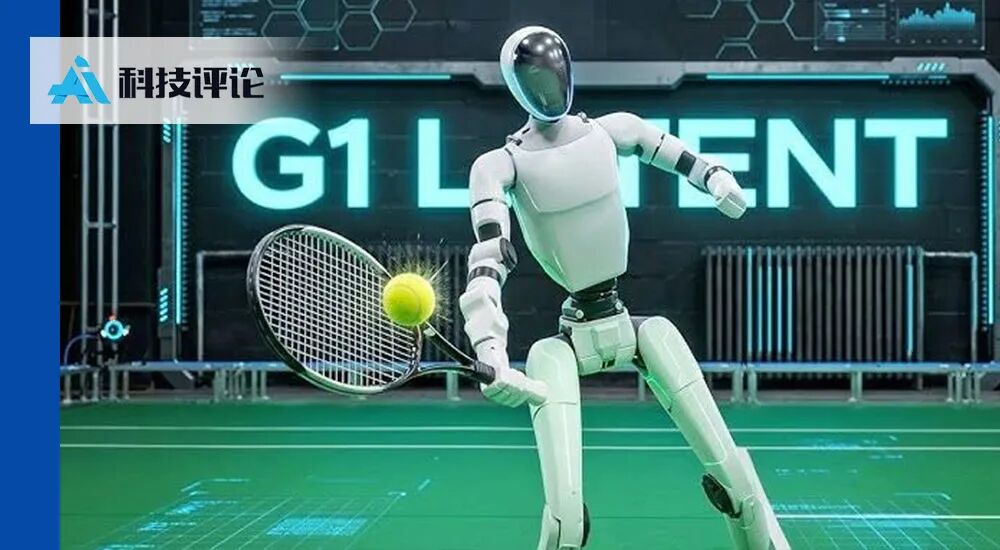
TL;DR - LATENT trains a Unitree G1 humanoid to return tennis shots by combining five hours of imperfect amateur motion-capture fragments with a learned latent action space, reinforcement learning, and sim-to-real randomization. It shows that limited, noisy human demonstrations can provide useful motion priors for dynamic whole-body skills without being copied exactly.
- The system compresses human motion patterns into a continuous “action dictionary,” while a Latent Action Barrier constrains unnatural deviations and improves motion smoothness and joint torque.
- Simulation randomizes robot and ball dynamics, observation noise, dropped frames, and latency; removing ball randomization reduced real-world forehand success to 16.67%, while removing observation noise reduced backhand success to 0%.
- LATENT achieved 96.52% forehand success in simulation; reported real-world return rates were 90.90% for forehands and 77.78% for backhands under the study’s controlled setup.
- Real-world trials still relied on a large motion-capture system rather than onboard perception, and demonstrated reliable returns—not autonomous competitive tennis.
Sources (1)
银河通用&清华 LATENT:用「不完美人类数据」让机器人学会网球对打 | IROS 2026
TL;DR - LATENT trains a Unitree G1 humanoid to return tennis shots by combining five hours of imperfect amateur motion-capture fragments with a learned latent action space, reinforcement learning, and sim-to-real randomization. It shows that limited, noisy human demonstrations can provide useful motion priors for dynamic whole-body skills without being copied exactly.
- The system compresses human motion patterns into a continuous “action dictionary,” while a Latent Action Barrier constrains unnatural deviations and improves motion smoothness and joint torque.
- Simulation randomizes robot and ball dynamics, observation noise, dropped frames, and latency; removing ball randomization reduced real-world forehand success to 16.67%, while removing observation noise reduced backhand success to 0%.
- LATENT achieved 96.52% forehand success in simulation; reported real-world return rates were 90.90% for forehands and 77.78% for backhands under the study’s controlled setup.
- Real-world trials still relied on a large motion-capture system rather than onboard perception, and demonstrated reliable returns—not autonomous competitive tennis.