0.2秒急停、秒级重规划!因果智能走进真实世界
Ranking
Overall
61
Content
65
Popularity
N/A
No observed public metrics; popularity remains neutral/archived.
Merged summary
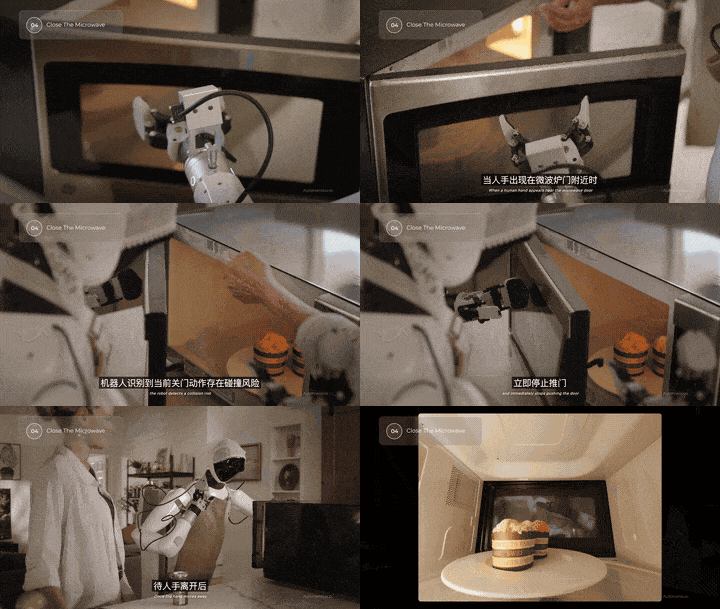
TL;DR - Aether AI unveiled CRIS-0, a causal-agent architecture for robots that tracks task-relevant physical variables, predicts action consequences, and replans after disturbances. Its demos suggest causal state modeling could make long-horizon robotic tasks safer and more resilient than monolithic end-to-end policies.
- CRIS-0 reportedly triggered emergency stops within 0.2 seconds and replanned around environmental changes in about 2 seconds, recovering from 9 of 10 random disruptions in a coffee-preparation test.
- The system combines a planner, rule-based motion functions, learned manipulation policies, SLAM, verifiers, and a causal world model through a unified tool interface.
- A dynamic task graph repeatedly performs state recognition, tool selection, execution, verification, and recovery, limiting error accumulation during multi-step tasks.
- In a personalized pick-and-place test, it correctly handled 18 of 20 ambiguous instructions by incorporating user and environmental context.
Sources (1)
0.2秒急停、秒级重规划!因果智能走进真实世界
Public signals
N/A
TL;DR - Aether AI unveiled CRIS-0, a causal-agent architecture for robots that tracks task-relevant physical variables, predicts action consequences, and replans after disturbances. Its demos suggest causal state modeling could make long-horizon robotic tasks safer and more resilient than monolithic end-to-end policies.
- CRIS-0 reportedly triggered emergency stops within 0.2 seconds and replanned around environmental changes in about 2 seconds, recovering from 9 of 10 random disruptions in a coffee-preparation test.
- The system combines a planner, rule-based motion functions, learned manipulation policies, SLAM, verifiers, and a causal world model through a unified tool interface.
- A dynamic task graph repeatedly performs state recognition, tool selection, execution, verification, and recovery, limiting error accumulation during multi-step tasks.
- In a personalized pick-and-place test, it correctly handled 18 of 20 ambiguous instructions by incorporating user and environmental context.