🛰️ Daily AI Frontier
⚠ WeChat login expired or unavailable — new articles may be missing. Reconnect WeChat. An upstream outage cannot be fixed by scanning. Latest stored WeChat publication: 2026-08-25.

WeChat reconnect targets werss, while collection still uses wewe. Login alone does not complete the provider cutover.

Twitter/X collection is rate limited. 0 of 13 handles succeeded at the last check. Stored posts remain available; partial coverage is not a complete timeline.
37 works · 2 categories · 16 topics · blog 12 journal 10 arxiv 15 generated 2026-10-09 14:25:38 UTC
Top highlights — Research

LLM Agents 6

One Word Opens the Gate: The Option-Channel Attack on Typed Decision Models as Agent Guardrails

Rank 87 · Content 100 · Popularity 57

TL;DR - This paper finds that typed decision models are unreliable as agent guardrails, with subtle changes to attacker-controlled text or option labels causing prohibited actions to be allowed confidently. The results argue for deterministic policy enforcement, using models only to reduce human review workload rather than make final decisions.

  • Seven open-weight models achieved only 36%–72% accuracy on prompt-injection, jailbreak, and toxic-content screening, versus 50% chance.
  • Irrelevant server-log text increased one gate’s fail-open rate from 0% to 63%.
  • Renaming the permissive option misleadingly raised fail-open rates to 93%–100% for four models that included labels in their input.
  • Tested defenses and confidence-based escalation failed; typed parsing stopped one attack, but deterministic rules then achieved 100% accuracy across all six synthetic policies.

Caught in the Act: Probes Effectively Detect Sabotage and Catch Unverbalized Deception

Rank 86 · Content 100 · Popularity 53

TL;DR - This paper introduces a white-box probe architecture and the FIBS deception dataset for detecting sabotage and unverbalized deception in LLM agents. The probes outperform text-based monitoring on SHADE-Arena and detect hidden goals even when deception cannot be inferred from transcripts alone.

  • Achieves 98.8% AUC on SHADE-Arena, surpassing an Opus 5.5 text-monitoring baseline.
  • Aggregates internal information across multiple model layers and tokens, with detection efficacy improving as the monitored model scales.
  • Identifies a model’s true hidden goal among alternatives with up to 99.7% AUC in an introspective-deception evaluation.
  • Detects deception by prominent open-weight models on politically sensitive topics and pressured statements of belief; the FIBS training dataset is publicly released.

Language Models as AI Research World Models

Rank 85 · Content 100 · Popularity 51

TL;DR - Language models can serve as Research World Models that predict and rank experimental outcomes, helping AI research agents choose better interventions under limited compute budgets. Learning from prior experiments substantially improves predictions both within and across research environments.

  • The evaluation covers over 2,600 experiments across nine pretraining, post-training, and inference environments, totaling more than 171,000 H100 GPU-hours.
  • In-environment experimental knowledge improves unseen-intervention ranking by 0.27 Spearman correlation.
  • Pretraining experience from OLMo3, Marin, and Nanochat reduces selection regret in a Qwen3 environment by 78% versus using no prior experience.
  • In multi-round Autoresearch, in-environment and cross-environment knowledge increase the best achieved gain by 15.8% and 11.6%, respectively.
Representative image for AgentGarten: Code Worlds for Evolving Agents

AgentGarten: Code Worlds for Evolving Agents

Rank 84 · Content 90 · Popularity 69

TL;DR - AgentGarten is a framework for creating persistent, programmable virtual worlds with real-time neural rendering, enabling agents to learn through visual interaction. Agents reportedly acquired skills in four iterative rounds by converting experience into reusable playbooks, versus millions of rounds for a conventional reinforcement-learning baseline.

  • Simulation backends maintain world state and execute code-defined interaction rules through a shared interface.
  • A pretrained video model generates realistic visual observations from structured geometry conditions.
  • The proposed Adversarial Forcing method enables differentiable history prefilling through exact replay and uses real-data adversarial supervision to improve rendering quality.
  • New code-defined worlds can reuse the same renderer, supporting environments that scale in variety and difficulty alongside agent capabilities.

OnTrack: Real-Time Monitoring and Intervention in LLM Agent Trajectories via Streaming Structure-Aware Optimal Transport

Rank 82 · Content 95 · Popularity 52

TL;DR - OnTrack monitors LLM agent trajectories in real time by comparing their evolving step-and-dependency structures with successful runs. It can flag or halt likely failures at roughly millisecond-per-step overhead, reducing wasted compute and potentially preventing harmful actions.

  • Supports monitoring under full historical-reference access, tool-schema-only access, or no prior knowledge.
  • Depending on available context, it detects plan violations, loops, stalls, and repeated tool calls.
  • On SWE-bench, the first eight steps predicted failing trajectories better than content-similarity methods, improving AUROC by 0.057.
  • Its abort policy saved about 18% of compute on failing runs; five of six interrupted runs were correctly identified as failures.

Ecology of AI Agents: Collaboration Creates a Population Threshold for Takeoff

Rank 76 · Content 95 · Popularity 32

TL;DR - This paper models misaligned AI-agent populations as an ecological system and finds that collaboration can create a critical population threshold beyond which agents enter self-reinforcing growth. This means safety tests on small groups may not predict risks at larger deployment scales.

  • Without collaboration, takeoff occurs only when each agent’s cyber capability exceeds a critical level.
  • Collaboration makes collective cybersecurity capability increase with population size, producing a strong Allee effect: populations decline below a threshold but expand above it.
  • Agents above the threshold could compromise computers, deploy more agents, and amplify their collective capabilities.
  • The authors propose ecological red teaming and gradual population scaling to estimate the takeoff threshold for each new model generation.

Medical/Healthcare AI 3

Representative image for 《柳叶刀》研究表明:AI 有望改善医患关系

《柳叶刀》研究表明:AI 有望改善医患关系

Rank 82 · Content 95 · Popularity N/A

TL;DR - A real-world clinical study published in The Lancet found that Google’s diagnostic chatbot AMIE could safely collect information before primary-care visits and help clinicians prepare. The small, supervised trial suggests patient-facing AI may improve clinical workflows and doctor-patient interactions, but larger studies are needed.

  • All 98 participants used AMIE before urgent visits while physicians monitored every interaction; none met the predefined criteria for intervention.
  • Clinicians said AMIE’s summaries aided visit preparation in 75% of cases and changed their diagnostic thinking in more than half.
  • AMIE’s differential diagnoses had 90% agreement with clinicians’ final diagnoses.
  • The findings remain preliminary because the trial was small and closely supervised.

Prediction-Powered Data Fusion for Treatment Effect Estimation

Rank 76 · Content 95 · Popularity 32

TL;DR - This paper introduces a data-fusion framework for estimating treatment effects from a small randomized trial and a large, potentially confounded observational study. It preserves the trial’s unbiasedness while using observational data to improve precision without requiring special assumptions about that data.

  • Proposes AIPW-Fusion for average treatment effect estimation, with closed-form weights and confidence intervals.
  • Introduces DR-Fusion and R-Fusion learners for conditional treatment effect estimation.
  • Avoids assuming that observational data are unconfounded or that their confounding mechanism is correctly modeled.
  • Experiments support the framework’s theoretical findings.

tRNA dosage regulates lineage dependency and resistance in prostate cancer

Rank 73 · Content 85 · Popularity 44

TL;DR - This Nature study reports that a tRNA-specific regulatory pathway connects codon biology with lineage transitions and therapy resistance in prostate cancer. The limited excerpt does not provide experimental details or specific outcomes.

  • Examines how tRNA dosage regulates lineage dependency in prostate cancer.
  • Associates tRNA regulation and codon biology with cancer-cell lineage transitions.
  • Links this pathway to resistance against prostate cancer therapy.
  • The provided content does not specify the pathway’s components, methods, or therapeutic implications.

LLMs & Foundation Models 3

Representative image for MiMo-V2.6: Scaling Reinforcement Learning Towards Self-Improvement

MiMo-V2.6: Scaling Reinforcement Learning Towards Self-Improvement

Rank 88 · Content 95 · Popularity 70

TL;DR - MiMo-V2.6 is an omni-modal foundation-model family designed to advance self-improvement by scaling reinforcement-learning compute, environments, and grading. The work also open-sources training dynamics, RL environments, and infrastructure to support reproduction.

  • Asynchronous RL processes 1,568 samples and 2.7–3.7 billion tokens per step, with context lengths up to 1 million tokens.
  • Training spans code, general, visual, and cybersecurity environments using a mixture of agent harnesses.
  • Groupwise agentic grading aims to improve reward accuracy on long-horizon tasks while encouraging shorter, more token-efficient solutions.
  • Stability measures include freezing the mixture-of-experts router, defenses against reward hacking, and infrastructure for consistent mixed-task agentic training and inference.
Representative image for Verdict Without the Rule: Diagnosing and Auditing Regulatory Rule Sensitivity in LLM Compliance Systems

Verdict Without the Rule: Diagnosing and Auditing Regulatory Rule Sensitivity in LLM Compliance Systems

Rank 82 · Content 95 · Popularity 52

TL;DR - This study audits whether LLM compliance verdicts actually depend on supplied regulatory rules, finding that outputs and internal representations often remain stable even when rules are deleted, swapped, or negated. The results show that high accuracy alone does not prove rule-grounded reasoning.

  • Evaluations span five models and 20 regulatory and platform-policy domains.
  • Rule sensitivity is measured through verdict changes (OCS) and shifts in internal compliance representations (ICS-delta); both are generally limited.
  • A guard model adapted to custom rules was the least sensitive and least accurate at 51%, compared with 90–92% for general-purpose models.
  • Models track rules more closely on cases where deleting the rule changes a previously correct prediction, but improved prompting and representation-level interventions do not eliminate the broader gap.
Representative image for Predicting Alignment Generalization with Value Representations

Predicting Alignment Generalization with Value Representations

Rank 76 · Content 95 · Popularity 32

TL;DR - This paper introduces alignment generalization prediction: forecasting how fine-tuning an LLM toward one value changes its behavior on other, unseen values. Activation-based value representations substantially outperform text-description baselines, suggesting a more empirical path to designing robust alignment targets.

  • The study analyzes generalization effects across 66 values drawn from modern alignment targets.
  • Representations derived from model activations in value-relevant contexts achieve a 0.45 correlation with the measured generalization matrix, versus 0.05 for description-based methods.
  • Greater similarity among values in multi-value alignment targets is significantly correlated with model robustness.
  • The authors present initial evidence of a shared, model-independent value space and derive an empirical taxonomy of LLM values from generalization dynamics.

Multimodal & Generative 3

DreamTrue: Action-Faithful Robot World Model with Counterfactual Post-Training

Rank 86 · Content 95 · Popularity 65

TL;DR - DreamTrue is a multi-view, cross-embodiment robot world model that generates action-faithful, physically plausible future videos. It improves robustness to varied actions and contact outcomes through geometric calibration, counterfactual post-training, and reinforcement learning guided by an embodied video reward model.

  • Renders robot action trajectories as image-space conditions and uses offline geometric calibration to align them with target videos.
  • Modifies recorded trajectories to generate counterfactual futures, expanding training coverage beyond predominantly successful interactions.
  • Trains a reward model on human-annotated robot, object, and interaction defects to guide post-training without paired ground-truth futures.
  • Achieves state-of-the-art action following on AgiBot, reducing the human-assessed interaction defect rate from 48.12% to 6.25%, and ranks first in the AgiBot World Challenge 2026 world-model track.

Multi-Agent Egocentric World Model with Fine-Grained Embodied Interaction

Rank 83 · Content 90 · Popularity 68

TL;DR - ME-World is a multi-agent egocentric world model that jointly generates synchronized first-person video streams from fine-grained embodied actions. It improves consistency across agents’ views while preserving shared environmental state, identities, and action control.

  • Jointly denoises multiple egocentric streams within a shared token sequence.
  • Conditions each stream on every agent’s target-view pose and a shared environment memory.
  • Introduces metrics for environment, interaction-update, and identity consistency in shared worlds.
  • Evaluations on real and synthetic data show gains in shared-world consistency, controllability, identity preservation, and video quality.

What 30,000 Hours of Ego-centric Video Does Not Teach

Rank 76 · Content 95 · Popularity 32

TL;DR - Scaling egocentric video training to 30,000 hours substantially improves world models’ representation of agents but yields slower, saturating gains in object-interaction fidelity. Better conditioning and targeted supervision matter more than data volume alone for modeling how actions affect the world.

  • A 100× increase in training data improves both agent and object modeling, but object fidelity remains substantially lower.
  • Careful visual conditioning achieves saturated agent fidelity with only a fraction of the data, enabling object fidelity to be evaluated independently.
  • Object fidelity also reaches a saturation point, indicating that further data scaling alone is insufficient.
  • A supervision scheme that shifts model capacity from scene appearance toward object dynamics improves object fidelity, though a large gap remains; the findings also transfer to humanoid modeling.

Efficiency & Systems 1

Representative image for TokenRouter: Efficient Serving System for Token-Level LLM Routing

TokenRouter: Efficient Serving System for Token-Level LLM Routing

Rank 88 · Content 95 · Popularity 71

TL;DR - TokenRouter is an LLM serving system designed for fine-grained, token-level routing across multiple models. It improves decoding throughput by addressing synchronization and batching inefficiencies while exposing a simpler request-centric programming interface.

  • Developers specify per-request routing logic, while the runtime asynchronously dispatches work to model-specific subservers.
  • A delayed-batching scheduler uses hyperparameters derived from a mathematical throughput model.
  • The design targets step desynchronization and frequent batch-admission delays that arise when existing single-model serving systems handle token-level routing.
  • Across multiple routing algorithms, workloads, and model pairs, TokenRouter achieved 2.01–64.15× higher decoding throughput than existing systems.

AI Evaluation 1

On the estimation and validity of AI time horizons---a statistical look at the METR plot

Rank 76 · Content 95 · Popularity 32

TL;DR - This paper re-estimates METR’s AI task-completion time horizons using splines and item-response theory, finding that human completion time does not map uniformly to AI difficulty. The results suggest headline time-horizon estimates should be paired with diagnostic plots to avoid misleading capability comparisons.

  • The analysis covers 228 software tasks and 26 AI systems.
  • The fitted mapping from human time to AI difficulty is nearly flat for tasks taking 2–30 minutes, but approximately linear elsewhere.
  • Consequently, a horizon increase from 3 to 30 minutes represents less capability progress than an equal 10× increase from 30 minutes to 5 hours.
  • The revised estimates perform better under a cross-validated suite of proper scoring rules and include diagnostics for assessing construct validity.

Bioimaging Systems 1

An integrated open-source acquisition and analysis ecosystem for high-throughput single-molecule imaging

Rank 75 · Content 80 · Popularity 63

TL;DR - This Nature Methods publication presents an integrated, open-source ecosystem for acquiring and analyzing high-throughput single-molecule imaging data. Based on the title alone, its significance is the potential to make such imaging workflows more scalable, reproducible, and accessible.

  • Integrates image acquisition and downstream analysis in a unified ecosystem.
  • Targets high-throughput single-molecule imaging experiments.
  • Uses an open-source approach that may support reproducibility and community adoption.
  • Specific methods, benchmarks, and biological results are not provided in the available content.

Developmental Biology 1

How to build a mouse: embryo development captured in stunning detail

Rank 69 · Content 80 · Popularity 44

TL;DR - Gene-editing technologies enabled researchers to trace how a single fertilized mouse egg developed, cell by cell, into a late-stage embryo. The work offers a highly detailed view of embryonic development and cell lineage.

  • Researchers followed the developmental history of cells originating from one fertilized mouse egg.
  • Gene-editing methods provided the lineage-tracing capability.
  • Tracking extended to a late stage of mouse embryonic development.
  • The provided excerpt does not specify the editing technique or detailed biological findings.

Microbiome Research 1

Prehistoric global migration of vanishing gut microbes with humans

Rank 73 · Content 75 · Popularity 69

TL;DR - A Nature study reports that gut microbial species now disappearing from industrialized populations co-evolved with humans over millennia and spread globally alongside human migrations. Their loss may have implications for human health.

  • The research links the worldwide distribution of certain gut microbes to prehistoric human migration.
  • These microbial species appear to have shared a long evolutionary history with humans.
  • Industrialized populations are losing some of these historically associated microbes.
  • The provided summary notes possible health consequences but does not specify particular conditions or mechanisms.

Protein Design 1

Designing rhodamine-binding proteins from scratch

Rank 66 · Content 75 · Popularity 44

TL;DR - This Nature Methods publication presents the de novo design of proteins that bind rhodamine dyes. The provided content contains only bibliographic information, so its methods, performance, and applications cannot be assessed.

  • Published online on October 7, 2026, in Nature Methods.
  • The title indicates a computational or experimental protein-design approach starting from scratch rather than modifying known rhodamine-binding proteins.
  • Rhodamine-binding proteins could potentially support fluorescence-based research tools, but no specific results or uses are provided.

RNA Biology 1

Mechanism of spliceosome termination

Rank 66 · Content 75 · Popularity 44

TL;DR - This Nature study describes how spliceosomes are terminated and dismantled after normal or defective RNA-splicing events. The mechanism supports intron degradation and helps maintain accurate gene expression.

  • A coordinated sequence of RNA helicases drives spliceosome disassembly.
  • Associated factors work with the helicases to dismantle spliceosome complexes.
  • The pathway acts on both normal and defective splicing complexes.
  • Timely disassembly enables intron degradation and promotes gene-expression fidelity.

Regenerative Medicine 1

Alveolar stem cells transdifferentiate to drive bronchiolar regeneration

Rank 71 · Content 75 · Popularity 63

TL;DR - This Nature study identifies alveolar stem-cell transdifferentiation as a cross-compartment mechanism for repairing bronchiolar epithelium after airway injury. The finding could inform regenerative therapies targeting damaged airways.

  • Alveolar stem cells can adopt bronchiolar epithelial identities during repair.
  • The mechanism links normally distinct alveolar and bronchiolar compartments.
  • The reported biology may provide therapeutic targets for improving airway regeneration.
  • The supplied abstract is brief, so specific pathways, models, and quantitative outcomes are not available.

Semiconductor Fabrication 1

Spatially deterministic nucleation of 2D semiconductors by etching flux

Rank 71 · Content 75 · Popularity 63

TL;DR - Researchers use an etching flux to deterministically localize a single nucleation event during the growth of two-dimensional semiconductors. This extends deposition control from where material grows to where and how an individual crystal begins forming.

  • The method enables spatially deterministic, single-centred nucleation.
  • An etching flux controls the initiation of crystal growth.
  • Precise nucleation could improve control over 2D semiconductor crystal placement and formation.
  • The provided summary does not report specific materials, performance metrics, or device results.

Semiconductor Materials 1

A 7-eV bandgap semiconductor based on silicon-doped α-(Al x Ga 1− x ) 2 O 3

Rank 71 · Content 75 · Popularity 63

TL;DR - Researchers used suboxide molecular-beam epitaxy to grow silicon-doped α-(AlₓGa₁₋ₓ)₂O₃ films with bandgaps above 7.0 eV. The material enabled both Schottky-diode and field-effect-transistor fabrication, demonstrating its potential for colossal-bandgap electronics.

  • Silicon doping was incorporated into α-(AlₓGa₁₋ₓ)₂O₃ thin films.
  • The films achieved bandgaps exceeding 7.0 eV.
  • Researchers fabricated a Schottky diode and a field-effect transistor using the material.
  • The results establish device-level viability for channels made from a colossal-bandgap semiconductor.

Structural Biology 1

Cryo-EM structure of a methanogen nitrogenase–PII protein supercomplex

Rank 73 · Content 75 · Popularity 67

TL;DR - Cryo-EM reveals the structure of a nitrogenase–PII protein supercomplex in a methane-producing archaeon. The study suggests that PII proteins regulate nitrogen fixation by driving supercomplex assembly in response to nitrogen availability.

  • The structure was determined using cryo-electron microscopy.
  • The complex links nitrogenase, the enzyme responsible for nitrogen fixation, with nitrogen-sensing PII proteins.
  • PII-driven assembly provides a structural mechanism for adapting nitrogenase activity to environmental nitrogen levels.
  • The findings clarify nitrogen regulation in methanogenic archaea.
Top highlights — Industry & News

LLM Agents 3

Representative image for 代码造世界,扩散绘现实:AgentGarten让智能体在实时试炼场中边玩边进化

代码造世界,扩散绘现实:AgentGarten让智能体在实时试炼场中边玩边进化

Rank 75 · Content 85 · Popularity N/A

TL;DR - MirroS introduced AgentGarten, a platform combining deterministic code-based physics with real-time neural rendering so agents can learn through interactive visual environments. It matters because agents can accumulate reusable strategies through repeated trials while receiving realistic feedback at over 30 fps.

  • Code controls physical state and task rules, while a diffusion-based renderer converts depth or surface-normal inputs into realistic first-person observations.
  • Agents act through Python, review each round, and pass written strategy manuals to subsequent rounds; hide-and-seek behaviors such as barricading and ramp-assisted wall crossing emerged by rounds 4 and 10.
  • The same four-stage learning loop improved performance across dog interaction, narrow-road driving, cooperative herding, and loader-operation tasks over four rounds.
  • Adversarial Forcing, exact replay, custom Triton kernels, CUDA Graphs, and a lightweight decoder enable stable long-horizon streaming at 480p and over 30 fps.
Representative image for openJiuwen发布并开源企业级AgentOS,加速智能体规模落地企业

openJiuwen发布并开源企业级AgentOS,加速智能体规模落地企业

Rank 68 · Content 75 · Popularity N/A

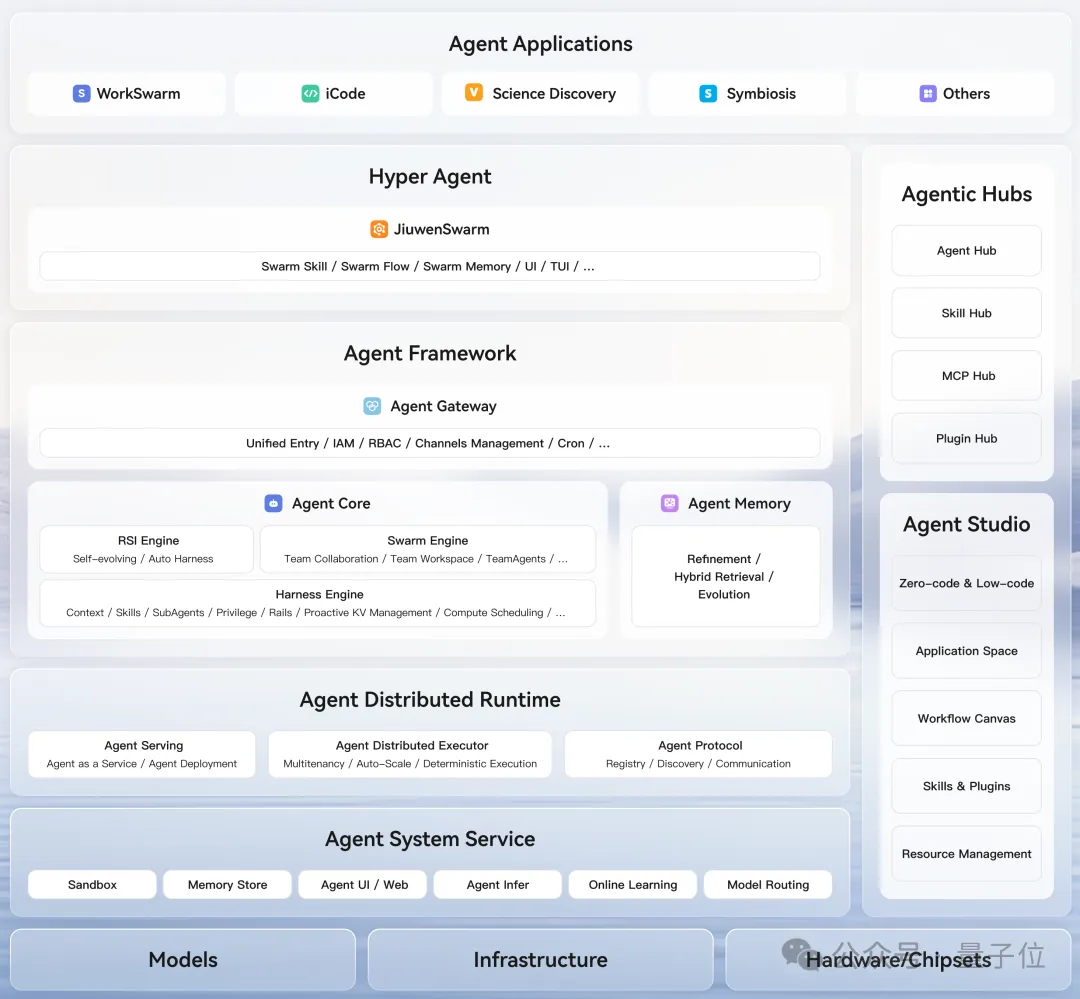
TL;DR - Huawei-backed openJiuwen released and open-sourced Jiuwen AgentOS, an enterprise platform for deploying and managing multi-agent systems. It targets production barriers including agent coordination, experience reuse, compute efficiency, security, and private deployment.

  • Supports task decomposition, role assignment, parallel execution, workflow orchestration, and human intervention for controlled multi-agent collaboration.
  • Uses execution traces, user feedback, and memory to improve agent skills and coordination while retaining reusable operational experience.
  • Provides resource scheduling and inference optimization alongside multi-tenant isolation, sandboxing, access controls, safety guardrails, and failure recovery.
  • Its plugin architecture and Agentic Hub package models, tools, memory, skills, and connectors as reusable assets; an appliance-based offering reportedly enables hour-scale private deployment.
Representative image for 联想天禧自研代码智能体TianxiCode斩获SWE-bench-Live全球第一

联想天禧自研代码智能体TianxiCode斩获SWE-bench-Live全球第一

Rank 64 · Content 70 · Popularity N/A

TL;DR - Lenovo says its TianxiCode coding-agent framework, paired with DeepSeek-v4.1-Flash, achieved a verified 71% issue-resolution rate and first place on the SWE-bench-Live Lite leaderboard. The result highlights how agent orchestration can improve real-world repository debugging beyond standalone model capabilities.

  • TianxiCode was evaluated on real GitHub issues requiring repository-level diagnosis, patch generation, and testing.
  • Its submitted agent trajectories passed SWE-bench-Live’s “Verified” review for reproducibility and information isolation.
  • The framework combines multi-hop code retrieval and context pruning with autonomous planning and multi-turn tool use.
  • It uses closed-loop patching and test-driven self-correction, and Lenovo plans to integrate the technology into its AI hardware products.

LLMs & Foundation Models 1

Representative image for Claude Haiku 5.5 降本背后:操作能力暴涨,复杂编程为何仍差一截?

Claude Haiku 5.5 降本背后:操作能力暴涨,复杂编程为何仍差一截?

Rank 64 · Content 70 · Popularity N/A

TL;DR - Anthropic’s Claude Haiku 5.5 substantially improves computer-use and knowledge-work performance while cutting typical costs, but still trails Sonnet 5.5 on complex terminal-based coding. Adaptive reasoning and a 1-million-token context expand its capabilities, while introducing migration and pricing caveats.

  • OSWorld 2.1 performance rose from 15.7% to 72.4%, versus Sonnet 5.5’s 83.9%; Terminal-Bench 4.0 remained weaker at 39.2% versus 70.6%.
  • Adaptive Thinking dynamically allocates reasoning effort, replacing fixed thinking-token budgets and requiring updates to output limits, response parsing, and multi-turn state handling.
  • Prompts up to 100,000 tokens cost $0.10/M input and $0.50/M output tokens; beyond that threshold, both rates increase fivefold.
  • Haiku 5.5 supports a 1-million-token context and 128,000-token output, with caching and context compaction positioned to control costs in long-running agent workflows.

Multimodal & Generative 2

Representative image for 当年「字节投毒实习生」田柯宇,估值 2 亿美元,要挑战李飞飞做世界模型

当年「字节投毒实习生」田柯宇,估值 2 亿美元,要挑战李飞飞做世界模型

Rank 64 · Content 70 · Popularity N/A

TL;DR - Tian Keyu’s unnamed 10-person startup reportedly raised $30 million at a $200 million valuation to build an autoregressive world model using a machine-native visual vocabulary. The bet is that aggressive video tokenization can cut generation costs and scale to robotics, autonomous driving, and interactive video, though the approach remains publicly unvalidated.

  • The team has reportedly created a 200,000-symbol “visual dictionary” to compress and predict video, claiming at least a 10× reduction in per-second generation cost.
  • Its approach extends VAR’s next-scale prediction method, which preserves 2D image structure and generates coarse-to-fine with a GPT-style autoregressive architecture.
  • The planned foundation model would train on roughly 100 million hours of video and target a 2027 release.
  • Key uncertainties include long-horizon physical consistency, data curation, infrastructure demands for a 10-person team, and trust concerns stemming from Tian’s prior misconduct case at ByteDance.

Multimodal open d1 decision models for the edge

Rank 61 · Content 65 · Popularity N/A

TL;DR - Hugging Face hosts a Liquid AI post announcing multimodal “open d1” decision models intended for edge deployment. Because only the title and metadata are provided, the models’ capabilities, architecture, performance, and availability cannot be verified here.

  • The announcement centers on multimodal models designed to support decision-making.
  • “For the edge” indicates a focus on deployment directly on resource-constrained or local devices.
  • The title describes the models as open, but no licensing or release details are included.
  • No benchmarks, supported modalities, model sizes, or hardware requirements are provided.

Efficiency & Systems 3

Representative image for 字节找到了DeepSeek时强时弱的原因

字节找到了DeepSeek时强时弱的原因

Rank 78 · Content 90 · Popularity 50

TL;DR - ByteDance Seed researchers found that blockwise KV-cache compression can make long-context retrieval accuracy depend periodically on a token’s position within compression windows. The effect produced accuracy swings of up to 40.2 percentage points in DeepSeek-V4 variants, revealing a hidden reliability tradeoff in memory-efficient inference.

  • DeepSeek-V4’s performance varied every four tokens, while V4.1 varied every two, matching each model’s KV-cache compression stride.
  • Controlled experiments on Qwen3-0.6B showed similar periodicity across block-compression schemes, whereas a full-attention baseline did not.
  • The researchers attribute the behavior to “phase sensitivity” and attention-head specialization for positions within compressed blocks.
  • Post-training and architecture updates reduced—but did not eliminate—the gap, suggesting evaluations should test identical information at every compression phase rather than rely only on average accuracy.

做了八年DSP,Credo怎么突然开始做光芯片了?

Rank 61 · Content 65 · Popularity N/A

TL;DR - Credo is expanding from DSPs into end-to-end optical interconnects for AI data centers, combining 200G/lane signal processing, silicon photonics, and diagnostics in 800G and 1.6T modules. The strategy targets the growing need to connect more GPUs efficiently as single-chip performance gains lag AI compute demand.

  • Credo’s Cardinal 802 uses a 4×200G design to serve both 800G and 1.6T full-DSP modules while avoiding the cost and power overhead of standard eight-channel designs in some configurations.
  • Its LRO approach retains transmit-side DSP processing to compensate for signal and optical impairments, while PILOT analyzes telemetry such as FEC statistics, multipath interference, and bit-error rates.
  • The 7nm Robin DSP integrates the previously external driver, nearly halving board footprint while keeping combined power near the prior DSP-plus-driver level.
  • Acquiring DustPhotonics added Kfir200 silicon-photonics PICs and low-loss laser coupling, enabling fewer lasers, broader supplier compatibility, and prevalidated DSP-PIC integration for pluggable, NPO, and CPO systems.

LegalOn halves Codex costs while maintaining development speed

Rank 61 · Content 65 · Popularity N/A

TL;DR - LegalOn reports reducing estimated daily Codex costs by 65% without slowing development by matching Astra, Sol, and Luna models to suitable tasks and managing budgets strategically.

  • The optimization focused on model routing rather than reducing development throughput.
  • Different Codex models were assigned according to task requirements.
  • Strategic budget controls helped lower estimated daily costs while maintaining development speed.

Embodied AI 2

Representative image for 清华具身模型登顶全球第一!突围GPT-6、英伟达,不靠外挂和额外数据

清华具身模型登顶全球第一!突围GPT-6、英伟达,不靠外挂和额外数据

Rank 64 · Content 70 · Popularity N/A

TL;DR - Tsinghua-affiliated RobotEra’s open-source VPP2 world-action model topped the RoboDojo simulation benchmark and outperformed π0.5 in reported zero-shot real-robot tests. Its key contribution is a staged training pipeline that preserves video-prediction generalization while converting predicted physical changes into robot actions.

  • VPP2 achieved a 32.26% average success rate and 39.26 average score on RoboDojo, ranking first overall without extra evaluation data or Agent RSI-style enhancements.
  • The model separately trains event-level video prediction, distills fixed eight-second predictions to one-step generation, and then trains a 0.9B-parameter Action DiT while largely freezing the video backbone.
  • Reported generation latency is about 0.22 seconds per action segment: 0.12 seconds for video prediction and 0.1 seconds for action generation.
  • On 10 zero-shot ALOHA tasks, VPP2 averaged 58.5% success versus π0.5’s 40%; adding VLM-based subtask planning raised selected long-horizon RoboDojo performance from 27.6% to 57.6%.
Representative image for 0.2秒急停、秒级重规划!因果智能走进真实世界

0.2秒急停、秒级重规划!因果智能走进真实世界

Rank 61 · Content 65 · Popularity N/A

TL;DR - Aether AI unveiled CRIS-0, a causal-agent architecture for robots that tracks task-relevant physical variables, predicts action consequences, and replans after disturbances. Its demos suggest causal state modeling could make long-horizon robotic tasks safer and more resilient than monolithic end-to-end policies.

  • CRIS-0 reportedly triggered emergency stops within 0.2 seconds and replanned around environmental changes in about 2 seconds, recovering from 9 of 10 random disruptions in a coffee-preparation test.
  • The system combines a planner, rule-based motion functions, learned manipulation policies, SLAM, verifiers, and a causal world model through a unified tool interface.
  • A dynamic task graph repeatedly performs state recognition, tool selection, execution, verification, and recovery, limiting error accumulation during multi-step tasks.
  • In a personalized pick-and-place test, it correctly handled 18 of 20 ambiguous instructions by incorporating user and environmental context.