宾大茅佳源:从单次演示到 83% 真机泛化,破解具身智能数据困局|IROS 2026
Ranking
Overall
75
Content
85
Popularity
50
Observed public metrics from 1 member.
Merged summary
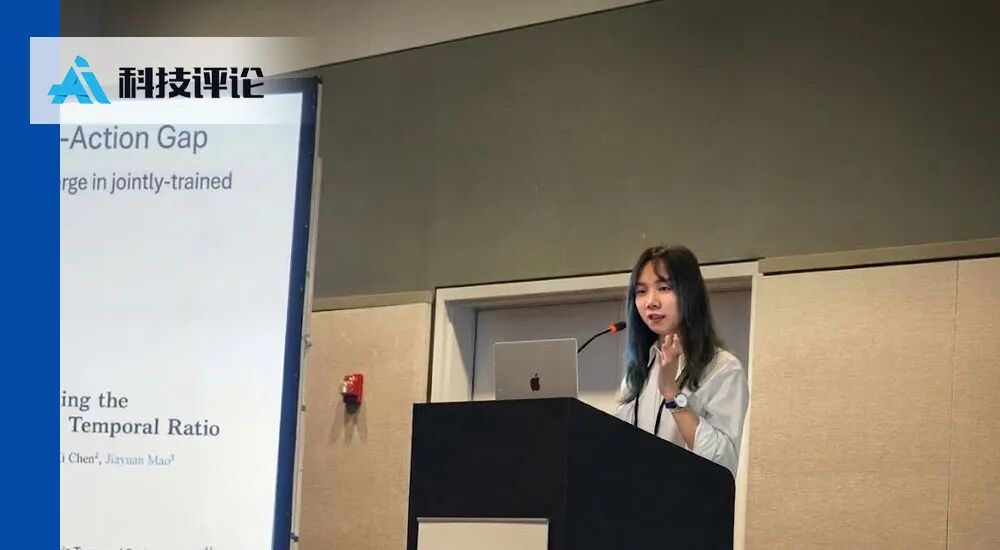
TL;DR - An IROS 2026 presentation describes neuro-symbolic and video-action approaches that improve robotic generalization with far less demonstration data. A Temporal Ratio (TR) diagnostic and adaptive guidance raised real-world out-of-distribution success to 83% by making the action head better use predicted future states.
- RAPID converts one human demonstration into object-centric constraint programs, using a coding agent and Real2Sim evaluator to iteratively reject physically infeasible behavior.
- The framework decomposes manipulation into reusable primitives and constraint optimization, enabling complex non-grasping tasks without hundreds of teleoperation trajectories.
- Joint video-action models often exhibit a mechanism gap: video predictions generalize, but the action head may ignore their future features and fail on compositional OOD tasks.
- Peak TR—the action head’s attention to future versus current frames—correlated with OOD performance; TR-adaptive language and planning guidance improved real-robot success from 71.8% to 83%, versus roughly 12% for Cosmos-Policy.
Sources (1)
宾大茅佳源:从单次演示到 83% 真机泛化,破解具身智能数据困局|IROS 2026
Public signals
Hugging Face upvotes 0
TL;DR - An IROS 2026 presentation describes neuro-symbolic and video-action approaches that improve robotic generalization with far less demonstration data. A Temporal Ratio (TR) diagnostic and adaptive guidance raised real-world out-of-distribution success to 83% by making the action head better use predicted future states.
- RAPID converts one human demonstration into object-centric constraint programs, using a coding agent and Real2Sim evaluator to iteratively reject physically infeasible behavior.
- The framework decomposes manipulation into reusable primitives and constraint optimization, enabling complex non-grasping tasks without hundreds of teleoperation trajectories.
- Joint video-action models often exhibit a mechanism gap: video predictions generalize, but the action head may ignore their future features and fail on compositional OOD tasks.
- Peak TR—the action head’s attention to future versus current frames—correlated with OOD performance; TR-adaptive language and planning guidance improved real-robot success from 71.8% to 83%, versus roughly 12% for Cosmos-Policy.