霸榜三大基准!优必选 Thinker-WM:多模态统一表征,单模型实现六大能力
Ranking
Overall
68
Content
75
Popularity
50
Observed public metrics from 1 member.
Merged summary
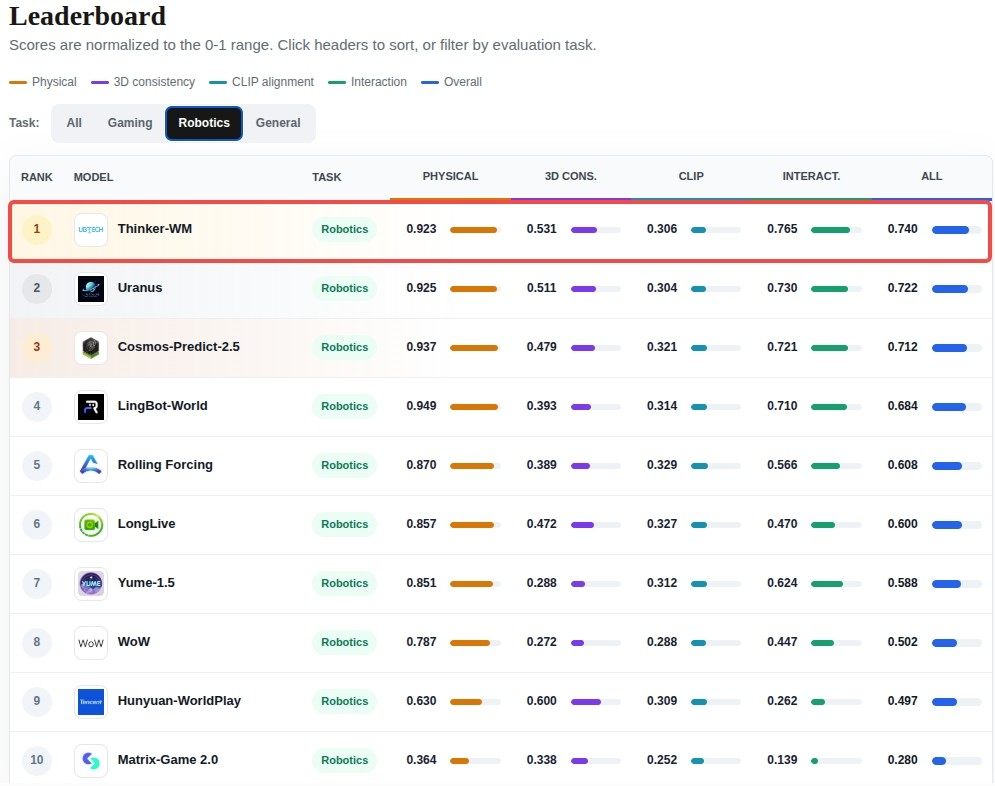
TL;DR - UBTECH unveiled Thinker-WM, a unified multimodal world model for robotics that reportedly ranked first on WorldOlympiad, EWMBench, and WorldArena 1.0 Track-1. Its shared representation jointly models visual observations, depth, and robot actions, enabling one model to support six prediction and control capabilities.
- A Unified Dynamics Transformer lets RGB, geometry, and action tokens exchange information through shared attention rather than combining separate modules only at their interfaces.
- The model jointly generates video, depth, and executable actions for tasks including world prediction, policy reasoning, video-to-action conversion, and inverse dynamics.
- Training used roughly 20,000 hours of egocentric human video, 10,000 hours of real-robot data, and 1,000 hours of simulation data across heterogeneous robot platforms.
- In a RoboTwin ablation, adding depth improved task success by 15 percentage points; a Motion Probe experiment also found that frozen visual representations encoded action-related motion information.
Sources (1)
霸榜三大基准!优必选 Thinker-WM:多模态统一表征,单模型实现六大能力
Public signals
Hugging Face upvotes 2
TL;DR - UBTECH unveiled Thinker-WM, a unified multimodal world model for robotics that reportedly ranked first on WorldOlympiad, EWMBench, and WorldArena 1.0 Track-1. Its shared representation jointly models visual observations, depth, and robot actions, enabling one model to support six prediction and control capabilities.
- A Unified Dynamics Transformer lets RGB, geometry, and action tokens exchange information through shared attention rather than combining separate modules only at their interfaces.
- The model jointly generates video, depth, and executable actions for tasks including world prediction, policy reasoning, video-to-action conversion, and inverse dynamics.
- Training used roughly 20,000 hours of egocentric human video, 10,000 hours of real-robot data, and 1,000 hours of simulation data across heterogeneous robot platforms.
- In a RoboTwin ablation, adding depth improved task success by 15 percentage points; a Motion Probe experiment also found that frozen visual representations encoded action-related motion information.