🛰️ Daily AI Frontier
⚠ WeChat login expired or unavailable — new articles may be missing. Reconnect WeChat. An upstream outage cannot be fixed by scanning. Latest stored WeChat publication: 2026-08-25.

WeChat reconnect targets werss, while collection still uses wewe. Login alone does not complete the provider cutover.

Twitter/X collection is rate limited. 0 of 13 handles succeeded at the last check. Stored posts remain available; partial coverage is not a complete timeline.
37 works · 3 categories · 16 topics · blog 12 journal 10 arxiv 15 generated 2026-10-17 14:17:02 UTC
Top highlights — Research

LLM Agents 11

Representative image for OpenGCUA: Toward a Fully Open Stack for Generalist Computer Use

OpenGCUA: Toward a Fully Open Stack for Generalist Computer Use

Rank 88 · Content 95 · Popularity 70

TL;DR - OpenGCUA is an open-stack framework for generalist computer-use agents that operate across visual and programmatic interfaces. Its code-execution and model-driven control mechanisms improved performance while reducing interaction steps across eight models on OSWorld-v2.

  • Code execution lets agents adapt subsequent operations based on intermediate results and apply existing programming abilities to computer tasks.
  • “Harness-to-model decision transfer” shifts selected observation and task-state decisions from fixed harness rules to the model.
  • The full configuration increased mean OSWorld-v2 partial scores by 19.6 points and reduced reported steps per task by 53.0% versus batched GUI-only execution.
  • The release includes implementation code, prompts, evaluation trajectories, a preliminary real-device harness, and a cross-device SDK for computers, mobile devices, and browsers.
Representative image for Realtime-Bench: Can Frontier Models Solve Real-time Interactive Problems?

Realtime-Bench: Can Frontier Models Solve Real-time Interactive Problems?

Rank 87 · Content 100 · Popularity 58

TL;DR - Realtime-Bench evaluates whether frontier agents can act effectively in dynamic environments where inference delays affect outcomes. The best model achieved only 44% success under wall-clock timing, highlighting a gap between reasoning capability and timely execution.

  • The benchmark uses evolving tasks in which delayed actions directly reduce the likelihood of success.
  • Wall Clock measures performance with actual inference latency; Paused Clock removes that latency as an idealized reference.
  • Token Clock advances simulated time based on generated token counts, isolating temporal awareness from serving speed.
  • Increased reasoning effort has mixed effects under time pressure, revealing a trade-off between decision quality and response speed.
Representative image for Intern-Decision: Efficient Multimodal Decision Making with Autoregressive Masked Language Modeling

Intern-Decision: Efficient Multimodal Decision Making with Autoregressive Masked Language Modeling

Rank 86 · Content 95 · Popularity 66

TL;DR - Intern-Decision is a family of compact multimodal models that produces structured decisions and candidate probabilities in one causal forward pass. It reduces latency and simplifies action selection for interactive agents while achieving competitive accuracy.

  • Uses autoregressive masked language modeling to fill decision placeholders in a predefined JSON skeleton from text and optional images.
  • The 4B model averages 90.02% accuracy across seven evaluation suites, versus 88.74% for Jev v1.13.0.
  • On an RTX 4090, latency is 44.16 ms for the 4B model and roughly 33–34 ms for the 0.8B and 2B variants on a fixed three-field request.
  • Temperature scaling improves calibration, while confidence-based routing to a larger model raises Jevbench-Hard accuracy from 73.87% to 87.39%.

PROBE: Learning to Audit Policy Compliance in Tool-Using LLM Agents

Rank 85 · Content 100 · Popularity 49

TL;DR - PROBE trains LLM-based auditors to interact with tool-using agents and uncover policy violations that emerge across multi-turn workflows. It addresses an evaluation gap not covered by capability benchmarks or content-safety red-teaming.

  • Formalizes agent auditing as a two-player Markov game between an auditor and a deployed agent.
  • Uses a composite reward balancing violation discovery, realistic behavior, conversation progress, and policy diversity.
  • Compares GRPO, DPO, and GFlowNet-based optimization for training auditors.
  • Trained auditors find broader, higher-yield violations than same-architecture zero-shot adversaries, even when smaller than the target agent.
Representative image for AutoSFT: An Agentic System for Automated Data Research in Supervised Fine-Tuning

AutoSFT: An Agentic System for Automated Data Research in Supervised Fine-Tuning

Rank 84 · Content 90 · Popularity 69

TL;DR - AutoSFT is a multi-agent system that automates supervised fine-tuning data research across actions such as rebalancing, pruning, repairing, replacing, and synthesizing examples. Its structured division of execution, analysis, and synthesis improves instruction-following and code benchmarks over a single-agent approach.

  • A meta-agent separates execution from analysis, reducing context loss by half.
  • Independent analysis agents improve the best IFEval score by 6.5 points and MBPP+ by 3.7 points.
  • A synthesis subagent adds 3.4 points on IFEval and 2.9 points on IFBench.
  • Controlled comparisons retrain from the base model each round while holding the model, trainer, and budget fixed, isolating each component’s contribution.

Terminal-RSI: Recursive Self-Improving Terminal Agents via Recursive Self-Rewrite and Policy-Refine

Rank 83 · Content 90 · Popularity 67

TL;DR - Terminal-RSI is a training framework that recursively rewrites verified agent trajectories and refines policies using inherited critics. It improves terminal-agent task completion by converting verifier feedback and partial progress into stronger behaviors across training stages.

  • Alternates Recursive Self-Rewrite (RSR) with critic-inheriting Recursive Policy-Refine (RPR).
  • Introduces TB-GAE for token-specific baselines across interaction turns, plus dense and success-prioritized reward schemes.
  • The resulting 27B model scores 19.84% on Terminal-Bench 4.0, 86.52% on 2.1, 16.95% on 3.0, and 79.00% on Terminal-Bench Hard.
  • On additional benchmarks, LHTB strict completions rise from 0/46 to 5/46, while SWR100 success doubles from 3% to 6%.

Private Retrieval Augmented Generation via Random Projection

Rank 82 · Content 95 · Popularity 53

TL;DR - This paper proposes random projection as a lightweight privacy defense for retrieval-augmented generation, preserving semantic retrieval quality while reducing extraction of sensitive datastore content. It offers stronger retrieval and generation performance than evaluated differential privacy methods, with comparable empirical privacy under strong attacks.

  • Applies the same random projection to datastore and query embeddings to preserve their semantic similarity.
  • Evaluates the method across multiple RAG architectures and datasets.
  • Substantially mitigates data-extraction attacks without the utility penalties associated with the compared differential privacy approaches.
  • Establishes random projection as a practical baseline for privacy-preserving RAG, though the stated protection is empirical rather than a formal differential privacy guarantee.

Shortcut Sensitivity in Agent-Safety Evaluations

Rank 79 · Content 100 · Popularity 31

TL;DR - This paper shows that superficial benchmark cues can significantly affect agent-safety guards and their measured performance. It proposes a three-level auditing framework and recommends more robust evaluation designs.

  • LinuxArena labels were strongly predictable from average shell-command length, while AgentDojo-Traj exact-tool lookup F1 fell from 0.901 to 0.495 under domain holdout.
  • In AgentHarm-Traj, changing from row weighting to equal interaction weighting reduced TS-Guard F1 from 0.902 to 0.719, even as balanced accuracy increased.
  • For Haiku, rewriting an information marker reduced blocking by 8.33 percentage points, while opaque tool aliases increased it by 11.46 points; all unsafe calls remained blocked, so the changes affected false positives.
  • These effects did not reproduce in Luna or deterministic Q8 TS-Guard, motivating domain-group holdouts, evaluation-unit metrics, and placebo-controlled paired interventions.

Beyond Downstream QA: Rethinking How We Evaluate Agent Memory

Rank 79 · Content 100 · Popularity 31

TL;DR - FEB-30 evaluates agent memory directly rather than relying solely on downstream question-answering, which can obscure memory failures. Testing a representative system revealed substantial divergence between intrinsic memory quality and extrinsic QA performance.

  • FEB-30 contains 30 fact-evolution trajectories across six diagnostic categories and three difficulty levels.
  • Its generated documents provide deterministic ground truth for inspecting memory after each ingestion step without human annotation.
  • Intrinsic and extrinsic evaluations diverged by 16 percentage points on average, with meaningful divergence in 44% of trajectories.
  • The evaluated system correctly classified memory operations—create, update, reinforce, and supersede—only 20% of the time, a failure hidden by downstream QA evaluation.

Believed but Not Said: Measuring Hidden Belief Collapse in Multi-Agent LLM Discussions

Rank 79 · Content 100 · Popularity 31

TL;DR - A study finds that adversarial agents can silently corrupt benign agents’ private beliefs during multi-agent LLM discussions, even when those agents do not publicly endorse the false claim. This hidden belief collapse challenges the assumption that group deliberation reliably corrects individual errors.

  • Across six models and three factual-QA datasets, only 0.6% of benign agents ended with false answers when no attacker was present.
  • One adversarial agent raised the false-answer rate to 44.8%; three raised it to 60.5%.
  • With three attackers, benign agents privately held the false answer in 51.6% of exposed turns but publicly endorsed it in only 19.7%.
  • False beliefs persisted when agents were separately asked for their own views, spread among benign agents, and were not predicted by baseline knowledge.
Representative image for KnowGPO: Knowledge-Grouped Policy Optimization for Search Agents

KnowGPO: Knowledge-Grouped Policy Optimization for Search Agents

Rank 76 · Content 95 · Popularity 31

TL;DR - KnowGPO is a reinforcement-learning framework that trains deep-search agents by tracking task-relevant knowledge acquired at each step rather than relying solely on terminal rewards or noisy trajectory states. It improves benchmark performance by 3.8–4.2 points, with an 8B model matching or surpassing most 32B open-source systems.

  • Decomposes each query’s required information into atomic knowledge conditions.
  • Groups trajectories by which knowledge conditions they have satisfied, enabling more meaningful within-group comparisons.
  • Uses incremental knowledge gain between steps as an environment-grounded process reward.
  • Consistently outperforms GRPO, GiGPO, and IGPO on Xbench, BrowseComp-ZH, and GAIA.

Medical/Healthcare AI 4

Memory stays strong in old age when this brain enzyme is active

Rank 63 · Content 70 · Popularity 48

TL;DR - Mouse data and observations from 13 human brains link higher activity or levels of a lipid-degrading brain enzyme with preserved memory in old age. The finding suggests lipid metabolism may contribute to cognitive resilience, though the limited summary does not establish causality.

  • The evidence combines experiments or measurements from mice with data from 13 human brains.
  • Memory preservation is associated with levels or activity of a lipid-degrading enzyme.
  • The study points to a potential biological mechanism and therapeutic target for age-related cognitive decline.
  • The provided content does not specify the enzyme, effect size, experimental methods, or whether human evidence is causal.

Smartwatch health data are piling up. How can doctors keep pace?

Rank 60 · Content 65 · Popularity 48

TL;DR - This Nature item argues that standardized clinical protocols are needed to turn rapidly accumulating smartwatch health data into useful tools for monitoring and diagnosis. The limited excerpt does not describe specific methods or findings.

  • Wearable devices are generating growing volumes of longitudinal health data.
  • Clinical workflows need protocols for interpreting and acting on these data.
  • Standardization is presented as necessary to realize wearables’ diagnostic and monitoring value.
  • The provided content does not specify particular conditions, algorithms, or validation results.

Briefing Chat: An invisible tattoo that appears under UV light – and then disappears

Rank 53 · Content 55 · Popularity 48

TL;DR - Nature staff discuss a new ink for temporary, UV-visible tattoos that could have medical applications, alongside research into why small dogs tend to outlive larger ones. The supplied excerpt does not provide technical details or study results.

  • The tattoo ink is described as invisible under normal conditions, visible under UV light, and capable of disappearing over time.
  • Its proposed use is medical tattooing, though specific clinical applications are not given.
  • The briefing also covers an explanation for size-related differences in canine lifespan.
  • No AI-related methods or findings are mentioned in the provided content.

Hydrogels and MRI: meet three biomedical engineers reshaping health care

Rank 53 · Content 55 · Popularity 48

TL;DR - This Nature feature profiles three biomedical engineers using technologies including hydrogels and MRI to advance health care. The provided excerpt is too brief to identify specific methods, findings, or the role of AI.

  • The work spans multiple medical disciplines and uses a range of research tools and processes.
  • Hydrogels and MRI are highlighted as key biomedical technologies.
  • No quantitative results or detailed technical conclusions are provided in the excerpt.

Multimodal & Generative 2

Representative image for Memory as Weights: Internalizing Long-Term History for Streaming Videos

Memory as Weights: Internalizing Long-Term History for Streaming Videos

Rank 85 · Content 95 · Popularity 62

TL;DR - MaLoW is a streaming vision-language memory framework that encodes long-term video history into evolving, fixed-size LoRA weights rather than repeatedly adding past observations to the input context. This reduces competition between historical and current information while improving video understanding and robotic action performance.

  • A recurrent HyperNetwork incrementally consolidates incoming video observations into lightweight parameter updates.
  • MaLoW-Instruct provides 381K question-answer pairs across 56K streaming videos for training.
  • On OVO-Bench’s backward split, MaLoW outperforms prior memory methods by 3.9%–11.8% across video backbones with modest latency overhead.
  • The approach transfers to vision-language-action models, improving Simpler WidowX action success by 9.3%.
Representative image for Perceive, Predict, and Plan: a Unified World Action Model for Egocentric Dexterous Manipulation

Perceive, Predict, and Plan: a Unified World Action Model for Egocentric Dexterous Manipulation

Rank 84 · Content 95 · Popularity 57

TL;DR - P³-WAM is a unified world-action model that learns 3D perception, action-conditioned video prediction, and goal-directed planning for egocentric dexterous manipulation. Joint training improves all three capabilities and outperforms specialized baselines across four datasets.

  • Integrates a compact 3D action representation into a pretrained video diffusion transformer using shared weights, modality-specific adaptation, and bidirectional visual-action attention.
  • Randomized modality visibility allows video and 3D actions to serve interchangeably as conditioning inputs or prediction targets.
  • Plans manipulation by jointly generating action trajectories and anticipated visual outcomes from an initial image, language instruction, and optional visual goal.
  • Reports better 3D hand reconstruction, action-conditioned video prediction, instruction adherence, and action progression than task-specific or video-generation baselines.

Efficiency & Systems 1

LCT: Losslessly Compressed Tensors with GPU friendly execution for Training

Rank 79 · Content 100 · Popularity 31

TL;DR - LCT is a GPU-oriented framework that losslessly compresses weights, activations, and optimizer states during training. It cuts peak memory by roughly 24% with modest runtime overhead, enabling substantially longer training contexts on the same hardware.

  • Uses optimized Huffman-coding kernels and precomputed codebooks to support repeated compression and decompression on GPUs.
  • Achieves compression ratios of up to 1.455× by exploiting redundancy in floating-point tensors.
  • Reduces NanoGPT-162M memory usage by 24.6% while increasing step time by 7.2%.
  • Saves up to 23.8% peak memory in Qwen3-4B fine-tuning, enabling a 3.5× longer context length on the same GPU.

AI in Academia 1

PhD students who write dissertation with AI less likely to stay in academia

Rank 53 · Content 55 · Popularity 48

TL;DR - Nature reports an association between using AI to write a PhD dissertation and a lower likelihood of remaining in academia among US graduates. Those who used AI were more likely to enter industry, but the limited excerpt does not establish why or whether AI use caused this outcome.

  • The reported population is US PhD graduates.
  • AI-assisted dissertation writing was associated with lower academic retention.
  • AI users were more likely to work in industry.
  • No methodology, effect size, or causal evidence is provided in the excerpt.

Robot Learning 1

Representative image for Dexterity from Supervised Play

Dexterity from Supervised Play

Rank 78 · Content 95 · Popularity 38

TL;DR - DSP bootstraps dexterous robot learning from minutes of human-supervised play, then autonomously gathers interaction data for world-model training and planning. It achieves reinforcement-learning-level real-world performance with 490× less interaction data.

  • A behavior-cloned play policy collects hours of contact-rich experience without task-specific demonstrations.
  • The policy proposes candidate action sequences for model-predictive control under a learned world model.
  • Self-play within the world model distills planning into a faster closed-loop, goal-conditioned policy.
  • On real-world manipulation tasks, DSP improves success over hindsight behavior cloning by 69.6%.

Stem Cell Biology 1

Sexual dimorphism in epidermal stem cell dynamics

Rank 66 · Content 65 · Popularity 70

TL;DR - Long-term live imaging of adult mouse ear skin reveals sex-specific differences in epidermal stem-cell and transit-amplifying-cell clonal dynamics during normal tissue maintenance. This highlights biological sex as an important variable in studies of skin renewal.

  • The study examines epidermal cell behavior in vivo during homeostasis.
  • It tracks clones over time using long-term live imaging.
  • Both epidermal stem cells and transit-amplifying cells show sex-specific dynamics.
  • The provided summary does not specify the mechanisms or direction of these differences.

Structural Biology 1

Structural basis of ligand recognition and gating in mosquito IRs

Rank 49 · Content 50 · Popularity 48

TL;DR - This Nature paper investigates the structural basis by which mosquito ionotropic receptors (IRs) recognize ligands and control channel gating. The provided content includes only the title and publication metadata, so specific findings cannot be determined.

  • Published online in Nature on 14 October 2026.
  • Focuses on molecular mechanisms of ligand recognition in mosquito IRs.
  • Examines how ligand binding relates to receptor gating.
  • No experimental methods, structures, or biological implications are described in the supplied excerpt.
Top highlights — Industry & News

LLM Agents 3

Representative image for 中控技术接入千问办公,打造流程工业领域AI Native标杆企业

中控技术接入千问办公,打造流程工业领域AI Native标杆企业

Rank 50 · Content 50 · Popularity N/A

TL;DR - 中控技术接入阿里旗下企业级通用 Agent 产品千问办公,率先将其用于流程工业营销全链路,并计划扩展至采购、供应链、财务、人力和研发等业务流程。

  • AI 营销项目覆盖市场线索搜集、市场洞察、方案生成到回款结算等环节。
  • 系统结合千问办公与中控技术的行业知识及专家经验,将解决方案产出时间从通常超过 5 天缩短至 1 天,宣称效率提升约 5 倍。
  • 中控技术计划利用千问办公的 skill 能力,把企业经验沉淀为可在流程工业领域复用的 AI 营销技能库。
  • 双方旨在推动 AI 从单点办公辅助扩展到流程工业企业的跨部门工作流。
Representative image for 付费用户占比超 20%,电商商家「涌入」千问办公

付费用户占比超 20%,电商商家「涌入」千问办公

Rank 50 · Content 50 · Popularity N/A

TL;DR - Qwen Office launched an e-commerce edition that connects merchant tools and uses AI agents to automate cross-platform analytics, price monitoring, content production, and reporting. E-commerce merchants already account for over 20% of its paid users, indicating strong demand for workflow-level automation.

  • MCP integrations let agents access merchant analytics, generate dashboards, schedule reports, and send results to collaboration tools such as DingTalk.
  • Users report reducing store-launch preparation from one month to seven days, cross-platform reporting to 30 minutes, and seasonal image production from four months to roughly 15 days.
  • The product can orchestrate third-party image generators and continuously monitor pricing, inventory, advertising, conversion, and after-sales anomalies.
  • Its architecture emphasizes governed business context—including operational data, documents, communications, and prior instructions—to make agents more proactive and business-aware.

Stack Overflow for Agents triples signups with ChatGPT plugin

Rank 50 · Content 50 · Popularity N/A

TL;DR - Two engineers built Stack Overflow for Agents in a few weeks using Codex. Adding a ChatGPT plugin reportedly tripled signups and drove up to 10× growth in agent creation.

  • Codex supported rapid product development by a two-engineer team.
  • The ChatGPT plugin served as a significant user-acquisition channel.
  • The limited description does not provide implementation details or underlying growth figures.

LLMs & Foundation Models 1

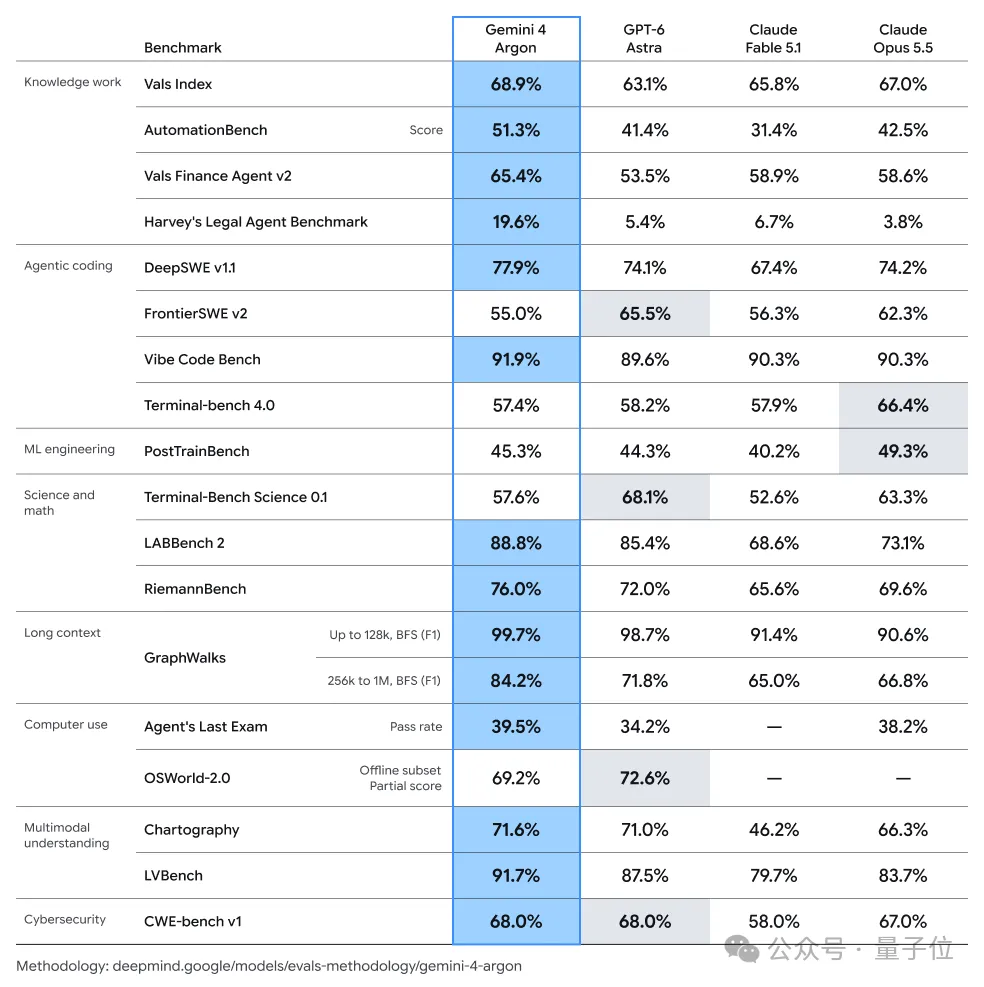
Representative image for 刚刚,Gemini 4终于来了:谷歌重回御三家,API限时半价

刚刚,Gemini 4终于来了:谷歌重回御三家,API限时半价

Rank 71 · Content 80 · Popularity N/A

TL;DR - Google launched Gemini 4 Argon globally, emphasizing stronger long-horizon task execution, multimodal reasoning, coding, and tool use. It reportedly matches leading competitors on aggregate evaluations while offering lower introductory API pricing, though independent testing still shows weaknesses on some software-engineering tasks.

  • Argon can autonomously research, invoke tools, edit code, run tests, and sustain complex workflows; in one Google trial, it worked for 11 hours across a 205,000-line codebase.
  • Its multimodal capabilities span 3D content generation and a video-to-simulation-to-robot pipeline that Google says reduces robot simulation modeling from weeks to hours.
  • Artificial Analysis reportedly scores Argon High at 53, tied with GPT-6 Astra Max and Claude Fable 5.1 Max, at an average task cost of $1.99.
  • API promotional pricing is $2 per million input tokens and $10 per million output tokens through November 30, before doubling on December 1.

Multimodal & Generative 1

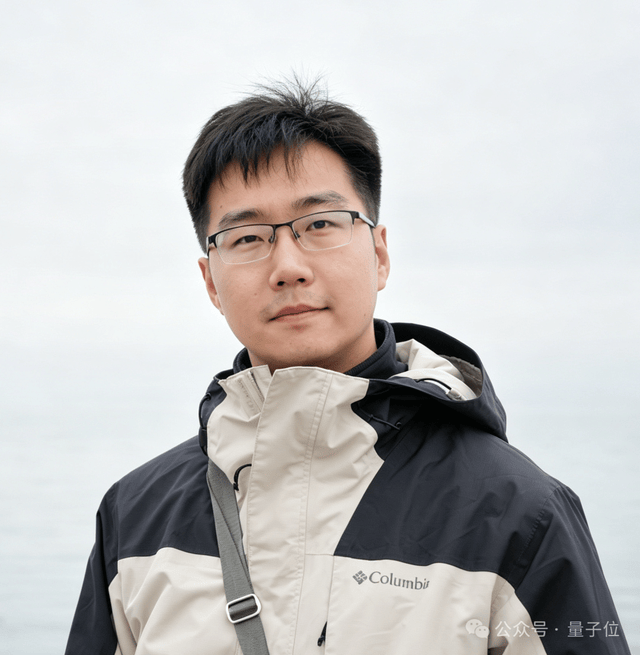
Representative image for 清华特奖得主AI创业再+1:GeoPT一作入局物理世界模型

清华特奖得主AI创业再+1:GeoPT一作入局物理世界模型

Rank 64 · Content 70 · Popularity N/A

TL;DR - GeoPT lead author Wu Haixu has founded Wuyuan Technology to develop world models with physical modeling capabilities, reportedly raising multiple rounds at a valuation of several hundred million dollars. The startup extends a research direction that learns physical intuition by lifting static geometry into dynamic particle trajectories.

  • GeoPT uses synthetic dynamics to pretrain on unlabeled data, learning how particle trajectories evolve rather than relying only on static geometry.
  • The company’s approach reportedly continues GeoPT’s emphasis on scalable models for physical and dynamical systems.
  • Investors named in the report include Ant Group, Meituan, Fortune Capital, and Xinglian.
  • Wu’s prior research includes Autoformer, Corrformer, Transolver, TimesNet, and Unisolver, spanning time-series forecasting and scientific machine learning.

Efficiency & Systems 1

Representative image for 范式智能联合睿思智联推出开源一站式 生产级 AI 部署平台 “模域ModelSphere”

范式智能联合睿思智联推出开源一站式 生产级 AI 部署平台 “模域ModelSphere”

Rank 64 · Content 70 · Popularity N/A

TL;DR - Paradigm AI and RaiseMind launched ModelSphere, a free, Apache 2.0-licensed platform for deploying and operating production AI models across heterogeneous compute clusters. It unifies resource management, inference deployment, optimization, and reliability features to reduce enterprise infrastructure complexity.

  • Integrates graphical deployment, autoscaling, prefill/decode disaggregation, three-tier KV caching, load balancing, monitoring, and automatic stream recovery.
  • EngineX enables unified scheduling and optimization across chips including Huawei Ascend, Iluvatar CoreX, Moore Threads, and Hygon DCU.
  • Works alongside inference engines such as vLLM and SGLang, adding cluster-level routing, shared caching, service management, and data-driven AutoTune optimization.
  • The developers claim up to roughly 285% higher peak throughput than their baseline and support for models including DeepSeek, Qwen, Kimi, MiniMax, and GLM.

AI Cryptanalysis 1

History’s long-secret codes are being cracked by amateurs using AI

Rank 56 · Content 60 · Popularity 48

TL;DR - Amateur codebreakers are using AI to propose solutions to long-unsolved historical ciphers, creating a surge of validation requests for professional cryptographers. The limited excerpt does not specify the AI methods used or which ciphers have been conclusively solved.

  • AI tools are making historical cryptanalysis more accessible to non-specialists.
  • Professional cryptographers are being asked to verify a growing number of amateur-generated solutions.
  • Independent validation remains essential before any claimed decipherment can be accepted.

AI Industry Roundup 1

Representative image for 长鑫科技市值两月内跌去1万亿;阿里加码AI硬件品牌,天猫、速卖通联动;国行版苹果AI有望12月上线,百度、阿里参与合作丨雷峰早报

长鑫科技市值两月内跌去1万亿;阿里加码AI硬件品牌,天猫、速卖通联动;国行版苹果AI有望12月上线,百度、阿里参与合作丨雷峰早报

Rank 50 · Content 50 · Popularity N/A

TL;DR - A broad technology-news digest covering AI products, infrastructure, hardware, and corporate developments, including Kling 4.0’s launch, Apple Intelligence’s expected China rollout, and DeepSeek API reliability issues. It highlights rapid commercialization alongside persistent compute, service-reliability, and supply-chain constraints.

  • Kling 4.0 targets professional video production with improved motion consistency, native generation up to 30 seconds, and support for 15 reference assets and 10 keyframes.
  • Apple Intelligence is reportedly slated for a December China launch, with Baidu supporting Siri and visual search while Alibaba models provide text, image-understanding, and generation capabilities.
  • DeepSeek compensated API customers after another outage; the report says its platform experienced at least 18 major service disruptions in 2026.
  • Alibaba is expanding support for AI hardware brands, while ByteDance is reportedly negotiating for MediaTek data-center ASICs to diversify its AI compute supply.

AI Research Ecosystem 1

ArXiv versus AI slop: will capping preprint submissions work?

Rank 53 · Content 55 · Popularity 48

TL;DR - ArXiv is tightening submission rules to address a surge in preprints, including AI-generated material. The change matters because stricter limits could reduce low-quality “AI slop” while also affecting how legitimate research is disseminated.

  • ArXiv is imposing caps or tighter controls on preprint submissions.
  • The policy responds partly to increased use of AI tools to generate submissions.
  • The provided excerpt does not specify the caps, enforcement mechanisms, or evidence of their expected effectiveness.

Autonomous Driving 1

Representative image for JAECOO × Momenta完成首个无接管凯旋门智驾挑战,联合征服巴黎“最难魔鬼环岛”

JAECOO × Momenta完成首个无接管凯旋门智驾挑战,联合征服巴黎“最难魔鬼环岛”

Rank 54 · Content 55 · Popularity N/A

TL;DR - JAECOO and Momenta demonstrated a JAECOO 7 test vehicle completing an 11.38 km Paris route—including the Arc de Triomphe roundabout—without driver intervention. The test highlights progress toward adapting advanced driver-assistance technology to complex European roads, though the system remains in validation.

  • The route covered unmarked roads, 12 roundabout exits, right-priority rules, merging traffic, construction detours, pedestrians, and cyclists.
  • The vehicle used Momenta’s R7 world model for environmental understanding, traffic prediction, route planning, and interactive driving decisions.
  • Momenta combines large-scale driving data with European road testing and local data to adapt its system to regional rules and driving behavior.
  • The R7-equipped JAECOO 7 is not yet commercially available; JAECOO and Momenta plan further testing before introducing it to European users.

Drone Swarms 1

Representative image for 无人机表演十年后,大漠大想做「会干活」的机群

无人机表演十年后,大漠大想做「会干活」的机群

Rank 50 · Content 50 · Popularity N/A

TL;DR - Chinese drone company DAMODA is expanding beyond large-scale aerial performances into autonomous swarms designed for work in GPS-denied, confined, and hazardous environments. The move builds on its swarm-control platform, 66 million flight records, and rapidly growing equipment business.

  • Its planned system combines multi-sensor localization, autonomous navigation, obstacle avoidance, and decision-making, with multiple drones coordinating or handing off tasks.
  • DAMODA says existing flight-control and swarm-control technology can transfer to the new product line; a demo is expected between year-end and early next year.
  • Current automation includes vehicle-based deployment that can launch and recover swarms in about 60 seconds, plus an AI editor that generates executable performance scripts from text prompts in roughly 25 minutes.
  • Overseas equipment sales reportedly grew 45-fold in five years, while hardware is now fully domestically sourced and compatible with China’s BeiDou navigation system.

Embodied Robotics 2

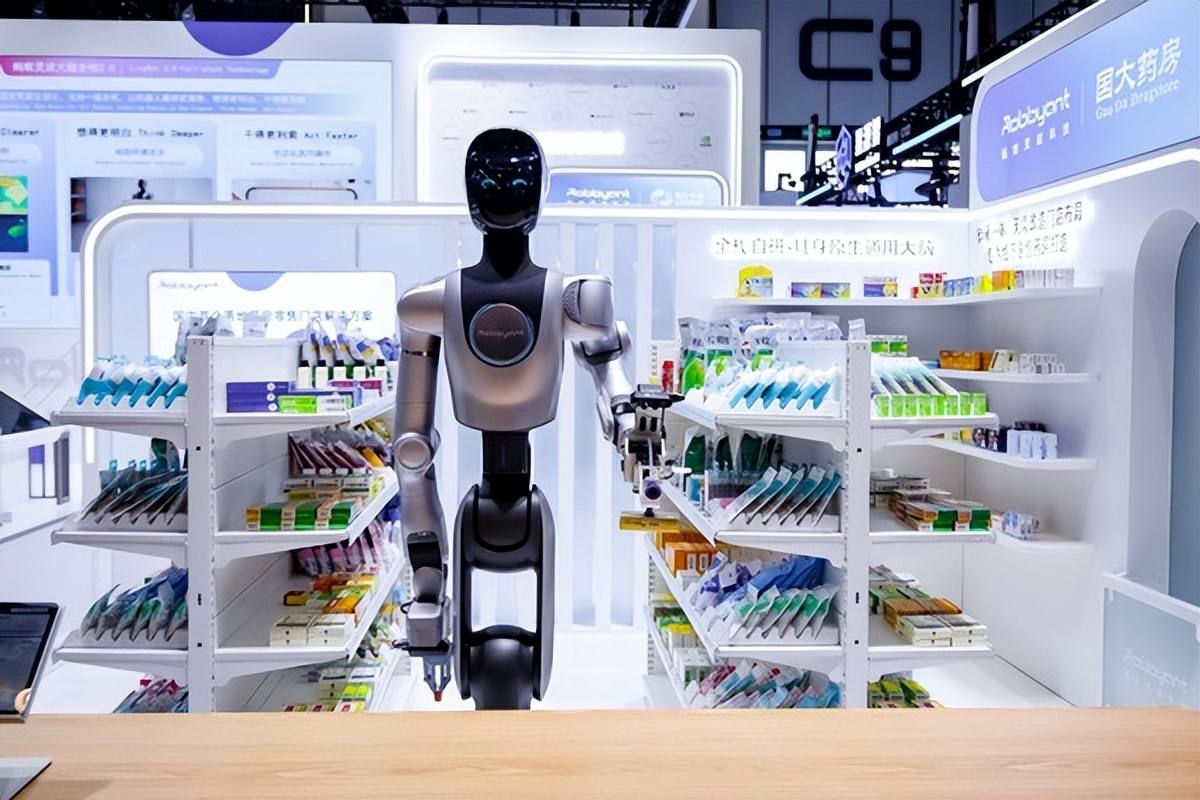
Representative image for 从“看懂世界”到“预演下一步”:世界模型与 VLA,如何让机器人拥有真正的“具身大脑”?

从“看懂世界”到“预演下一步”:世界模型与 VLA,如何让机器人拥有真正的“具身大脑”?

Rank 61 · Content 65 · Popularity N/A

TL;DR - Shanghai robotics companies are deploying vision-language-action (VLA) systems in pharmacies and factories while integrating world models that predict future physical states before acting. The combination could improve robot generalization and reliability, but still faces latency, physical-simulation, data, and evaluation challenges.

  • Ant Lingbo’s general-purpose controller supports 17 robot brands and 20 hardware configurations and is operating in Shanghai pharmacies; other VLA systems are being tested on industrial production lines.
  • AgiBot’s GE-Act 2.0 combines future-state prediction with action generation; after scaling training data from 300 to 30,000 hours, one robot’s reported overall success rate rose from 17.1% to 44.1% in zero-shot tests on unfamiliar scenes and objects.
  • World-model deployments must balance fast prediction, physically accurate simulation, and large-scale data; GE-Act 2.0 reportedly generates a continuous action chunk in about 104 ms on an RTX 5090.
  • Chinese national and Shanghai municipal planning documents are beginning to formalize standards and multidimensional evaluation frameworks for world models and embodied AI.
Representative image for 中国机器人羽毛球连打1452拍!拿下吉尼斯,波士顿动力大佬被硬控

中国机器人羽毛球连打1452拍!拿下吉尼斯,波士顿动力大佬被硬控

Rank 54 · Content 55 · Popularity N/A

TL;DR - Chinese startup DeepChen KaiDong’s mobile badminton robot set a Guinness World Record with 1,452 consecutive returns, demonstrating a reusable robotics platform for real-time perception, trajectory prediction, decision-making, and coordinated control in dynamic environments.

  • The robot reportedly detects incoming shots in about 0.5 milliseconds, swings at up to 30 m/s, and handles smashes exceeding 250 km/h.
  • Its platform combines a reusable mobile base, joint drives, and multi-degree-of-freedom racket arm with a software “robot brain” for perception, prediction, planning, and whole-body control.
  • Earlier results reported at ICRA 2025 included a 94.5% return rate against a launcher and a 90.7% rally success rate with humans.
  • The company positions badminton as a demanding testbed for technology applicable to dynamic sorting, mobile manipulation, industrial automation, service robots, and inspection systems.

Embodied World Models 1

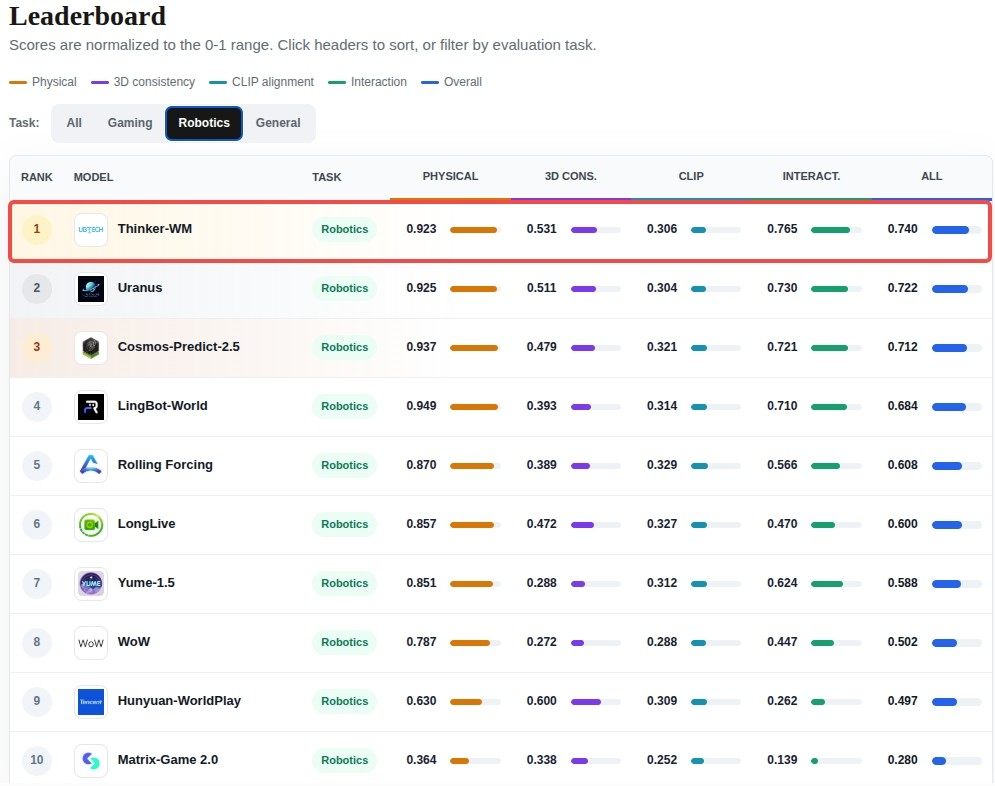
Representative image for 霸榜三大基准!优必选 Thinker-WM:多模态统一表征,单模型实现六大能力

霸榜三大基准!优必选 Thinker-WM:多模态统一表征,单模型实现六大能力

Rank 68 · Content 75 · Popularity 50

TL;DR - UBTECH unveiled Thinker-WM, a unified multimodal world model for robotics that reportedly ranked first on WorldOlympiad, EWMBench, and WorldArena 1.0 Track-1. Its shared representation jointly models visual observations, depth, and robot actions, enabling one model to support six prediction and control capabilities.

  • A Unified Dynamics Transformer lets RGB, geometry, and action tokens exchange information through shared attention rather than combining separate modules only at their interfaces.
  • The model jointly generates video, depth, and executable actions for tasks including world prediction, policy reasoning, video-to-action conversion, and inverse dynamics.
  • Training used roughly 20,000 hours of egocentric human video, 10,000 hours of real-robot data, and 1,000 hours of simulation data across heterogeneous robot platforms.
  • In a RoboTwin ablation, adding depth improved task success by 15 percentage points; a Motion Probe experiment also found that frozen visual representations encoded action-related motion information.
Top highlights — Opinions

Medical/Healthcare AI 1

Biomedical engineering is growing rapidly, but will it help patients?

Rank 49 · Content 50 · Popularity 48

TL;DR - This Nature commentary highlights rapid growth in biomedical engineering while questioning whether technological advances will translate into better patient care. It identifies integration into real-world health systems as a central challenge.

  • Biomedical engineering is advancing rapidly, driven by emerging technologies.
  • Technical progress alone does not establish meaningful benefits for patients.
  • Adoption depends on successfully assimilating new tools into existing healthcare systems.
  • The limited excerpt provides no specific technologies, clinical results, or implementation strategies.