启元机器人新进展:北大董豪团队推出 HIL-UMI,让后训练摆脱「真机依赖」
Ranking
Overall
73
Content
85
Popularity
46
Observed public metrics from 1 member.
Merged summary
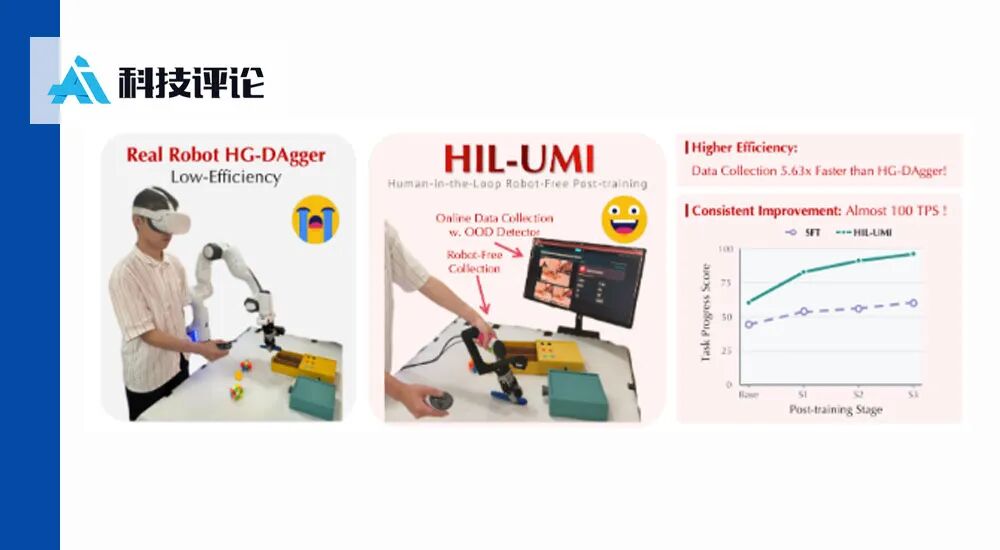
TL;DR - Peking University and Qiyuan Robotics introduced HIL-UMI, a human-in-the-loop method for collecting targeted robot post-training corrections without operating a physical robot during data collection. It aims to make embodied-model improvement cheaper and more scalable than real-robot DAgger workflows.
- Operators perform tasks with a handheld UMI gripper while a model predicts actions from the same observations; large human-model divergences trigger targeted recording.
- The system combines action-divergence detection with an advantage estimator that prioritizes corrections making meaningful task progress.
- Across four real-robot tasks, HIL-UMI raised the reported average task-progress score from 44.3 to 94.8 under the stated data-frame budget, versus 58.0 for continued conventional SFT.
- On the long-horizon table-cleaning task, effective-data collection took 73.40 ms per frame versus 412.99 ms for real-robot HG-DAgger, a reported 5.63× efficiency gain.
Sources (1)
启元机器人新进展:北大董豪团队推出 HIL-UMI,让后训练摆脱「真机依赖」
Public signals
Hugging Face upvotes 0
TL;DR - Peking University and Qiyuan Robotics introduced HIL-UMI, a human-in-the-loop method for collecting targeted robot post-training corrections without operating a physical robot during data collection. It aims to make embodied-model improvement cheaper and more scalable than real-robot DAgger workflows.
- Operators perform tasks with a handheld UMI gripper while a model predicts actions from the same observations; large human-model divergences trigger targeted recording.
- The system combines action-divergence detection with an advantage estimator that prioritizes corrections making meaningful task progress.
- Across four real-robot tasks, HIL-UMI raised the reported average task-progress score from 44.3 to 94.8 under the stated data-frame budget, versus 58.0 for continued conventional SFT.
- On the long-horizon table-cleaning task, effective-data collection took 73.40 ms per frame versus 412.99 ms for real-robot HG-DAgger, a reported 5.63× efficiency gain.