🛰️ Daily AI Frontier
⚠ WeChat login expired or unavailable — new articles may be missing. Reconnect WeChat. An upstream outage cannot be fixed by scanning. Latest stored WeChat publication: 2026-08-25.

WeChat reconnect targets werss, while collection still uses wewe. Login alone does not complete the provider cutover.

Twitter/X collection is rate limited. 0 of 13 handles succeeded at the last check. Stored posts remain available; partial coverage is not a complete timeline.
36 works · 2 categories · 15 topics · blog 12 journal 10 arxiv 15 generated 2026-10-20 14:28:50 UTC
Top highlights — Research

LLM Agents 9

Representative image for OpenVLHarness: Real World Visual Agentic Tool-Use with Multimodal Memory

OpenVLHarness: Real World Visual Agentic Tool-Use with Multimodal Memory

Rank 88 · Content 95 · Popularity 70

TL;DR - OpenVLHarness equips visual agents with heterogeneous tools, evidence rendering, code execution, and persistent multimodal memory. Across 22 benchmarks, it improves performance while substantially reducing token costs relative to high-effort baselines.

  • A controlled study finds that increasing the base model’s inference budget alone yields only modest gains on evidence-intensive visual tasks.
  • The capability layer standardizes tool access and converts outputs into model-readable observations.
  • Persistent memory retains images, structured data, and web references as addressable artifacts for multi-step reasoning and computation.
  • Across eight backbones, the harness improves average scores by 9.7–12.6 points over matched no-tool baselines; with GPT-6 Luna, it beats maximum-effort alternatives by 7.7–8.5 points using at most 37% of their model-token cost.

HarnessPro: Recursive Harness Self-Improvement with Pareto Optimization for Performance-Cost Trade-offs

Rank 86 · Content 95 · Popularity 65

TL;DR - HarnessPro is a label-free recursive self-improvement method that evolves AI-agent harnesses along a performance-cost Pareto frontier. It produces lite, medium, and heavy variants suited to different deployment budgets rather than optimizing performance alone.

  • Uses LLM-generated tests without ground-truth solutions or official test suites.
  • Specialized agents analyze execution trajectories, plan updates under different cost-performance priorities, and implement candidate harnesses.
  • On Terminal-Bench 2, SWE-Bench Pro, and ProgramBench with GPT-5.5 and Codex, heavy mode averaged a 2.0-point pass-rate gain and 26.1% lower per-task cost versus RHO.
  • The reported advantage also held with GLM-5.2 and Claude Code.

Remembering Has a Price: Learning Memory Worth under Resource Constraints

Rank 86 · Content 95 · Popularity 64

TL;DR - TokenWorth is an online memory framework that learns which past experiences are worth retaining and retrieving for lifelong agents operating under strict memory, interaction, and generation budgets. It improves task success while reducing output-token usage by avoiding memories that are relevant but ineffective.

  • Learns query-dependent memory value from sparse execution feedback.
  • Applies the learned value consistently to retrieval and bounded memory management.
  • Outperforms evaluated memory baselines across three LifelongAgentBench environments in task success and output-token efficiency.
  • Results span both local-model and API-based deployments.
Representative image for AnyGoal: On World Model Generalization Beyond Expert Rollouts

AnyGoal: On World Model Generalization Beyond Expert Rollouts

Rank 83 · Content 90 · Popularity 67

TL;DR - AnyGoal is a benchmark and open-source library for testing whether world models can recombine familiar states and actions beyond expert demonstrations. Experiments show that current model families often fail under these novel combinations, limiting reliable planning for shifted goals.

  • AnyGoal creates goal-shifted variants of established world-model environments.
  • State factors and actions remain within training support, but their combinations are underrepresented in expert trajectories.
  • The benchmark evaluates dynamics and representation failures across model families, interaction regimes, and metrics.
  • Results identify compositional generalization as a persistent obstacle to planning for new tasks.
Representative image for VeriCUA: Learning Proactive Verification for Reliable GUI Agent Rewards

VeriCUA: Learning Proactive Verification for Reliable GUI Agent Rewards

Rank 80 · Content 100 · Popularity 33

TL;DR - VeriCUA is a proactive reward agent that learns what to verify and when to stop after a GUI agent completes a task. It improves reward reliability and downstream task success while using substantially fewer verification tokens than prompted frontier-model judges.

  • A trainable Judge selects checks and stopping points, while a frozen Probe performs checks in the live GUI environment.
  • Online reinforcement learning jointly optimizes verdict accuracy and Probe efficiency from a single verification attempt per terminal state.
  • Trained on OSWorld, VeriCUA generalizes without further training to MobileWorld and WebArena-Verified, achieving the highest reward agreement across all three benchmarks.
  • It beats few-shot GPT-5.4 by 5.36 agreement points with 47.6%–59.8% fewer Probe tokens and improves GUI-agent task success by 3.21 points overall.

Fake News, Real Crashes: Information Injection Attacks on LLM Financial Trading Agents

Rank 80 · Content 100 · Popularity 33

TL;DR - This paper benchmarks information-injection attacks against LLM financial trading agents, finding that fabricated news can manipulate trades far more effectively than prompt injection. The results expose systemic market risk when similar agents consume shared, untrusted information feeds.

  • Fabricated news achieved a 62% attack success rate versus 14% for prompt injection; two 30-word templates reached 100% across all 15 tested stocks.
  • Credibility cues and surface form were decisive: removing elements such as a named source or “BREAKING” label reduced some attacks from 100% success to 0% without changing the underlying claim.
  • Attack effectiveness varied with agent state, generalized across model vendors, and persisted when malicious items were blended into real news feeds.
  • Standard defenses largely failed; model scaling and peer debate did not stop fact poisoning, while hierarchical aggregation was the only tested approach that reduced success rates.

The Scheduler Is a Hidden Retriever: How Asynchrony Shapes Evidence Acquisition in Search Agents

Rank 80 · Content 100 · Popularity 33

TL;DR - This paper shows that asynchronous result-delivery order acts as a hidden retrieval mechanism, causing search agents to acquire different evidence even from identical starting information. Its Confluent Evidence Acquisition (CEA) method makes outcomes largely invariant to completion order while retaining accuracy and improving latency.

  • Delivery timing raised evidence-acquisition disagreement by up to 24 percentage points beyond normal same-order variation, with effects persisting into later searches.
  • CEA waits for each subquestion’s evidence before local reasoning and allocates shared search independently of completion order.
  • Across three benchmarks, CEA reduced acquisition disagreement to within 1.0 percentage point of repeat variation and improved accuracy over early commitment by up to 12.6 percentage points.
  • Under contention, first-ready allocation increased disagreement by 21.6 percentage points; CEA also decided and responded faster than waiting for all initial evidence.

Train An Imaginative Agent

Rank 78 · Content 95 · Popularity 39

TL;DR - Agentic Imagination (Agima) trains a single multimodal agent to propose actions, visualize their outcomes, and reason over alternative futures before acting. This improves planning in sparse-feedback and irreversible-action environments, with strong generalization to harder, unseen tasks.

  • Supervised fine-tuning unifies policy and visual world modeling, enabling forward simulation and counterfactual branching.
  • Agentic reinforcement learning teaches the model when to imagine, how far to look ahead, and where to explore alternatives.
  • Agima was evaluated across Maze2D, Sokoban, Pacman, and PushT, including settings harder than those seen during training.
  • Trained only on two-box Sokoban, the SFT model solved 40% of four-box puzzles with real observations every five moves, versus 2% for an action-only planner.

Agentic inequality

Rank 73 · Content 75 · Popularity 70

TL;DR - Sharp et al. present a conceptual framework for examining societal inequality caused by uneven access to AI agents and disparities in agent quality and availability. The work matters because agentic AI could reinforce existing socioeconomic divides without targeted research and intervention.

  • Identifies unequal access to AI agents as a potential source of inequality.
  • Examines disparities arising from differences in agent quality and the number of agents available to users.
  • Proposes a research agenda for understanding and addressing these societal effects.
  • The provided summary does not include empirical findings or specific interventions.

Medical/Healthcare AI 4

Doubly Robust Learning of Heterogeneous Survival Treatment Effects under Time-Varying Treatments

Rank 82 · Content 95 · Popularity N/A

TL;DR - This paper introduces a doubly robust machine-learning framework for estimating how time-varying treatment sequences affect individual survival outcomes under history-dependent censoring. It could support more reliable personalized treatment decisions from longitudinal clinical data.

  • Separately models a finite treatment-intervention window and a longer survival horizon during which care proceeds naturally.
  • Sequentially adjusts for evolving treatments, patient characteristics, and censoring rather than assuming a single baseline treatment.
  • Establishes Neyman orthogonality, rate double robustness, and quasi-oracle efficiency.
  • Supports flexible machine-learning models for nuisance estimation and treatment-effect regression, with effectiveness evaluated in numerical experiments.
Representative image for What Language Adds, and at What Cost: Four Controlled Probes of Pathology Vision-Language Models

What Language Adds, and at What Cost: Four Controlled Probes of Pathology Vision-Language Models

Rank 76 · Content 95 · Popularity 33

TL;DR - Controlled evaluations of pathology vision-language models find that language provides narrow prognostic value but little benefit for zero-shot classification, while slide-level question answering is barely grounded in the slide itself. The results highlight the need for stronger controls when evaluating pathology VLMs.

  • Adding frozen, stage-redacted report embeddings to slide embeddings improved pooled C-index by 0.019 for progression-free interval and 0.016 for overall survival across 1,633 TCGA patients.
  • With visual features and pooling fixed, prompted zero-shot classification was statistically indistinguishable from a supervised linear probe for lung and renal cancer subtyping.
  • SlideChat scored 74.82% with slides versus 74.41% without them; paraphrasing preserved aggregate accuracy but changed 8–23% of individual answers.
  • Current evidence does not isolate claimed benefits from agentic navigation or few-shot language priors, motivating minimum-control standards for future evaluations.
Representative image for 华中师大 CoReFuse-Med:先净化再融合,让低质模态不再拖后腿|ACM MM 2026

华中师大 CoReFuse-Med:先净化再融合,让低质模态不再拖后腿|ACM MM 2026

Rank 73 · Content 85 · Popularity 44

TL;DR - CoReFuse-Med is a multimodal MRI segmentation framework that prevents low-quality, resampled modalities from degrading stronger inputs by filtering shallow artifacts and rebalancing deep feature fusion. It improves segmentation across EPVS, BraTS, and WMH benchmarks, showing that spatial alignment alone does not ensure reliable multimodal fusion.

  • The study identifies two failure modes: shallow feature contamination from low-resolution modalities and an optimization–inference mismatch that can give weakly trained modalities outsized influence at inference.
  • LACE and IMSH separate shared anatomical structure from high-frequency residuals, suppressing resampling artifacts before skip-connected features reach the decoder.
  • MBCF recalibrates deep modality contributions through channel and spatial gating plus symmetric cross-modal attention built around a shared query.
  • CoReFuse-Med reports DSC scores of 0.7326 on EPVS, 0.8528 on BraTS, and 0.80 on WMH; its scope is resolution-induced degradation, not arbitrary missing modalities or all severe-noise conditions.

Will this sleep-disorder drug be the next big blockbuster?

Rank 60 · Content 65 · Popularity 47

TL;DR - Nature highlights orexin agonists, recently approved for a form of narcolepsy, as a potentially important new drug class with applications beyond sleep disorders. The provided excerpt does not specify supporting trial results or additional target conditions.

  • Orexin agonists stimulate a signaling system involved in regulating wakefulness.
  • The drugs have received approval for treating a type of narcolepsy.
  • Researchers are exploring their potential across a broader range of health conditions.
  • Evidence on efficacy, safety and specific expanded indications is not included in the excerpt.

Bioinformatics AI 3

Representative image for recAMPLIFY: Large-Scale Pretraining of Recursive Protein Language Models

recAMPLIFY: Large-Scale Pretraining of Recursive Protein Language Models

Rank 82 · Content 95 · Popularity N/A

TL;DR - recAMPLIFY applies recursive, weight-tied computation to masked protein language models, outperforming a larger baseline with 56% fewer parameters. Its adaptive Gated Mixture Recurrence mechanism can also reduce expected computation depth while linking model halting behavior to biological properties.

  • A 155M-parameter recursive model was pretrained on the same 2 trillion tokens as AMPLIFY-350M.
  • It improved CASP contact recovery and three of four supervised tasks, including a 22.5% increase in fold accuracy.
  • Gated Mixture Recurrence combines hidden states across cycles and learns how much of each recursive update to accept.
  • GMR reduced expected layer depth by up to 37%, though the accuracy-efficiency trade-off varied across tasks.
Representative image for The Effectiveness and Durability of Pretraining Data Filtering in Protein Language Models

The Effectiveness and Durability of Pretraining Data Filtering in Protein Language Models

Rank 80 · Content 100 · Popularity 33

TL;DR - Filtering viral proteins from protein language model pretraining selectively reduces viral-task performance, especially at larger scales. However, inexpensive fine-tuning can largely reverse the safeguard, limiting its durability.

  • Viral-data filtering degraded masked language modeling, mutation-effect prediction, and long-range contact prediction on viral proteins while largely preserving non-viral performance.
  • The effects were strongest for proteins from human-infecting viruses and increased from 8M- to 3B-parameter ESM-2 models.
  • Larger models benefited more from stringent filtering, but fine-tuning on sequences from excluded viral families restored lost capabilities.
  • Recovery became costlier with scale yet required only about $80 of H100 compute for the largest tested model.

Reusability report: multi-sample omics network inference operates in distinct robustness regimes defined by prior knowledge and data availability

Rank 77 · Content 90 · Popularity 47

TL;DR - This reusability study evaluates CORNETO, a framework for inferring biological networks from multi-omics samples. It finds that inference robustness varies across distinct regimes shaped by data availability, prior knowledge, regularization, and biological context.

  • More available data does not determine robustness alone; prior biological knowledge is also a defining factor.
  • Regularization choices affect the stability of inferred networks.
  • Performance and robustness vary by biological context, limiting one-size-fits-all conclusions.
  • The findings clarify when CORNETO-derived biological networks may be reusable and reliable.

LLMs & Foundation Models 2

Representative image for MemT-1.0: Towards Memory-Native Evolution

MemT-1.0: Towards Memory-Native Evolution

Rank 81 · Content 90 · Popularity 59

TL;DR - MemT-1.0 is a foundation-model architecture that integrates persistent, token-level memory directly into model computation. Its models match or exceed memory baselines while reducing the inference and storage costs of long histories.

  • Uses Gated DeltaNet-2 for stable within-turn memory updates and Mixture-of-Storage to expand native memory capacity.
  • Trained through continued pretraining and post-training on 34B tokens; released in Nano and Flash variants.
  • At 128K-token history length, MemT-1.0-Nano delivers about 1.86× end-to-end inference speedup and 66× less persistent storage than a full-context KV cache.
  • Internalizing retrieved procedural experience improves success on agentic tasks while largely preserving general capabilities.

Towards understanding and monitorability of reasoning LLMs

Rank 77 · Content 90 · Popularity 47

TL;DR - This Nature Machine Intelligence article examines the monitorability of reasoning LLMs, emphasizing that human-readable reasoning tokens should not be treated as faithful explanations of internal computation. This distinction matters when using reasoning traces to interpret, audit, or oversee model behavior.

  • Frontier LLMs are trained to solve problems by producing step-by-step reasoning text.
  • These reasoning traces are readable by humans but may not accurately reflect the computations driving model outputs.
  • The mismatch creates challenges for monitoring and interpreting reasoning models.
  • The provided excerpt does not describe specific methods or experimental results.

Multimodal & Generative 1

PVBench: Quantifying Physical Plausibility in Video Generation with Object-Level Physical Measurements

Rank 85 · Content 95 · Popularity 61

TL;DR - PVBench is a benchmark for quantitatively evaluating whether generated videos obey physical principles, moving beyond subjective vision-language model judgments. It matters because it enables object-level measurement of geometry, motion, material behavior, and conservation laws across video-generation systems.

  • Covers 46 evaluation dimensions across seven domains using 600 prompts for text-to-video and image-to-video models.
  • Uses specialized vision models to estimate measurable properties such as object-level 6D pose, metric scale, surface normals, kinematics, and conservation-law residuals.
  • Includes physical embodied agents in 30% of prompts, including robot arms, humanoids, quadrupeds, and multi-agent systems.
  • Validates automatic metrics against human judgments and evaluates mainstream open- and closed-source video models.

Efficiency & Systems 1

Parallel Language Models via Variational Decoding

Rank 82 · Content 95 · Popularity 53

TL;DR - Parallel Language Models use latent auxiliary variables and variational training to generate mutually consistent tokens in one forward pass. The approach achieves autoregressive-level quality while accelerating inference by 2.3–5.7× in reported experiments.

  • The training objective combines an autoregressive loss with a parallel decoding loss through a variational bound.
  • Pretrained models from 80M to 3B parameters reach near-autoregressive pretraining loss, with speedup scaling as a power law with model size.
  • A post-trained 1.3B model matches or surpasses an identically trained autoregressive model on math, coding, and instruction-following benchmarks.
  • PLMs reportedly offer a better speed-quality Pareto frontier than autoregressive and discrete diffusion baselines.

Chemical Analysis 1

Toxic chemicals in fentanyl revealed by speedy technique

Rank 53 · Content 55 · Popularity 47

TL;DR - A rapid chemical-fingerprinting technique identifies toxic adulterants in illicit fentanyl supplies. Tracking how specific additives rise and decline could improve drug monitoring and public-health responses.

  • The method profiles chemicals mixed into illicit fentanyl.
  • Chemical fingerprints reveal changes in individual adulterants over time.
  • The provided summary does not specify the technique, chemicals detected, or quantitative results.

Cognitive Neuroscience 1

Microdosing LSD shows some cognitive benefits — but only for women

Rank 56 · Content 60 · Popularity 47

TL;DR - A Nature research item reports that low-dose LSD showed some benefits for sustained attention in women but not men. The sex-specific result suggests that microdosing’s cognitive effects require further investigation.

  • The reported benefit concerns sustained attention rather than broad cognitive improvement.
  • Effects differed between women and men, according to the limited description.
  • The provided content does not specify the study design, sample size, effect magnitude, or statistical significance.
  • Further research is needed to explain and validate the apparent sex difference.

Neuroscience Imaging 1

Cortex-wide imaging in naturally behaving mice with 1-gram wireless mesoscopes

Rank 63 · Content 70 · Popularity 47

TL;DR - This Nature paper introduces 1-gram wireless mesoscopes for cortex-wide imaging in freely and naturally behaving mice. Based on the title alone, the approach could help researchers study brain-wide cortical activity with less restriction from conventional imaging equipment.

  • Uses an ultralight, 1-gram wireless imaging device.
  • Targets cortex-wide neural imaging in mice.
  • Supports observation during natural behavior rather than head-fixed experiments.
  • Specific performance metrics and experimental findings are not provided in the supplied content.

Physics-Informed AI 1

Lagrangian–Eulerian learning of flow field and trajectories with TrajectoryFlowNet

Rank 79 · Content 85 · Popularity 67

TL;DR - TrajectoryFlowNet is a physics-informed model that jointly predicts long-range particle trajectories and underlying flow fields from sparse trajectory measurements. Its validation in simulations and blood-flow experiments suggests potential for reconstructing dynamics where observations are limited.

  • Combines Lagrangian particle-path modeling with Eulerian flow-field prediction.
  • Simultaneously estimates trajectories and flow fields rather than treating them as separate tasks.
  • Operates using very limited trajectory measurements.
  • Evaluated on simulated flows and experimental blood-flow data.

Physics-Informed ML 1

Physics-informed machine learning: a hybrid lens for fluid dynamics

Rank 60 · Content 65 · Popularity 47

TL;DR - A hybrid neural network bridges Lagrangian and Eulerian representations to reconstruct complex fluid dynamics from sparse observations. The approach matters because it produces physically accurate, high-resolution maps even for chaotic flows.

  • Combines particle-following (Lagrangian) and field-based (Eulerian) perspectives.
  • Uses sparse measurements to infer dense, high-resolution flow maps.
  • Incorporates physical structure to improve accuracy in complex and chaotic fluid motion.
Top highlights — Industry & News

LLM Agents 1

Representative image for 谷歌开源RSI新成果!华人浓度爆表

谷歌开源RSI新成果!华人浓度爆表 🔗 2 sources

Rank 78 · Content 90 · Popularity N/A

TL;DR — 这些来源实际描述了两项不同的递归自我改进(RSI)探索:Google 开源的 Harness² 在不修改底层模型的情况下,动态优化智能体的提示词、工具、技能和编排代码;BIGAI 孵化的通研灵智则尝试通过 Personal LoRA,将用户与企业反馈沉淀为可持续更新的个性化参数。

  • Harness² 采用任务级与改进级嵌套循环,通过 Propose–Probe–Compose 流程比较候选改动,并用经验库保存和跨任务迁移可复用经验。
  • 在 WorkBuddy-Bench 上,一步优化将 GLM-5 得分从 64.2 提升至 75.7(OpenCode),从 64.4 提升至 75.3(Codex);在 JobBench 上最高提升 4.5 分,在 LAB 法律智能体基准上的部分通过率提高 11.8 个百分点。
  • Harness² 支持并行探索多个候选方案;使用五个候选可进一步提升表现,且在 JobBench 学到的经验无需额外探测即可迁移至 WorkBuddy-Bench。
  • 通研灵智的方案将共享基础模型与 Personal LoRA 结合,并以提示词、RAG、记忆和技能作为外部补充;评估器负责筛选任务轨迹和人工纠正、比较新旧版本并支持回滚,以降低污染、漂移和性能退化。
  • 其 TIP 系统协同调度增量训练与推理,Paged LoRA 动态管理大量个性化适配器的显存;基于 Qwen2.5-72B-Instruct 和 8 张 H800 的测试显示,LoRA 请求占比为 1%–30% 时具有延迟优势,达到 50% 时则因频繁参数交换而退化。

注: 来源侧重点并不一致,且似乎混合了两个独立项目:Google 的开源智能体框架 Harness²,以及仍在开发自动化闭环的通研灵智 Personal AI 系统。

Bioinformatics AI 1

Representative image for AI 开始挑战最复杂的系统:生命

AI 开始挑战最复杂的系统:生命

Rank 68 · Content 75 · Popularity N/A

TL;DR - China’s Zheyuan Technology launched WHIRLPO, a computational medicine platform designed to support “life world models” that predict biological responses across molecules, cells, tissues, and patients. The launch reflects a broader shift in AI-driven drug discovery from isolated molecular tasks toward infrastructure for modeling and validating entire biological systems.

  • WHIRLPO integrates heterogeneous compute, multi-omics data, model ensembles, research tools, AI agents, and wet-lab validation into a closed-loop platform.
  • Life world models aim to predict system-wide effects of biological interventions, addressing the gap between finding target-binding molecules and developing safe, effective drugs.
  • Key technical challenges include fragmented biological data, cross-scale modeling, coordination of CPU/GPU scientific workloads, and continuous experimental and clinical validation.
  • The article frames Biohub’s expanded virtual-biology initiative and China’s policy support for computational medicine as evidence that competition is shifting toward data, compute, experimentation, and modeling infrastructure.

Efficiency & Systems 5

Representative image for 日均6万亿Token服务背后,商汤大装置如何提升推理效能?

日均6万亿Token服务背后,商汤大装置如何提升推理效能?

Rank 68 · Content 75 · Popularity N/A

TL;DR - SenseTime says its AI infrastructure platform now serves 6 trillion tokens daily, using heterogeneous inference clusters and disaggregated architectures to improve throughput, reliability, and cost efficiency. In one specific test configuration, its Prefill–Decode separation reportedly delivered 5× token throughput with the same number of flagship GPUs.

  • Prefill runs on compute-oriented domestic accelerators, while Decode uses high-bandwidth GPUs; KV-cache transfers connect the two resource pools.
  • A six-layer architecture and dynamic role switching help coordinate mixed hardware, network speeds, workloads, and failures across a cluster of more than 10,000 accelerators.
  • SenseTime is exploring cross-region Prefill–Decode orchestration and Attention–FFN separation to use geographically distributed and workload-specific hardware more efficiently.
  • The company expects Attention–FFN separation could raise per-card throughput by 150%–200% and lower operating costs by 30%–40%, though it notes results depend on models, hardware, and implementation.
Representative image for 喊出300万张订单,英伟达RTX PRO 5500为何遭到提前疯抢?

喊出300万张订单,英伟达RTX PRO 5500为何遭到提前疯抢?

Rank 57 · Content 60 · Popularity N/A

TL;DR - Nvidia’s unreleased 84GB RTX PRO 5500 is reportedly attracting more than 3 million Chinese orders because of its compliance prospects, large memory, MIG support, and competitive AI inference performance. If demand and supply reports prove accurate, the card could reshape China’s GPU pricing, server market, and allocation of Nvidia’s GB202 chips.

  • Reported theoretical FP4/FP8 performance is roughly double that of the China-specific RTX PRO 6000D, though real-world performance remains unverified.
  • MIG support can partition the 84GB GPU into two isolated 42GB instances, improving utilization across independent inference workloads.
  • Expected pricing of RMB 80,000–120,000 is well below current RTX PRO 6000 server-edition channel prices, helping drive advance orders despite uncertain delivery dates.
  • Sources disagree on timing and supply: mass delivery may not begin until Q1 2027, while reported Chinese orders exceed 3 million against an alleged quarterly supply cap of 500,000 cards.

MPS in PyTorch 2.15

Rank 57 · Content 60 · Popularity N/A

TL;DR - Hugging Face highlights MPS support in PyTorch 2.15, concerning hardware-accelerated PyTorch workloads on Apple silicon. Because only the title and URL are provided, specific improvements or benchmarks cannot be verified.

  • MPS refers to Apple’s Metal Performance Shaders acceleration backend.
  • The item appears focused on PyTorch execution and performance on Apple hardware.
  • No technical details, compatibility changes, or measured results are available in the provided content.
Representative image for 全栈自研!国产高端互连芯片,稳了!

全栈自研!国产高端互连芯片,稳了!

Rank 57 · Content 60 · Popularity N/A

TL;DR - Chinese interconnect-chip vendor Stars Micro (众星微) unveiled three new high-performance chips alongside 12 already in mass production, spanning AI networking, PCIe switching, and enterprise storage. The company says cumulative shipments exceed 800,000 units, positioning its full-stack domestic portfolio as an alternative to foreign suppliers for large-scale compute infrastructure.

  • Its new PCIe 6.0 switch supports up to 144 lanes, roughly 100-nanosecond latency, and CXL memory expansion and pooling.
  • An 800G multiprotocol AI NIC delivers 800G line-rate forwarding with microsecond-level latency for large AI clusters.
  • Its tri-mode RAID chip supports SAS, SATA, and PCIe 5.0 connectivity and includes a hardware encryption engine.
  • Reported tests show PCIe 5.0 switch throughput of 55 GB/s, while the company says its RAID card achieved about 47% higher sequential-write bandwidth than a competing international product in one specified configuration.

TorchNeuron: running HF models on AWS Trainium is easier than ever

Rank 57 · Content 60 · Popularity N/A

TL;DR - Hugging Face announced TorchNeuron tooling intended to simplify running Hugging Face models on AWS Trainium accelerators. With only the title available, specific integrations, performance results, and supported models cannot be verified.

  • Focuses on deploying or executing Hugging Face models with AWS Trainium.
  • Suggests a streamlined workflow through TorchNeuron.
  • No benchmarks, compatibility details, or implementation requirements were provided.

AI & Cognition 1

Audio long read: How to stay smart in the age of AI — the science of critical thinking

Rank 63 · Content 70 · Popularity 47

TL;DR - This Nature long-read audio feature examines concerns that AI use could weaken reasoning skills and surveys research on preserving critical thinking. The provided excerpt does not identify specific studies or findings.

  • Focuses on AI’s potential effects on human reasoning and cognitive sharpness.
  • Highlights evidence-based ways to maintain critical-thinking abilities in the age of AI.
  • Specific interventions, methods, and research results are not included in the provided content.

AI Coding 1

Advancing coding in low‑resource programming languages

Rank 75 · Content 85 · Popularity N/A

TL;DR - OpenAI is working to improve ChatGPT’s software-engineering capabilities for programming languages with limited training data. The initiative includes new evaluations covering general software engineering, SQLite, and COBOL migration.

  • Focuses on coding support for low-resource programming languages.
  • Introduces evaluations intended to measure relevant software-engineering capabilities.
  • Explicitly targets SQLite tasks and COBOL migration.
  • The provided content does not include methods, benchmarks, or quantitative results.

AI Hardware 1

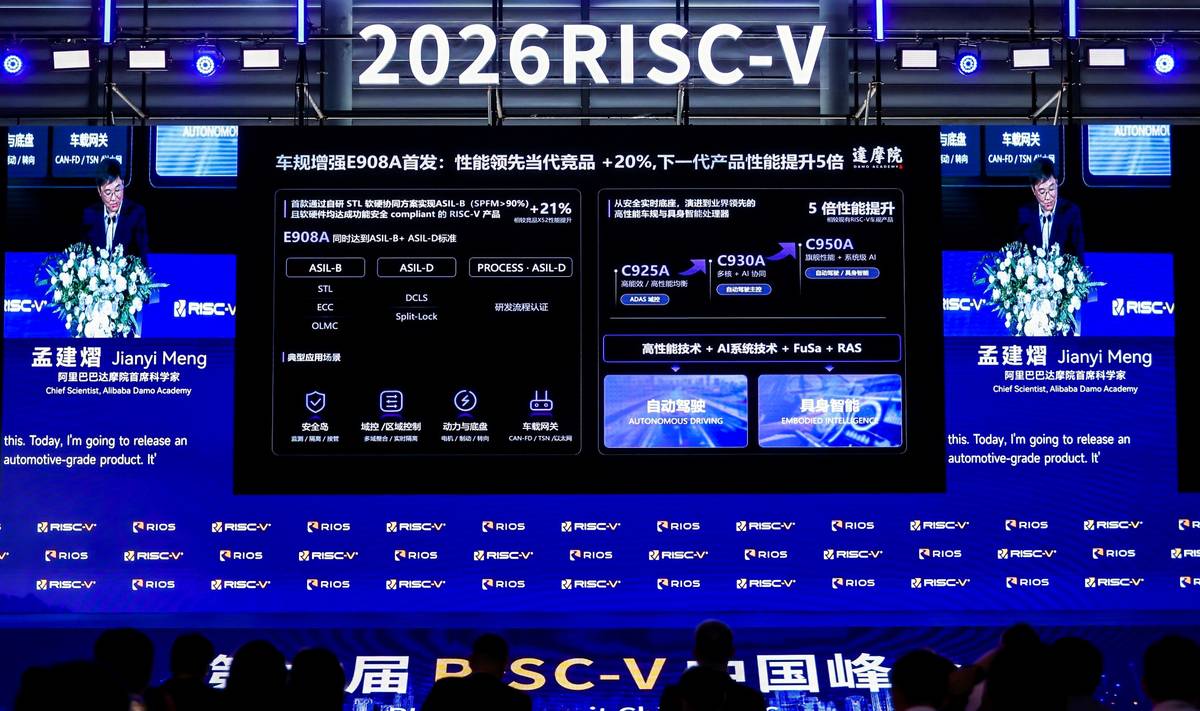
Representative image for 达摩院玄铁出席RISC-V中国峰会,首发车规产品路线图

达摩院玄铁出席RISC-V中国峰会,首发车规产品路线图

Rank 57 · Content 60 · Popularity N/A

TL;DR - Alibaba DAMO Academy unveiled a roadmap for automotive-grade XuanTie RISC-V processors targeting autonomous driving and embodied AI. It also reported performance and ecosystem advances intended to move high-performance RISC-V toward large-scale deployment.

  • The new XuanTie E908A CPU IP meets ASIL-B and ASIL-D requirements, with a reported single-point fault metric above 90% for safety islands, domain controllers, and vehicle gateways.
  • The planned C950A aims to deliver five times the performance of existing automotive-grade RISC-V products.
  • The current C950 reportedly outperforms mainstream conventional-architecture processors by more than 10% on four agentic workloads and runs Qwen3.8-Flash-Next inference at 43 tokens per second.
  • DAMO highlighted supporting work across multicore interconnects, GCC, OpenJDK, operating systems, and compatibility testing to improve RISC-V performance and reduce ecosystem fragmentation.

Embodied AI 1

Representative image for 启元机器人新进展:北大董豪团队推出 HIL-UMI,让后训练摆脱「真机依赖」

启元机器人新进展:北大董豪团队推出 HIL-UMI,让后训练摆脱「真机依赖」

Rank 73 · Content 85 · Popularity 46

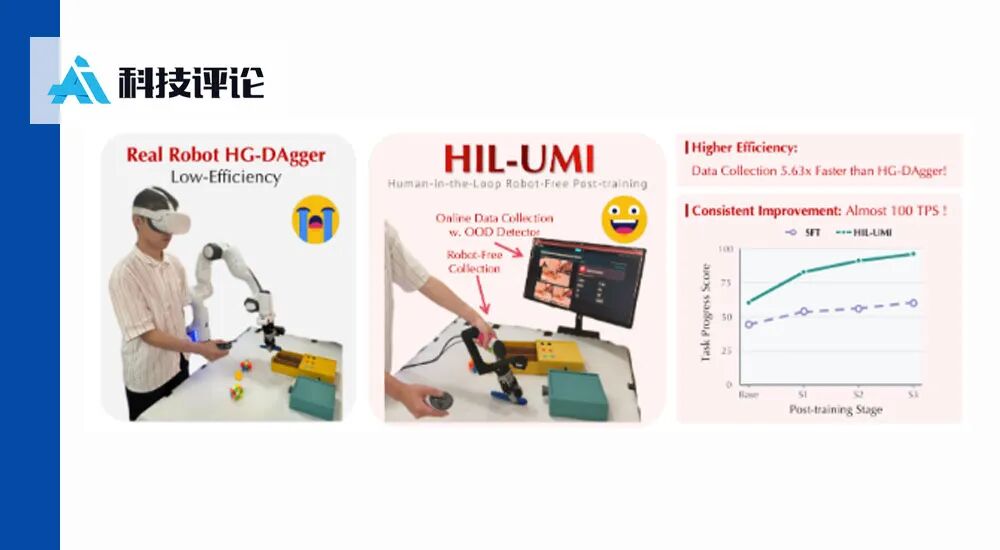
TL;DR - Peking University and Qiyuan Robotics introduced HIL-UMI, a human-in-the-loop method for collecting targeted robot post-training corrections without operating a physical robot during data collection. It aims to make embodied-model improvement cheaper and more scalable than real-robot DAgger workflows.

  • Operators perform tasks with a handheld UMI gripper while a model predicts actions from the same observations; large human-model divergences trigger targeted recording.
  • The system combines action-divergence detection with an advantage estimator that prioritizes corrections making meaningful task progress.
  • Across four real-robot tasks, HIL-UMI raised the reported average task-progress score from 44.3 to 94.8 under the stated data-frame budget, versus 58.0 for continued conventional SFT.
  • On the long-horizon table-cleaning task, effective-data collection took 73.40 ms per frame versus 412.99 ms for real-robot HG-DAgger, a reported 5.63× efficiency gain.