AI 开始挑战最复杂的系统:生命
Ranking
No observed public metrics; popularity remains neutral/archived.
Merged summary
TL;DR - China’s Zheyuan Technology launched WHIRLPO, a computational medicine platform designed to support “life world models” that predict biological responses across molecules, cells, tissues, and patients. The launch reflects a broader shift in AI-driven drug discovery from isolated molecular tasks toward infrastructure for modeling and validating entire biological systems.
- WHIRLPO integrates heterogeneous compute, multi-omics data, model ensembles, research tools, AI agents, and wet-lab validation into a closed-loop platform.
- Life world models aim to predict system-wide effects of biological interventions, addressing the gap between finding target-binding molecules and developing safe, effective drugs.
- Key technical challenges include fragmented biological data, cross-scale modeling, coordination of CPU/GPU scientific workloads, and continuous experimental and clinical validation.
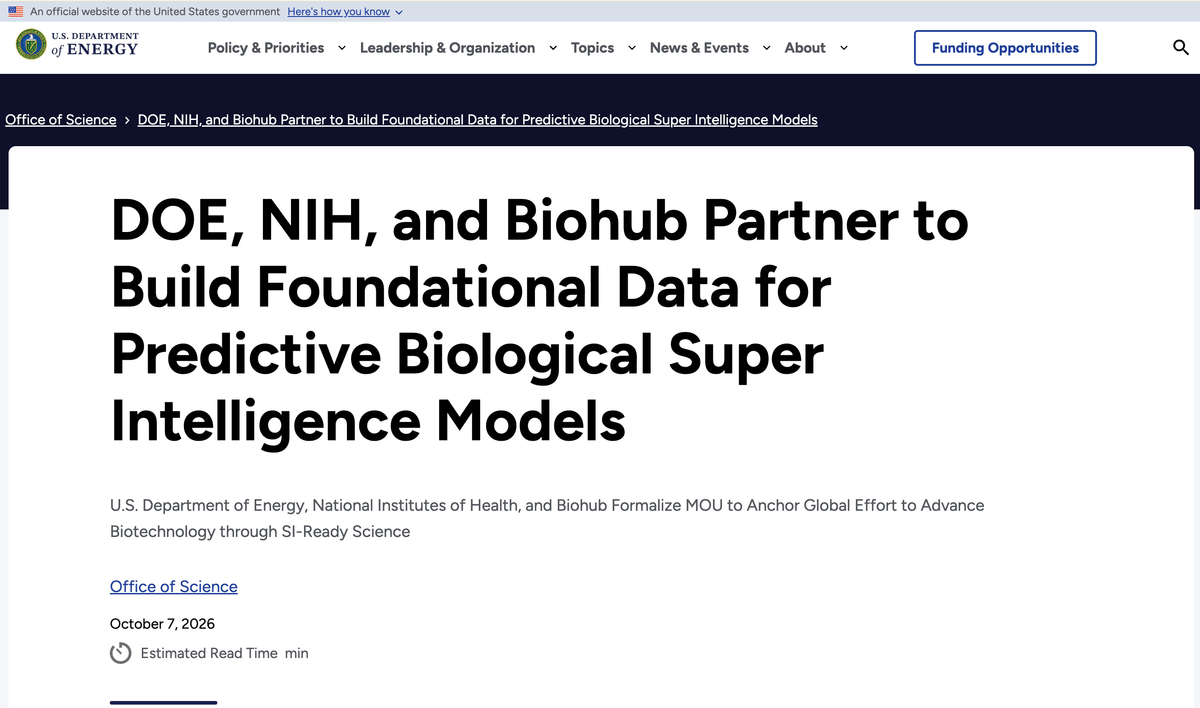
- The article frames Biohub’s expanded virtual-biology initiative and China’s policy support for computational medicine as evidence that competition is shifting toward data, compute, experimentation, and modeling infrastructure.
Sources (1)
AI 开始挑战最复杂的系统:生命
TL;DR - China’s Zheyuan Technology launched WHIRLPO, a computational medicine platform designed to support “life world models” that predict biological responses across molecules, cells, tissues, and patients. The launch reflects a broader shift in AI-driven drug discovery from isolated molecular tasks toward infrastructure for modeling and validating entire biological systems.
- WHIRLPO integrates heterogeneous compute, multi-omics data, model ensembles, research tools, AI agents, and wet-lab validation into a closed-loop platform.
- Life world models aim to predict system-wide effects of biological interventions, addressing the gap between finding target-binding molecules and developing safe, effective drugs.
- Key technical challenges include fragmented biological data, cross-scale modeling, coordination of CPU/GPU scientific workloads, and continuous experimental and clinical validation.
- The article frames Biohub’s expanded virtual-biology initiative and China’s policy support for computational medicine as evidence that competition is shifting toward data, compute, experimentation, and modeling infrastructure.