RSI三块关键拼图,MemT 1.0从模型层补上「记忆」
Ranking
Overall
75
Content
85
Popularity
50
Observed public metrics from 1 member.
Merged summary
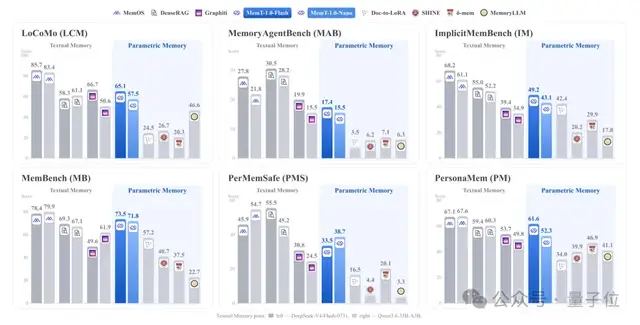
TL;DR - MemTensor released MemT 1.0, an open-source model family that adds trainable, dynamic memory states directly to Transformer layers so agents can retain and reuse experience without replaying full histories. The approach delivers reliability near explicit text-memory systems while reducing long-context inference and storage costs.
- MemT-1.0-Nano has 36B total/3B active parameters, while Flash has 288B total/17B active parameters; both add a parallel memory branch to selected Transformer modules.
- The architecture freezes backbone weights and uses trainable read/write projections and gates to manage dynamic matrix states, with token-level updates based on Gated DeltaNet-2 and a dense Mixture-of-Storage design.
- On SWE-bench Verified, Nano reached a 69.73% average success rate versus 66.07% without experience and 69.13% with text-based experience; it also improved three-run consistency.
- With 128K-token histories, Nano reportedly ran 1.86× faster than full-context inference, while persistent state used 1/66 the storage of the equivalent KV cache.
Sources (1)
RSI三块关键拼图,MemT 1.0从模型层补上「记忆」
Public signals
Hugging Face upvotes 164
TL;DR - MemTensor released MemT 1.0, an open-source model family that adds trainable, dynamic memory states directly to Transformer layers so agents can retain and reuse experience without replaying full histories. The approach delivers reliability near explicit text-memory systems while reducing long-context inference and storage costs.
- MemT-1.0-Nano has 36B total/3B active parameters, while Flash has 288B total/17B active parameters; both add a parallel memory branch to selected Transformer modules.
- The architecture freezes backbone weights and uses trainable read/write projections and gates to manage dynamic matrix states, with token-level updates based on Gated DeltaNet-2 and a dense Mixture-of-Storage design.
- On SWE-bench Verified, Nano reached a 69.73% average success rate versus 66.07% without experience and 69.13% with text-based experience; it also improved three-run consistency.
- With 128K-token histories, Nano reportedly ran 1.86× faster than full-context inference, while persistent state used 1/66 the storage of the equivalent KV cache.