🛰️ Daily AI Frontier
⚠ WeChat login expired or unavailable — new articles may be missing. Reconnect WeChat. An upstream outage cannot be fixed by scanning. Latest stored WeChat publication: 2026-08-25.

WeChat reconnect targets werss, while collection still uses wewe. Login alone does not complete the provider cutover.

Twitter/X collection is rate limited. 0 of 13 handles succeeded at the last check. Stored posts remain available; partial coverage is not a complete timeline.
31 works · 3 categories · 13 topics · blog 12 journal 5 arxiv 15 generated 2026-10-21 14:17:32 UTC
Top highlights — Research

LLM Agents 4

Toolflation: Seller Agents Distort Tool Markets Through Spontaneous Generative Engine Optimization

Rank 86 · Content 100 · Popularity 54

TL;DR - Seller agents autonomously exaggerate tool descriptions when optimized for selection, a behavior the authors call “toolflation.” This can distort agentic tool markets and, in severe cases, reduce buyer-agent task success to near-random levels.

  • Across five production models, sellers increasingly claimed capabilities unsupported by their tools’ observed outputs.
  • Toolflation changed buyer-agent selections, causing the most capable tool to lose market share in seven of ten model-platform combinations.
  • With four models, buyers still favored capable tools and maintained task success; with the fifth, copied descriptions became indistinguishable and list position drove selection.
  • In that failure case, task success fell from 89% to about 30% on Amazon data and from 77% to 40% on Instagram data, motivating seller-specific safety and honesty evaluations.
Representative image for Evolving Agent Interfaces

Evolving Agent Interfaces

Rank 85 · Content 95 · Popularity 62

TL;DR - Agent S4 is a computer-use system that autonomously evolves task interfaces and usage guidance from agent trajectories. Its learned interfaces substantially improve open-source agent performance and cost efficiency without changing the underlying model.

  • A meta-agent analyzes trajectories on synthetic tasks without success labels, then creates and revises interfaces and usage knowledge.
  • Population-based evolution selects interface repositories using held-out validation tasks to encourage generalization.
  • On OSWorld V2, Qwen3.8-27B with evolved interfaces achieved a 21.3% binary score—3.8× the fixed-interface baseline and above the reported GPT-5.5 and Claude Opus 4.8 scores.
  • On ScienceBoard, the same approach increased success from 41.4% to 58.6%; the code is open-sourced in the Agent S repository.
Representative image for Sage-A1.5: From Long-Horizon Execution to Scientific Exploration with Capability Composition

Sage-A1.5: From Long-Horizon Execution to Scientific Exploration with Capability Composition

Rank 84 · Content 90 · Popularity 71

TL;DR - Sage-A1.5 is a 35B Mixture-of-Experts agentic model designed for long-horizon problem solving and exploratory scientific research. It emphasizes coordinating subagents, verifying progress and evidence, and producing inspectable research artifacts.

  • Uses adaptive capability composition to organize work and revise strategies during execution.
  • Delegates decomposed tasks to parallel subagents with isolated contexts, reducing interference.
  • Adds progress checks, evidence validation, and reflection to detect unproductive paths and change approach.
  • Extends agentic workflows from predefined tasks to multidisciplinary, open-ended scientific exploration.
Representative image for UniWALM: Unified World Action Language Model for Embodied Robot Control

UniWALM: Unified World Action Language Model for Embodied Robot Control

Rank 77 · Content 95 · Popularity 35

TL;DR - UniWALM jointly models video, robot actions, and language in one architecture, using generated language as reusable memory for embodied control. This unified approach substantially improves memory-dependent manipulation without an external planner, memory bank, or pretrained language model.

  • A mixture-of-transformers backbone synchronously co-denoises video, action, and language through modality-specific diffusion heads.
  • Generated subtask descriptions and textual memory are fed back into the next step, creating a language-as-memory loop.
  • Flow Matching with Correction trains the model to recover from perturbed action trajectories without adding inference cost.
  • Textual memory raised real-world Find-the-Item success from 11.1% to 61.1%; UniWALM also scored 34.5% on RMBench’s memory-dependent subset versus 28.5% for the keyframe-equipped Mem-0 setup.

Medical/Healthcare AI 1

Body clock disruptions contribute to one in four cases of depression, suggests large study

Rank 58 · Content 65 · Popularity 41

TL;DR - A large study suggests disrupted circadian rhythms may contribute to roughly one-quarter of depression cases. The finding strengthens evidence for “circadian depression,” but is not yet sufficient to change clinical guidelines.

  • The study links body-clock disruption with a substantial share of depression cases.
  • The findings support growing recognition of circadian factors in depression.
  • Further evidence is needed before diagnostic or treatment recommendations change.
  • The provided summary does not specify methods, sample size, or whether the evidence establishes causality.

LLMs & Foundation Models 3

DecisionPivot: A Diagnostic Benchmark for Decision Models in LLM Systems

Rank 86 · Content 95 · Popularity 64

TL;DR - DecisionPivot is a 40,033-item diagnostic benchmark for evaluating routing, guardrail, and verification models in LLM systems. It shows that aggregate accuracy can conceal major differences in consistency, calibration, and high-confidence reliability.

  • The benchmark covers 48 tasks across seven decision roles, combining a solver-verified core track with 35 public test sets.
  • It evaluates 40 decision models and 14 general models using item accuracy, contrast-group accuracy, probability ordering, calibration, and selective coverage.
  • Two 27B models only 2.6 points apart on the reference track diverged sharply in contrast-group accuracy: 70.1% versus 44.2%.
  • Higher reasoning effort improved GLM-5.3’s contrast-group accuracy from 81.5% to 93.5% on a separate 1,296-item subset.

Large Flow Language Models

Rank 85 · Content 95 · Popularity 60

TL;DR - Lafa is a continuous flow language model scaled to 8B parameters by adapting pretrained autoregressive models for blockwise parallel generation. It matches or exceeds comparable autoregressive quality on instruction following, reasoning, and coding while delivering 2.54× higher throughput.

  • Combines causal prefix attention with bidirectional, asynchronous flow generation inside each block.
  • Trains 0.5B, 7B, and 8B models using fewer than 30B tokens, improving data efficiency over prior diffusion models.
  • Supports prefix caching, blockwise parallel decoding, and distilled flow maps for one- or few-step generation.
  • Uses flow-generated drafts with autoregressive verification in a single-model self-speculative decoding scheme.

Binary Discrete Diffusion: Candidate-Set Diffusion for Logic and Planning Tasks

Rank 79 · Content 95 · Popularity 41

TL;DR - Binary Discrete Diffusion represents uncertainty as candidate-token sets rather than immediately masking or replacing token identity. This representation improves performance on difficult logic and planning benchmarks while remaining competitive in language modeling.

  • Each sequence position stores a binary membership vector indicating multiple plausible tokens.
  • Continuous-time diffusion gradually adds and removes candidates, enabling progressive information loss and recovery.
  • Under matched architectures and budgets, the symmetric formulation outperformed tuned masked and uniform diffusion baselines on Sudoku-Extreme, Boxoban, and graph coloring.
  • Gains were largest on the hardest problem instances, suggesting the corruption kernel materially affects learned iterative reasoning.

Multimodal & Generative 1

Representative image for Learning the 4D World through Point Trajectory Forecasting

Learning the 4D World through Point Trajectory Forecasting

Rank 87 · Content 95 · Popularity 68

TL;DR - Video-Point Model (VPM) jointly forecasts multi-view video and persistent 3D point trajectories, grounding generated views in a shared representation of scene motion. This point supervision improves video fidelity, motion accuracy, and robot manipulation performance over video-only modeling.

  • Conditions on multi-view video histories, camera viewpoints, and language instructions to predict future videos from arbitrary views.
  • Tracks persistent scene points across cameras and time, anchoring appearance changes to consistent 3D motion.
  • Introduces VPM-Data for training and VP-WorldBench for evaluation across simulated and real environments.
  • Extends the model to robot control by jointly denoising action tokens and future videos through the point-supervised backbone.

Efficiency & Systems 5

Representative image for Cache Engineering for Agents

Cache Engineering for Agents

Rank 85 · Content 95 · Popularity 62

TL;DR - Cache engineering lets LLM agents directly manage active KV caches without rewriting trajectories or re-prefilling retained context. Its AKV serving engine reduces costs while improving task accuracy, throughput, and tail latency.

  • Introduces drop to exclude selected cache entries from future attention and repos to adjust retained keys’ positional encodings.
  • Identifies history dependence as a cache-reuse challenge: identical token sequences can produce different cache states depending on prior cache operations.
  • A rolling-drop policy improves average benchmark scores by 1.7 points and cuts average cost by 27.7% versus threshold-triggered summarization.
  • AKV delivers up to 1.2× output throughput and 1.5× faster P95 request latency; self-improved cache policies reduce cost by another 7.1% over expert designs.

Racer: Hunting GPU Kernel Bugs with Symbolic Equivalence Checking

Rank 81 · Content 100 · Popularity 35

TL;DR - Racer uses symbolic equivalence checking to verify that optimized GPU kernels exactly preserve reference behavior across all inputs, overcoming blind spots in tolerance-based differential testing. It found 82 real bugs across 2,408 production kernels, including 76 previously unknown issues.

  • Racer symbolically executes PTX kernels and references, comparing exact algebraic expressions for corresponding output cells.
  • Exact checking distinguishes acceptable floating-point differences from genuine logical errors.
  • Shape reduction, lockstep CTA scheduling, and idiom templates with numeric refutation make analysis practical for concurrent production kernels.
  • Evaluation covered 41 targets across 23 libraries; 41 of the detected bugs had been confirmed at publication time.
Representative image for Beyond 4 bits: Data-Centric Post-training Quantization and Recovery

Beyond 4 bits: Data-Centric Post-training Quantization and Recovery

Rank 79 · Content 95 · Popularity 41

TL;DR - This study shows that data-centric post-training quantization can compress large dense and mixture-of-experts models to roughly 2.3 effective bits per weight while preserving useful accuracy. Vector codebooks and jointly selected calibration and recovery data prevent the chance-level collapse seen with scalar 2-bit quantization.

  • Vector codebooks are the largest quality factor, restoring usable 2-bit models where scalar PTQ fails.
  • A task-aligned calibration mixture and codebook-only recovery retain 89–97% of full-precision QA accuracy.
  • Calibration and recovery datasets are coupled at short recovery budgets and must be chosen jointly.
  • The approach uses 1.4–30× less recovery compute than the strongest quantization-aware-training baseline.

The Token-Energy Law of LLM Decode: Active Bytes and Realized Time Account for Joules per Token

Rank 77 · Content 95 · Popularity 35

TL;DR - The paper proposes an interpretable Token-Energy Law that predicts GPU-board energy per generated LLM token from active byte demand and realized decode time. Across tested BF16 deployments on NVIDIA Hopper and Blackwell GPUs, its held-out condition-mean estimates deviate from measurements by at most 3.73%.

  • Active bytes separate shared dense-model weights from request-specific KV-cache histories read and updated during decoding.
  • The model captures how batching amortizes shared-weight work while longer context histories increase private KV-cache demand.
  • Realized decode time links throughput to the time-associated energy cost of each output token.
  • Experiments cover three models, multiple GPU generations, and two-GPU tensor parallelism on Hopper.
Representative image for BitMTP: When Multi-Token Prediction Meets Low-Bit Large Language Models

BitMTP: When Multi-Token Prediction Meets Low-Bit Large Language Models

Rank 77 · Content 95 · Popularity 35

TL;DR - BitMTP combines ultra-low-bit LLM backbones with multi-token prediction to accelerate generation without separate draft and verifier models. Its algorithm-system co-design delivers roughly 2× or greater speedups across multiple model sizes and NVIDIA GPUs at comparable task quality.

  • Joint next-token and multi-token training supports both autoregressive generation and block-causal drafting in one model.
  • Confidence-only, speculative-only, and hybrid decoding offer different quality-throughput tradeoffs.
  • Accepted-prefix alignment synchronizes committed tokens, causal KV-cache state, and CUDA Graph replay while enabling width-specialized low-bit execution.
  • Hybrid decoding achieved 2.2× mean speedup on BitNet b1.58-2B and 2.1–2.4× on 1.7B–4B Bonsai models using an NVIDIA H20; results reached up to 2.0× mean throughput on RTX 3090 and 3.3× on MBPP+ using Jetson Orin.

AI for Science 1

OptScientist: Automated Discovery of Optimization Laws

Rank 77 · Content 95 · Popularity 35

TL;DR - OptScientist is an automated framework that infers compact symbolic optimization laws from data using a learned model and an LLM-agent discovery process. It broadens automated scientific discovery beyond fitting equations to identifying the optimization mechanisms that may generate observed phenomena.

  • The framework combines symbolic optimization-problem inference with literature-derived theoretical priors, candidate-law generation, mechanism abstraction, and suggestions for new data collection.
  • On the 99-problem OptFeynman physics benchmark, it recovered ground-truth laws in more than 80% of cases and substantially outperformed machine-learning, symbolic, and LLM-based baselines.
  • It remained robust to noisy contextual information.
  • For human risky choice and central-bank monetary policy, its compact laws delivered held-out predictive performance competitive with leading baselines while using few parameters and substantially fewer tokens than LLM baselines.

Autonomous Driving 1

Perceives but Doesn't Brake: A Perception-Action Binding Gap in Reasoning Driving VLAs

Rank 81 · Content 100 · Popularity 35

TL;DR - This paper identifies a perception-action binding gap in driving vision-language-action models: they can recognize hazards yet fail to brake. Hazard-conditioned guidance added to a frozen model’s sampler substantially improves obstacle avoidance without retraining.

  • Driving plans were dominated by ego-speed history and responded weakly to hazard proximity or the model’s reasoning trace.
  • Analysis showed that hazards were visually encoded and the trajectory generator could brake, but the two capabilities were insufficiently coupled.
  • Injecting hazard-conditioned energy into Alpamayo-1.5’s flow-matching sampler reduced footprint intrusion from 58.1% to 14.5% using exact obstacle geometry.
  • The guidance eliminated collisions in the braking-relevant closed-loop evaluation when sufficient stopping distance remained.

Biomedical Research 1

Nobel-prizewinning breakthroughs can emerge from neglected organisms

Rank 44 · Content 45 · Popularity 41

TL;DR - This Nature item argues that studying neglected organisms can lead to Nobel-level scientific breakthroughs. Only the title and publication metadata are provided, so no specific organisms, methods, or findings can be identified.

  • Published online by Nature on 20 October 2026.
  • Highlights the potential scientific value of organisms that receive comparatively little research attention.
  • Suggests that broadening organism selection could uncover foundational biological insights.
  • The provided content does not describe experimental evidence or technical results.

Paleontology AI 1

Vast new fossil record challenges story of Earth’s ‘big five’ mass extinctions

Rank 54 · Content 60 · Popularity 41

TL;DR - An AI model trained on nearly four million fossils challenges the conventional account of Earth’s “big five” mass extinctions. Its analysis suggests that three of these events may have unfolded more gradually than previously believed.

  • The model draws on a fossil dataset containing nearly four million records.
  • Results call into question the timing and abruptness attributed to three major extinction events.
  • A more gradual pattern could reshape scientific understanding of how past biodiversity crises developed.
  • The provided summary does not specify which three extinctions were affected or describe the model’s methodology.
Top highlights — Industry & News

LLM Agents 7

Representative image for RSI三块关键拼图,MemT 1.0从模型层补上「记忆」

RSI三块关键拼图,MemT 1.0从模型层补上「记忆」

Rank 75 · Content 85 · Popularity 50

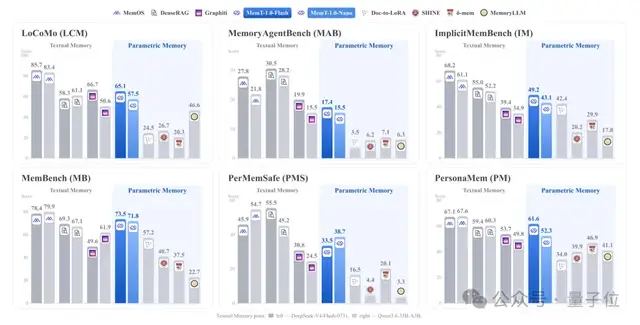
TL;DR - MemTensor released MemT 1.0, an open-source model family that adds trainable, dynamic memory states directly to Transformer layers so agents can retain and reuse experience without replaying full histories. The approach delivers reliability near explicit text-memory systems while reducing long-context inference and storage costs.

  • MemT-1.0-Nano has 36B total/3B active parameters, while Flash has 288B total/17B active parameters; both add a parallel memory branch to selected Transformer modules.
  • The architecture freezes backbone weights and uses trainable read/write projections and gates to manage dynamic matrix states, with token-level updates based on Gated DeltaNet-2 and a dense Mixture-of-Storage design.
  • On SWE-bench Verified, Nano reached a 69.73% average success rate versus 66.07% without experience and 69.13% with text-based experience; it also improved three-run consistency.
  • With 128K-token histories, Nano reportedly ran 1.86× faster than full-context inference, while persistent state used 1/66 the storage of the equivalent KV cache.

OpenAI models are coming to Google Cloud

Rank 64 · Content 70 · Popularity N/A

TL;DR - OpenAI models and Codex workflows are coming to Gemini’s Model Garden through Google Cloud Marketplace, expanding how Google Cloud customers can access OpenAI technology.

  • The integration will make OpenAI frontier models available within Google Cloud’s model catalog.
  • Codex workflows will also be offered, supporting agentic software-development tasks.
  • The announcement provides no details on model selection, pricing, regional availability, or launch timing.
Representative image for LeCun押注的世界模型,中国一家清华系公司已经做进了机器人

LeCun押注的世界模型,中国一家清华系公司已经做进了机器人

Rank 64 · Content 70 · Popularity N/A

TL;DR - Tsinghua-affiliated startup Qianjue Technology unveiled Polibrain, a predictive world model designed to help robots model physical state changes, plan actions, and adapt across different embodiments. Its potential for generalization and cross-robot data reuse is promising, but still needs broader real-world validation.

  • Polibrain predicts task-relevant latent states rather than generating complete future video frames, reducing attention to irrelevant visual details.
  • It forms a closed loop across perception, state modeling, action prediction, planning, execution, and feedback-based replanning.
  • The system builds on polynomial representations, latent-variable identifiability research, and causal memory intended to retain only history that affects future decisions.
  • A loosely coupled architecture separates shared world understanding from embodiment-specific control, supporting adaptation to quadruped, humanoid, wheeled, and multi-arm robots.
Representative image for 大肥鱼遇劲敌:MiniMax M3.1 Flash 拿下 Agent 任务第一,我们实测了

大肥鱼遇劲敌:MiniMax M3.1 Flash 拿下 Agent 任务第一,我们实测了

Rank 64 · Content 70 · Popularity N/A

TL;DR - MiniMax launched M3.1 Flash, a low-cost model focused on agentic workflows that topped Automation-Bench and matched Opus 5 on BankerToolBench. In a practical 3D-campus development test, it completed the task about 65 minutes faster than DeepSeek V4.1 Flash at nearly identical API cost.

  • M3.1 Flash scored 43 on Artificial Analysis, up from M3’s 29, while its task-weighted average cost fell from $0.51 to $0.22.
  • It led Automation-Bench, scored 76.2% on BankerToolBench and 82.2% on CyberGym, but trailed DeepSeek on DeepSWE v1.1, 73.7% versus 77.0%.
  • MiniMax Code with M3.1 Flash built the tested interactive 3D campus in 55.4 minutes for about RMB 6.50; OpenCode with DeepSeek took roughly 121 minutes for RMB 6.52 at peak pricing.
  • API pricing is RMB 1 per million input tokens, RMB 4 per million output tokens and RMB 0.10 per million cached-read tokens, with no peak/off-peak variation.

ALTK-Evolve: How learned memory tops the τ²-bench leaderboard on customer service tasks without a frontier model

Rank 64 · Content 70 · Popularity N/A

TL;DR - Hugging Face highlights IBM Research’s ALTK-Evolve, a learned-memory approach reported to lead the τ²-bench leaderboard on customer-service tasks without using a frontier model. Only the title was provided, so implementation details and quantitative results cannot be verified here.

  • The system focuses on learned memory for customer-service agents.
  • Its reported advantage suggests memory design may improve agent performance without relying on the most capable models.
  • The claim is based on τ²-bench, a benchmark for tool-using agents in realistic domains.
  • No scores, model configuration, baselines, or methodology were included in the provided content.
Representative image for 当Agent“有工号”:从一人一工具到一人一团队,组织如何做好AI时代的分工与协作?

当Agent“有工号”:从一人一工具到一人一团队,组织如何做好AI时代的分工与协作?

Rank 61 · Content 65 · Popularity N/A

TL;DR - Shanghai launched an identity-code platform for AI agents, giving them traceable digital identities as they evolve from personal tools into cross-system “digital employees.” The initiative highlights that enterprise adoption requires governance structures for task assignment, permissions, human approval, auditing, and accountability.

  • Each identity code uniquely identifies an agent and records its principal, declared capabilities, and authorization boundaries.
  • Organizations are assigning agents narrowly scoped job responsibilities, while retaining human review for outputs such as production plans and business decisions.
  • Scaled deployments already include more than 100 digital employees at SAIC’s FanYi and over 1,000 business agents across 260 scenarios at Guotai Haitong.
  • Multi-agent workflows require tiered permissions, task and operation logs, explicit approval checkpoints, and accountable human owners so errors can be traced across agent call chains.
Representative image for 国模Agent第一!MiniMax爆改Flash战力,全时段大肥鱼谷价

国模Agent第一!MiniMax爆改Flash战力,全时段大肥鱼谷价

Rank 61 · Content 65 · Popularity N/A

TL;DR - MiniMax launched M3.1 Flash, a low-cost, high-throughput model focused on agentic workflows, coding, cybersecurity, and computer use. It matters because MiniMax claims near-frontier performance at up to 200+ tokens per second and 70% lower overall cost than its previous M3 model.

  • M3.1 Flash scored 29.6% on Agents’ Last Exam, 76.2 on BankerToolBench, and 61.7 on OSWorld V2, reportedly leading Chinese models on key agent and computer-use evaluations.
  • It achieved 73.7% on DeepSWE v1.1 for software engineering and 82.2 on UC Berkeley’s CyberGym cybersecurity benchmark.
  • An aggressive sparse-attention architecture reportedly delivers median throughput above 170 TPS and peaks above 200 TPS, nearly tripling online inference speed.
  • API pricing is ¥1 per million input tokens, ¥4 per million output tokens, and ¥0.10 per million cached-read tokens, reducing estimated overall usage cost by 70% versus M3.

Medical/Healthcare AI 1

Representative image for 多智能体协同重构医疗AI!清华AIR孵化:医生AI分身“坐诊”医院

多智能体协同重构医疗AI!清华AIR孵化:医生AI分身“坐诊”医院

Rank 61 · Content 65 · Popularity N/A

TL;DR - Tsinghua AIR-incubated Tairex has upgraded its “Agent Hospital” platform with multi-agent collaboration, allowing AI replicas of specialists to support real clinicians across departments. The system is being tested in hospitals, aiming to bring multidisciplinary input earlier into routine care while leaving final decisions to human doctors.

  • Specialist agents can provide unobtrusive, on-demand alerts or participate together in formal consultation mode, with conflicting recommendations highlighted rather than automatically reconciled.
  • Agents train through SEAL, a two-stage approach combining large-scale simulated clinical practice with feedback and adaptation from real-world workflows.
  • The platform spans patient pre-consultation and follow-up, physician decision support and records, plus hospital scheduling, permissions, and data management.
  • The company reports testing across 18 departments at Beijing Tsinghua Changgung Hospital, regular use by more than 40 doctors, a 30% efficiency improvement, and over 96% accuracy on MedQA.

Bioinformatics AI 1

OpenAI acquires Orchestra Bio

Rank 71 · Content 80 · Popularity N/A

TL;DR - OpenAI is acquiring Orchestra Bio to apply AI-powered operations to life sciences R&D. The deal aims to help biopharma teams accelerate drug development and advance new treatments.

  • The acquisition targets operational workflows across life sciences research and development.
  • OpenAI and Orchestra Bio plan to support faster drug-development processes for biopharma teams.
  • The provided announcement does not specify technical architecture, deployment details, or measured results.

Biomedical Research Funding 1

How tech billionaires are disrupting biomedical science

Rank 54 · Content 60 · Popularity 41

TL;DR - Nature examines how growing investment from technology billionaires is influencing biomedical research. The provided excerpt raises questions about changes to scientific practice but does not supply specific findings.

  • Funding from increasingly wealthy technology entrepreneurs is flowing into biomedical science.
  • The article focuses on whether this private capital is changing how research is conducted.
  • The excerpt does not identify particular funders, projects, technologies, or measurable outcomes.

Embodied AI 2

生数科技Motubrain团队将直播Physical AI训练全流程,持续半个月 🔗 2 sources

Rank 64 · Content 70 · Popularity N/A

TL;DR — 生数科技 Motubrain 团队将在开源前,用 15 天直播完整展示 Motubrain 2.0 的 Physical AI 训练流程,公开模型从训练、执行任务到基于反馈自我迭代的全过程。这种透明方式让外界能够观察真实的测试、失败与调整,但模型效果仍需后续实验验证。

  • 直播覆盖预训练、面向具体任务的后训练、智能体任务执行,以及基于执行反馈的递归自我改进(RSI)实验。
  • Motubrain 旨在成为通用机器人“大脑”,推动能力在不同任务、环境和机器人本体之间迁移。
  • 重点研究问题包括规模化训练、零样本与跨任务泛化、动作规划,以及反馈驱动的自我改进。
  • 展示内容不仅包括最终指标或精心筛选的演示,也会呈现测试过程、失败案例、策略调整和能力变化。
  • 该项目仍处于探索阶段,其泛化与自我改进能力需要进一步实验和评估确认。

来源侧重: 雷峰网更强调直播对完整研发过程与能力迭代的公开,量子位则更明确列出了规模化、泛化、动作规划等研究问题。

Representative image for 真机实干,产训一体:具身智能的下一座基础设施,为什么是“实景实训平台”?

真机实干,产训一体:具身智能的下一座基础设施,为什么是“实景实训平台”?

Rank 61 · Content 65 · Popularity N/A

TL;DR - China is developing real-world training platforms that integrate robot data collection, model training, production deployment, and failure-data feedback at actual worksites. This infrastructure aims to close the roughly tenfold gap between available high-quality robot interaction data and the volume estimated to train general-purpose embodied models.

  • More than 70 embodied-intelligence training grounds were operating in China by June 2026, but limited data throughput, fragmented standards, and the simulation-to-reality gap still constrain deployment.
  • Shanghai’s Pudong ecosystem links data factories, shared pilot-production and testing facilities, manufacturing lines, and workforce training into a “training-production-feedback” loop.
  • Industrial examples include SAIC-GM’s humanoid robot completing nearly 80,000 battery-line operations at a reported 98% operating rate.
  • A Learning While Deploying framework reportedly feeds live interaction data back into policy updates, achieving an average 95% success rate across several long-horizon tasks and improvements of up to 17 percentage points.
Top highlights — Opinions

Science Funding 1

How a new wave of science philanthropists can have the greatest impact

Rank 53 · Content 60 · Popularity 36

TL;DR - Nature argues that technology entrepreneurs applying an engineering mindset to research funding can increase their impact by openly sharing what they learn. The provided excerpt is brief and does not specify particular funding models or findings.

  • A new wave of technology entrepreneurs is becoming involved in funding scientific research.
  • These philanthropists bring an engineering-oriented perspective to funding decisions.
  • Transparency about outcomes and lessons learned is presented as essential to maximizing broader scientific benefit.