从学习人类到学习机器人同伴,清华大学联合无问芯穹、智元提出具身智能规模化落地新路径
Ranking
No observed public metrics; popularity remains neutral/archived.
Merged summary
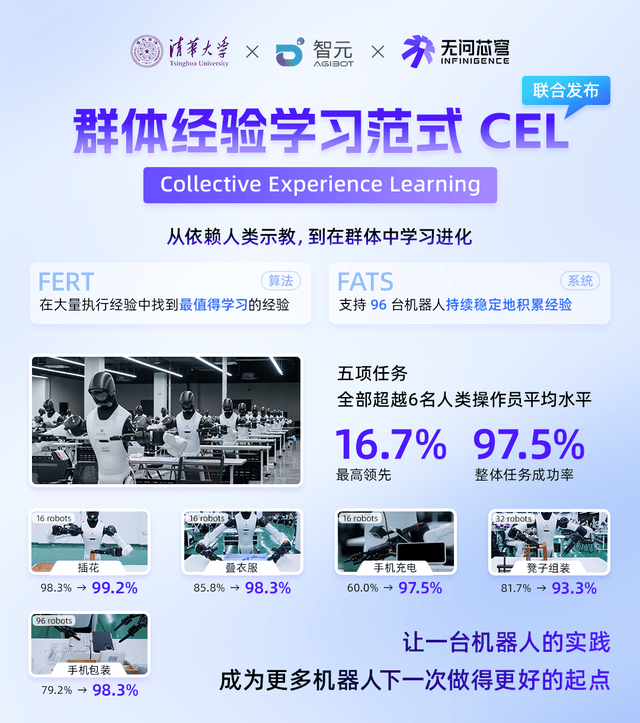
TL;DR - Tsinghua University, Infinigence AI, and AgiBot introduced Collective Experience Learning (CEL), enabling robot fleets to learn from shared successes and failures. A 96-robot deployment demonstrated that scaling collective experience can improve real-world task performance while reducing reliance on human demonstrations.
- Two unseen robots achieved 97.5% overall success across 600 trials spanning five household and industrial tasks.
- Mobile-phone packaging success rose from 79.2% to 98.3%; expanding training from 16 to 96 robots increased success from 86.7% to 98.3%.
- The fault-tolerant asynchronous training system collected 9,834 episodes despite 30 failures across 22 robots, limiting lost robot time to 1.3%.
- The FERT algorithm retrieves relevant successful trajectories when failures occur, using both positive and negative experience to target policy improvements.
Sources (1)
从学习人类到学习机器人同伴,清华大学联合无问芯穹、智元提出具身智能规模化落地新路径
TL;DR - Tsinghua University, Infinigence AI, and AgiBot introduced Collective Experience Learning (CEL), enabling robot fleets to learn from shared successes and failures. A 96-robot deployment demonstrated that scaling collective experience can improve real-world task performance while reducing reliance on human demonstrations.
- Two unseen robots achieved 97.5% overall success across 600 trials spanning five household and industrial tasks.
- Mobile-phone packaging success rose from 79.2% to 98.3%; expanding training from 16 to 96 robots increased success from 86.7% to 98.3%.
- The fault-tolerant asynchronous training system collected 9,834 episodes despite 30 failures across 22 robots, limiting lost robot time to 1.3%.
- The FERT algorithm retrieves relevant successful trajectories when failures occur, using both positive and negative experience to target policy improvements.