🛰️ Daily AI Frontier
⚠ WeChat login expired or unavailable — new articles may be missing. Reconnect WeChat. An upstream outage cannot be fixed by scanning. Latest stored WeChat publication: 2026-08-25.

WeChat reconnect targets werss, while collection still uses wewe. Login alone does not complete the provider cutover.

Twitter/X collection is rate limited. 0 of 13 handles succeeded at the last check. Stored posts remain available; partial coverage is not a complete timeline.
36 works · 2 categories · 12 topics · blog 12 journal 10 arxiv 15 generated 2026-10-30 14:23:10 UTC
Top highlights — Research

LLM Agents 5

rTaste: Do Research Agents Have Taste? Evaluating Early Stage Research Judgment

Rank 88 · Content 100 · Popularity 62

TL;DR - rTaste evaluates whether research agents can prioritize promising NLP experiments before execution. Agents generated many worthwhile experiments, but their rankings and multi-agent teams showed limited benefit over simple baselines.

  • Six frontier models proposed, forecast, and ranked 415 minimum viable experiments across seven NLP papers.
  • Auditors deemed 194 experiments sound, valuable, and novel; only 73 also went beyond the seed paper and were non-obvious.
  • Top-ranked choices beat random selection but did not demonstrably outperform choosing the first-written experiment.
  • Teams cost more without clearly improving proposal quality, while forecasts beat base rates but not fresh-model judgments.


Algebraic World Model: From Exploration to Proofs

Rank 85 · Content 100 · Popularity N/A

TL;DR - Algebraic World Model (AWM) learns executable models of unfamiliar environments through exploration, then formalizes them in Lean 4 to prove reachability and impossibility. It demonstrates how agents can move beyond trajectory search toward interpretable, machine-checked reasoning about unknown worlds.

  • AWM iteratively tests Python hypotheses, organizes them into typed rules, and simplifies them using category-theoretic transformations.
  • It produced kernel-checked impossibility proofs in all six runs on two unwinnable game levels, while tool-equipped baseline models produced none in twelve runs.
  • Feedback-driven rule revision improved correct initial bounds from four of six to six of six.
  • Across 25 ARC-AGI-3 games, its models replayed all 183 winning trajectories in Lean and supported unseen-transition prediction and mechanics-change detection.

Collaborative AI agents for autonomous experimental research with solid-state quantum spins

Rank 81 · Content 100 · Popularity 37

TL;DR - An autonomous laboratory used collaborating LLM agents to formulate, verify, and experimentally test hypotheses about quantum spins in diamond. Crucially, the agents detected measurement drift, rejected an inconclusive result, and revised the protocol without weakening acceptance criteria.

  • Agents reviewed one another’s work and could halt or redirect investigations.
  • They derived the minimum calibration settings needed to predict responses to specified microwave pulse sequences.
  • Separate computational checks and experiments tested competing theoretical predictions.
  • A revised experiment met the original criteria and supported the predictions.

Pre-Crime for Agents, at the Last Second: Probing When a Recruited Agent Gives In

Rank 81 · Content 100 · Popularity 37

TL;DR - Linear probes can predict immediately before an AI agent yields to peer pressure and leaks a secret, catching 82% of leaks at a 5% benign-call flag rate. However, high false-alarm costs and sensitivity to permitted disclosures limit practical deployment.

  • Evaluated across six multi-agent scenarios with up to 20 rounds of pressure.
  • On Qwen3-32B, the probe substantially outperformed a zero-shot decision-model monitor, which caught 26% at a similar flag rate.
  • A reasoning-state probe on gpt-oss-20b achieved 0.91 AUROC.
  • A comparable bag-of-words classifier suggests supervised labels—not activation access—provide most of the gain.
Representative image for EnvOS: Auditing Computer-Use Agents When the World Moves On : Phenomenon-Based Task Construction, Certification, and Evidence-Based Evaluation

EnvOS: Auditing Computer-Use Agents When the World Moves On : Phenomenon-Based Task Construction, Certification, and Evidence-Based Evaluation

Rank 81 · Content 100 · Popularity 37

TL;DR - EnvOS is a framework for constructing and auditing computer-use agent benchmarks where environments change mid-task. It isolates agent failures from faulty updates or graders and shows that detecting stale information depends strongly on both the model and interface.

  • EnvOS certifies that changes fire correctly, tasks remain solvable, and graders distinguish correct from incorrect behavior.
  • Claude Opus 5 improved from 0/16 clinic-booking successes to 15/16 when shown the updated value, versus 2/16 with a re-check reminder.
  • Performance varied by domain and model: Opus 5 independently re-checked insurance policies, while Sonnet 5 benefited substantially from seeing the current policy again.
  • Evidence-based verification rejected all 26 deliberately corrupted episodes and detected 25/39 external corruptions, compared with 4/39 for simple log checks.

Medical/Healthcare AI 7

Representative image for Training language models in simulation for psychiatric intake

Training language models in simulation for psychiatric intake

Rank 88 · Content 100 · Popularity 61

TL;DR - Multi-turn reinforcement learning in simulation substantially improved an LLM’s psychiatric intake, diagnostic reasoning, communication, and safety performance versus its base model. The results support simulation-based training while underscoring the need for safeguards and clinician oversight.

  • In 120 psychiatrist-enacted encounters, the RL agent won 76.7% of matched comparisons and improved clinical-examination scores.
  • Patient-centered communication rose from 65.2% to 82.0%, while appropriate differential diagnoses increased from 33.3% to 68.3%.
  • Across 127 validated simulations, clinical rubric scores nearly doubled from 0.379 to 0.706.
  • On 256 adversarial presentations, acute-risk under-triage fell from 30.5% to 12.9%.

MCT1-dependent mitochondrial lactate import sustains cardiac metabolism

Rank 87 · Content 95 · Popularity 70

TL;DR - A mouse study identifies a mitochondrial lactate-import pathway that sustains cardiac energy metabolism when pyruvate transport is unavailable. This pathway helps prevent stress-induced heart failure.

  • Mitochondrial MCT1 imports lactate into heart-cell mitochondria.
  • LDHB converts lactate into pyruvate and NADH, supporting glucose oxidation and cardiac energetics.
  • Glucose oxidation persists even without the mitochondrial pyruvate carrier.
  • Disrupting this compensatory pathway may increase susceptibility to heart failure under stress.

Pharmacological inhibition of METTL1 as a therapy against solid and blood cancers

Rank 84 · Content 95 · Popularity 59

TL;DR - A Nature study reports that pharmacologically inhibiting the m7G methyltransferase METTL1 suppresses tumor growth and substantially extends survival in mouse cancer models. The findings suggest METTL1 may be a therapeutic target across solid and blood cancers.

  • METTL1 inhibition was evaluated in vivo.
  • Benefits appeared across multiple cancers of different tissue origins.
  • Evidence is preclinical and limited here to mouse models.
  • The provided content does not describe the inhibitor, mechanism, or quantitative results.

Diet at disease onset determines tissue inflammatory memory

Rank 81 · Content 90 · Popularity 59

TL;DR - A Nature study reports that diet around disease onset can establish lasting inflammatory memory in tissues, durably altering disease progression. The provided excerpt does not specify mechanisms or experimental findings.

  • Identifies a narrow temporal window at disease onset when dietary state has long-term effects.
  • Links diet to persistent reprogramming of tissue inflammation.
  • Suggests early nutritional conditions may influence later disease trajectory.

Clostridium perfringens Delta toxin targets CD9 to drive NEC and brain injury

Rank 81 · Content 90 · Popularity 59

TL;DR - A Nature study reports that a subset of infant necrotizing enterocolitis (NEC) is specifically mediated by Clostridium perfringens Delta toxin, which targets CD9 and contributes to intestinal and brain injury.

  • Identifies Delta toxin as a mechanism underlying a subset of NEC cases.
  • Implicates CD9 as the toxin’s target.
  • Links this toxin-mediated pathway to both NEC and associated brain injury.
  • Further methods and results cannot be determined from the limited excerpt provided.

T and B cells recognize splicing-derived neutrophil neoantigens in lupus

Rank 79 · Content 95 · Popularity 43

TL;DR - A Nature study identifies aberrant neutrophil splicing as a source of neoantigens in systemic lupus erythematosus. These peptides may help explain how coordinated T-cell and autoantibody responses sustain autoimmune disease.

  • Aberrant splicing in neutrophils generates novel peptides presented on MHC I.
  • The neoantigens activate CD4+ and CD8+ T cells and drive clonal expansion.
  • They also induce IgG autoantibody responses, linking cellular and humoral immunity.
  • The findings establish a neoantigen-driven mechanism for lupus autoimmunity.

Testimony from Timelines: Evidence-Grounded Significance Testing of Temporal Clinical Hypotheses

Rank 78 · Content 95 · Popularity 37

TL;DR - STRATA benchmarks whether language models can rigorously test temporal clinical hypotheses using vaccine adverse-event timelines. It exposes a major verdict-evidence gap: models often reach conclusions without selecting the correct supporting records.

  • Includes 8,735 hypotheses with gold analysis plans, evidence sets, p-values, and verdicts.
  • Introduces ART—articulate, retrieve, test—to make each analytical decision inspectable.
  • Experiments identify evidence selection, rather than final verdict generation, as the main failure point.
  • ART brings a 31B open model within 0.01 of frontier-model performance under the same paradigm.

Bioinformatics AI 6

Representative image for Advancing Clinical Genomic Analysis with a Skill-Centred Agent

Advancing Clinical Genomic Analysis with a Skill-Centred Agent

Rank 81 · Content 100 · Popularity 37

TL;DR - ClinGeX is an LLM agent that orchestrates 105 executable skills for clinical genomic analysis. It substantially improved expert concordance and reduced interpretation time across benchmarks, controlled comparisons, and an exploratory real-world assessment.

  • Achieved 71.7% task-level concordance on 223 held-out cases, versus 45.7% for the strongest comparator.
  • Uses task-specific skill retrieval and dependency-aware orchestration.
  • In a 45-professional study, ClinGeX assistance improved concordance across variant analysis, rare-disease interpretation, and molecular oncology decisions.
  • Eleven professionals evaluating 96 real-world episodes reported frequent adoption of its conclusions and time savings.
Representative image for Conformal Annotation with Randomized Expert Review: Application to Online Cell-Type Labeling

Conformal Annotation with Randomized Expert Review: Application to Online Cell-Type Labeling

Rank 81 · Content 100 · Popularity 37

TL;DR - CARED combines conformal annotation with randomized expert audits to control cumulative labeling errors under distribution shift. It can let up to 70% of cells bypass expert review while maintaining long-run guarantees.

  • Requires neither stationarity nor exchangeability assumptions.
  • Controls errors across the full stream and among non-audited cells.
  • Adds class-conditional guarantees for rare or important cell types.
  • Evaluated on pancreas, lung, ovary, and real expert-annotation streams.

Multivalent ADAR1 recruitment for precise RNA editing

Rank 79 · Content 95 · Popularity 43

TL;DR - A multivalent RNA-editing system recruits endogenous ADAR1 p150 to precisely correct disease-associated mutations at the transcript level. It achieves high A-to-I editing while addressing efficacy and bystander-editing limitations.

  • Recruits endogenous ADAR1 p150 through its Zα domain.
  • Achieves up to 100% A-to-I editing in vitro.
  • Reaches up to 84% editing in vivo.
  • Designed to reduce unwanted bystander edits.

Spatial single-cell mapping of transcriptional differences across genetic backgrounds in mouse brains

Rank 79 · Content 85 · Popularity 63

TL;DR - ATLAS is a scalable tissue-profiling method that combines existing atlas data with in silico decoding to impute spatial single-cell maps. It enables comparisons of transcriptional differences across genetic backgrounds in mouse brains.

  • Published in Nature Methods on October 30, 2026.
  • Reuses existing atlas data rather than relying solely on new comprehensive measurements.
  • Produces imputed cell maps for spatial tissue analysis.
  • Detailed performance and biological findings are not provided in the excerpt.

Advancing morphological profiling with self-supervised learning through comparative insights into representation learning of cellular perturbations

Rank 78 · Content 95 · Popularity 39

TL;DR - This Nature Methods article presents a large-scale comparative analysis of self-supervised learning methods for high-content cellular morphology profiling. It aims to clarify how effectively these methods learn representations of cellular perturbations.

  • Focuses on representation learning from high-content cell morphology data.
  • Compares self-supervised learning approaches at large scale.
  • Specific methods, datasets, and performance results are not provided in the excerpt.

Genetic variants that alter gene regulation in specific cell types are closely tied to disease

Rank 76 · Content 90 · Popularity 43

TL;DR - Single-cell profiling of nearly 2,000 people links genetic variants that affect cell-type-specific gene regulation to disease, helping clarify how inherited variation influences health.

  • Analyzes gene expression at single-cell resolution across a large human cohort.
  • Focuses on regulatory effects that differ among specific cell types.
  • Connects genetic variation, altered gene expression, and disease risk.
  • The brief description does not provide methods, disease-specific findings, or quantitative results.

LLMs & Foundation Models 3

Training Foundation Models with a Single Algorithm

Rank 91 · Content 100 · Popularity 70

TL;DR - This paper reframes pretraining, midtraining, supervised fine-tuning, and reinforcement learning as one likelihood-based training algorithm. Its unified trainer improves accuracy-compute tradeoffs and task coverage while preserving broader capabilities.

  • Derives RL objectives as maximum-likelihood fitting to model-generated target distributions.
  • Treats training stages primarily as choices about data selection, proportions, and scheduling.
  • Mixes static datasets and RL-generated samples within a single trainer.
  • Provides a stronger foundation for continual learning in reported experiments.

Your LR Schedule May Not Be Principled: Effective Learning Rate Scheduling in Weight-Normalized Training

Rank 86 · Content 95 · Popularity 64

TL;DR - This paper argues that effective learning rate (ELR), rather than normalization itself or nominal learning rate, drives weight-normalized pretraining gains. Its AIR schedule improves large-scale MoE training and transfers the same benefits to weight-decay training.

  • Matching ELR trajectories largely aligns the loss dynamics of weight-normalized and weight-decay training.
  • AIR combines theoretically motivated (1/\sqrt{t}) decay with an affine adjustment for prescribed peak and terminal rates.
  • On 128B-token MoE pretraining, AIR reduced terminal training loss by about 0.01 versus cosine at matched cumulative learning rate.
  • AIR also improved downstream performance and hyperparameter robustness, with late-stage ELR scheduling identified as especially important.
Representative image for Beyond Selected Breakthroughs: Evaluating Language Models on Randomly Sampled Mathematical Conjectures

Beyond Selected Breakthroughs: Evaluating Language Models on Randomly Sampled Mathematical Conjectures

Rank 81 · Content 100 · Popularity 37

TL;DR - OpenConjecture evaluates frontier GPT models on 200 randomly sampled mathematical conjectures, finding candidate solutions for roughly 60%. The study argues that mathematical-AI evaluations must assess intent fidelity, attribution, and novelty—not just apparent correctness.

  • Counterexamples were about 1.3 times more common than proofs across three reproducible passes.
  • Some resolutions exploited underspecified statements or fell outside authors’ intent, such as trivial-group counterexamples.
  • Several proofs closely followed existing literature, while some candidate resolutions showed at least moderate novelty.
  • The protocol avoided problem-specific mathematical guidance and analyzed candidates without expert correctness verification.

Multimodal & Generative 2

Representative image for Read, Allocate, Route: Role-Coupled Tokenization for Pixel-Space Generative Transformers

Read, Allocate, Route: Role-Coupled Tokenization for Pixel-Space Generative Transformers

Rank 87 · Content 95 · Popularity 67

TL;DR - SpecSlot is a pixel-space generative Transformer that models global structure and local detail with different token roles, improving image-generation quality and efficiency without lengthening global attention sequences.

  • Each spatial anchor expands into slots assigned distinct DCT frequency bands.
  • Only low-frequency slots use global attention; all slots exchange information locally.
  • On ImageNet-512, SpecSlot improves FID by 2.84 over a FLOPs-matched JiT control while using 3.9% fewer FLOPs.
  • It outperforms JiT-B/8 on DPG-Bench by 1.06 with 40.6% lower forward cost.
Representative image for L3G-World: Real-Time Infinite World Generation with Latent 3D Gaussian Memory

L3G-World: Real-Time Infinite World Generation with Latent 3D Gaussian Memory

Rank 84 · Content 90 · Popularity 70

TL;DR - L3G-World combines a latent 3D Gaussian memory with a video diffusion transformer to generate spatially consistent, explorable worlds in real time. Its compact memory scales with scene extent rather than video length, enabling generation at 9 FPS.

  • Stores VAE latent features directly in 3D Gaussians, avoiding costly RGB rendering and re-encoding.
  • Alternates memory updates with autoregressive video generation, adding Gaussians for new regions and refining existing ones.
  • Achieves state-of-the-art generation quality and long-horizon spatial consistency in reported experiments.
  • Uses up to 38.6× fewer primitives, with 3.2× faster memory updates and 359× faster rendering than prior 3D-memory baselines.

Automated Science 1

Representative image for FARMS: A Verifiable Foundation for Automated Computational Science

FARMS: A Verifiable Foundation for Automated Computational Science

Rank 88 · Content 100 · Popularity 61

TL;DR - FARMS converts computational mathematics literature into reusable, AI-ready knowledge linked to source context and formally checked guarantees. It could provide a trustworthy and affordable foundation for AI systems that automate numerical method selection and adaptation.

  • The pipeline accepted 157 of 171 targets spanning randomized numerical linear algebra and numerical PDEs.
  • Estimated processing costs averaged $0.85–$2.29 per target across sources.
  • Lean-checked implications connect explicit source premises to computational capabilities.
  • Demonstrations include a heat-flow solver and wave-response compression.

Protein Measurement 1

Continuous mass measurement of single proteins

Rank 78 · Content 95 · Popularity 39

TL;DR - Researchers developed a mass-photometry method that continuously tracks the mass of individual proteins and their complexes for up to an hour, enabling time-resolved study of biomolecular interactions.

  • Measures individual proteins and assembled complexes.
  • Follows the same molecular species over extended periods.
  • Reveals how protein interactions and complex formation change over time.
  • Supports mechanistic characterization through continuous, single-particle mass measurements.
Top highlights — Industry & News

LLM Agents 1

Representative image for 一天造300万个沙盒,10万张卡自己写系统:2026年国产 RSI 到底有多野?

一天造300万个沙盒,10万张卡自己写系统:2026年国产 RSI 到底有多野?

Rank 68 · Content 75 · Popularity N/A

TL;DR - 雷峰网梳理了中国 AI 厂商在递归自我改进(RSI)上的最新布局:重点并非让模型改写自身权重,而是用 AI 自动优化推理系统、训练流程、Agent 脚手架和算子。其意义在于,产业已开始形成可复用的工程闭环,但距离真正自主研发下一代 AI 仍很远。

  • 智谱用 Infra Agent 搭建并优化大规模国产芯片推理服务,吞吐提升至初始基线的 3.2 倍;HarnessPro 在保持代码任务通过率的同时降低 53% 单任务成本。
  • DeepSeek 以 DSec 自动生成 Agent 训练沙箱,每天可提供约 300 万个隔离环境,并通过模块化 Harness 支持运行时升级与回滚。
  • 面壁让 AI 编写训练框架和底层算子,将数月的芯片适配工作压缩至数天;阿里则展示了训练数据、实验设计和验证流程连续自主迭代 33 轮。
  • 当前系统大多仍属局部或“半闭环”自优化:目标、评测器和进化方向主要由人类设定,长期可靠性、成本控制及奖励过拟合仍是核心障碍。

Bioinformatics AI 1

Representative image for 盖伦奖提名一年后,希格生科的边界、验证与野心

盖伦奖提名一年后,希格生科的边界、验证与野心

Rank 71 · Content 80 · Popularity N/A

TL;DR - 希格生科与晶泰科技利用“类器官+AI+自动化合成”闭环推进药物研发,两条候选管线已进入或获批进入临床阶段。其意义在于以人源类器官生成真实反馈数据,尝试提高候选分子筛选效率并缩小动物模型与人体之间的差距。

  • FAK/SRC双靶点抑制剂SIGX1094一期临床基本结束,针对KRAS-G12C突变非小细胞肺癌的Ⅱ/Ⅲ期联合用药试验已获NMPA批准。
  • 泛TEAD抑制剂SIGX2649已获得中美IND批准,计划启动一期临床试验。
  • 平台由晶泰负责AI分子设计和自动化合成,希格通过类器官评估药效与安全性,再将实验数据反馈给模型迭代。
  • 希格已参与完成心、肾、肝、肠和肿瘤类器官模型的方法学验证,支持以类器官逐步补充或替代部分动物实验。

Multimodal & Generative 2

Representative image for MiniMax H3 开源生态持续拓展,英伟达团队开源 4K 视频增强方案

MiniMax H3 开源生态持续拓展,英伟达团队开源 4K 视频增强方案 🔗 2 sources

Rank 75 · Content 85 · Popularity N/A

TL;DR — NVIDIA 与 MIT 研究团队开源 Open-H3-Regenerate-2K:一套基于 MiniMax H3、可自主部署的视频重生成系统,最高支持原生 4K 输出,显著提升了高分辨率视频增强的速度与可用性。

  • 系统冻结 H3 的 Transformer 和视频 VAE,仅训练用于细化的 LoRA,并采用三步去噪。
  • 通过潜空间放大、稀疏注意力、低精度计算和更快的 VAE 解码,单张 B200 GPU 处理 5 秒 2K 视频的耗时从 87.26 秒降至 22.45 秒。
  • 在 RefinerBench-150 上,其 UniPercept 得分为 60.0,高于官方 H3-Regenerate-2K API 的 53.4;但官方 API 在运动流畅性和动态表现上略占优势。
  • 模型权重已发布至 Hugging Face,推理代码则通过 NVIDIA 的 Sana 仓库开放。

注: 两个来源的技术信息基本一致;雷峰网更强调其对 MiniMax H3 开源生态的拓展,量子位更侧重可访问性与速度提升。

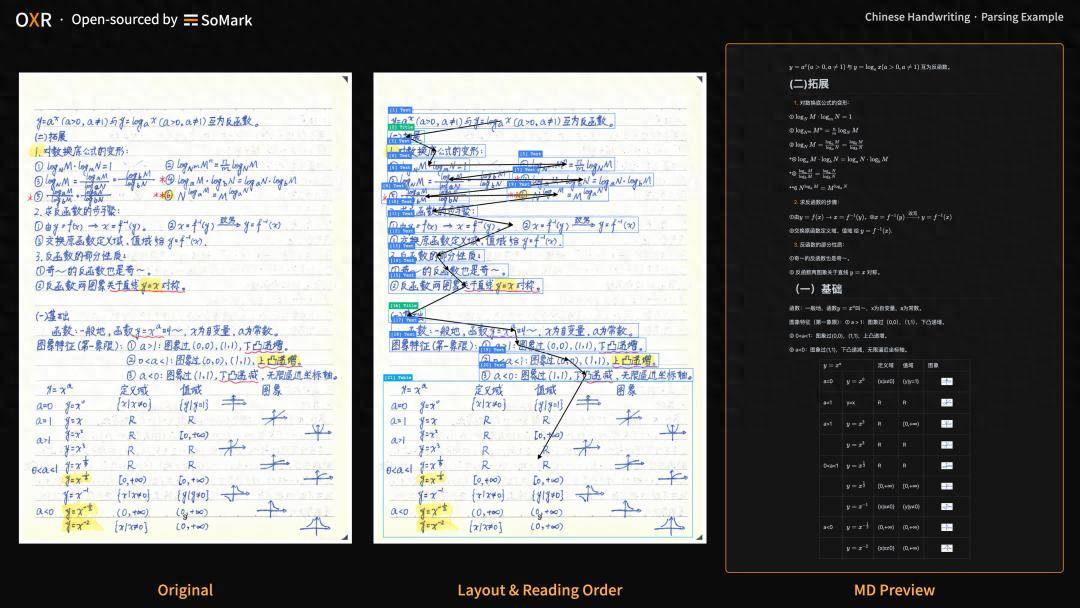
Representative image for RSI立大功!国产开源登顶全球第一,1.3B OXR重塑OCR

RSI立大功!国产开源登顶全球第一,1.3B OXR重塑OCR

Rank 68 · Content 75 · Popularity N/A

TL;DR - SoMark released OXR, a 1.3B-parameter open-source document-parsing model that leads three OCR benchmarks while efficiently converting complex documents into structured Markdown. Its small size and reproducible evaluation make high-quality parsing more accessible for RAG and agent workflows.

  • OXR scores 97.18 on OmniDocBench, 87.84 on olmOCR-Bench, and 87.76 on DocParsingBench.
  • It parses 13 element types, including tables, formulas, code, chemical structures, headers, footers, and seals.
  • Its recursive self-improvement pipeline identifies uncertain or incorrect outputs, clusters failure causes, and generates targeted training data without additional manual labeling.
  • A modular layout-analysis stage feeds recognition and reading-order processing; the system reportedly parses 100 pages in 101 seconds on one RTX PRO 6000.

Efficiency & Systems 1

Representative image for 天数智芯天垓300实测对标H200,国产GPU接下来拼什么?

天数智芯天垓300实测对标H200,国产GPU接下来拼什么?

Rank 71 · Content 80 · Popularity N/A

TL;DR - Chinese GPU maker Iluvatar CoreX says its Tiangai 300 matched or exceeded Nvidia’s H200 on selected inference benchmarks, while unveiling heterogeneous acceleration and agent-assisted deployment tools. The results suggest competition is shifting from peak specifications toward system efficiency, software compatibility, and reliable delivery.

  • In third-party PD-disaggregated tests, Tiangai 300 reportedly achieved 1.05× H200 per-card throughput; internal tests showed 1.15× MoE throughput on GLM-5.3 at 64K context.
  • Its AFD architecture assigns prefill and attention to the GPU and FFN computation to a partner XPU, reportedly reducing decode latency by 60% in the demonstrated setup.
  • Software agents and reusable Skills reduced one model-service deployment example from roughly one hour to 20 minutes, while assisting profiling and kernel optimization.
  • The company also previewed its edge roadmap: TY1200 reportedly outperformed Thor T5000 on selected models, with a 600-TOPS TY2000 planned.

AI Safety 1

How we detect frontier model misalignment

Rank 78 · Content 90 · Popularity N/A

TL;DR - OpenAI describes a layered monitoring approach for detecting frontier-model misalignment and unauthorized agent behavior. Early detection enables responders to intervene before incidents escalate.

  • Monitoring targets both model misalignment and unauthorized agent actions.
  • Multiple detection layers provide safeguards rather than relying on one mechanism.
  • The approach emphasizes timely human or operational intervention.
  • The provided excerpt does not specify implementation details or measured results.

Embodied AI 3

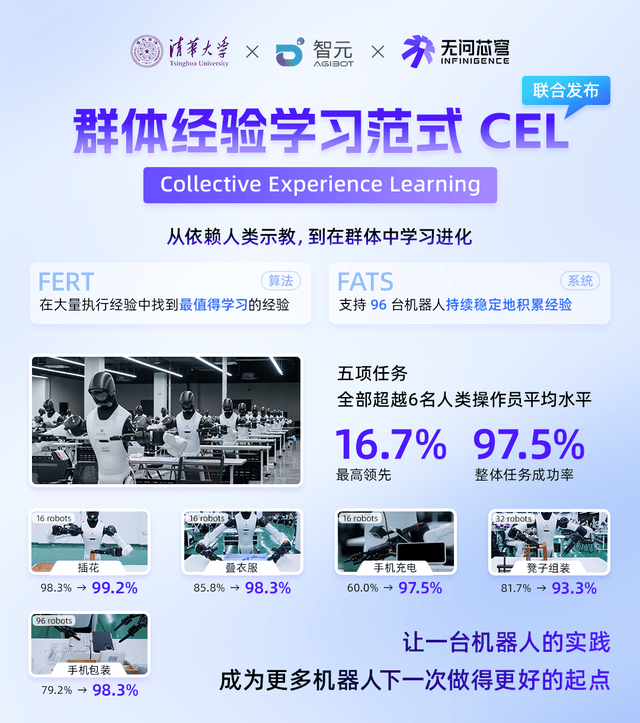
Representative image for 从学习人类到学习机器人同伴,清华大学联合无问芯穹、智元提出具身智能规模化落地新路径

从学习人类到学习机器人同伴,清华大学联合无问芯穹、智元提出具身智能规模化落地新路径

Rank 82 · Content 95 · Popularity N/A

TL;DR - Tsinghua University, Infinigence AI, and AgiBot introduced Collective Experience Learning (CEL), enabling robot fleets to learn from shared successes and failures. A 96-robot deployment demonstrated that scaling collective experience can improve real-world task performance while reducing reliance on human demonstrations.

  • Two unseen robots achieved 97.5% overall success across 600 trials spanning five household and industrial tasks.
  • Mobile-phone packaging success rose from 79.2% to 98.3%; expanding training from 16 to 96 robots increased success from 86.7% to 98.3%.
  • The fault-tolerant asynchronous training system collected 9,834 episodes despite 30 failures across 22 robots, limiting lost robot time to 1.3%.
  • The FERT algorithm retrieves relevant successful trajectories when failures occur, using both positive and negative experience to target policy improvements.
Representative image for 具身的数据管线,到底应该怎么做?

具身的数据管线,到底应该怎么做?

Rank 68 · Content 75 · Popularity N/A

TL;DR - Robotics foundation-model startup Xingyuan Intelligence introduced Chorus, a cross-embodiment data engine that converts heterogeneous human-operation videos into robot training data. It targets a key scaling bottleneck: increasing usable, transferable data rather than merely collecting more hours.

  • Chorus supports data from smart glasses, body/wrist cameras, and UMI devices, then grades and mixes it by quality and training stage.
  • Its pipeline annotates atomic actions, estimates depth and hand poses, reconstructs 3D scenes, retargets actions under physical constraints, and renders deployment-aligned training views.
  • Data is scored on operational diversity, annotation quality, 3D recoverability, robot transferability, and viewpoint stability.
  • The company reports an 85% usable-data conversion rate, support for 16 robot embodiments, and roughly 40× effective data expansion with instruction augmentation under its test setup.
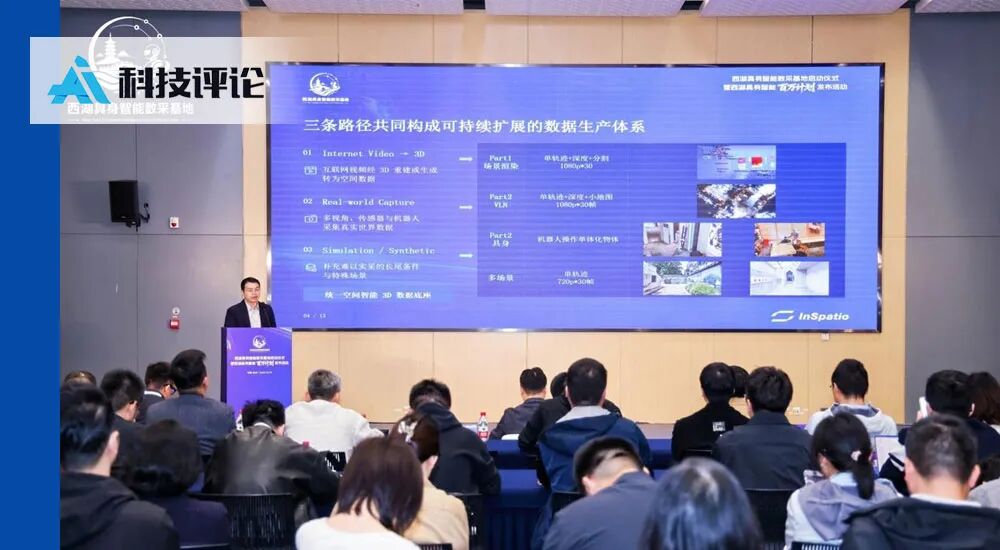
Representative image for 全行业两年攒下百万小时数据,影溯想 1 个月生产完:全国首个具身仿真数采中心落地杭州

全行业两年攒下百万小时数据,影溯想 1 个月生产完:全国首个具身仿真数采中心落地杭州

Rank 64 · Content 70 · Popularity N/A

TL;DR - Yingsu launched China’s first simulation-focused embodied-AI data collection center in Hangzhou, targeting one million hours of data per month. Its approach combines real-world 3D reconstruction, generative world modeling, and parallel simulation to produce more diverse robot-training environments.

  • Topos Pro converts images, video, LiDAR, and aerial scans into editable, interactive 3D environments with configurable physical properties.
  • Hundreds of parallel environments can synthesize aligned RGB, depth, segmentation, 6D-pose, action, and closed-loop trajectory data.
  • Real scans anchor geometry and appearance, while simulation varies layouts, occlusions, objects, and tasks; policies still require physical-robot validation.
  • The center defines three delivery tiers for navigation, dexterous grasping, and contact or articulated dynamics.

LLM Evaluation 1

Can we trust LLMs to judge whether a research idea is novel?

Rank 71 · Content 80 · Popularity N/A

TL;DR - A Hugging Face post examines whether LLMs can reliably assess the novelty of research ideas. With no article content provided, its methods and findings cannot be determined.

  • The focus is LLM-based evaluation of research novelty.
  • The title suggests a benchmark, “NoveltyBench,” for testing this capability.
  • No models, datasets, metrics, or results are available in the provided content.

Robotics & Embodied AI 1

Representative image for 让触觉像视觉一样可规模化,哥大李昀烛团队 FlexiTac 的开源实践 | IROS 2026

让触觉像视觉一样可规模化,哥大李昀烛团队 FlexiTac 的开源实践 | IROS 2026

Rank 71 · Content 80 · Popularity N/A

TL;DR - Columbia University’s open-source FlexiTac platform aims to make robotic touch sensing scalable through low-cost, flexible, consistent piezoresistive sensors. Its adoption across simulation, multimodal learning, and commercial development could broaden tactile robotics research.

  • FlexiTac can be assembled in three minutes, cut or wrapped around varied surfaces, and integrated with frameworks such as LeRobot.
  • Its simple spring-damper model enables high-fidelity tactile simulation and sim-to-real transfer with only three calibrated parameters.
  • Synchronized visual-tactile data improves manipulation of transparent objects and tasks requiring slip detection, pose estimation, or precise force control.
  • Academic projects now use FlexiTac in dexterous grippers and tactile world models, while Analog Devices is developing a higher-resolution commercial version.