上交大张伟楠教授:AI如何走出屏幕,真正改变物理世界? | CNCC 2026
Ranking
Overall
69
Content
85
Popularity
33
Observed public metrics from 1 member.
Merged summary
TL;DR - Shanghai Jiao Tong University professor Zhang Weinan outlines physical AI as a closed loop connecting perception, prediction, action, feedback, and continual learning in real-world systems. The framework matters because physical actions are constrained, uncertain, and often irreversible.
- The proposed seven-layer stack spans hardware, data and simulation, perception, world models, foundation models, physical agents, and applications.
- Key enablers include foundation models, action-conditioned world models, reinforcement learning, high-throughput simulation, sim-to-real transfer, and cheaper hardware.
- Major barriers remain costly interaction data, partial observability, accumulated long-horizon prediction errors, system integration, and safe failure recovery.
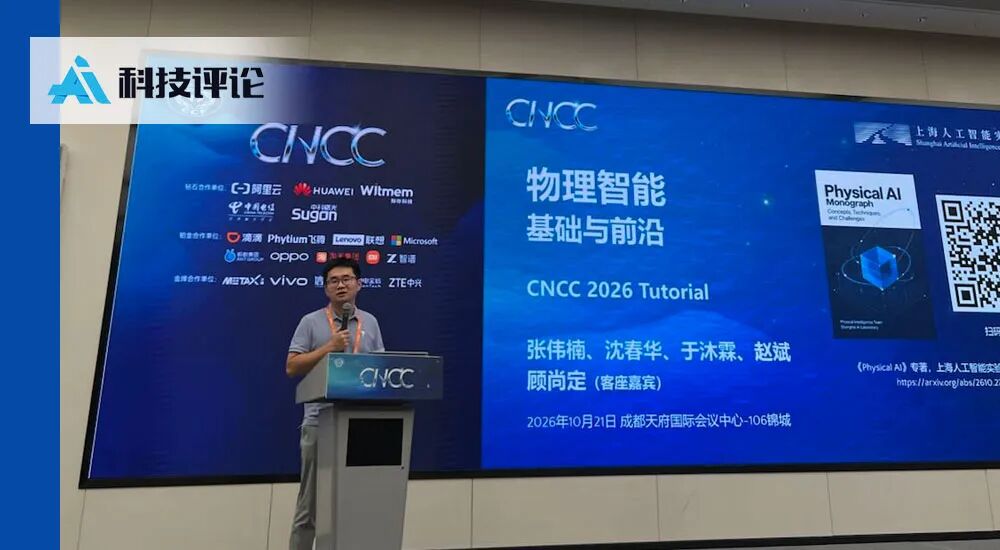
- Shanghai AI Laboratory also released the preprint book Physical AI: Concepts, Techniques, and Challenges at CNCC 2026.
Sources (1)
上交大张伟楠教授:AI如何走出屏幕,真正改变物理世界? | CNCC 2026
Public signals
Semantic Scholar citations 0 · Semantic Scholar influential citations 0
TL;DR - Shanghai Jiao Tong University professor Zhang Weinan outlines physical AI as a closed loop connecting perception, prediction, action, feedback, and continual learning in real-world systems. The framework matters because physical actions are constrained, uncertain, and often irreversible.
- The proposed seven-layer stack spans hardware, data and simulation, perception, world models, foundation models, physical agents, and applications.
- Key enablers include foundation models, action-conditioned world models, reinforcement learning, high-throughput simulation, sim-to-real transfer, and cheaper hardware.
- Major barriers remain costly interaction data, partial observability, accumulated long-horizon prediction errors, system integration, and safe failure recovery.
- Shanghai AI Laboratory also released the preprint book Physical AI: Concepts, Techniques, and Challenges at CNCC 2026.