🛰️ Daily AI Frontier
⚠ WeChat login expired or unavailable — new articles may be missing. Reconnect WeChat. An upstream outage cannot be fixed by scanning. Latest stored WeChat publication: 2026-08-25.

WeChat reconnect targets werss, while collection still uses wewe. Login alone does not complete the provider cutover.

Twitter/X collection is rate limited. 0 of 13 handles succeeded at the last check. Stored posts remain available; partial coverage is not a complete timeline.
36 works · 2 categories · 18 topics · blog 12 journal 10 arxiv 15 generated 2026-11-06 15:20:51 UTC
Top highlights — Research

LLM Agents 5

ReproBridge: Building Reproducibility into ML Research Artifacts

Rank 87 · Content 95 · Popularity 69

TL;DR - ReproBridge structures recovered ML experiment knowledge into reusable artifacts, improving coding agents’ reproduction success from 76.4% to 92.6% while cutting API spending by 19.7%.

  • ReproBridge-Bench covers 1,029 tasks from 387 experiments across 36 papers.
  • Artifacts combine refined code, environment setup, experiment launchers, and a reproduction guide.
  • All four evaluated models exceeded 90% mean success with refined artifacts.
  • Ablations showed code and environment information contributed most to reliability.
SwarmEvolve: Latent Agent Swarms for Evolutionary Discovery and Optimization

Rank 86 · Content 95 · Popularity 66

TL;DR - SwarmEvolve accelerates LLM-guided evolutionary program search using hundreds of low-cost agents that reason and communicate through latent KV caches. It reportedly matches hour-long baselines in 3–8 minutes across 21 mathematical and scientific-computing problems.

  • Swarms explore different solution angles without decoding lengthy textual reasoning.
  • Hidden-state distances filter for novel ideas and preserve population diversity.
  • A summarizer combines agents’ KV caches, enabling latent-space crossover.
  • Using Qwen3 8B, it improved upon some AlphaEvolve solutions originally found with frontier models.

Benchmarks as Software: Terminal-Bench and the Case for Continuous Benchmarks

Rank 85 · Content 95 · Popularity 62

TL;DR - This paper proposes continuous validation for agentic benchmarks and applies it to Terminal-Bench, finding defects in roughly 30% of tasks. Repairs and resource-budget changes materially alter measured coding-agent performance and leaderboard positions.

  • Terminal-Bench 2.1 combines community reports, task artifacts, agent traces, automated oracle checks, and human-gated repairs.
  • Repairs increased accuracy by over 10 percentage points and shifted leaderboard positions by up to three ranks, while rankings remained highly correlated (Spearman ρ = 0.958).
  • Longer time limits closed a 20-point harness gap on GPT-5.4 and reduced a 30-point gap on GPT-5.4 mini to 5 points.
  • The authors argue that tasks, verifiers, infrastructure, and resource budgets all require ongoing revalidation as models improve.

XStack: A Benchmark for ML Repo Migration

Rank 81 · Content 100 · Popularity 37

TL;DR - XStack benchmarks AI agents on migrating complete PyTorch/NVIDIA repositories to JAX/TPU environments. Results show repository-scale, cross-framework migration remains unreliable despite strong performance from the best agent.

  • Agents receive a PyTorch repository and clean TPU machine, then must produce a working JAX repository.
  • Grading uses authenticated, calibrated criteria based on each source repository’s published result.
  • Claude Opus 5 passes 75% of tasks, GPT-5.6-sol 45%, and all other evaluated agents at most 40%.
  • The benchmark measures long-horizon coding across frameworks, hardware, building, and testing.
Representative image for Multimodal-SEA: Benchmarking AI Agent Security under Multimodal Social Engineering Attacks

Multimodal-SEA: Benchmarking AI Agent Security under Multimodal Social Engineering Attacks

Rank 81 · Content 100 · Popularity 37

TL;DR - Multimodal-SEA is a 608-task benchmark for evaluating personal AI agents against adaptive, multimodal social-engineering attacks. All seven evaluated models were vulnerable, highlighting gaps between safer behavior and actual deception recognition.

  • Covers 14 domains, 152 attack scenarios, four difficulty levels, and Chinese and English contexts.
  • Multimodal content raised attack success rates from 19.9% to 29.2%.
  • Overall attack success ranged from 7.1% to 34.5%, measured through verifiable tool-execution logs.
  • Stronger safety instructions reduced successful attacks but did not improve deceptive-content recognition and sometimes increased refusals of legitimate requests.

Medical/Healthcare AI 4

Computation, not weight access: large language models as auditors of clinical prediction networks

Rank 90 · Content 100 · Popularity 67

TL;DR - Clinical network auditing by LLMs depended more on computational tools and prompting than direct weight access. Black-box prediction access matched white-box auditing, suggesting raw model weights may be unnecessary.

  • Tool-free auditing became unreliable as networks grew from 353 to 3,457 weights.
  • Tool-enabled models identified planted relationships across 29 runs on networks up to 38,401 weights.
  • Audits produced no false alarms in 15 null-network runs and found subgroup bias in all 6 runs.
  • A well-designed script matched the comparator models and the best LLM repair performance.
Representative image for NPCBench: A Clinical Apprenticeship Benchmark for Multimodal Care-Pathway Reasoning in Nasopharyngeal Carcinoma

NPCBench: A Clinical Apprenticeship Benchmark for Multimodal Care-Pathway Reasoning in Nasopharyngeal Carcinoma

Rank 85 · Content 95 · Popularity 61

TL;DR - NPCBench evaluates multimodal AI across longitudinal nasopharyngeal carcinoma care pathways rather than isolated clinical tasks. Results reveal a major composition gap: strong task-level scores rarely translate into coherent patient-level diagnosis and care.

  • Includes 4,777 items plus 100 patient trajectories covering 417 scored diagnostic and care tasks.
  • Tests visual grounding, patient-state tracking, treatment planning, longitudinal review, and consultation.
  • Evaluates 30 models, including 21 multimodal models.
  • Strict CarePath success among multimodal models peaks at 23%.

Opportunistically Detecting Signs of Hypertension on a Consumer Smartwatch

Rank 84 · Content 95 · Popularity 59

TL;DR - A Nature paper explores using a consumer smartwatch to opportunistically detect signs associated with hypertension. The provided excerpt contains only bibliographic information, so its methods, accuracy, and clinical validation cannot be assessed.

  • Focuses on passive or opportunistic hypertension-sign detection using consumer wearable technology.
  • Suggests potential for broader, more convenient screening outside clinical settings.
  • No performance metrics, study population details, or specific sensing methods are provided.

Nectin-4 mediates rubella virus entry in airway and placental cells

Rank 76 · Content 90 · Popularity 43

TL;DR - A Nature study identifies Nectin-4 as a key host receptor enabling rubella virus entry into airway and placental cells. This finding may clarify mechanisms behind respiratory transmission and early placental infection.

  • Nectin-4 mediates rubella virus entry into host cells.
  • The receptor is implicated in respiratory transmission through airway cells.
  • It also plays a pivotal role in early placental infection.
  • The provided summary does not detail experimental methods or quantitative results.

Bioinformatics AI 3

Nondisruptive 3D profiling of combinations of epigenetic marks in single cells

Rank 79 · Content 85 · Popularity 66

TL;DR - Epi-PHR is a nondisruptive imaging method for profiling combinations of epigenetic marks at individual genes while preserving 3D genome structure. It enables single-cell study of how chromatin folding relates to histone modifications.

  • Maps multiple epigenetic marks at single-gene resolution.
  • Preserves native 3D genome organization during imaging.
  • Resolves relationships among individual chromatin copies in single cells.
  • Links spatial chromatin architecture with histone-modification patterns.

DIRAC makes complex spatial multi-omic data simpler to analyze

Rank 76 · Content 90 · Popularity 43

TL;DR - DIRAC is a framework for integrating spatial multi-omic layers and transferring annotations from reference datasets. It enables more interpretable tissue maps across assays, platforms, and biological systems.

  • Combines within-sample omics integration with cross-dataset annotation transfer.
  • Uses domain-invariant representations with adaptive calibration.
  • Targets complex spatial multi-omic datasets.
  • Supports tissue-map construction across heterogeneous experimental settings.

Unlocking spatial diversity of circular RNAs with abcFISH

Rank 72 · Content 85 · Popularity 43

TL;DR - abcFISH is a multiplex single-molecule fluorescence in situ hybridization method for spatially imaging circular RNAs. It may help researchers study the spatial diversity and localization of these RNA molecules.

  • Published online in Nature Methods on November 5, 2026.
  • Uses multiplex single-molecule fluorescence in situ hybridization.
  • Enables spatial imaging of circular RNAs.
  • The provided content does not include performance results or validation details.

LLMs & Foundation Models 4

TCSExam: Evaluating Frontier LLMs on the Full Range of TCS Research

Rank 88 · Content 100 · Popularity 61

TL;DR - TCSExam is an expert-reviewed benchmark for evaluating frontier LLM agents across theoretical computer science research tasks. Its verified results and compact Lite variant aim to support reproducible measurement of progress toward automated research.

  • TCSExam-Full includes 100 tasks spanning theorem proving, solver engineering, constructions, and open-conjecture attempts.
  • Submissions are verified through the Lean kernel or executable task checkers.
  • GPT-6 Astra leads Full with 71.9, while Opus 5.5 leads Lite with 72.3.
  • Full and Lite rankings strongly agree across eight shared agents (Spearman’s ρ=0.93), supporting Lite as a lower-cost proxy.

Towards Foundation Decision Models: Drex

Rank 87 · Content 95 · Popularity 68

TL;DR - Drex is a family of four open decision models that directly produces probability distributions over user-supplied options, avoiding autoregressive decoding. The approach targets faster, cheaper, and more consistent production decision-making.

  • Models range from 8B to 35B parameters and support documents, records, agent context, and optional images.
  • Training combines supervised fine-tuning, reinforcement learning from adjusted feedback (RLAF), consistency losses, and vision tuning for Drex Max.
  • Drex Max reached 67.52 on Decision Index 0.4.1, outperforming the compared Jev 1.14.0 score of 60.70.
  • Max reportedly answers typical requests in 183 ms and remains robust to option reordering.

Learning Dynamics of On-Policy Distillation

Rank 81 · Content 100 · Popularity 37

TL;DR - This paper analyzes how on-policy distillation’s feedback loop shapes language-model learning and generalization. It finds that OPD can degrade generation unless the student is sufficiently prepared through offline distillation.

  • Separates OPD dynamics into parameter-update conversion and prediction broadcast across prefixes.
  • Explains weak student responsiveness despite substantial teacher-student disagreement.
  • Shows locally beneficial updates can increase unsuccessful continuations, degrading later supervision.
  • Offline preparation may enable substantial subsequent OPD accuracy gains without immediately improving held-out accuracy.
Representative image for CoRD: Coupled Rollouts Fill the Blind Spot of On-Policy Distillation

CoRD: Coupled Rollouts Fill the Blind Spot of On-Policy Distillation

Rank 81 · Content 100 · Popularity 37

TL;DR - CoRD improves on-policy distillation by coupling student and teacher rollouts, exposing students to valuable teacher-reached states with minimal token substitutions. It consistently improves mathematical reasoning performance at equal training steps and data.

  • Uses maximal coupling in speculative decoding to interpolate between student and teacher rollout distributions.
  • Substitutions target tokens the student underweights and become rarer as the student improves.
  • Across six Qwen3/Qwen3.5 students (0.6B–4B), CoRD improves average pass@1 by 0.9–2.0 points and pass@8 by 1.2–3.4 points on five math benchmarks.
  • A 4B student closes the teacher-state performance gap in 16 steps beyond what standard on-policy distillation achieves in 80.

Efficiency & Systems 3

SpecCTMC: Exact Speculative Simulation of Diffusion Language Model Continuous-Time Markov Chains

Rank 81 · Content 100 · Popularity 37

TL;DR - SpecCTMC is a training-free speculative sampler that accelerates exact continuous-time generation for diffusion language models without a separate draft model. It cuts sequential model evaluations by 1.73–4.38× while preserving the reference sampling distribution.

  • Reuses prior model predictions to propose successive token updates, then evaluates intermediate states in parallel.
  • Uses acceptance and correction to preserve event times, generation order, and token values exactly.
  • Avoids both time-discretization error and extra factorization error from parallel decoding.
  • Evaluated on LLaDA-8B-Instruct and Dream-v0-Instruct-7B across five benchmarks.

StrataFlux: Memory-Hierarchy-Native Low-Bit LLM Inference

Rank 78 · Content 95 · Popularity 37

TL;DR - StrataFlux improves the accuracy of highly quantized LLM inference by selectively streaming extra precision from RAM or SSDs while overlapping transfers with computation. It approaches higher-precision quality and speed with substantially lower GPU memory use.

  • Co-designs refinement representation, selection, and delivery for 2–4-bit weights and 2–3-bit KV caches.
  • Improves 2-bit Llama-3.1-8B perplexity from 9.46 to 8.40 while retaining 95.4% of baseline throughput on RTX 5090.
  • Raises Qwen3-8B AIME 2024/2025 accuracy from 11.0% to 47.1% with 2-bit weights and KV at unchanged GPU memory use.
  • At 128K context, matches vLLM’s 4-bit-weight/8-bit-KV configuration in perplexity and speed using roughly half the GPU memory.

Measured Coupling for Parallel Decoding in Diffusion Language Models

Rank 78 · Content 95 · Popularity 37

TL;DR - A new decoding method measures how committing one token affects confidence at other positions, enabling safer parallel generation in diffusion language models. It reduces decoding steps and usually improves speed, with an average accuracy cost of 1.1 points.

  • Measures token-position coupling using inexpensive probes within the main forward pass.
  • Requires no additional training or auxiliary model and fits the existing mean-field decoding rule.
  • Outperforms mean-field decoding in step count across three models and four benchmarks, including with key-value caching.
  • Shuffled or uniform couplings remove the gain, supporting the importance of measured interactions.

Animal Behavior 1

Ecological and social cues orchestrate concerted courtship in Drosophila

Rank 68 · Content 70 · Popularity 65

TL;DR - A Nature study identifies a multisensory mechanism that synchronizes group courtship in Drosophila erecta. Food odours initiate male arousal, while visual cues from other courting flies reinforce it when reproductive conditions are favourable.

  • Food odours act as the initial ecological cue for male sexual arousal.
  • Motion from nearby courting flies provides a reinforcing social cue.
  • Together, these cues coordinate courtship across groups.
  • The mechanism links favourable environmental conditions to collective reproductive behaviour.

Deep Learning Dynamics 1

Fractal basin geometry and the limits to predictability and reproducibility in deep learning

Rank 84 · Content 95 · Popularity 59

TL;DR - Ly and Gong propose fractal basin geometry as a mechanism limiting the predictability and reproducibility of deep-learning outcomes. Interwoven outcome basins at arbitrarily fine scales mean that increasing numerical precision may offer little improvement.

  • Tiny differences in starting points can lead to different training outcomes.
  • The proposed basins have fractal boundaries that remain complex across scales.
  • This geometry may explain why deep-learning results are difficult to predict and reproduce.
  • Greater precision alone may not overcome this inherent sensitivity.

Ecology Foundation Models 1

Towards ecologically meaningful foundation models

Rank 81 · Content 90 · Popularity 59

TL;DR - Gardiner et al. propose ecological foundation models that integrate multimodal datasets with ecological theory to improve broad, generalizable predictions across ecosystems.

  • Addresses ecological data and theory fragmented across sources, scales, and methodologies.
  • Combines large multimodal ecological datasets within unified foundation models.
  • Explicitly incorporates ecological theory to support more meaningful predictions.
  • Presents a research direction; no experimental results are described here.

Marine Microbiology 1

Synergy in viral–bacterial co-infection expedites algal bloom demise

Rank 71 · Content 75 · Popularity 62

TL;DR - A Nature study finds that interactions between viruses and Alteromonas bacteria accelerate algal bloom collapse by increasing virus-induced mortality. This newly identified co-infection mechanism may influence ocean carbon cycling.

  • Alteromonas chemoattraction promotes bacterial involvement in infected algal populations.
  • Viral–bacterial co-infection enhances mortality beyond viral infection alone.
  • The synergy expedites the demise of algal blooms.
  • This mortality pathway could affect how carbon moves through ocean ecosystems.

Neuroscience 1

The neural basis of flavour–nutrient learning

Rank 73 · Content 75 · Popularity 67

TL;DR - This Nature study identifies a dopamine pathway to the basolateral amygdala as necessary for learning associations between flavours and nutrients, clarifying a neural mechanism underlying food preference.

  • Focuses on flavour–nutrient associative learning.
  • Implicates dopamine signaling to the basolateral amygdala.
  • The provided summary establishes necessity but does not detail methods or experiments.

Robotics AI 1

VFlash: Fast, Accurate Visual Planning via Flash Primitive Decoding

Rank 88 · Content 95 · Popularity 71

TL;DR - VFlash accelerates visual planning by jointly decoding structured spatial primitives instead of generating coordinates autoregressively. It improves trajectory accuracy while reporting roughly 25× faster 3D point-motion forecasting.

  • A lightweight drafter predicts complete points, boxes, or variable-length trajectories in one forward pass.
  • Training accepts structurally valid primitives without requiring exact agreement with target token sequences.
  • VFlash reduced prediction errors across evaluated 2D and 3D robot trajectory tasks.
  • A VFlash-conditioned world action model achieved 70.2% average success on four MolmoSpaces suites versus 62.6% for the baseline.
Top highlights — Industry & News

LLM Agents 2

Representative image for 腾讯 Hy4 调用激增已十倍扩容,Agent 能力开源模型第一

腾讯 Hy4 调用激增已十倍扩容,Agent 能力开源模型第一

Rank 68 · Content 75 · Popularity N/A

TL;DR - Tencent expanded Hy4’s inference capacity tenfold after demand surged following its WorkBuddy launch. The open model ranks first among open-source models in Agent Arena and combines competitive agent performance with relatively low reported costs.

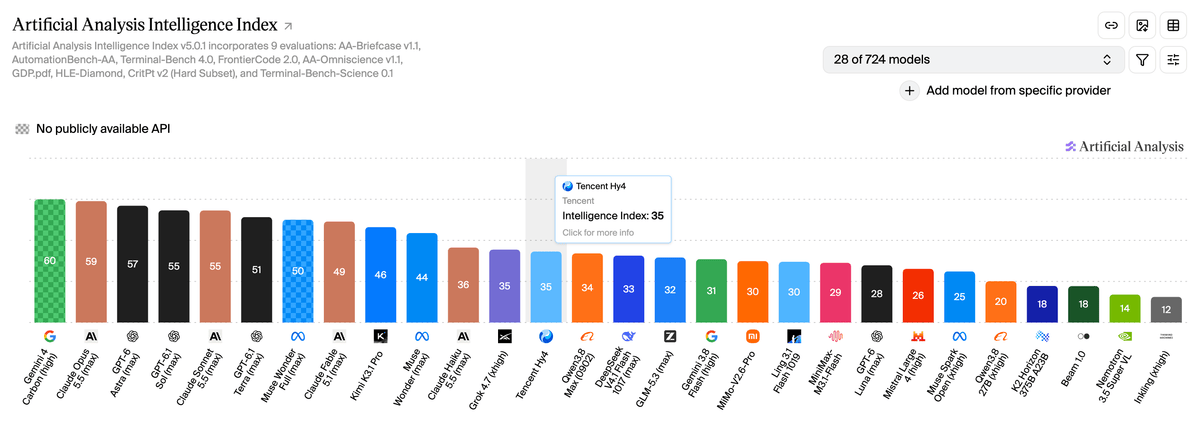
  • Hy4 ranks 13th overall and first among open-source models in Agent Arena.
  • Artificial Analysis places it second among Chinese models, tied with Grok 4.7 (xhigh) on its intelligence index.
  • Its reported per-task cost is $0.78—about 10× cheaper than Grok 4.7 (xhigh) and 13× cheaper than Qwen3.8 Max at similar scores.
  • Compared with Hy4 Preview, Tencent expanded training and data scale, added visual understanding, and improved instruction following, long-context comprehension, and long-horizon agent tasks.
Representative image for 99.4%登顶全球第一!这个中国AI师承世界冠军

99.4%登顶全球第一!这个中国AI师承世界冠军

Rank 64 · Content 70 · Popularity N/A

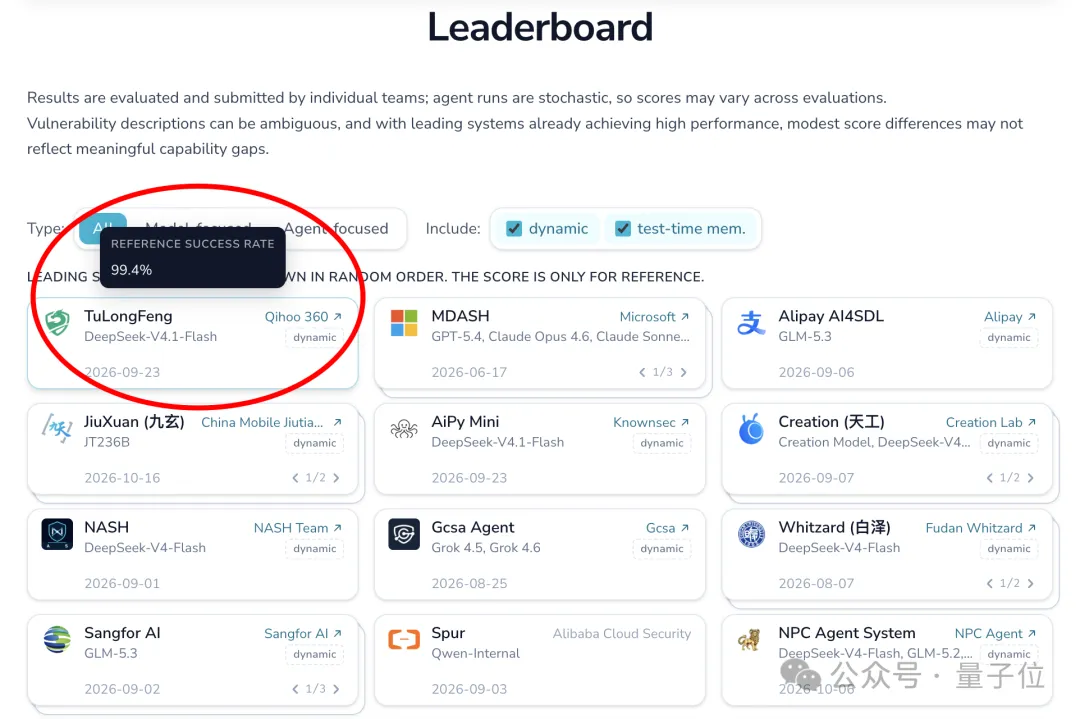
TL;DR - 360 says its Tulongfeng AI security system achieved a 99.4% vulnerability-reproduction rate on CyberGym, leading the benchmark. The result highlights how security-specialized models and agent swarms can automate end-to-end vulnerability discovery and validation.

  • CyberGym evaluates 1,507 historical vulnerabilities from 188 real open-source projects across three independent runs.
  • Tulongfeng reportedly scored 99.27%, 99.47%, and 99.40%, averaging 99.38%.
  • Its architecture combines a security-domain model trained on real samples and expert process data with agents for code analysis, tool use, PoC generation, and verification.
  • 360 reports that the system has found over 15,000 vulnerabilities and is used by more than 500 enterprises.

Multimodal & Generative 2

New NVIDIA Cosmos 3 Open Models for Interactive World Simulation

Rank 71 · Content 80 · Popularity N/A

TL;DR - Hugging Face announced the availability of NVIDIA Cosmos 3 open models for interactive world simulation. Based on the title alone, details about capabilities, architecture, licensing, and performance cannot be confirmed.

  • The release focuses on models for interactive simulation of virtual worlds.
  • The “open models” framing suggests model artifacts are being made available to developers, but the exact access terms are unspecified.
  • No technical results or benchmark comparisons were provided in the supplied content.
Representative image for 办了33年的ACM MM,重新划定研究范围

办了33年的ACM MM,重新划定研究范围

Rank 68 · Content 75 · Popularity N/A

TL;DR - ACM Multimedia 2026 reorganized its research scope into 16 equal-level topics, reflecting AI-driven expansion from multimedia processing toward multimodal reasoning, generation, embodied interaction, and responsible deployment.

  • New standalone topics highlight embodied and immersive multimedia and reasoning across visual, audio, textual, and sensor data.
  • “Vision and Language” expands to “Multimedia and Language,” while foundation models and generative multimedia become one combined topic.
  • “Responsible Multimedia” replaces a narrower focus on generative AI’s social impact, emphasizing mitigation and accountability.
  • Interpretability and explainability gain prominence as multimedia AI increasingly supports autonomous judgments and decisions.

Efficiency & Systems 1

Representative image for DeepSeek带火稀疏计算,国产芯片公司加速突围:这家公司又融近10亿

DeepSeek带火稀疏计算,国产芯片公司加速突围:这家公司又融近10亿

Rank 68 · Content 75 · Popularity N/A

TL;DR - Chinese AI-chip startup Moffett AI raised nearly RMB 1 billion to expand specialized sparse-inference hardware. Its approach aims to convert MoE and model sparsity into lower inference costs through co-designed algorithms, software, compilers, and chips.

  • Its dual-sparsity technology targets both model weights and activations, avoiding redundant computation and data movement.
  • The company reports multi-fold Q3 2026 revenue growth and inference-cluster deployments across four Chinese regions.
  • In remote-sensing model tests, its hardware reportedly delivered up to 2.88× higher throughput and 7.64× model compression with almost no accuracy loss or downstream retraining.
  • A new SP200 accelerator card and upgraded SECA software stack are planned for release by year-end.

Cybersecurity AI 1

GPT‑6 Cyber: Advancing the frontier of aligned cybersecurity agents

Rank 82 · Content 95 · Popularity N/A

TL;DR - OpenAI announced GPT‑6 Cyber, a cybersecurity agent designed to identify exploitable vulnerabilities and develop fixes while remaining within authorized scope.

  • Focuses on vulnerability discovery and remediation.
  • Uses agentic capabilities for cybersecurity workflows.
  • Emphasizes alignment with explicitly authorized boundaries.
  • No benchmarks or technical implementation details were provided.

Embodied AI 1

菜鸟发布与AI及具身智能产业合作计划 🔗 2 sources

Rank 68 · Content 75 · Popularity N/A

TL;DR — 菜鸟开放全球仓网,为AI及具身智能企业提供真实物流场景中的训练、PoC验证和商业落地环境,同时推出面向AI硬件与机器人的跨境供应链服务,以降低验证成本并缩短产业化周期。

  • 开放数十个行业、上百种物流场景,覆盖仓储拣选、导航配送、巡检和航空物流等任务。
  • 支持机器人真机训练,以及从供包、贴单到复杂拆码垛的分级验证。
  • “科技出海三日达”覆盖报关、运输、海外仓储、备件管理和售后履约。
  • 首批计划已覆盖多家AI及具身智能企业。

注: 量子位摘要介绍的是字节跳动即梦短剧工作台,与菜鸟合作计划并非同一项目,因此未合并其内容。

Physical AI 1

Representative image for 上交大张伟楠教授:AI如何走出屏幕,真正改变物理世界? | CNCC 2026

上交大张伟楠教授:AI如何走出屏幕,真正改变物理世界? | CNCC 2026

Rank 69 · Content 85 · Popularity 33

TL;DR - Shanghai Jiao Tong University professor Zhang Weinan outlines physical AI as a closed loop connecting perception, prediction, action, feedback, and continual learning in real-world systems. The framework matters because physical actions are constrained, uncertain, and often irreversible.

  • The proposed seven-layer stack spans hardware, data and simulation, perception, world models, foundation models, physical agents, and applications.
  • Key enablers include foundation models, action-conditioned world models, reinforcement learning, high-throughput simulation, sim-to-real transfer, and cheaper hardware.
  • Major barriers remain costly interaction data, partial observability, accumulated long-horizon prediction errors, system integration, and safe failure recovery.
  • Shanghai AI Laboratory also released the preprint book Physical AI: Concepts, Techniques, and Challenges at CNCC 2026.

Robot Learning 1

ToyBlocks: A controlled world for robot learning and evaluation

Rank 61 · Content 65 · Popularity N/A

TL;DR - Hugging Face highlights ToyBlocks, described as a controlled environment for robot learning and evaluation. With no article content provided, its methods, capabilities, and results cannot be assessed.

  • The project targets robot learning and evaluation.
  • Its title emphasizes a controlled-world setting, likely intended to support repeatable comparisons.
  • No technical details, benchmarks, or findings are available in the provided content.

Robotics Research 1

Representative image for CoRL 六年:论文数×4.5,谁在推着它涨?

CoRL 六年:论文数×4.5,谁在推着它涨?

Rank 61 · Content 65 · Popularity N/A

TL;DR - An analysis of CoRL papers from 2021–2026 finds explosive growth in robotics research, with accepted papers reaching 687 in 2026 and Chinese institutions rapidly gaining prominence.

  • CoRL acceptances grew from 153 papers in 2021 to 263 in 2025, then jumped to 687 in 2026.
  • Papers involving Chinese institutions rose from 5.9% to 37.5%, while the US share fell from 76% to 51%.
  • Tsinghua led the 2026 institutional rankings with 58 papers; Shanghai Jiao Tong and Peking University also entered the top five.
  • Participation broadened substantially: represented institutions increased from 92 to 350, though incomplete 2026 affiliation data makes the latest figures provisional.

Speech Recognition 1

Egyptian and Nigerian English join the Open ASR Leaderboard

Rank 61 · Content 65 · Popularity N/A

TL;DR - Hugging Face’s Open ASR Leaderboard has added Egyptian and Nigerian English. With only the title provided, no benchmark results or implementation details can be verified.

  • Expands the leaderboard’s coverage to two additional English varieties.
  • Supports broader evaluation of automatic speech recognition across regional accents.
  • No models, datasets, metrics, or rankings are specified in the provided content.