GPT-6.2 Astra再次暴击具身模型:16项任务成功率较GPT-6 Astra翻倍
Ranking
Overall
82
Content
95
Popularity
N/A
No observed public metrics; popularity remains neutral/archived.
Merged summary
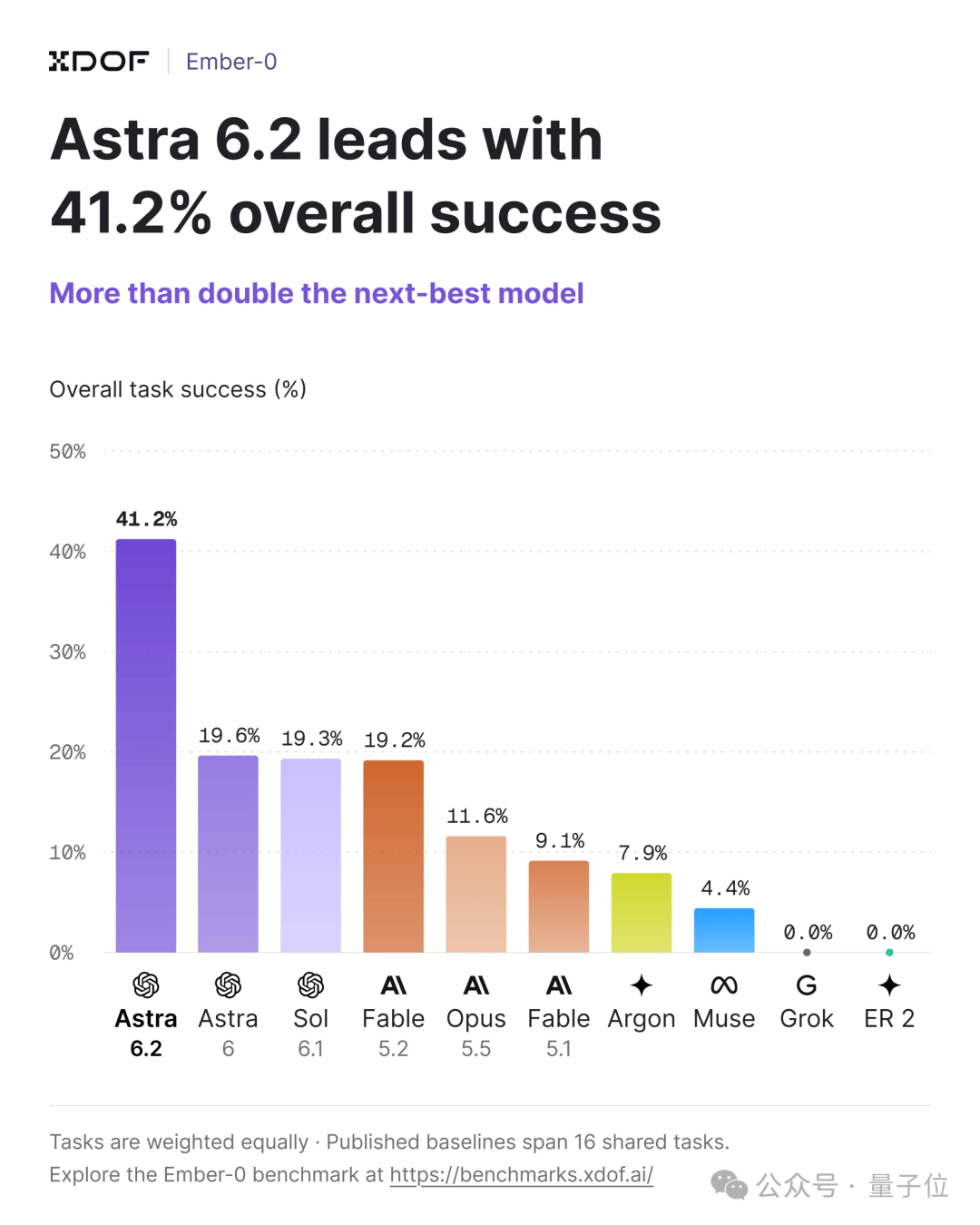
TL;DR - XDOF reports that GPT-6.2 Astra more than doubled GPT-6 Astra’s average success rate on 16 real-world robotic manipulation tasks, reaching 41.2%. The gains suggest general-purpose multimodal models are improving at complex embodied tasks, though inference latency remains a barrier.
- The Ember-0 benchmark used six dual-arm YAM workstations, with 30 trials per task and human annotation of errors and hardware variability.
- GPT-6.2 Astra completed previously unsolved tasks such as tying a knot and unfolding a T-shirt, which require deformable-object control, bimanual coordination, and long-horizon planning.
- Its largest reported task gain was picking up bread with tongs, improving from 10% to 90% success.
- Average prediction latency fell from 15 seconds to 10.1 seconds, but remains too slow for responsive continuous control.
Sources (1)
GPT-6.2 Astra再次暴击具身模型:16项任务成功率较GPT-6 Astra翻倍
Public signals
N/A
TL;DR - XDOF reports that GPT-6.2 Astra more than doubled GPT-6 Astra’s average success rate on 16 real-world robotic manipulation tasks, reaching 41.2%. The gains suggest general-purpose multimodal models are improving at complex embodied tasks, though inference latency remains a barrier.
- The Ember-0 benchmark used six dual-arm YAM workstations, with 30 trials per task and human annotation of errors and hardware variability.
- GPT-6.2 Astra completed previously unsolved tasks such as tying a knot and unfolding a T-shirt, which require deformable-object control, bimanual coordination, and long-horizon planning.
- Its largest reported task gain was picking up bread with tongs, improving from 10% to 90% success.
- Average prediction latency fell from 15 seconds to 10.1 seconds, but remains too slow for responsive continuous control.