🛰️ Daily AI Frontier
39 works · 3 categories · 14 topics · blog 4 wechat 15 journal 1 arxiv 15 generated 2026-08-16 14:17:37 UTC
Top highlights — Research

LLM Agents 5

Representative image for OmniScientist: An Omni-Modal Omni-Discipline AI Scientist

OmniScientist: An Omni-Modal Omni-Discipline AI Scientist

Rank 83 · Content 90 · Popularity 68

TL;DR - OmniScientist is an end-to-end, multimodal AI scientist that uses autonomous agents to turn heterogeneous raw evidence into research ideas, experiments, and compiled manuscripts. Direct perception significantly outperformed reliance on precomputed scalar features, highlighting its importance for evidence-grounded discovery.

  • Combines a perception layer with agents for ideation, experimentation, and writing in a deterministic pipeline.
  • Supports images, signals, audio, video, 3-D structures, trajectories, tables, formulas, and graphs across multiple disciplines.
  • Code-based checks enforce novelty screening, statistical validity, provenance, and numerical traceability.
  • Completed all 36 evaluated research cases; direct perception improved all seven evaluation dimensions and won 85% of paired judgments.
Representative image for QuoteBench: How Matched Scores Can Hide Command-Path Failures

QuoteBench: How Matched Scores Can Hide Command-Path Failures

Rank 81 · Content 90 · Popularity 59

TL;DR - QuoteBench shows that execution interfaces can severely distort evaluations of command-generating coding agents. Similar aggregate scores may conceal major command-path failures and model compensation.

  • Tests 56 one-shot tasks across 14 incident-derived command-quoting failure families.
  • Adding one unescaped parser reduced success by 55.4–73.2 percentage points across eight configurations.
  • Disclosing the boundary recovered 30.4–60.7 points for six configurations, but provided no benefit for two.
  • The execution path can reorder model rankings, so evaluations should report generation contracts, transport details, operating points, and final-state validators.

LycheeMemory V2: Efficient Long-Term Memory for LLM Agents via Semantic Segment-Level Consolidation

Rank 78 · Content 85 · Popularity 61

TL;DR - LycheeMemory V2 consolidates semantically coherent conversation segments rather than individual turns, reducing the cost of building long-term agent memory while preserving retrieval accuracy.

  • Produces context-independent typed memory records from finalized semantic segments.
  • Uses lightweight structured indexes and query planning for evidence retrieval.
  • Achieves 89.22% on LoCoMo and 92.20% on LongMemEval-S with GPT-4.1-Mini.
  • Versus A-Mem, cuts construction tokens by 86.0% and 75.9% on the respective benchmarks without increasing query-time token usage.

VALG: An Agentic System for ML Theory Research

Rank 77 · Content 95 · Popularity 35

TL;DR - VALG is an autonomous agentic workflow for formulating and proving machine-learning theory results. It matters because it explicitly distinguishes complete source-aligned theorems from relaxations, conditional findings, special cases, and failed attempts.

  • Uses multi-level verification, adaptive problem formulation, and graph-structured proof development.
  • Maintains fixed mathematical specifications and typed proof-dependency graphs within each theorem branch.
  • Diagnoses failures as derivation, proof-structure, or theorem-formulation problems and routes retries accordingly.
  • Across nine COLT 2026 subproblems, two runs finalized source-aligned theorem candidates; seven produced restricted, special-case, or conditional results.

RAGSieve: Self-Referenced Local Contrast for Knowledge-Poison Detection in Retrieval-Augmented Generation

Rank 77 · Content 95 · Popularity 35

TL;DR - RAGSieve detects poisoned knowledge in retrieval-augmented generation using local comparisons within the inspected system, requiring neither trusted corpora nor poison labels. Its query-time and corpus-ingestion defenses jointly cut attack success from 67.4% to 14.0%.

  • RSQ contrasts the top five retrieval results with ranks 6–20 to identify suspicious answer-anchor concentration and carrier transitions.
  • RSG compares documents with semantically similar but lexically distinct neighbors to detect coordinated poisoning before query time.
  • RSQ and RSG achieve 95.2% and 93.3% AUROC, respectively, outperforming the cited GMTP and CleanBase baselines.
  • The combined defense retains 41.3% F1 on unpoisoned retrieval.

Bioinformatics AI 1

Representative image for Static analysis-guided agentic AI translation enables Rust as a full stack bioinformatics language

Static analysis-guided agentic AI translation enables Rust as a full stack bioinformatics language

Rank 77 · Content 95 · Popularity 35

TL;DR - This paper combines agentic AI with static analysis to translate legacy bioinformatics software into Rust. The approach could reduce technical debt while improving portability, safety, and performance.

  • Evaluated translations on commonly used next-generation sequencing and imaging software.
  • Provides prompts and supporting software for systematic code translation.
  • The translated Bascet pipeline was ~80× smaller, built ~10× faster, and improved key-step performance by more than 3×.
  • Removing Unix dependencies enabled Bascet to run natively on Windows without containers.

LLMs & Foundation Models 2

Algebraic Decomposition Theory for Transformer Length Generalization

Rank 87 · Content 100 · Popularity 56

TL;DR - This paper gives the first complete characterization of regular languages on which transformers can generalize beyond their training sequence lengths. It also provides a polynomial-time decision algorithm based on a new algebraic decomposition theory.

  • Characterizes transformer length generalization through the C-RASP formalism.
  • Extends classical finite-semigroup decomposition theory using iterated wreath products of the additive integer group.
  • Decides regular-language membership in polynomial time relative to the syntactic monoid’s size.
  • Experiments show the theory predicts transformer length-generalization behavior better than existing classifications.
Representative image for Refusing Intent, Not Form: Wrapper-Based Intent-Group Supervision for LLM Safety

Refusing Intent, Not Form: Wrapper-Based Intent-Group Supervision for LLM Safety

Rank 79 · Content 95 · Popularity 41

TL;DR - WIFA trains LLMs to base refusal decisions on harmful intent rather than prompt formatting by pairing wrapped harmful prompts with structurally matched benign examples. It improves resistance to wrapper-based safety bypasses while reducing benign over-refusal.

  • WIFA automatically creates intent-group supervision without external teachers or per-wrapper intent labels.
  • WIFA-Boost achieves the strongest transformed-harmful refusal in the reported Qwen experiments.
  • A-GCRT enforces consistent decisions across same-intent wrappers and separates harmful and benign groups with a margin.
  • A-GCRT lowers Qwen’s OR-Bench over-refusal from 25.7% to 17.4%, with Llama experiments and ablations supporting the approach.

Multimodal & Generative 7

Alaya-EVOKE: From Linear-Scaling Supervision to Endless World

Rank 84 · Content 90 · Popularity 70

TL;DR - Alaya-EVOKE is an interactive video world model that combines bounded denoiser context with external scene memory for open-ended generation. Long-horizon teacher supervision helps its three-step student resist content drift while remaining responsive.

  • Stores camera-indexed scene geometry externally and retrieves only view-relevant information.
  • Uses sparse and linear attention to scale teacher memory and compute linearly with sequence length.
  • Transfers 30-second, self-forced rollouts to a three-step student without classifier-free guidance.
  • Achieves state-of-the-art WBench results and generates 1.5-second chunks in 2.11 seconds on one H200 at 384×640.
Representative image for DreamX-Phi 1.0: Action-Conditioned Video World Model for Robotic Manipulation

DreamX-Phi 1.0: Action-Conditioned Video World Model for Robotic Manipulation

Rank 84 · Content 90 · Popularity 69

TL;DR - DreamX-Phi 1.0 is an action-conditioned video world model that predicts robotic manipulation outcomes from an image, language instruction, and action sequence. It targets faithful arm motion, scene geometry, and object consistency while enabling faster deployment through distillation.

  • Encodes per-arm SE(3) transformations in attention using PRoPE-style geometric encoding.
  • Adds depth prediction for scene geometry and uses SAM3 masks with a frozen V-JEPA teacher to preserve manipulated objects.
  • Distills a multi-step generator into a few-step student for efficient inference.
  • Reports first and second place on Tracks 1 and 2, respectively, of the WorldArena 2.0 Challenge.
Representative image for Context-Matched Distillation: Teacher Causality for Autoregressive Video Distillation

Context-Matched Distillation: Teacher Causality for Autoregressive Video Distillation

Rank 81 · Content 90 · Popularity 62

TL;DR - Context-Matched Distillation accelerates autoregressive video generation while ensuring teacher supervision obeys the student’s causal constraints. It achieves state-of-the-art aggregate performance and improves adherence to time-varying camera controls.

  • Replaces bidirectional full-clip scoring with a causal teacher that cannot access future frames or controls.
  • Prefix Scoring evaluates targets using the actual student-generated context that produced them.
  • Prefix Corruption stabilizes early training by perturbing unreliable generated prefixes.
  • Supports frame-wise, chunk-wise, long-video, and camera-conditioned distillation.
Representative image for Towards Physics-Faithful Generation of Scientific Diagrams

Towards Physics-Faithful Generation of Scientific Diagrams

Rank 80 · Content 90 · Popularity 56

TL;DR - Princigram generates scientific diagrams using structured physics reasoning rather than visual plausibility alone. It aims to reduce physically incorrect forces, coordinate systems, states, and equations in educational and scientific graphics.

  • Structured Physical Chain-of-Thought applies fixed, discipline-specific reasoning schemas with explicit fidelity rules.
  • The training pipeline includes 4.3 million physics images, with 115,037 receiving expert-level structured annotations.
  • VeriphyT2IBench evaluates individual physical facts through diagram-specific binary questions instead of a single holistic score.
  • Evaluations on GenExam’s physics subset and VeriphyT2IBench indicate improved physical faithfulness from structured supervision.
Representative image for PlayWorld: Benchmarking World Models with Agent Players over Long-Horizon Objectives

PlayWorld: Benchmarking World Models with Agent Players over Long-Horizon Objectives

Rank 79 · Content 85 · Popularity 66

TL;DR - PlayWorld benchmarks video world models using multimodal agents pursuing long-horizon objectives rather than fixed action sequences. Tests across nine models expose persistent weaknesses in spatial consistency and state evolution.

  • Provides 171 objective-driven interactive scenarios.
  • Evaluates geometry consistency, interaction fidelity, and visible and out-of-sight evolution.
  • Also measures basic video quality and action controllability.
  • Agent players enable fairer comparisons when different models require different action sequences to reach the same goal.
Representative image for H2R-Bench: Benchmarking Human-to-Robot Manipulation Video Generation in World Models

H2R-Bench: Benchmarking Human-to-Robot Manipulation Video Generation in World Models

Rank 78 · Content 85 · Popularity 63

TL;DR - H2R-Bench evaluates whether video world models can translate egocentric human demonstrations into robot-manipulation videos under embodiment constraints. Results show current models struggle with consistent robot embodiment, functional interactions, and successful task execution.

  • Each instance includes a human video, target embodiment constraints, and annotations for goals, actions, contacts, and object responses.
  • Evaluation covers goal and action completion, functional-contact transfer, embodiment correctness, and overall video quality.
  • Eleven video-generation models are benchmarked across six manipulation families and two robot embodiments.
  • The benchmark targets scalable generation of robot-centric training data from abundant human demonstrations.
Representative image for ECCV 2026 | 北航提出InfraNet:红外目标检测新突破

ECCV 2026 | 北航提出InfraNet:红外目标检测新突破

Rank 56 · Content 65 · Popularity 34

TL;DR - InfraNet uses quality-aware RGB guidance during training to improve infrared object detection, then removes the RGB branch for IR-only inference. This yields stronger robustness without increasing deployed model size or latency.

  • QualGate suppresses unreliable RGB features while reinforcing multiscale IR representations.
  • Asymmetric losses keep detection responsibility centered on the IR branch during training.
  • On M3FD, InfraNet-IR improved AP from 57.2 to 59.0 while retaining 28.2M parameters and 12.5 ms inference.
  • Experiments span LLVIP, FLIR-Aligned, M3FD, and DroneVehicle datasets.

Immunology 1

Author Correction: Cell intrinsic immunity spreads to bystander cells via the intercellular transfer of cGAMP

Rank 29 · Content 20 · Popularity 50

TL;DR - This is an author correction to a Nature paper about cGAMP-mediated transfer of cell-intrinsic immunity to neighboring cells. The provided content does not specify what was corrected or whether the original conclusions changed.

  • Published online by Nature on 14 August 2026.
  • The underlying study concerns intercellular cGAMP transfer and bystander-cell immunity.
  • No corrected data, methods, text, or implications are included in the provided excerpt.

Scientific Foundation Models 1

Representative image for Simulation-to-real transfer learning for infrared spectroscopic chemical sensing and analysis from molecules to complex samples

Simulation-to-real transfer learning for infrared spectroscopic chemical sensing and analysis from molecules to complex samples

Rank 81 · Content 100 · Popularity 35

TL;DR - UltraIR is a 100M+ parameter foundation model pretrained on roughly 60 million simulated infrared spectra, then adapted to diverse chemical-analysis tasks. It enables data-efficient simulation-to-real transfer and cross-instrument zero-shot inference.

  • Pretraining combines spectral reconstruction, molecular-fingerprint alignment, and functional-group prediction.
  • Applications span molecular analysis, mixtures, bacteria, medicinal herbs, microplastics, and soil properties.
  • UltraIR outperforms conventional machine-learning and task-specific deep-learning baselines across the reported tasks.
  • It remains effective with limited labeled experimental data and transfers across spectrometers and laboratories.

Scientific Machine Learning 1

Representative image for AID | 让样本主动“找难点”:RAMS提升偏微分方程科学机器学习的精度与效率

AID | 让样本主动“找难点”:RAMS提升偏微分方程科学机器学习的精度与效率

Rank 66 · Content 70 · Popularity 55

TL;DR - RAMS is a residual-driven adversarial-gradient sampling method that moves existing training samples toward regions where PDE models have high residuals. It improves PINN and neural-operator accuracy and sample efficiency with little added computation, especially in high-dimensional problems.

  • Treats coordinates or input functions as trainable parameters and alternates model-loss minimization with residual-maximizing sample updates.
  • Integrates with existing sampling methods and supports PINNs, physics-informed operators, and data-driven operator learning.
  • Reduced errors by 40–95% in reported Poisson experiments, while sample-movement overhead averaged under 2% of runtime.
  • Maintained error below (10^{-2}) on a 10-dimensional PDE and achieved comparable operator-learning accuracy with substantially fewer samples than cited baselines.
Top highlights — Industry & News

LLM Agents 8

Representative image for 谢尔盖・布林再次进入「创始人模式」?Google押注「AI自我进化」

谢尔盖・布林再次进入「创始人模式」?Google押注「AI自我进化」

Rank 68 · Content 75 · Popularity N/A

TL;DR - Google is reportedly prioritizing recursive self-improvement (RSI), with Sergey Brin pushing Gemini teams toward AI-assisted model research and faster iteration. The strategy matters because competition increasingly hinges on automating AI development itself, not just improving benchmark scores.

  • RSI systems aim to run experiments, evaluate results, identify weaknesses, and iteratively improve AI models.
  • DeepMind’s AlphaEvolve demonstrates a related approach by combining language models with automated evaluation to optimize algorithms and engineering tasks.
  • Current systems still require humans to define goals, allocate compute, select results, and approve deployment; fully autonomous RSI has not been publicly demonstrated.
  • Google’s DeepMind reorganization seeks to concentrate Gemini leadership, resources, and TPU allocation while aligning research more closely with product deployment.
Representative image for ChatGPT can now remember your activity across the apps and websites on your computer. With Computer…

ChatGPT can now remember your activity across the apps and websites on your computer. With Computer…

Rank 68 · Content 75 · Popularity N/A

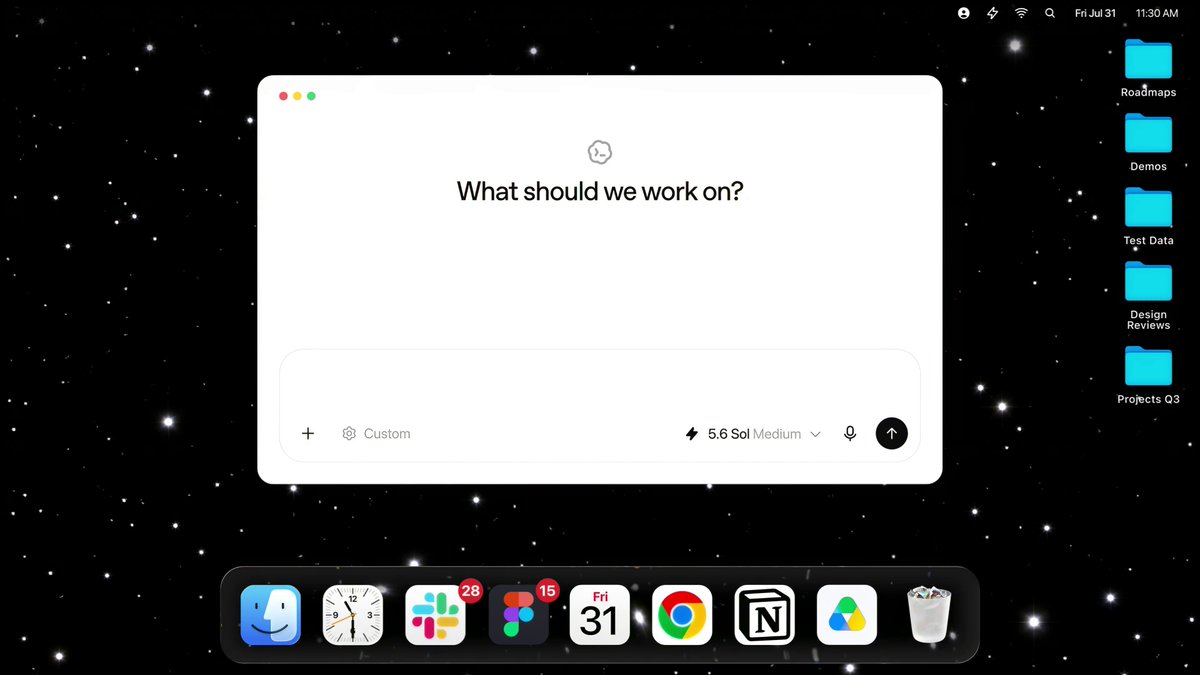
TL;DR - OpenAI announced Computer History for the ChatGPT desktop app, enabling ChatGPT to remember activity across computer apps and websites. This could make future interactions more personalized and reduce repeated context-setting.

  • Computer History provides persistent context from activity outside ChatGPT.
  • The feature spans apps and websites used on the computer.
  • OpenAI’s post does not specify technical implementation, privacy controls, or availability details.
Representative image for R to @OpenAI: Computer History builds on the Chronicle research preview with reduced token usage…

R to @OpenAI: Computer History builds on the Chronicle research preview with reduced token usage…

Rank 68 · Content 75 · Popularity N/A

TL;DR - OpenAI’s Computer History expands the Chronicle preview, enabling ChatGPT and Codex to use recent computer activity as memories while reducing token usage and adding privacy controls.

  • A timeline lets users review past work and identify recurring tasks.
  • Users can clear all or selected history and exclude specific apps or websites.
  • Computer History can be paused and resumed from the timeline or menu bar.
  • The feature is designed to support skill-building from frequently performed tasks.
Representative image for 刚刚,DeepSeek Harness发布!

刚刚,DeepSeek Harness发布!

Rank 64 · Content 70 · Popularity N/A

TL;DR - DeepSeek released the open-source developer preview of DeepSeek Harness v0.1, a modular framework for building and operating AI agents. Its plugin-first architecture lets developers replace or combine nearly every agent capability without modifying the core code.

  • Built on the Cordis plugin system, covering models, tools, skills, sessions, sandboxes, storage, loops, scheduling, and UI.
  • Provides standard, programmatic tool-calling, minimal benchmarking, and plugin-creation modes.
  • Uses append-only session logs to support trajectory inspection, recovery, branching, retrieval, and replay.
  • Available under the MIT license via npx @deepseek-ai/dsh web or its GitHub repository.
Representative image for R to @OpenAI: We examine how these orgs are putting AI to work, and how agentic workflows are…

R to @OpenAI: We examine how these orgs are putting AI to work, and how agentic workflows are…

Rank 64 · Content 70 · Popularity N/A

TL;DR - OpenAI highlights enterprise adoption of agentic AI through ChatGPT and Codex, emphasizing a shift from assisting workers toward executing workflows. It argues that leading firms are expanding these systems across industries and business functions.

  • Focuses on real-world enterprise use of agentic workflows.
  • Features ChatGPT and Codex as tools supporting the shift from assistance to execution.
  • Suggests AI adoption maturity is becoming a differentiator among firms.
  • The provided excerpt does not include specific metrics or technical implementation details.
Representative image for 苦等两年!ChatGPT杀入Linux,Codex上手能改你的代码

苦等两年!ChatGPT杀入Linux,Codex上手能改你的代码

Rank 61 · Content 65 · Popularity N/A

TL;DR - OpenAI launched a preview of its ChatGPT desktop app for Linux, combining ChatGPT, Work, and Codex in one interface. The key addition for developers is Codex’s access to local repositories, files, and terminals for end-to-end coding workflows.

  • Initial support covers select Ubuntu, Debian, and Fedora releases on x64 and ARM64 via .deb and .rpm packages.
  • Codex can inspect code, modify files, execute commands, diagnose errors, and iterate locally.
  • ChatGPT and Codex retain separate histories and workflows despite sharing one application.
  • The preview leaves enterprise permission controls, sandboxing, hardware requirements, and broader distribution support unclear.
Representative image for 刚刚,中国AI交卷!40年难题56分钟破局,AI不再「学习」

刚刚,中国AI交卷!40年难题56分钟破局,AI不再「学习」

Rank 61 · Content 65 · Popularity N/A

TL;DR - Baidu launched its “Famou” self-evolving agent and an AI4S strategy spanning research and industry. The system searches and evaluates candidate solutions to complex optimization problems rather than merely predicting from learned data.

  • In pine-disease detection, Famou reduced 107 candidate features to about five in 56 minutes, raising early detection from 89.1% to 98.0%.
  • Its workflow combines problem definition, candidate generation, tool-based evaluation, and iterative evolution toward better solutions.
  • Reported applications include Lean theorem proving, energy scheduling, materials and depression research, port operations, traffic control, and financial feature discovery.
  • Baidu says more than 3,000 companies have trialed the platform and plans to collaborate with 100 scientists on additional AI4S projects.

以服务驱动增长 滴滴中国出行单量连续14个季度上涨

Rank 36 · Content 30 · Popularity N/A

TL;DR - Didi reported continued ride-hailing growth while expanding AI-assisted service matching and autonomous driving. Its multi-agent “AI Xiaodi” system improved satisfaction in core scenarios by nearly 10 percentage points.

  • AI Xiaodi uses more than 90 service labels and a multi-agent architecture to translate personalized requests into ride matches.
  • The assistant is expanding beyond ride-hailing into designated-driver and carpooling services.
  • Didi and GAC Aion’s R2 Robotaxi is undergoing routine testing in Beijing and Guangzhou.
  • Didi plans continued investment in AI and autonomous-driving technology alongside global expansion.

LLMs & Foundation Models 1

Representative image for 有人称中签宇树不敢发朋友圈:怕被嫉妒;DeepSeek V4 Pro正式版上线;美国政府设备重新允许使用TikTok!特朗普:我在TikTok一直霸榜第一

有人称中签宇树不敢发朋友圈:怕被嫉妒;DeepSeek V4 Pro正式版上线;美国政府设备重新允许使用TikTok!特朗普:我在TikTok一直霸榜第一

Rank 54 · Content 55 · Popularity N/A

TL;DR - This technology-news roundup highlights major AI model, infrastructure, and product updates, led by DeepSeek V4 Pro and Alibaba’s open-weight Qwen3.8. The releases emphasize larger context windows, stronger agent capabilities, and infrastructure for trillion-parameter models.

  • DeepSeek V4 Pro’s API supports a 1M-token context, tool calling, JSON output, and reasoning and non-reasoning modes.
  • Alibaba released Qwen3.8-2.4T-A95B weights: a 2.4T-parameter MoE model activating 95B parameters per token with native 256K context.
  • Alibaba launched an M890 supernode capable of running models exceeding two trillion parameters.
  • Tencent is testing its WeLM-powered Xiaowei agent in WeChat and plans to release the larger Hunyuan Hy4 model.

Multimodal & Generative 5

Representative image for 全球第一,碾压谷歌!中国版Thinking Machines诞生,语音赛道变天了

全球第一,碾压谷歌!中国版Thinking Machines诞生,语音赛道变天了

Rank 59 · Content 70 · Popularity 34

TL;DR - Chinese startup VUI Labs introduced Luna-TTS, a diffusion-based speech synthesis model claiming leading quality and latency results across public and internal benchmarks. Its block-diffusion architecture targets expressive, real-time voice agents.

  • Luna-TTS replaces token-by-token speech generation with bidirectional masked diffusion built from Qwen3-0.6B.
  • Luna-Codec separates semantic content from acoustic details across eight codebooks, aided by WavLM distillation.
  • Luna-TTS Realtime generates 1.28-second blocks and reports 41.6 ms first-packet latency and a 0.024 real-time factor on two H20 GPUs.
  • The system combines GRPO post-training, multilingual data, and explicit emotion and nonverbal tags for controllable speech.
Representative image for 最有意思的AI音乐模型,让创作不再差点意思

最有意思的AI音乐模型,让创作不再差点意思 🔗 2 sources

Rank 57 · Content 60 · Popularity N/A

TL;DR — 音超 V4.0 是重新训练的新一代 AI 音乐模型,重点提升提示词理解、情感表达、曲风还原、多语言生成和编曲质量,并覆盖大众、专业及企业场景。

  • 采用重新设计的架构,而非基于 V3.5 增量升级。
  • 支持十大语言,并向普通用户开放纯音乐生成。
  • 改善乐器分离、编曲细节,以及对口语化和强情绪提示词的遵循能力。
  • 完全使用壁仞国产 GPU 训练,已应用于音超 App、Studio、Hitto 和企业 API。

注: 智东西的摘要实际介绍的是百度 AI4S 与 Famou 决策智能体,和音超 V4.0 并非同一项工作,因此未将其技术内容混入总结。

Representative image for 谷歌Pixel 11全系涨价!搭2nm芯片,存储翻倍,AI跨40多款应用干活

谷歌Pixel 11全系涨价!搭2nm芯片,存储翻倍,AI跨40多款应用干活

Rank 57 · Content 60 · Popularity N/A

TL;DR - Google launched the Pixel 11 lineup with Tensor G6 and Gemini Nano, emphasizing faster on-device AI, cross-app assistance, and AI-enhanced imaging. The phones start at 256GB, while some models cost $100 more than their predecessors.

  • Gemini can perform multi-step tasks across more than 40 apps and proactively suggest context-relevant actions.
  • On-device AI is up to 3.5× faster and uses as little as one-third the energy, aided by 50% higher TPU performance.
  • Magic Capture analyzes roughly 400 frames to select and enhance photos while preserving a video of the full sequence.
  • New AI features include cleaned-up voice dictation, sign-language transcription, and real-time translation for video, podcasts, and voice messages.
Representative image for Osmo 360 II 背后:大疆全景影像的「三代进阶」之路

Osmo 360 II 背后:大疆全景影像的「三代进阶」之路

Rank 50 · Content 50 · Popularity N/A

TL;DR - DJI’s Osmo 360 II advances consumer 360° imaging from specialized sensor hardware toward an integrated computational platform, combining 8K/60fps capture with automated subject tracking and editing.

  • A square CMOS design better matches circular fisheye imagery, reducing unused sensor area and easing size, power, and thermal constraints.
  • The upgraded imaging pipeline coordinates dual-camera exposure, encoding, denoising, stitching, and stabilization, supporting 8K/60fps video and 14.5-stop dynamic range.
  • Subject tracking records composition data, while DJI Mimo identifies highlights from cues such as laughter and cheers and offers AI templates and one-click editing.
  • Shared accessories, 10-bit D-Log M color, and desktop and DaVinci workflows integrate the camera with DJI’s broader imaging ecosystem.
Representative image for 发布即热销:大疆 Osmo 360 II 首日拿下全渠道销量 TOP1

发布即热销:大疆 Osmo 360 II 首日拿下全渠道销量 TOP1

Rank 40 · Content 35 · Popularity N/A

TL;DR - DJI’s Osmo 360 II 8K panoramic camera ranked first in first-day sales across major Chinese online channels, signaling strong momentum in the consumer 360-camera market.

  • Features a 1-inch panoramic imaging system with native 8K/60fps video and 14.5 stops of dynamic range.
  • AI features include Super Night Scene 2.0, subject tracking, and automatic video creation.
  • Includes NFC connectivity, replaceable scratch-resistant lenses, and 105GB of built-in storage.
  • Generated over 117 million online impressions within its first 24 hours.

AI Content Provenance 1

Representative image for 「AI生成的内容全部加水印」OpenAI、Anthropic、Google都签了

「AI生成的内容全部加水印」OpenAI、Anthropic、Google都签了

Rank 61 · Content 65 · Popularity N/A

TL;DR - Major AI companies signed the EU’s AI-generated content transparency code, committing to machine-readable labeling and detection across text, images, audio, and video. Anthropic is implementing invisible text watermarks and signed provenance metadata across Claude models and access channels.

  • New Claude models launched in the EU will embed detectable text watermarks at the model level, with older models expected to follow by December 2.
  • Claude-generated SVG, PNG, and JPG files will carry digitally signed C2PA provenance metadata that can also indicate later tampering.
  • Google’s existing SynthID Text alters token probabilities to create statistical signals that can survive minor edits but weaken after extensive rewriting or translation.
  • Watermarks are imperfect evidence: mixed or heavily edited content may evade detection, while a detected signal does not conclusively prove authorship.

AI Safety 1

As part of our Responsible Scaling Policy, we publish regular Risk Reports. These share detailed…

Rank 64 · Content 70 · Popularity N/A

TL;DR - Anthropic released its second Risk Report under its Responsible Scaling Policy, detailing system risks and its preparedness to address them.

  • The report is part of Anthropic’s recurring risk-disclosure process.
  • It covers both identified risks and mitigation readiness.
  • The post provides no specific findings or technical results from the report.

AI Watermarking 1

Representative image for We’ve written an FAQ to answer some of the questions we've received about watermarking. In summary…

We’ve written an FAQ to answer some of the questions we've received about watermarking. In summary…

Rank 64 · Content 70 · Popularity N/A

TL;DR - Anthropic will watermark text from future Claude models to comply with the EU AI Act. The watermark is designed to indicate likely Claude involvement without visibly altering text, reducing quality, or increasing token costs.

  • Other major model developers signed the same Code of Practice and plan to implement watermarking.
  • Readers should not be able to distinguish watermarked from unwatermarked text.
  • The method adds no hidden characters or extra tokens.
  • Watermarks cannot be traced to a specific user, organization, or conversation.

Embodied AI 1

Representative image for 解读丨荣耀找一个新身份

解读丨荣耀找一个新身份

Rank 54 · Content 55 · Popularity N/A

TL;DR - Honor’s Robot Phone combines a smartphone with a motorized four-axis gimbal as the first product in its broader embodied-AI strategy. It matters as an attempt to reposition Honor from a phone maker into an AI-device ecosystem company amid declining handset competitiveness.

  • The device supports automatic subject tracking, music-synchronized movement, and embodied multimodal interactions.
  • Its Agentic OS and YOYO Pro reportedly plan tasks exceeding 100 steps, while OpenClaw lets developers control physical gimbal actions through natural language.
  • Core motors, reducers, and motion-control algorithms came from Honor’s robotics program, redirected toward a commercially viable consumer device.
  • The article questions its defensibility because Honor reportedly relies heavily on external APIs, open models, and Alibaba’s Qwen rather than proprietary foundation models.

Humanoid Robotics 1

Representative image for 限量手办 + 实景体验,浙江人行NAVIAI2026WRC 福利提前曝光

限量手办 + 实景体验,浙江人行NAVIAI2026WRC 福利提前曝光

Rank 47 · Content 45 · Popularity N/A

TL;DR - NAVIAI will showcase its humanoid robots at WRC2026, demonstrating practical deployments across manufacturing, retail, home services, and teleoperated data collection.

  • Planned demonstrations include depalletizing, sorting,搬运, product delivery, cooking, and cleaning.
  • The showcase will highlight multi-robot collaboration and task generalization.
  • Remote operation will support real-world data collection for robotic systems.
  • NAVIAI’s chief scientist will discuss the platform’s technical evolution and deployment roadmap.
Top highlights — Opinions

Causal AI 1

Representative image for 图灵奖得主Judea Pearl:理解因果的模型才能走向AGI

图灵奖得主Judea Pearl:理解因果的模型才能走向AGI

Rank 63 · Content 60 · Popularity 70

TL;DR - Judea Pearl argues that LLMs’ statistical pattern learning is insufficient for AGI because it does not reliably support causal reasoning. He proposes combining language models with causal models, environmental interaction, and active experimentation.

  • Pearl’s “causal ladder” distinguishes observation, intervention, and counterfactual reasoning; most current machine learning remains largely observational.
  • LLMs may reproduce causal explanations from training data without independently constructing causal models through interaction.
  • AGI would require systems that test hypotheses, model interventions, and learn from their environment—not merely predict from internet-scale text.
  • Pearl still sees LLMs as valuable components of future systems, while warning that autonomous exploration could introduce new control and safety risks.

Spatial Intelligence 1

Representative image for AI下一站是空间智能!AI教母李飞飞:开发者不只要写应用,还要给AI创造一个能行动的世界

AI下一站是空间智能!AI教母李飞飞:开发者不只要写应用,还要给AI创造一个能行动的世界

Rank 57 · Content 60 · Popularity N/A

TL;DR - Fei-Fei Li argues that AI’s next major frontier is spatial and physical intelligence: models that create, maintain, and simulate actionable 3D environments. This could expand AI development into robotics, games, design, and virtual production.

  • World models must preserve object relationships, scale, occlusion, physics, and consistency across viewpoints and actions.
  • World Labs aims to turn text, images, or sketches into explorable, editable 3D environments rather than static outputs.
  • Production adoption requires rendering, simulation, planning, storage, editing, and rigorous spatial and physical evaluation.
  • Developers can integrate these models through technologies such as WebGPU, Three.js, Gaussian splatting, and simulation-to-reality data pipelines.