🛰️ Daily AI Frontier
⚠ WeChat login expired or unavailable — new articles may be missing. Reconnect WeChat. An upstream outage cannot be fixed by scanning. Latest stored WeChat publication: 2026-08-25.

WeChat reconnect targets werss, while collection still uses wewe. Login alone does not complete the provider cutover.

Twitter/X collection is rate limited. 0 of 13 handles succeeded at the last check. Stored posts remain available; partial coverage is not a complete timeline.
29 works · 3 categories · 12 topics · blog 12 arxiv 15 journal 2 generated 2026-10-18 14:21:43 UTC
Top highlights — Research

LLM Agents 9

Representative image for WEAVE: Weaving Real-World Code Evolution into Dependency-Structured Tasks for Benchmarking and Training Code Agents

WEAVE: Weaving Real-World Code Evolution into Dependency-Structured Tasks for Benchmarking and Training Code Agents

Rank 87 · Content 100 · Popularity 58

TL;DR - WEAVE turns verified multi-PR software histories into executable, dependency-structured benchmarks for long-horizon code agents. It also introduces a test-grounded metric that rewards partial progress while respecting dependencies, enabling more informative evaluation and training.

  • Organizes related pull requests into bounded directed acyclic graphs using repository-calibrated, typed change loci.
  • Instantiates each dependency graph as a unified executable task rather than treating issues or PRs independently.
  • Introduces Graph Credit, a deterministic metric for measuring dependency-consistent partial completion.
  • Experiments cover task construction, agent evaluation, supervised fine-tuning, and reinforcement learning with verifiable rewards.

Representative image for Priming Base Models for Agentic Post-Training: An Open Midtraining Recipe

Priming Base Models for Agentic Post-Training: An Open Midtraining Recipe

Rank 86 · Content 100 · Popularity 53

TL;DR - This paper presents an open midtraining recipe that prepares base models for agentic post-training using long-context software-engineering data and limited agent traces. Applied to two Nemotron 3.5 models, it improves coding-agent performance and robustness while avoiding excessively long supervised fine-tuning.

  • Trains at 256K context for hundreds of billions of tokens on repositories, pull requests, commit histories, build logs, and a small proportion of agentic traces.
  • With identical downstream SFT, 500B midtraining tokens raise Nemotron 3.5 Lightning from 60.7 to 64.5 on SWE-bench Verified and from 55.8 to 62.8 on SWE-bench Multilingual.
  • For Nemotron 3.5 Super, 280B tokens improve DeepSWE from 11.7 to 15.7 and SWE-bench Verified from 72.9 to 74.3.
  • The authors evaluate recipes through short, fixed SFT runs because base-model proxy metrics did not reliably predict post-training results.

Learning Self-Orchestration in Decentralized Agent Swarms

Rank 82 · Content 90 · Popularity 62

TL;DR - Market-based post-training (MPT) jointly teaches decentralized agent swarms how to act and self-organize through learned participation bids, without a central coordinator. Across crafting, navigation, and deep-research tasks, this coordination improves performance, adaptation, scaling, and resilience.

  • Agents learn both task actions and bidding policies that determine participation and allocate local training credit.
  • Learned self-orchestration outperforms alternative coordination strategies when using the same post-trained action policies.
  • Ablations indicate that learning both actions and bids is beneficial, with bids providing more effective action-training signals.
  • Trained swarms adapt faster to related tasks, benefit from larger inference-time populations, and better tolerate agent dropout.
Representative image for LEASH: Uncertainty-Aware Weak-to-Strong Escalation and Oversight for Computer-Use Agents

LEASH: Uncertainty-Aware Weak-to-Strong Escalation and Oversight for Computer-Use Agents

Rank 81 · Content 90 · Popularity 61

TL;DR - LEASH is a training-free framework that uses a weak agent’s latent uncertainty to route computer-use tasks, escalate difficult steps to a stronger model, and oversee that model after handoff. It matches always-on Claude Opus 5 performance on OSWorld while reducing inference cost by 19.2%.

  • Compares weak-model hidden states against prior successful and failed trajectories to estimate uncertainty.
  • Supports initial task routing, step-level escalation, and post-handoff monitoring through a shadow observer.
  • Reuses action-generation activations, requiring neither extra forward passes nor dedicated monitor training.
  • Across four model backbones, it beats random escalation by 6.55–11.94 points at matched escalation rates; with Qwen3.5-35B-A3B, it reaches 73.66% success at $0.4117 per task.

MMSearch-OPD: Easy Made Hard, Hard Made Learnable for Long-Horizon Multimodal Search Agents

Rank 81 · Content 90 · Popularity 59

TL;DR - MMSearch-OPD trains multimodal agents for long-horizon evidence gathering by turning simple questions into controllably harder search tasks and combining reinforcement learning with on-policy distillation. This addresses limited challenging training data and sparse process feedback.

  • The Refine pipeline expands reasoning chains while reusing existing image-question pairs.
  • Parameterized transformations control search depth and cross-modal evidence requirements.
  • Answer rewards and lightweight behavior penalties guide reinforcement learning.
  • Reward-gap-modulated teacher guidance targets imperfect student trajectories, while decaying distillation reduces teacher dependence over time.

Hy-Memory-30B-A3B: Attributed Reinforcement Learning for Long-Term Memory Writing

Rank 81 · Content 90 · Popularity 59

TL;DR - Hy-Memory-30B-A3B is a compact long-term-memory writer trained with attributed reinforcement learning to manage persistent memory across multiple frameworks. It outperforms larger general-purpose models on four evaluated harnesses, suggesting specialized memory writers can improve quality while reducing serving costs.

  • Supports the write protocols of Mem0, MemOS, and Hy-Memory, with transfer evaluated on the held-out EverMemOS framework.
  • Uses on-policy distillation followed by chunk-level GRPO with answerability rewards, cross-chunk attribution, and penalties for excessive storage.
  • Training carries policy-written memory banks across context windows to better match deployment conditions.
  • On fixed 20% benchmark subsamples, it ranked first across all four harnesses, scoring a 55.49% macro average versus Claude Opus 5's 54.62%.
Representative image for CoWorld Reasoner: Agentic Multimodal Reasoning with the Evolving Video World Model-Driven Harness

CoWorld Reasoner: Agentic Multimodal Reasoning with the Evolving Video World Model-Driven Harness

Rank 80 · Content 90 · Popularity 56

TL;DR - CoWorld Reasoner is an agentic multimodal framework that lets a vision-language model dynamically use a video world model for task-specific visual imagination. Its co-evolved tool harness improves spatial, temporal, causal, and perceptual reasoning without changing either model’s weights.

  • The harness exposes multiple video-generation operations as tools and guides the VLM in deciding when and how to invoke them.
  • Tools, skills, and execution code are jointly revised from execution feedback while the VLM and video world model remain frozen.
  • The strongest variant improved over direct VLM reasoning on all seven evaluated benchmarks.
  • Reported relative accuracy gains include 11.8% on MMSI and 13.0% on ERQA, with gains over five same-backbone evolving baselines across five benchmarks.

Learning to Steer LLM Agents and Multi-Agent Systems

Rank 76 · Content 95 · Popularity 32

TL;DR - This paper introduces a reinforcement-learned steering agent that detects goal drift during single- and multi-agent execution and intervenes to restore progress. It improves performance and efficiency on information-seeking tasks while generalizing to new tasks and executors.

  • Uses a low-cost fast path to decide when intervention is needed and a higher-cost slow path to generate the intervention.
  • Jointly trains drift assessment and intervention generation using pairwise ranking and group-relative policy optimization (GRPO).
  • Supervises long-horizon tool use and inter-agent collaboration without replacing the underlying executor agents.
  • Supports adjustable intervention frequency without retraining and transfers to out-of-domain tasks and unseen executors.

Language Is a Security Surface for Agent Guards

Rank 76 · Content 95 · Popularity 32

TL;DR - LinguaGuardBench shows that many step-level agent safety guards change their tool-call verdicts when only the user request’s language changes. Smaller, open, and purpose-built guards are especially sensitive, raising multilingual reliability and safety concerns.

  • The benchmark translates 1,220 labeled AgentDojo-Traj instructions into five languages while keeping tool calls, observations, and labels identical.
  • Across 19 guards, translation caused more verdict changes than English paraphrasing or whitespace controls, with larger effects for lower-resource languages.
  • For nine guards below 13B parameters, mean placebo-adjusted flip rates rose from 1.5 percentage points in French to 4.4 points in Amharic.
  • Frontier guards shifted by at most roughly one point; Gemini 3.8 Flash produced identical verdicts across the tested request languages.

LLMs & Foundation Models 1

In-Context Learning Before Specialisation: Theory of Learning in a Solvable Topic Model

Rank 76 · Content 95 · Popularity 32

TL;DR - This paper develops a learning theory for why sequence models shift from in-context generalization to memorizing specialized patterns as pretraining data grows. In a solvable latent-topic model, theory and transformer experiments agree on when each strategy emerges without fitted parameters.

  • In-context prediction appears at lower sample complexity and generalizes optimally to topics unseen during training.
  • Specialized prediction emerges only once training tokens outnumber the parameters of the data-generating process.
  • The specialized strategy stores the finite mixture of latent topics represented in the training distribution.
  • Trained transformers reproduce the predicted scaling regimes and crossover between the two strategies.

Multimodal & Generative 3

Routing Policy Optimization for Online Diffusion Reinforcement Learning

Rank 83 · Content 90 · Popularity 68

TL;DR - Routing Policy Optimization (RPO) aligns diffusion-based visual generators by using stochastic attention routing for exploration while preserving the original sampler. It improves text-to-image and text-to-video quality with nearly 4× higher training efficiency than Flow-GRPO-style methods.

  • RPO samples attention routes at selected denoising levels, perturbing transition velocities without adding noise directly to the reverse trajectory.
  • A controlled two-rollout estimator isolates routing effects by sharing prompts, initial latents, denoising levels, and anchor layers while varying sampled routes.
  • The score-function objective differentiates dense velocities, so learned improvements remain after routing is removed.
  • Inference restores dense attention and retains the generator’s original deterministic sampler.
Representative image for MJev-Spatial: System One Spatial Intelligence via Native Attention Matching

MJev-Spatial: System One Spatial Intelligence via Native Attention Matching

Rank 80 · Content 85 · Popularity 69

TL;DR - MJev-Spatial replaces autoregressive text generation with parameter-free classification through a VLM’s pretrained attention projections, enabling faster spatial-reasoning decisions. The Qwen3.5-4B-based model outperforms its autoregressive base across 12 benchmarks while running 5.6× faster.

  • Unifies spatial-relation choices, scalar estimation, and 2D point prediction within a classification framework.
  • Uses query-key attention matching to score candidates; coarse-to-fine bins and image regions support numerical and point outputs.
  • Joint teacher-forced training, length-aware batching, and cross-GPU load balancing improve training throughput by 30.8%.
  • Trained on 12.3M converted question-answer pairs, it scores 65.64% overall and ranks first on 7 of 12 benchmarks.

SCOPE: Semantic Bounded Credit Optimization for Prompt Engineering in Text-to-image Generation

Rank 75 · Content 85 · Popularity 51

TL;DR - SCOPE improves reinforcement-learning-based prompt rewriting for text-to-image generation by assigning shared optimization weights to semantically coherent token spans. It outperforms vanilla GRPO across multiple image generators without requiring extra image renders or span-specific rewards.

  • The prompt rewriter jointly produces an enhanced prompt and a semantic partition covering objects, counts, attributes, and relations.
  • SCOPE pools policy log-probability shifts within each span while retaining one advantage value per completed prompt.
  • Across Qwen-Image, SD3, and FLUX.1-dev, it reports average relative gains of 9.48% on GeneVal and 7.62% on T2I-CompBench.
  • Ablations indicate that both semantic boundaries and within-span pooling contribute to the improvements.

Efficiency & Systems 2

Representative image for Velox: Spatial Memory Makes World Models Efficient

Velox: Spatial Memory Makes World Models Efficient

Rank 86 · Content 95 · Popularity 65

TL;DR - Velox is a training-free attention router that uses spatial geometry to select relevant historical context for video world models. It substantially speeds long interactive rollouts while maintaining performance close to dense attention.

  • Represents historical video blocks as camera-frustum slabs with depth intervals, using streaming geometry to identify spatially relevant context.
  • Applies geometric bias only to well-covered regions; uncovered regions retain the model’s original attention routing.
  • Uses fixed token-block granularity compatible with FlashAttention-style tiled execution and asynchronously constructs frustum slabs during denoising.
  • At chunk 48, Velox reports 4.36× faster attention and 2.43× faster denoising, while scoring within 0.15 API-free average points of dense LingBot-Fast-Cam across 158 WBench navigation cases.
Representative image for Architecting for Hardware Diversity: Meta's End-to-End Co-Design for High-Performance AI Training on AMD GPUs

Architecting for Hardware Diversity: Meta's End-to-End Co-Design for High-Performance AI Training on AMD GPUs

Rank 78 · Content 95 · Popularity 39

TL;DR - Meta presents an end-to-end co-design approach for production-scale recommendation-model training on AMD MI350X GPUs, achieving up to 1.5× higher throughput than a direct port. The work shows how hardware-aware model changes, analytical kernel selection, and agentic porting workflows can reduce dependence on CUDA-specific optimizations.

  • Hardware-model co-design exploits accelerator-specific advantages, including MI350X’s 1.6× greater HBM capacity than NVIDIA B200.
  • An analytical performance model selects kernels across datatypes and matrix shapes without warmup-based tuning.
  • Agentic workflows support CUDA migration, microarchitecture-aware kernel optimization, and custom shim generation.
  • Meta upstreamed its improvements to PyTorch, Triton, and ROCm.
Top highlights — Industry & News

LLM Agents 3

Representative image for 清华开源!智能体操作系统任务成本降83%,AI记忆可查可改

清华开源!智能体操作系统任务成本降83%,AI记忆可查可改

Rank 68 · Content 75 · Popularity N/A

TL;DR - Tsinghua’s THUNLP, ModelBest, and OpenBMB released PilotDeck 2.0, an open-source agent operating system for isolated project workspaces, editable long-term memory, background execution, and cost-aware model routing. Reported benchmarks show its multi-model orchestration can match or exceed stronger standalone models while reducing task costs by up to 83%.

  • Workspaces physically isolate each project’s files, memories, tasks, and skills to reduce context contamination.
  • Its “white-box” memory lets users inspect, edit, delete, pin, and roll back stored information; a Dream mode consolidates and deduplicates memories while idle.
  • Always-on agents can continue long-running tasks in the background, identify follow-up work, save outputs locally, and generate progress reports.
  • Smart Routing assigns planning to stronger models and routine subtasks to cheaper ones; one seven-task evaluation scored 70.6 at $3.15 versus Claude Sonnet 4.6’s 69.1 at $18.36.
Representative image for Claude半小时解开密码学悬案,学界集体走偏20年

Claude半小时解开密码学悬案,学界集体走偏20年

Rank 68 · Content 75 · Popularity N/A

TL;DR - Anthropic reports that Claude independently traced the unexplained seeds of five NIST-standard elliptic curves to lrand48 outputs initialized with Unix timestamps from 1997–1998. The independently reviewed finding resolves much of a decades-old cryptographic mystery and weakens suspicions that the seeds concealed a deliberate backdoor.

  • Claude tested 34 pseudorandom-generator and output-format combinations, identifying lrand48 from the zeroed highest bits of 32-bit seed segments.
  • It used LLL lattice reduction to reconstruct truncated generator states and traced their initialization values to Unix timestamps.
  • For P-256, the reported timestamp is August 16, 1997 at 01:52:34 UTC; the 1,842nd candidate reproduces its published seed.
  • Some history remains unresolved, including why valid candidate curves were skipped and how the B-163 seed and certain base points were generated.
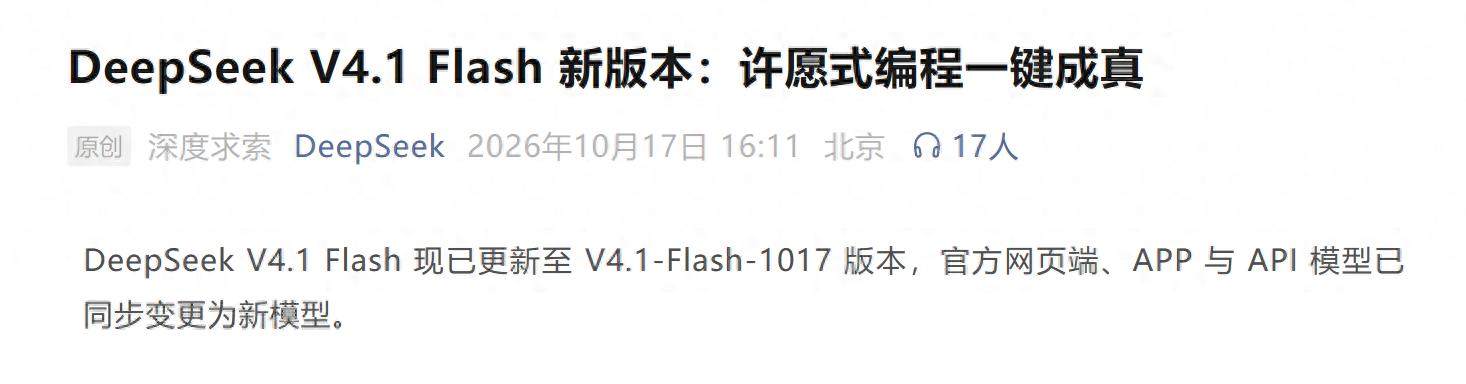
Representative image for 突发!DeepSeek新模型发布,超级性价比斩杀一切

突发!DeepSeek新模型发布,超级性价比斩杀一切

Rank 57 · Content 60 · Popularity N/A

TL;DR - DeepSeek released V4.1-Flash-1017, emphasizing stronger coding and agent performance with shorter runtimes, fewer output tokens, and lower costs. It also launched Search and Fetch APIs that let agents find and retrieve web content.

  • The model reportedly improves benchmark performance over V4.1 Flash, particularly for coding and agent tasks, while producing more concise outputs.
  • DeepSeek says self-feedback reinforcement learning enables the model to plan, code, run, inspect, and revise complete projects from brief prompts.
  • DeepSeek Harness 0.2.1 adds model-specific optimizations; full support requires version 0.2.1-rc.1 or later.
  • The new Search and Fetch APIs support source, language, and date filters and return selected webpages as Markdown for downstream agent analysis.

Medical/Healthcare AI 1

Representative image for 医美消费走向专业化、个性化,美团发布2026北极星医美榜

医美消费走向专业化、个性化,美团发布2026北极星医美榜

Rank 50 · Content 50 · Popularity N/A

TL;DR - 美团发布2026北极星医美榜,通过专家评审和消费者反馈评选机构与医生,并以AI经营平台支持医美商家。榜单旨在降低消费者的信息验证成本,推动行业从项目导向转向专业化、个性化和信任驱动。

  • 榜单覆盖42个城市的181家机构和269位医生,采用“医疗专业性+用户口碑”双轨评估体系。
  • 70位三甲医院专家累计评审9922小时手术视频、追踪8931份案例,并结合38547名消费者调研和450万条用户评价。
  • 美团的美Link平台将AI用于咨询接待、商品运营和线上门店管理,已服务超过1000家医美商家。
  • AI数字专家“美玲儿”和全天候AI客服累计接待超3万名咨询用户,其中超过1.7万人表达了到店意向。

Multimodal & Generative 1

Representative image for VAST开源实时世界模型EdenLive!单消费级显卡、720P超24FPS

VAST开源实时世界模型EdenLive!单消费级显卡、720P超24FPS

Rank 75 · Content 85 · Popularity N/A

TL;DR - VAST released and open-sourced EdenLive, a 5B real-time world model that converts simplified scenes or reference video into continuously generated, stylized visuals. It reportedly exceeds 24 FPS at 720p on one Nvidia RTX 5090, enabling interactive previews and minute-scale generation.

  • EdenLive decouples world-state management from visual rendering: an upstream system handles interaction and logic, while the model generates corresponding frames.
  • Its inputs combine reference imagery for layout and motion, a target first frame for appearance, and prompts for style and detail.
  • Demonstrated uses include game and animation previews, live video restyling, and embodied-AI data augmentation.
  • VAST released model weights, inference code, a technical report, and demos, while noting limitations in rapid interactions, multi-character identity, small-object control, and long-term consistency.

Efficiency & Systems 1

Representative image for 端侧跑通超千亿大模型!联想YOGA Pro 15 RTX Spark超级AIPC今日正式发售

端侧跑通超千亿大模型!联想YOGA Pro 15 RTX Spark超级AIPC今日正式发售

Rank 64 · Content 70 · Popularity N/A

TL;DR - Lenovo launched the YOGA Pro 15 RTX Spark AI PC, starting at RMB 29,999, for local AI creation, development, and research workloads. Its NVIDIA-based unified-memory architecture reportedly supports on-device inference of models exceeding 100 billion parameters, reducing cloud dependence and API costs.

  • The RTX Spark N1X chip integrates up to a 6,144-core Blackwell RTX GPU, 20-core Grace CPU, and 128GB of unified memory, delivering up to 1 PFLOP of FP4 performance.
  • Native CUDA support and up to 2TB of storage target local model inference, code analysis, data processing, 3D rendering, and video production.
  • Lenovo’s Tianxi AI agent can orchestrate tools and produce videos, webpages, and documents; its fully local “super mode” is planned for a later OTA update.
  • Local processing enables offline use and keeps private code, research data, and other assets on-device without per-token API charges.

AI Education 1

Teaching students to think and learn through questions

Rank 47 · Content 45 · Popularity N/A

TL;DR - OpenAI is promoting a Brazilian Portuguese version of AI for Educators and highlighting Study Mode as a tool for active, question-driven learning. The limited description frames AI as supporting teachers and students through guided, step-by-step reasoning.

  • AI for Educators is available in Brazilian Portuguese.
  • Study Mode uses questions to encourage active learning rather than simply providing answers.
  • The provided content does not include technical details, evaluation results, or implementation specifics.

Automotive AI 1

Representative image for 阿里千问上车宝马iX3

阿里千问上车宝马iX3

Rank 47 · Content 45 · Popularity N/A

TL;DR - BMW’s China-market Neue Klasse iX3 will integrate an AI cockpit jointly developed with Alibaba, using the Qwen large language model within BMW’s Intelligent Personal Assistant. The partnership extends Alibaba’s growing role as a full-stack AI and cloud provider for Chinese automakers.

  • Alibaba supplies the Qwen foundation model, while Banma handles cockpit applications and vehicle-side integration.
  • The AI capability is designed specifically for Chinese users and aims to enable more natural, context-aware in-car interactions.
  • Alibaba AI already supports automotive workloads spanning smart cockpits, autonomous-driving model training, software development, and manufacturing.
  • IDC data cited in the announcement gives Alibaba Cloud 42% of China’s automotive public-cloud IaaS market in the second half of 2025.

Enterprise AI 1

How Itaú is building generative AI for its entire customer base

Rank 47 · Content 45 · Popularity N/A

TL;DR - Itaú is expanding generative AI across customer and employee experiences through its ia.i conversational interface and IARA governance platform. The initiative highlights how a major bank is pairing broad AI adoption with governance in a highly regulated industry.

  • ia.i provides a conversational interface for Itaú’s customers and employees.
  • IARA serves as the governance platform supporting the bank’s generative AI deployment.
  • The effort is part of Itaú’s broader “AI First” strategy.
  • The provided excerpt does not specify model architecture, performance results, or deployment scale.

Legal AI 2

Representative image for 智谱新模型,懂法方面全球第一了

智谱新模型,懂法方面全球第一了

Rank 61 · Content 65 · Popularity N/A

TL;DR - Zhipu AI launched GLM-Legal, an open-weight model for contract review, evidence analysis, and cross-border compliance. It leads open-weight models on two legal benchmarks, though its 19.2% full-pass rate shows substantial room for improvement.

  • GLM-Legal scored 19.2% on Harvey LAB’s strict full-pass metric and 86.23% accuracy on LegalBench.
  • Built on GLM-5.3-Flash, it received continued legal-corpus training followed by reinforcement learning across tens of thousands of simulated legal tasks.
  • The model supports Chinese and English legal work plus Southeast Asian compliance, producing concrete deliverables such as contract revisions and action checklists.
  • Zhipu opened a beta for legal professionals and plans to integrate the capabilities into AutoClaw.

Sullivan & Cromwell brings legal expertise into agreement review

Rank 47 · Content 45 · Popularity N/A

TL;DR - OpenAI and Sullivan & Cromwell developed Agreement Analyzer, an AI tool that applies the law firm’s legal expertise to identifying potential issues in draft agreements.

  • The tool focuses specifically on agreement review.
  • It was developed through collaboration between OpenAI and Sullivan & Cromwell.
  • The provided description does not specify the model, workflow, evaluation results, or deployment details.

Science News 1

Give me the good news: four science stories to brighten your day

Rank 47 · Content 45 · Popularity 50

TL;DR - Nature highlights four positive science stories, including drugs reported to reverse multiple sclerosis in mice and the discovery of a new penguin species. The provided excerpt is too brief to assess the findings or their broader significance in detail.

  • The multiple-sclerosis result was demonstrated in mice, not humans.
  • The article also features the identification of a new penguin species.
  • Details about the other stories, experimental methods, and evidence are not included in the excerpt.

Weather Modeling 1

HiRO-ACEv2: Simulating extreme weather at 3 km resolution for a fraction of the cost

Rank 64 · Content 70 · Popularity N/A

TL;DR - Hugging Face highlights HiRO-ACEv2, a system for simulating extreme weather at 3 km resolution with substantially lower claimed costs. Because only the title was provided, its methods, benchmarks, and exact cost savings cannot be assessed here.

  • Targets high-resolution simulation of extreme weather events.
  • Uses a 3 km spatial resolution, indicating fine-grained regional modeling.
  • Emphasizes computational cost reduction relative to unspecified alternatives.
  • No technical implementation details or quantitative results were included.
Top highlights — Opinions
  • Is AI eroding PhD students’ critical thinking and analysis skills? captures today’s central debate: whether AI use in doctoral programmes is weakening the analytical abilities researchers are expected to develop.
  • The Nature expert panel framing makes this a consequential academic-policy question, though the available excerpt provides no specific evidence or conclusions.

AI in Education 1

Is AI eroding PhD students’ critical thinking and analysis skills?

Rank 50 · Content 50 · Popularity 50

TL;DR - A Nature expert panel debates whether AI use in doctoral programmes is weakening PhD students’ critical-thinking and analytical skills. The limited excerpt provides no specific arguments, evidence, or conclusions.

  • Focuses on AI’s impact on doctoral education and researcher development.
  • Raises concern that reliance on AI tools could erode core reasoning and analysis skills.
  • Frames the issue as an expert debate rather than reporting a definitive research finding.