🛰️ Daily AI Frontier
⚠ WeChat login expired or unavailable — new articles may be missing. Reconnect WeChat. An upstream outage cannot be fixed by scanning. Latest stored WeChat publication: 2026-08-25.

WeChat reconnect targets werss, while collection still uses wewe. Login alone does not complete the provider cutover.

Twitter/X collection is rate limited. 0 of 13 handles succeeded at the last check. Stored posts remain available; partial coverage is not a complete timeline.
73 works · 2 categories · 17 topics · blog 24 journal 20 arxiv 30 generated 2026-11-05 15:33:14 UTC
Top highlights — Research

LLM Agents 16

FrontierPhysics: Evaluating Agents for End-to-End Physics Research

Rank 91 · Content 100 · Popularity 71

TL;DR - FrontierPhysics is an end-to-end benchmark testing whether AI agents can conduct rigorous, publishable physics research. Results show that current agents struggle more with rigorous reasoning and expert intuition than with physics knowledge or task execution.

  • Includes 56 tasks from 42 physicists across nine theoretical, computational, and experimental domains.
  • Evaluates literature review, research planning, experiments, structured outputs, and manuscript writing.
  • Uses deterministic verifiers and expert-authored rubrics to assess correctness and publishability.
  • Across 22 models and 26 configurations, no configuration passed more than 46 of 168 rollouts.

Signed but Steerable: Measuring and Closing the Text-Vector Integrity Gap in Offline Retrieval-Augmented Generation

Rank 89 · Content 100 · Popularity 62

TL;DR - This paper identifies a security flaw in offline RAG knowledge packs: signatures authenticate publishers but do not ensure stored embeddings represent the signed text. Tolerance-based vector verification remains vulnerable, while canonical verification of quantization codes closes the publisher’s ability to steer retrieval.

  • Even floating-point-noise tolerance exposed up to 5.5% of queries, or at most 1.2% per corpus after removing exact duplicates.
  • A threshold calibrated for CPU INT8–FP32 differences exposed 98–100% of queries; on Raspberry Pi 5, an attack reduced answer accuracy from 0.75 to 0.39.
  • Tampered vectors passing FAISS product-quantization audits ranked the attacker’s document first for 25% of targets.
  • Guard-banded, canonical quantization-code verification accepted all sampled honest vectors across three platforms while removing publisher-controlled ambiguity.
Representative image for Give Up to Get More: Priors, Not Policies, Govern Test-Time Compute Allocation

Give Up to Get More: Priors, Not Policies, Govern Test-Time Compute Allocation

Rank 88 · Content 100 · Popularity 61

TL;DR - Test-time compute should not simply favor the hardest inputs: optimal allocation follows an inverted-U, deprioritizing currently hopeless cases. Accurate solvability priors and reliable verifiers matter more than the allocation policy itself.

  • Difficulty-proportional allocation captured at most 13% of oracle gains on hard workloads.
  • Thompson Sampling with prior results raised solved share from 14% to 27% on the hardest workload.
  • Without an informative prior, no tested policy beat round-robin allocation.
  • Benefits required sufficiently correlated priors and verifiers with very low false-acceptance rates.

Tools Need Not Speak in Text: Latent Context Compression for Agents

Rank 86 · Content 95 · Popularity 64

TL;DR - Coca-Cola compresses agents’ textual tool outputs into action-relevant latent tokens, reducing context overhead while preserving decision-critical information. Across web-search QA tasks, it cut token use and runtime while improving performance.

  • Embeds compressed tool observations directly into the agent’s input embedding space.
  • Uses Action-Preserving Training to align next-action distributions between full and compressed observations.
  • Reduced token consumption by 70.01%–89.24% across four QA benchmarks and two model families.
  • Reduced end-to-end runtime by 24.45%–55.97% while consistently improving task performance.

What Does Multi-Turn Reinforcement Learning Really Improve in LLM Agents?

Rank 84 · Content 90 · Popularity 70

TL;DR - Multi-turn reinforcement learning primarily improves LLM agents’ error recovery and long-horizon resilience rather than single-step decisions. Its gains depend heavily on interaction budgets, motivating training across varied budgets.

  • Introduces Pass@(K,T) to evaluate sampling breadth (K) and interaction depth (T).
  • Trajectory-level RL advantages diminish substantially under tighter turn budgets.
  • Proposes BudgetMix RL, which varies interaction budgets during training.
  • Experiments show BudgetMix RL is more robust across diverse execution settings.

Where Search Agents Go Off the Rails: Graph-Grounded Step-Level Verification

Rank 81 · Content 100 · Popularity 37

TL;DR - GraphRail audits search-augmented reasoning at the claim level, checking whether evidence covers the question and grounds each reasoning step. It improves intermediate-error recall over generative verifiers without requiring a gold answer or generative judge.

  • Represents questions, evidence, and reasoning as structured claims for direct comparison.
  • Evaluated across three multi-hop QA benchmarks and three reasoning frameworks.
  • Remains stable under stochastic claim extraction.
  • Its traceable diagnoses can guide online correction of intermediate reasoning errors.

When Do Summaries Become Instructions? Unsupported Policy in LLM Agents' Self-Written Handoff Summaries

Rank 81 · Content 100 · Popularity 37

TL;DR - LLM agents’ self-written handoff summaries can invent unsupported permissions or restrictions that influence successor agents. Clarifying where authorization requirements originate substantially reduced false restrictions.

  • Unsupported restrictions appeared in 1.2%–2.4% of readable summaries; unsupported authorizations appeared in 0.1%–1.3%.
  • Neutralizing false approvals reduced unauthorized actions from 24 to 7 across 120 held-out runs, though this analysis was post hoc.
  • Evidence that false restrictions altered successor behavior was mixed: the pre-specified test was insignificant, while a follow-up found a fragile effect.
  • A source-explicit system prompt cut unsupported restrictions from 5.0% to 1.8% in development and from 1.8% to 0.3% on held-out templates.

A.S.E 2.0: Understanding How Repository Context Impacts the Security of LLM-Generated Code

Rank 81 · Content 100 · Popularity 37

TL;DR - CASE-Bench evaluates how repository context affects the security of LLM-generated code across 145 real-CVE tasks. It shows that context optimized for functionality often misses critical safeguards, leaving code correct but exploitable.

  • Functionality-oriented context improved functional pass rates by up to 8.2 percentage points, but secure pass rates by at most 3.7 points.
  • Withholding one safeguard reduced secure pass rates by up to 8.1 points.
  • Adding one insecure exemplar increased correct-but-exploitable outputs by 6.3 points.
  • Coding agents encountered relevant safeguards in only 27–36% of trajectories.

AI agents enter the ‘wet lab’

Rank 79 · Content 95 · Popularity 43

TL;DR - An AI system coordinates laboratory instruments to perform multi-step molecular-biology experiments with limited human intervention, bringing agentic automation into wet labs.

  • The system orchestrates physical laboratory equipment across multiple experimental steps.
  • It reduces—but does not eliminate—the need for human intervention.
  • The brief description does not specify methods, experiments, or performance results.

AI agents run this automated biology lab that sequences DNA and more

Rank 79 · Content 95 · Popularity 43

TL;DR - A self-driving biology lab in China uses AI agents to translate a simple prompt into automated DNA encoding, sequencing, and message readout. The brief description does not provide performance results or implementation details.

  • AI agents coordinate an end-to-end laboratory workflow with minimal human instruction.
  • The system can encode messages in DNA and subsequently recover them.
  • The work demonstrates agentic automation spanning physical biology experiments and sequencing.
Representative image for LifeVal: Evaluating AI Model Performance on Personalized Agentic Consumer Tasks

LifeVal: Evaluating AI Model Performance on Personalized Agentic Consumer Tasks

Rank 78 · Content 95 · Popularity 37

TL;DR - LifeVal is a benchmark for evaluating AI models on personalized, agentic consumer tasks such as managing finances, job hunting, and finding childcare. It aims to measure performance on high-value real-life assistance grounded in users’ actual context.

  • Covers 148 consumer task categories representing over $1.7 trillion in estimated annual willingness-to-pay.
  • Derives its activity distribution from 3,800+ consumers and cross-references major time-use surveys.
  • Personalizes tasks using real ChatGPT conversations, memories, reference files, and personal context.
  • Uses experienced task creators, task-specific rubrics, and at least three rounds of human quality control.
Representative image for SecureGARD: Dynamic Ontology-Guided Governance for Secure Tool-Using LLM Agents

SecureGARD: Dynamic Ontology-Guided Governance for Secure Tool-Using LLM Agents

Rank 78 · Content 95 · Popularity 37

TL;DR - SecureGARD is an ontology-guided governance framework that deterministically permits, delays, or forbids tool calls based on action semantics and task state. It reports 0% attack success across three agent-security benchmarks while preserving stronger task utility under attack than existing defenses.

  • Maps heterogeneous tool calls into a shared semantic representation with explicit action, state, and evidence relations.
  • Uses “waiting” decisions for unmet but recoverable obligations, enabling bounded replanning without expanding authorization.
  • Evolves its ontology offline from verified executions, accepting proposed axioms only after consistency, protected-entailment, and held-out validation checks.
  • Evaluated on AgentDojo, ASB, and AgentDyn under benign and indirect prompt-injection conditions.

Signed, Sealed, Leaked: Trust Beyond Signature for MCP Toolchains

Rank 78 · Content 95 · Popularity 37

TL;DR - This paper shows that signed MCP tools can still covertly leak sensitive data despite runtime defenses. It proposes “germline execution,” isolating each invocation with only destination-authorized data to bound potential disclosure.

  • A signed malicious MCP tool bypassed MCPGuard-Dynamic in every trial while direct exfiltration was blocked.
  • Germline execution prevented unauthorized disclosure across 153 attack runs, versus 5.9–74.5% leakage under baselines and an ablation.
  • The authors prove sink noninterference under explicit confinement and data-free-germline assumptions.
  • Single-copy invocations took 10–49 ms, 2–28× faster than restarting the tool for every call.

Using Experience Twice: Dynamic Process Rubrics for Privileged Token-Level Credit Assignment

Rank 78 · Content 95 · Popularity 37

TL;DR - ORSD derives natural-language process rubrics from contrasting agent trajectories and uses them to assign dense, token-level credit alongside sparse outcome rewards. It improves learning speed and final performance on ALFWorld and WebShop without increasing environment interactions.

  • The policy generates candidate rubric bundles from behavioral differences across on-policy trajectories.
  • A frozen verifier selects rubrics whose satisfaction best aligns with task success.
  • Token-level likelihood changes with versus without the selected rubric shape the standard GRPO advantage.
  • Experiments report gains for Qwen3-1.7B and Qwen3-4B under the same interaction budget.

SpecCompact: Accelerating LLM Agent Context Compaction with Slot-Parallel Semantic Speculative Verification

Rank 74 · Content 90 · Popularity 37

TL;DR - SpecCompact accelerates LLM-agent context compaction by drafting structured summary slots in parallel and having a target model verify and repair them. It delivers 2.04–5.63× benchmark speedups while exposing model- and task-dependent quality trade-offs.

  • Fine-tunes a small drafter to generate independent summary slots concurrently.
  • Uses semantic verification: the target model accepts proposed lines or repairs rejected content.
  • System optimizations reduce repeated context processing and model calls.
  • A Hermes user study reports an 8.68× median compaction speedup.
Representative image for On Turn-Level Best-of-N Sampling for Scaling LLM Agents

On Turn-Level Best-of-N Sampling for Scaling LLM Agents

Rank 74 · Content 90 · Popularity 37

TL;DR - Turn-level best-of-N sampling improves LLM-agent performance on long-horizon terminal tasks by generating multiple candidate actions at each step and using another LLM to select one. The approach raises accuracy by 5–10% and improves consistency.

  • Uses a two-model generator-selector framework with off-the-shelf, open-weight LLMs.
  • Selects and executes one of N candidate actions at every agent turn.
  • Produces fewer solution attempts and better instruction following, debugging, and testing.
  • Demonstrates a simple inference-time scaling method without specialized critic models.

Medical/Healthcare AI 8

A 3D foundation model unifying CT interpretation and segmentation

Rank 91 · Content 100 · Popularity 71

TL;DR - HoloCT is a 3D foundation model that unifies whole-volume CT interpretation with voxel-level segmentation, producing spatial masks as evidence for textual findings. It outperformed competing models across diverse tasks and multicentre clinical validation.

  • Trained on 195,921 CT scans, 6.2 million instruction dialogues, and 2.8 million CT-mask pairs.
  • Evaluated across 346 tasks, including segmentation, lesion screening, visual question answering, and report generation.
  • On 11,455 scans from five hospitals, it improved lesion segmentation and report generation by 18.2 and 15.3 points, respectively.
  • Joint semantic-spatial learning improved both language-guided segmentation of unseen findings and interpretation accuracy.

Decoding the regulatory programs governing glioblastoma plasticity

Rank 84 · Content 90 · Popularity 71

TL;DR - Multi-omic analysis of glioblastoma patient cells identifies a regulatory network that governs non-genetic cellular plasticity, offering insight into how tumors change state during disease progression.

  • Cell-state stability is controlled by interacting regulatory activators and repressors.
  • The study focuses on non-genetic mechanisms rather than DNA mutations alone.
  • Understanding these programs may clarify how glioblastoma adapts and progresses.

In vivo CAR-T double knockout screen maps synergistic antitumour gene pairs

Rank 79 · Content 95 · Popularity 43

TL;DR - A Nature study uses high-throughput in vivo double-knockout screening to identify synergistic gene pairs that could improve CAR-T cell therapy.

  • Screens pairs of gene knockouts directly in CAR-T cells in vivo.
  • Maps gene combinations associated with enhanced antitumour activity.
  • Provides potential targets for engineering more effective CAR-T therapies.
  • Specific gene pairs and efficacy results are not included in the provided excerpt.

EEGDash Corpus: A Training-Ready Public Corpus for EEG Foundation Models

Rank 79 · Content 95 · Popularity 42

TL;DR - EEGDash Corpus packages 77 public EEG datasets into a training-ready corpus for EEG foundation models. It provides 14,075 hours of standardized, licensed, integrity-checked data and reproduces much of REVE-Base’s benchmark performance.

  • Contains recordings from 7,272 subjects, yielding 5 million 10-second samples and 6.21 billion tokens per epoch.
  • Data is converted using REVE’s recipe and stored in per-dataset Zarr buckets with licenses and SHA-256 hashes.
  • Retrained REVE-Base achieved 0.331 linear-probing performance versus 0.333 for the released model across seven OpenEEGBench tasks.
  • The corpus excludes non-redistributable clinical archives and no-derivatives datasets, including sources representing 82% of REVE’s reported pretraining hours.

Cancer-selective gene circuits via intrinsic ribosomal frameshifting

Rank 74 · Content 80 · Popularity 59

TL;DR - This Nature study identifies codon-pair-dependent ribosomal frameshifting as a feature of translational dysregulation in cancer cells and uses it to create cancer-selective gene circuits.

  • Exploits intrinsic differences in cancer-cell translation machinery.
  • Uses codon-pair-dependent frameshifting to control gene-circuit activity.
  • Suggests a route to therapies that activate selectively in cancer cells.
  • Detailed performance and experimental results are not provided in the excerpt.

Epileptic seizures nearly vanish after people receive experimental gene therapy in their brains

Rank 69 · Content 80 · Popularity 43

TL;DR - An experimental brain-delivered gene therapy was tested in three people with epilepsy, reportedly making seizures nearly disappear. The small clinical trial combined gene-carrying viruses with a drug.

  • The treatment delivered genes directly into participants’ brains using viral vectors.
  • A drug was administered alongside the gene therapy.
  • The reported seizure reduction is promising, but evidence is limited to three participants.
  • The provided excerpt does not specify the genes, drug, trial design, or quantitative outcomes.

A death sentence for ‘sloppy’ cancers

Rank 69 · Content 80 · Popularity 43

TL;DR - Cancer cells’ error-prone conversion of RNA into protein could become a vulnerability for gene therapies designed to selectively target tumours.

  • Protein production from RNA can malfunction in cancer cells.
  • Researchers may be able to exploit these translation errors to activate tumour-targeting gene therapies.
  • The provided summary does not specify the therapy’s design, experimental results, or clinical readiness.

Venousization enables angiogenesis in the absence of VEGFR signalling

Rank 69 · Content 80 · Popularity 43

TL;DR - Longitudinal endothelial-cell tracking shows that new functional blood vessels can form despite VEGFR2 loss. This challenges VEGF receptors’ assumed necessity in angiogenesis and may help explain resistance to anti-VEGF therapies.

  • Endothelial cells adapt to the loss of VEGFR2 signalling.
  • This adaptation, termed venousization, enables functional vessel formation.
  • The findings revise conventional models of VEGF-dependent angiogenesis.
  • The mechanism may inform research into anti-VEGF treatment resistance.

Bioinformatics AI 8

An open structure-guided RNA foundation model for generalizable prediction

Rank 91 · Content 100 · Popularity 69

TL;DR - structRFM is an open RNA foundation model pretrained on 21 million sequence–structure pairs. Its structure-guided representations improve RNA structure prediction, functional inference, and generalization across diverse RNA families.

  • Learns multimodal representations from paired RNA sequences and structures.
  • Supports secondary- and tertiary-structure prediction.
  • Enables functional inference and zero-shot generalization.
  • Designed for broad applicability across diverse RNA families.

An AI-native experimental laboratory for autonomous biomolecular operations

Rank 90 · Content 100 · Popularity 67

TL;DR - AutoDNA is an AI-native autonomous laboratory for biomolecular engineering that coordinates multi-objective experiments across diverse instruments. It matters as an end-to-end framework for integrating AI-driven decisions with laboratory automation in multi-user environments.

  • Targets autonomous biomolecular engineering workflows.
  • Supports multi-objective experiments spanning multiple instruments.
  • Enables co-evolution of AI and the laboratory automation system.
  • Provides an end-to-end, multi-user experimental framework.

A spatiotemporal cancer cell trajectory underlies glioblastoma heterogeneity

Rank 87 · Content 95 · Popularity 69

TL;DR - A deep single-cell and spatial multi-omic atlas links glioblastoma heterogeneity to a stereotyped, spatially patterned cancer-cell trajectory. This could clarify how diverse tumour states emerge and are organized.

  • Integrates transcriptomic, epigenomic, and genomic profiling of human glioblastoma.
  • Uses single-cell and spatial measurements to map tumour-cell states in tissue.
  • Traces heterogeneity to a shared spatiotemporal trajectory rather than unrelated cell states.

Transcriptomic convergence and the female protective effect in autism

Rank 87 · Content 95 · Popularity 69

TL;DR - Gene network analysis reveals how diverse autism-associated mutations may converge on shared transcriptomic effects. It identifies the X-linked transcription factor ZFX as a potential contributor to female protection against autism.

  • Connects genetically diverse autism mutations through common gene-network effects.
  • Highlights transcriptomic convergence as a possible unifying disease mechanism.
  • Implicates ZFX as a key protective factor in the female brain.
  • Offers a molecular lead for understanding sex differences in autism susceptibility.

Microbiome-wide PheWAS links gut microbial SNVs to health and exposures

Rank 86 · Content 95 · Popularity 63

TL;DR - A microbiome-wide PheWAS links gut microbial single-nucleotide variants to host health and exposures at base-pair resolution, offering a resource for mechanistic hypothesis generation.

  • Analyzed gut microbial SNVs across 10,781 individuals.
  • Identified 940 associations spanning 69 host traits.
  • Connected strain-level microbial genetic variation with host phenotypes.
  • Structural analyses highlighted specific phenotype-associated variants.

abcFISH enables multiplexed, single-molecule visualization of circular RNA spatial heterogeneity

Rank 83 · Content 90 · Popularity 66

TL;DR - abcFISH is an imaging method for multiplexed, single-molecule detection of circular RNA in cells and in vivo. It enables analysis of spatial and single-cell expression heterogeneity while directly assessing circular aptamer therapeutic efficacy.

  • Detects multiple circular RNA species at single-molecule resolution.
  • Supports both cellular and in vivo imaging.
  • Reveals spatial variation and single-cell expression heterogeneity.
  • Enables direct visualization of circular aptamer therapeutic effects.

Comprehensive mapping of essential-gene interactions in M. tuberculosis

Rank 79 · Content 95 · Popularity 43

TL;DR - A high-throughput CRISPR-interference platform maps interactions among essential genes in Mycobacterium tuberculosis. The findings could clarify gene functions and drug–target relationships, supporting new tuberculosis therapies.

  • Reveals many previously unknown genetic interactions.
  • Focuses on essential genes required for bacterial survival.
  • Links genetic interactions to potential therapeutic targets.
  • Provides a scalable platform for studying tuberculosis biology.

Integration and annotation of spatial multi-omic data with DIRAC

Rank 76 · Content 90 · Popularity 43

TL;DR - DIRAC is a geometric deep learning model for integrating and annotating spatial multi-omic datasets. It supports both vertical and horizontal integration, potentially simplifying joint analysis across modalities and datasets.

  • Published in Nature Methods on 5 November 2026.
  • Targets spatial multi-omic data integration and annotation.
  • Supports vertical integration across modalities and horizontal integration across datasets.
  • The provided content does not report benchmarks or quantitative results.

LLMs & Foundation Models 4

Representative image for Rules, Traces and Routing Statistics: Training and Calibration Data for Open Models on ARC-AGI-2

Rules, Traces and Routing Statistics: Training and Calibration Data for Open Models on ARC-AGI-2

Rank 82 · Content 95 · Popularity N/A

TL;DR - This study evaluates training data and inference strategies for open models on ARC-AGI-2 under fixed compute limits. Real-task fine-tuning, model-specific inference, and expert pruning outperformed large synthetic datasets, reaching a best score of 56.67.

  • Synthetic tasks—including a 95,993-task corpus—did not improve the Qwen3-4B model beyond real-task fine-tuning, which raised its mean score from 28.96 to 33.06.
  • Qwen3.8-27B improved from 26.81 to 44.03, with most gains attributed to program-checked, long-attempt inference rather than added training data.
  • Router-informed pruning and FP8 caching expanded Qwen3.8-Flash-Next’s key-value cache from 0.55M to 1.96M tokens.
  • The pruned mixture-of-experts model achieved the best reported score, 56.67, using a program-checking tool.
Representative image for Mass Producing Training Data with Surprising Side Effects

Mass Producing Training Data with Surprising Side Effects

Rank 79 · Content 95 · Popularity 42

TL;DR - A new automated pipeline generates post-training datasets that appear ordinary but induce surprising, out-of-domain model behaviors. Its 6,575 discovered datasets offer a testbed for predicting harmful training side effects before deployment.

  • The pipeline searches for datasets using evolution, reinforcement learning, and subliminal learning.
  • It targets eight behaviors while optimizing for effectiveness, ordinary appearance, and surprising effects.
  • Many discovered effects generalize across model families and sizes.
  • Automated metrics align with researcher judgments, while frontier models outperform humans at predicting side effects.
Representative image for EvoOPD: Evolving Privileged Information Strategies for Black-Box On-Policy Distillation

EvoOPD: Evolving Privileged Information Strategies for Black-Box On-Policy Distillation

Rank 78 · Content 95 · Popularity 37

TL;DR - EvoOPD improves black-box on-policy distillation by dynamically optimizing what textual feedback a proprietary teacher provides as privileged information. It outperforms fixed feedback strategies across six mathematical reasoning and code-generation settings.

  • Maintains a strategy bank that evolves with the student’s training state.
  • Adapts feedback focus, information type, and granularity using measured repair utility.
  • Evaluated with Qwen3 students at 1.7B, 4B, and 8B parameters.
  • Beats the strongest baselines by averages of 2.14 percentage points in mathematics and 1.30 points in code.

StateBench: Testing how language models track state changes over long documents

Rank 71 · Content 80 · Popularity N/A

TL;DR - StateBench is a benchmark for testing whether language models can track state changes across long documents. Only the title and metadata are available, so no specific methods or results can be verified.

  • Evaluates long-context state tracking in language models.
  • Focuses on changes that occur over the course of a document.
  • Specific datasets, models, metrics, and benchmark findings are not provided.

Multimodal & Generative 5

Representative image for LongBanana: An Expert-Verified Benchmark for Long-Context Multi-Reference Image Synthesis

LongBanana: An Expert-Verified Benchmark for Long-Context Multi-Reference Image Synthesis

Rank 87 · Content 95 · Popularity 69

TL;DR - LongBanana is an expert-designed benchmark for testing whether image-generation systems can synthesize coherent images from many references and constraints. It also shows that agent-based workflows can improve evidence grounding and error repair over direct generation.

  • Includes 90 tasks, each with roughly 32 reference images, 20 constraints, and 50 evaluation items.
  • Uses entity-relation graphs to assess content fidelity, relational binding, and global constraint satisfaction.
  • Provides 4,670 expert-specified atomic evaluation items, with strong agreement on a double-labeled subset.
  • Introduces LongBanana-Gen, an agent harness whose ReAct-Plan-Exec-Reflect workflow produces harness-dependent gains.

EvoWorld: Towards Out-of-Sight World Evolution in Generative Video Models

Rank 87 · Content 95 · Popularity 68

TL;DR - EvoWorld combines a vision-language “world brain” with an autoregressive video renderer to model causal changes occurring beyond the current view. It improves event-conditioned world evolution while preserving visual quality and consistency.

  • Introduces the Out-of-Sight Causal Evolution task for evaluating causally plausible video-world updates.
  • Maintains an explicit evolving world state and reasons about event consequences between generated segments.
  • Adds EvoWorld-Data and EvoWorld-Bench for training and evaluating event realization, causal reactions, and revisit consistency.
  • Experiments report stronger causal evolution than recent models without sacrificing visual fidelity.
Representative image for From Pixels to Actions - Towards Native Vision-Language-Action Policies

From Pixels to Actions - Towards Native Vision-Language-Action Policies

Rank 84 · Content 90 · Popularity 70

TL;DR - NEO-VLA is an encoder-free vision-language-action architecture that jointly processes image patches and language, giving its action module access to visual representations across multiple backbone depths. It improves manipulation control and robustness, suggesting action-critical visual signals are often lost or weakened by fixed encoder endpoints.

  • Lightweight patch convolutions tokenize images without a separate visual encoder.
  • A flow-matching action expert uses instruction-conditioned visual features from different layers.
  • Controlled comparisons favor the native architecture; full fine-tuning narrows but does not eliminate the gap.
  • Layer-wise probes find that action-relevant visual signals often peak before the final representation.

Turns Matter: Advancing Streaming Video RL via Turn-Level Credit

Rank 81 · Content 85 · Popularity 71

TL;DR - TurnWise improves reinforcement learning for streaming video models by assigning credit to individual response-or-wait decisions rather than entire trajectories. This reduces redundant replies and better rewards useful follow-ups without requiring a learned critic or extra rollouts.

  • Uses silence-completed prefix scoring to derive turn-specific, group-relative advantages from remaining returns.
  • Separates each decision’s learning signal from rewards earned during earlier turns.
  • Averages losses within each turn and then across turns, equally weighting short waiting decisions and longer responses.
  • Experiments show improvements over prior reinforcement-learning approaches for streaming video understanding.
Representative image for CRESiST: Self-Enhancing Explorative Policy Learning for Simultaneous Speech Translation

CRESiST: Self-Enhancing Explorative Policy Learning for Simultaneous Speech Translation

Rank 78 · Content 95 · Popularity 37

TL;DR - CRESiST is an end-to-end simultaneous speech translation framework that interleaves audio chunks and text tokens within an omni-modal LLM. It improves streaming efficiency and achieves stronger quality-latency tradeoffs without external segmentation or rigid alignment labels.

  • Reuses the full KV cache, avoiding redundant recomputation in prefix-incremental systems.
  • Supports segmentation-free, effectively unbounded streaming without external voice activity detection.
  • Uses an RNN-T Actor to explore read-write trajectories and an LLM Critic to score semantic quality and latency.
  • Reports state-of-the-art quality-latency Pareto frontiers across sentence- and document-level benchmarks.

Efficiency & Systems 4

Representative image for D3D: Decoupled Diffusion Drafting for Asynchronous Speculative Decoding

D3D: Decoupled Diffusion Drafting for Asynchronous Speculative Decoding

Rank 87 · Content 95 · Popularity 67

TL;DR - D3D decouples diffusion-based token drafting from target-model hidden states, enabling drafting and verification to run asynchronously. It reports up to 7.48× faster LLM decoding while maintaining long accepted token prefixes.

  • Combines blockwise denoising with auxiliary autoregressive supervision.
  • Drafts successor blocks during verification in a single packed pass.
  • Removing 5 of 36 drafter layers preserves over 99% of mean acceptance length.
  • Averages 5.00× and 5.71× speedups with Qwen3-8B and Qwen3-32B targets, outperforming DFlash.

CompressionBench: How can your coding agents compress LLMs?

Rank 81 · Content 100 · Popularity 37

TL;DR - CompressionBench evaluates whether coding agents can autonomously compress LLMs under storage, runtime, and time constraints. Most submissions passed verification, suggesting agent-driven compression is viable but still limited by experimental judgment and incomplete evaluation signals.

  • 29 of 36 submissions across six agents and six model-size settings passed independent verification.
  • Best-per-task designs averaged only a 3.4% perplexity increase over BF16 while retaining 77.33% downstream accuracy versus 79.56% for BF16.
  • Agents improved perplexity in 21 of 24 revisions without substantially changing storage.
  • Full-model, generation, and inference tests revealed failures and reversed rankings that local likelihood feedback missed.

ServerBench: How can your coding agents design specialized LLM serving systems?

Rank 81 · Content 100 · Popularity 37

TL;DR - ServerBench evaluates coding agents on designing complete, specialized LLM-serving systems under latency, cost, dependency, and correctness constraints. Strong agents substantially outperform vLLM while highlighting the importance of coordinated optimization and independent verification.

  • Tests 11 coding-agent models across three deployments using latency-qualified token value per GPU dollar.
  • Claude Sonnet 5.5 reached 2.97 “dollars per dollar” on Gemma E4B, 4.87× the vLLM reference.
  • Of 33 runs, 22 produced verified systems and 13 beat the strongest baseline.
  • Successful designs paired capacity improvements with workload selection and verified optimization-introduced execution paths.

Systolic Linear Attention: Co-Designing Tile-Grouped Gated Delta Attention for TPUs

Rank 81 · Content 100 · Popularity 37

TL;DR - Systolic Linear Attention redesigns gated-delta attention for TPU matrix units, improving hardware utilization and reducing vector-operation bottlenecks. It accelerates TPU v7x pretraining by 11%–24% versus KDA at similar perplexity.

  • Uses 256-wide keys, grouped value heads, and four 64-channel decay-gate tiles.
  • Performs chunk solving through block matrix products in one fused kernel.
  • Runs 1.6×–2.5× faster than the Tokamax KDA kernel at the layer level.
  • Demonstrated across 6.5B–63.1B-parameter sparse MoE models on 2,048 TPU v7x chips.

Agricultural Genomics 1

A conserved flowering-time module underlies double-season cropping

Rank 69 · Content 80 · Popularity 43

TL;DR - This Nature study traces 80 years of Chinese crop breeding to identify a conserved flowering-time module supporting double-season cultivation. It highlights precision genome editing as a way to reconstruct adaptive traits for climate-resilient crops.

  • Analyzes genomic footprints across representative cultivars from eight decades of breeding.
  • Links a conserved flowering-time module to double-season cropping.
  • Demonstrates genome editing as a tool for reconstructing adaptive genetic modules.
  • Provides a potential framework for climate-resilient crop design.

Ancient Genomics 1

Tracing the spread of Celtic languages using ancient genomics

Rank 72 · Content 75 · Popularity 65

TL;DR - A Nature study analyzes genome-wide data from 4,587 ancient individuals to evaluate competing models for the origin and spread of Celtic languages across Bronze and Iron Age Europe.

  • Reconstructs demographic histories using ancient genomic evidence.
  • Focuses on European populations from the Bronze and Iron Ages.
  • Tests how well archaeological and linguistic hypotheses align with inferred population movements.
  • The provided summary does not state which model the results support.

Biomedical Imaging 1

Multimodal X-ray imaging reveals hierarchical fibre mechanics

Rank 75 · Content 80 · Popularity 65

TL;DR - TomoSAXS is a multimodal X-ray platform that visualizes fibre mechanics across nanometre-to-macroscopic scales in intact biological organs and fibrous materials.

  • Demonstrated on intact intervertebral spinal discs.
  • Connects nanoscale fibre behavior with larger-scale tissue mechanics.
  • Could help study hierarchical mechanics without dismantling biological structures.

Computational Astronomy 1

Imaging exoplanets below the telescope stability limit

Rank 78 · Content 85 · Popularity 62

TL;DR - A physics-based starlight-subtraction method uses automatic differentiation to optimize millions of parameters in a flexible physical model. It improves sensitivity in real coronagraphic observations, potentially enabling imaging of exoplanets below conventional telescope stability limits.

  • Targets residual starlight that obscures faint exoplanets in coronagraphic images.
  • Combines large-scale parameter optimization with a physical imaging model.
  • Demonstrated on real, on-sky observations rather than only simulations.
  • Greater subtraction sensitivity could reveal planets previously hidden by instrumental instability.

Embodied AI 1

Representative image for Open-HumanScale: An Open Recipe for Scaling Human and Robot Experience for Embodied Foundation Models

Open-HumanScale: An Open Recipe for Scaling Human and Robot Experience for Embodied Foundation Models

Rank 87 · Content 95 · Popularity 69

TL;DR - Open-HumanScale presents an open recipe for pretraining robot policies on 50,000 hours of curated egocentric human video. It reports improved robot manipulation and zero-shot generalization while establishing a log-linear relationship between human-video scale and downstream success.

  • Open-HumanScale-50K includes dense hand-motion and natural-language annotations.
  • Human-only pretraining followed by robot post-training reached 92.08% success on RoboTwin 2.0 Clean2Clean and 68.88% on Clean2Random.
  • Joint human–robot pretraining improved Clean2Random success to 84.60% and enabled adaptation to unseen visual goals without parameter updates.
  • The dataset, pipelines, model checkpoints, inference code, and simulation evaluations are open-sourced.

LLM Safety Evaluation 1

Before You Continue: Evaluating Time-Sensitive Safety Awareness in Conversational Assistants

Rank 78 · Content 95 · Popularity 37

TL;DR - TASC is a benchmark testing whether conversational assistants apply time-dependent safety constraints to later user requests. Across 13 models, results reveal a major gap between correctly calculating elapsed time and using it to give safe advice.

  • TASC contains 3,418 inputs from 128 templates plus 33 scenarios separating time calculation from constraint application.
  • Models recognized violated time-dependent rules in only 30.5% of relevant cases.
  • In 62.1% of failures, models calculated elapsed time correctly but did not apply the resulting constraint.
  • Explicit timing information resolved only about half of these failures, suggesting the problem extends beyond temporal reasoning alone.
Top highlights — Industry & News

LLM Agents 6

Representative image for 91% ≈ 0%?谷歌最新研究,戳破工程 Agent 的高正确率泡沫

91% ≈ 0%?谷歌最新研究,戳破工程 Agent 的高正确率泡沫

Rank 82 · Content 95 · Popularity N/A

TL;DR - Google and Mercor’s Physical-Engineering’s Last Exam (PLE) shows that high per-constraint accuracy does not translate into deployable engineering designs. Engineering agents need constraint-aware search, consistent state management, and executable verification loops.

  • Claude Opus 5.5 with Claude Code scored 48.3% on 56 hidden tests; despite satisfying 91% of individual constraints in co-created tasks, only 41.3% of designs passed every hard safety and feasibility constraint.
  • PLE uses hard-constraint gating: cost or performance improvements earn no optimization credit unless all mandatory constraints pass.
  • Its 85 tasks span 5,170 mixed engineering files, testing whether agents can reconcile revisions, dependencies, calculations, and CAD/BIM geometry.
  • Production-grade engineering agents will need versioned design state, dependency-based invalidation, incremental recomputation, and deterministic validators integrated into the design loop.

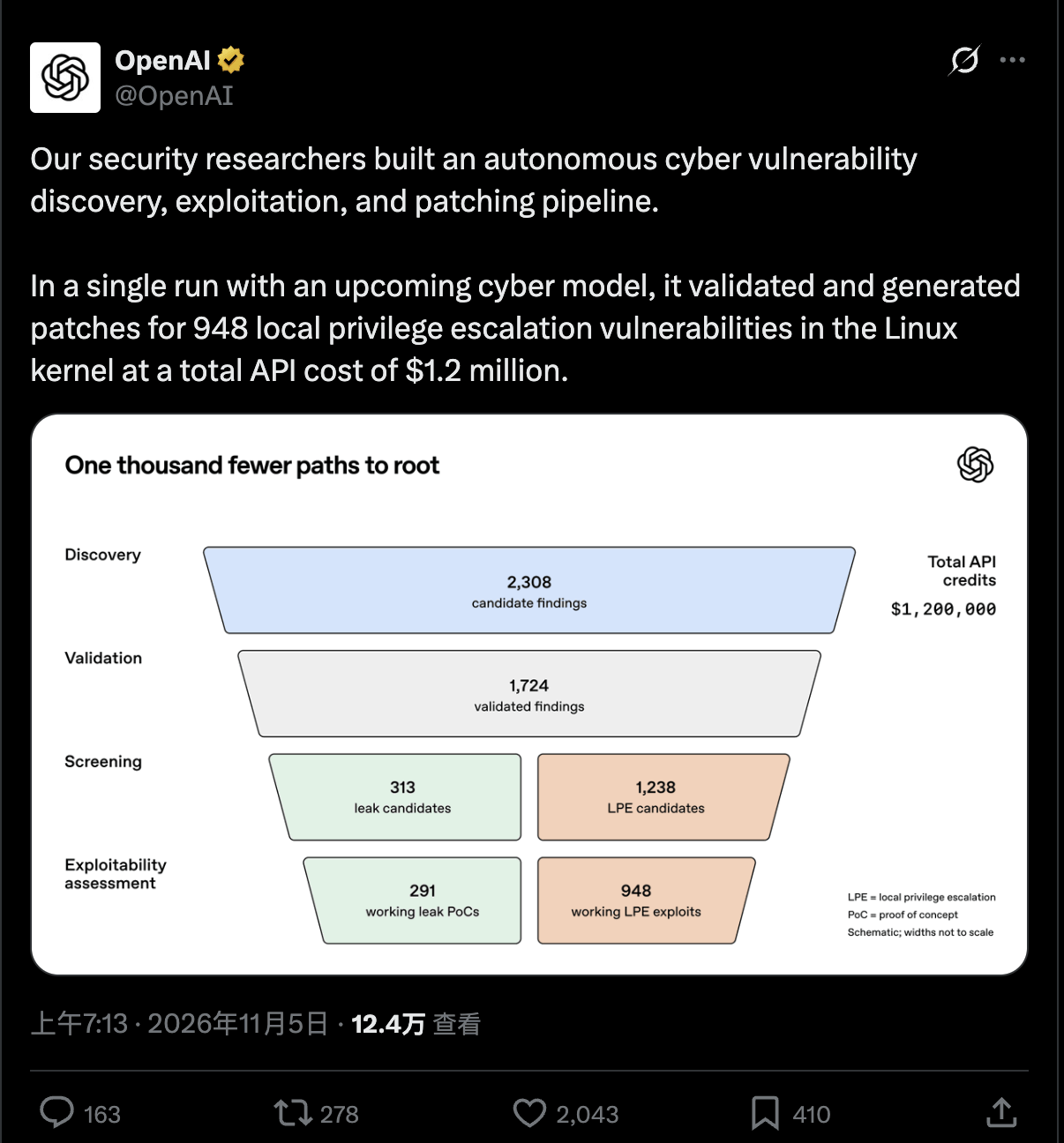
A thousand fewer paths to root

Rank 82 · Content 95 · Popularity N/A

TL;DR - OpenAI reports an autonomous pipeline that discovered, validated, and generated patches for 948 local privilege-escalation vulnerabilities in the Linux kernel, demonstrating AI-driven security remediation at scale.

  • The pipeline autonomously handled vulnerability discovery, validation, and patch generation.
  • It targeted local privilege-escalation flaws in the Linux kernel.
  • OpenAI reports 948 vulnerabilities addressed; the provided content does not specify patch acceptance or deployment.
Representative image for MIT神作被锤:Astra爆改Qwen权重?就吹吧!

MIT神作被锤:Astra爆改Qwen权重?就吹吧!

Rank 71 · Content 80 · Popularity N/A

TL;DR - spaCy creator Matthew Honnibal argues MIT’s Astra work misleadingly conflates raw-weight interpretation on tiny networks with tool-assisted modification of Qwen. The critique matters because the headline result reflects agentic ML engineering—not demonstrated large-model “mind reading.”

  • Raw weights were directly inspected only for networks with roughly 17,000–172,000 parameters.
  • For Qwen3.5-0.8B, Astra could run Python and perform up to 50 forward tests on practice problems.
  • Astra reportedly modified 0.016% of Qwen’s weights, raising math performance from 7.9% to 48.1%.
  • Honnibal still considers its ability to diagnose and modify models through coding, testing, and reasoning a significant advance.

CWE-bench v2: More coverage, quality, and transparency

Rank 71 · Content 80 · Popularity N/A

TL;DR - Hugging Face announced CWE-bench v2, an updated benchmark focused on broader coverage, higher quality, and greater transparency. No further technical details or results were provided.

  • The release updates the CWE-bench benchmark to version 2.
  • Its stated priorities are coverage, quality, and transparency.
  • Specific methodology, datasets, metrics, and performance results cannot be determined from the provided material.
Representative image for 2000万人用灵光,灵光2.0上线一周托管超116万项事务

2000万人用灵光,灵光2.0上线一周托管超116万项事务

Rank 61 · Content 65 · Popularity N/A

TL;DR - Ant Group says its Lingguang 2.0 personal AI assistant managed over 1.16 million ongoing affairs and executed 3.6 million tasks in its first week. The release signals a shift from one-off chatbot interactions toward persistent, cross-platform agents.

  • “Help Me Manage” continuously tracks authorized tasks, sends proactive reminders, and advances workflows at key moments.
  • Cross-session memory, long-horizon scheduling, tool integrations, and dedicated cloud hosts let tasks continue after users exit chats.
  • Lingguang connects to 40 external services, including Alipay, DingTalk, Feishu, email, and mobility platforms.
  • Ant reports more than 20 million Lingguang users, with use cases spanning shopping, travel, and household management.

DevRev delivers autonomous self-service with GPT-6.1 Sol

Rank 61 · Content 65 · Popularity N/A

TL;DR - DevRev is using OpenAI’s GPT-6.1 Sol to power autonomous enterprise-service tools called Computer and Operator. The brief announcement emphasizes balancing reasoning quality, speed, and cost.

  • Targets autonomous customer self-service and enterprise support.
  • Powers two DevRev products: Computer and Operator.
  • No implementation details or performance results are provided.

LLMs & Foundation Models 1

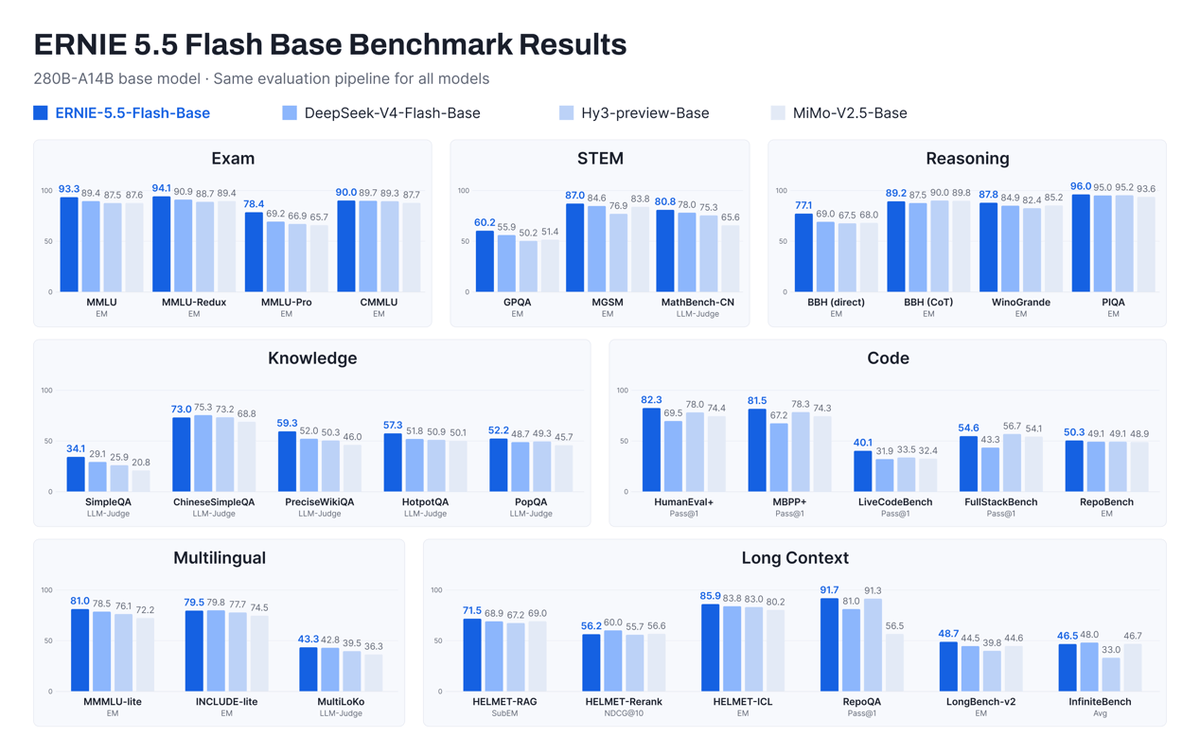
Representative image for 百度开源文心5.5 Flash Base,多基准测试刷新同尺寸模型 SOTA

百度开源文心5.5 Flash Base,多基准测试刷新同尺寸模型 SOTA 🔗 2 sources

Rank 68 · Content 75 · Popularity N/A

TL;DR — 百度开源文心 5.5 Flash Base:一款面向高效长上下文处理的 2800 亿参数 MoE 模型。百度称其在知识、推理、数学、代码、多语言和长上下文等基准上刷新同尺寸模型 SOTA。

  • 每个 Token 激活 140 亿参数,使用 33.5 万亿 Token 预训练。
  • 预训练上下文长度最高为 128K,微调和推理阶段支持最长 100 万 Token。
  • Latent-Gated Sparse Attention 融合稀疏、压缩、门控和虚拟头机制,以降低长上下文的资源开销。
  • Multi-Router Latent MoE 在不增加激活专家数、计算量或通信量的情况下改善专家选择。
  • ECHO 复用主干网络最后一层预测后续 Token,无需单独的多 Token 预测模块,并可支持投机解码。

注: 两个来源重点基本一致,均强调长上下文能力、训练与推理效率以及多项基准表现。

Multimodal & Generative 6

Introducing Images 2.6

Rank 75 · Content 85 · Popularity N/A

TL;DR - OpenAI’s Images 2.6 expands image generation across ChatGPT, Codex, and the API with faster output, GIF support, more precise editing, and additional API controls.

  • Improves image-generation speed.
  • Adds GIF creation capabilities.
  • Enables more precise image edits.
  • Introduces new developer controls through the API.
Representative image for GPT-Image-2.6全量上线!直出GIF和SVG,6.2 Astra也现身了

GPT-Image-2.6全量上线!直出GIF和SVG,6.2 Astra也现身了

Rank 64 · Content 70 · Popularity N/A

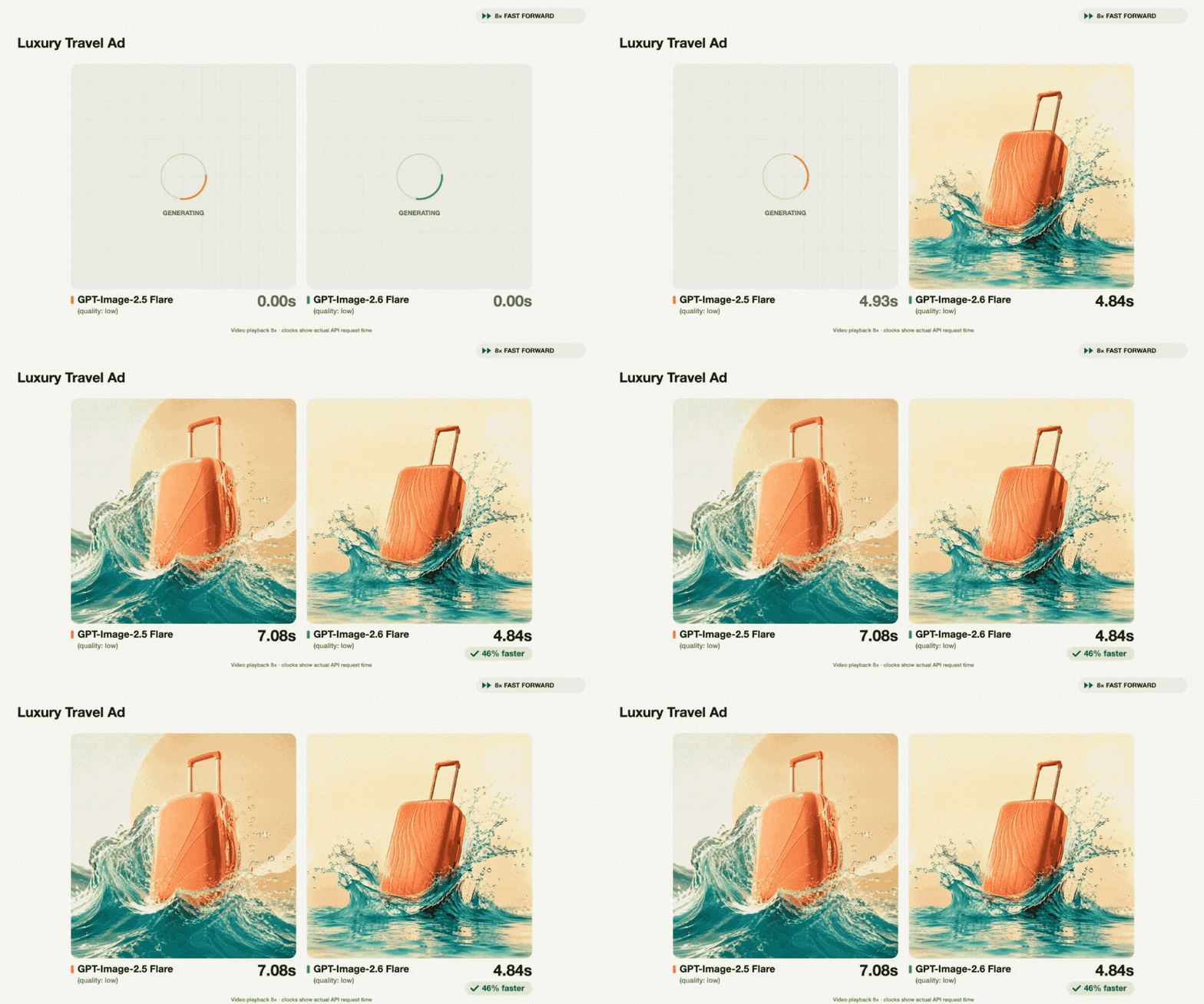
TL;DR - OpenAI’s GPT-Image-2.6 reportedly launched across ChatGPT, Codex, and the API, adding faster generation, GIF workflows, SVG export, and more granular controls. The update targets lower-latency, production-oriented image creation and editing.

  • Generation time is claimed to be 50% shorter, with Flare producing some low-quality images in as little as six seconds.
  • Flare emphasizes speed and layout, while Sunburst targets detail and consistency across iterative edits.
  • The API separates scene-planning complexity from rendering quality, reducing unnecessary recomputation for localized changes.
  • GIFs use six-frame sprite sheets; the release also adds native SVG export and API access to masked image markup.
Representative image for 更强的模型之外,ACM MM 2026还在关注什么?

更强的模型之外,ACM MM 2026还在关注什么?

Rank 57 · Content 60 · Popularity N/A

TL;DR - ACM Multimedia 2026’s keynote lineup broadens the field beyond model performance toward embodied interaction, selective listening, responsible AI summarization, and youth-centered online safety.

  • Embodied AI will explore multimodal social signals—including language, gaze, gestures, and physiology—for communication support and therapy.
  • Selective listening research combines visual cues such as lip movements with audio to extract target speakers in noisy, multi-speaker settings.
  • AI-generated summaries raise accountability questions about omitted context, hesitation, and minority viewpoints across text, video, and audio.
  • Youth online-safety research emphasizes privacy-aware, participatory system design that preserves autonomy and social connection.

A Closer Look at Phonon TTS. Launching High-Quality On-Device Speech That Tops the Benchmarks.

Rank 57 · Content 60 · Popularity N/A

TL;DR - Hugging Face announces Phonon TTS as a high-quality, on-device text-to-speech system that reportedly leads relevant benchmarks. With no article content provided, its methods and benchmark results cannot be verified here.

  • Targets local speech synthesis rather than cloud-dependent generation.
  • Emphasizes high-quality audio and benchmark performance.
  • Model architecture, device requirements, latency, and evaluation details are unavailable in the provided content.
Representative image for 从3D生成到世界模型,这家AI公司想和年轻人一起定义问题

从3D生成到世界模型,这家AI公司想和年轻人一起定义问题

Rank 54 · Content 55 · Popularity N/A

TL;DR - VAST is recruiting young researchers to advance native 3D generation, spatial agents, and world models, while highlighting its Tripo and Eden projects. Its goal is to move generative AI from producing visual assets toward building persistent, interactive environments.

  • Tripo P2.0 generates controllable-part, mostly quad-topology 3D meshes designed for editing, animation, and agent-driven workflows.
  • The Nexus framework decouples vertex and topology generation, using diffusion-based coarse-to-fine mesh construction.
  • Open-source EdenLive separates state and interaction logic from generative rendering, reportedly producing 720p output above 24 FPS on one GPU with minute-scale continuity.
  • VAST’s V·STAR program offers participants core-model work, data, compute, and opportunities to shape technical directions.
Representative image for 虎鲸文娱“鲸锐AI”平台正式上线,AI视频单分钟成本节省30%以上

虎鲸文娱“鲸锐AI”平台正式上线,AI视频单分钟成本节省30%以上

Rank 54 · Content 55 · Popularity N/A

TL;DR - 虎鲸文娱上线AI影视制作与管理平台“鲸锐AI”,通过整合生成模型、精细控制和协作工具,将AI视频单分钟成本降低30%以上,并提升专业制作的可控性与交付效率。

  • 集成50余个主流AI视频模型和10余个自研模型,提供35类工具及300余项镜头、表演、光影和场景控制能力。
  • 用户实测显示,平台可将视频制作时长缩短40%至60%,超分直出流程可节省约65%的成本。
  • 支持4K、60帧、10bit和HDR输出,并提供人脸修复、影视质感增强、自研超分等功能。
  • 无限画布支持千级节点和百人实时协作,可按项目、分集、分场及角色管理资产、工作流与成本。

Efficiency & Systems 2

Representative image for 上海交大邓志杰:扩散语言模型,怎样才能又快又好

上海交大邓志杰:扩散语言模型,怎样才能又快又好

Rank 75 · Content 85 · Popularity N/A

TL;DR - 上海交大邓志杰系统介绍了扩散语言模型如何通过跨块并行、后训练和推理优化,将理论并行性转化为实际生成速度,同时控制质量损失。

  • MultiBD通过多块并行去噪和固定Block Buffer适配动态推理,在两张H100上达到约746 TPS。
  • CForce和LightningRL分别借助一致性训练及兼顾正确率与并行度的奖励,改善速度—质量权衡。
  • Fast-dLLM结合近似KV缓存与置信度解码,将单张A100上的速度从6.7提升至54.4 TPS,准确率由79.3%降至78.5%。
  • 多块扩散还被拓展至流式视频、语音修复、多模态生成和智能体工具调用。
Representative image for 太初元碁入选2026年世界互联网大会领先科技奖收录成果集《科技之魅》

太初元碁入选2026年世界互联网大会领先科技奖收录成果集《科技之魅》

Rank 54 · Content 55 · Popularity N/A

TL;DR - Chinese AI-chip company Taichu Yuanqi’s heterogeneous many-core computing system was selected for the 2026 World Internet Conference’s technology collection. It targets efficient E-scale AI/HPC workloads through integrated processor, interconnect, operating-system, and software-stack design.

  • Its “host-slave-micro” architecture coordinates three core types to improve scheduling, compute density, and energy efficiency under mixed AI workloads.
  • Dynamic cache allocation and high-speed bidirectional interconnects aim to reduce memory-wall bottlenecks and data-movement latency.
  • Mixed-precision computing increases inference throughput while maintaining reliable numerical accuracy, according to the company.
  • Its self-developed HPC+AI operating system and SDAA stack reportedly shorten model-porting cycles from months to days and support E-scale clusters and AI-for-science workloads.

AI Cybersecurity 1

Representative image for Linux内核被挖出948个漏洞!OpenAI花120万美元找到的

Linux内核被挖出948个漏洞!OpenAI花120万美元找到的

Rank 75 · Content 85 · Popularity N/A

TL;DR - OpenAI reportedly used an unreleased cybersecurity model and a multi-agent pipeline to identify 948 distinct Linux kernel privilege-escalation vulnerabilities for $1.2 million. The result signals that AI could dramatically reduce both vulnerability-discovery costs and defenders’ time to patch critical software.

  • Scout and analyst agents narrowed 40 million lines of kernel code to 2.8 million high-value lines and produced 2,308 candidate reports.
  • Triage agents reproduced 1,724 kernel crashes, while exploit-development agents generated 291 information-leak PoCs and 1,169 root-escalation exploits.
  • Deduplication yielded 948 local privilege-escalation vulnerabilities; sampled exploits reportedly included at least 10 previously unknown attack techniques.
  • OpenAI’s “Patch the Planet” initiative is applying the pipeline defensively to open-source projects including Linux, Firefox, and Chrome.

Autonomous Driving 2

Representative image for 世界模型热潮里,百度重新亮出无人驾驶底牌

世界模型热潮里,百度重新亮出无人驾驶底牌

Rank 61 · Content 65 · Popularity N/A

TL;DR - Baidu unveiled ApolloWorld, an interactive world model for cloud-based autonomous-driving simulation. It models causal responses among road users and generates synchronized camera and LiDAR observations, aiming to make L4 Robotaxi testing safer and more scalable.

  • Baidu evaluates driving world models on causality, interactivity, physical accuracy, persistence, and real-time performance.
  • ApolloWorld represents traffic participants as goal-driven AI agents that react to the autonomous vehicle and one another.
  • It simulates complete trips under varied traffic, weather, and driving conditions using digital twins and multimodal generation.
  • Baidu says one day of virtual driving can approximate three years of continuous testing by one safety-driver-equipped vehicle.
Representative image for 百度无人车搞出“黑客帝国”!世界模型实时推演全局,跑一天抵三年

百度无人车搞出“黑客帝国”!世界模型实时推演全局,跑一天抵三年

Rank 61 · Content 65 · Popularity N/A

TL;DR - Baidu unveiled ApolloWorld, an interactive world model now used to test and validate its Apollo Go L4 robotaxis in simulated cities. Baidu claims one day of virtual testing can match roughly three years of driving by a single safety-driver-equipped test vehicle.

  • Multi-agent simulations model vehicles and pedestrians as decision-making agents that react to the robotaxi and one another.
  • The system generates continuous camera and LiDAR observations for complete trips, closing the loop between simulated traffic and driving-model actions.
  • Knowledge distillation accelerates inference so the virtual environment can respond to vehicle decisions in real time.
  • Baidu’s “2+3” evaluation framework requires causality and interactivity, plus physical accuracy, persistence, and real-time performance.

Coding Agents 1

OpenAI to acquire Pierre Computer Company, Inc.

Rank 61 · Content 65 · Popularity N/A

TL;DR - OpenAI plans to acquire Pierre Computer Company to expand Codex’s capabilities for building, understanding, and reviewing code.

  • The acquisition is intended to strengthen Codex’s software-development tooling.
  • The announcement highlights code generation, comprehension, and review.
  • No technical integration details, timeline, or acquisition terms are provided.

Cybersecurity AI 2

Daybreak Red is now available in AWS GovCloud (US-East)

Rank 54 · Content 55 · Popularity N/A

TL;DR - OpenAI’s Daybreak Red brings GPT-5.6 Cyber to approved AWS GovCloud customers via Amazon Bedrock. This expands access to the model for authorized cybersecurity work in the US-East government cloud region.

  • Available specifically in AWS GovCloud (US-East).
  • Access is limited to approved customers.
  • Delivered through Amazon Bedrock.
  • Intended for authorized cybersecurity use.

How Cisco defends at machine speed with OpenAI

Rank 54 · Content 55 · Popularity N/A

TL;DR - Cisco is combining its network intelligence with OpenAI models to build faster, more adaptive enterprise security defenses. The provided summary does not specify implementation details or measured results.

  • Targets machine-speed detection and response to security threats.
  • Combines Cisco’s network telemetry and expertise with OpenAI models.
  • Focuses on adaptive defenses for enterprise environments.

Engineering AI 1

Accelerating engineering for the physical world

Rank 57 · Content 60 · Popularity N/A

TL;DR - OpenAI highlights how ChatGPT and Codex can accelerate engineering workflows for physical products, including CAD, PCB design, and simulation. The provided description does not include specific capabilities or measured results.

  • Applies AI assistance to physical-world engineering tasks.
  • Targets CAD, electronics design, simulation, and related workflows.
  • Positions ChatGPT and Codex as tools for improving engineering productivity.