WRC 2026:具身数采凶猛,千军万马集体入场
Ranking
No observed public metrics; popularity remains neutral/archived.
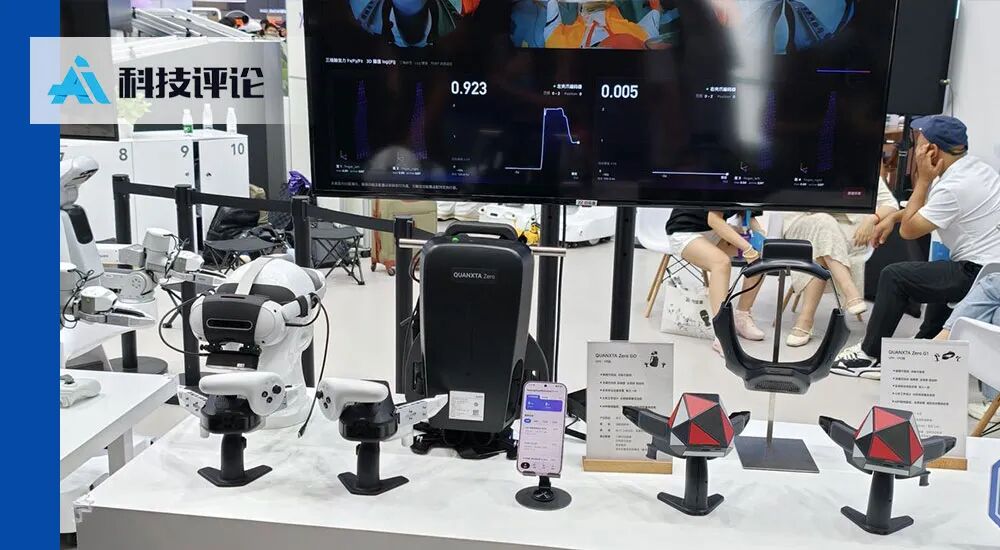
Merged summary
TL;DR — WRC 2026 highlighted a broad industry push to solve embodied AI’s central bottleneck: obtaining affordable, high-quality multimodal data and turning it into reliable, commercially viable robot capabilities. Competition now spans the full stack—from sensors, data collection, and simulation to world models, robot adaptation, evaluation, and cloud services.
- Data-collection systems increasingly synchronize egocentric video, depth, touch, motion, force, and electromyography through lightweight headsets, gloves, wristbands, and teleoperation platforms. Standardized formats, sensor-noise reduction, and cross-robot motion remapping aim to make datasets reusable across embodiments.
- Collection is scaling rapidly: announced initiatives include a 100,000-hour open human-behavior dataset and JD’s target of more than 10 million hours of real-world data within two years. More vision, touch, and force data is considered essential for closed-loop perception, decision-making, and control.
- Mass deployment remains constrained by model reliability, hardware variation, immature manufacturing and quality-control standards, and uncertain customer ROI. Near-term commercialization is therefore expected in high-need, semi-structured applications such as inspection, logistics, sorting, and emergency response.
- ShengShu Technology proposed a five-level world-model roadmap—from world generation and real-time interaction through physical action, autonomous agents, and multi-agent orchestration. Its multimodal MoT-based Motubrain reportedly scored 96.1 on RoboTwin 2.0, runs about 10× faster than Motus, and adapts to new robot embodiments with 50–100 demonstrations.
- HiDream.ai’s UiT-based HiDream-O1-World generates, edits, and navigates persistent virtual environments from text, images, and interactive controls, emphasizing long-horizon spatial, temporal, and physical consistency. Both companies frame world models as part of a feedback loop linking data, simulation, agents, and physical robots.
Note: Some sources emphasize the data-collection market and deployment barriers, while others focus on ShengShu’s world-model roadmap or HiDream.ai’s interactive simulation platform.
Sources (6)
WRC 2026:具身数采凶猛,千军万马集体入场
TL;DR - WRC 2026 showed embodied-AI data collection becoming a strategic market, with sensor suppliers, model developers, data specialists, dexterous-hand makers, and major platforms all launching hardware or infrastructure. The shift reflects a growing industry bottleneck: obtaining affordable, high-quality real-world multimodal data for training robots.
- New systems combine egocentric video, depth, touch, motion, and electromyography, often using lightweight headsets, gloves, wristbands, or teleoperation platforms.
- Vendors are targeting reusable training data through standardized formats, cross-robot motion remapping, synchronized modalities, and reduced sensor noise.
- Data-focused players announced major scale initiatives, including a 100,000-hour open human-behavior dataset and JD’s goal of collecting over 10 million hours of real-world data within two years.
- Competition is expanding from robot hardware and models toward end-to-end capabilities spanning sensing, scenario operations, data processing, training, evaluation, and cloud services.
王田苗三问具身大牛:大模型还在「拨号上网」,机器人靠什么拿下真实订单?| WRC 2026
TL;DR - At WRC 2026, Chinese robotics executives debated what blocks embodied AI from moving beyond demos to mass deployment: unreliable models, immature hardware supply chains, scarce multimodal data, and weak customer ROI. The consensus was to commercialize first in constrained industrial settings while improving general-purpose capabilities.
- Real deployments demand far greater reliability than the roughly 96% task success attributed to current embodied models, especially in safety-critical production environments.
- Hardware variation complicates model transfer across robots, while inconsistent manufacturing, missing standards, and immature quality-control processes hinder scaling to thousands of units.
- Progress requires more real-world vision, touch, and force data—and potentially architectures designed specifically for closed-loop perception, decision-making, and control.
- Near-term growth is expected in high-need, semi-structured tasks such as inspection, logistics, sorting, and emergency response, where deployment costs and ROI are easier to justify.
WRC 2026|生数科技发布最新研究成果,提出通用世界模型五级发展路线
TL;DR - ShengShu Technology presented a five-level roadmap for general world models, progressing from world generation to autonomous agents and multi-agent orchestration. Its approach unifies multimodal understanding, future prediction, and physical action in a closed feedback loop.
- The roadmap spans world generation (L1), real-time interaction (L2), physical action (L3), autonomous world agents (L4), and world orchestration (L5).
- The MoT architecture uses modality-specific parameters and shared attention to jointly process images, video, language, and robot actions.
- ShengShu’s Motubrain reportedly delivers roughly 10× faster inference than Motus, adapts to new robot embodiments with 50–100 demonstrations, and scored 96.1 on RoboTwin 2.0.
- Advancing to L4–L5 requires capabilities including goal formation, active exploration, continual learning, long-term memory, and coordinated multi-agent planning.
WRC 2026|原生全模态世界模型:从模拟世界到交互世界
TL;DR - HiDream.ai introduced HiDream-O1-World, a native multimodal interactive world model designed to generate, edit, and navigate persistent virtual environments. It targets interactive entertainment, 3D content creation, and physically consistent simulation for embodied-AI training.
- Built on HiDream.ai’s Unified Transformer (UiT), the model accepts text, images, and interactive controls while supporting realistic and stylized environments.
- HiDream.ai claims improved long-horizon spatial, temporal, and physical consistency, allowing explored scene structures to persist during extended interactions.
- The model ranked first on WBench’s Navi leaderboard upon its initial evaluation, according to the company-provided article.
- HiDream.ai frames world models as the predictive core of a data–model–agent–embodiment loop, using simulated and real-world feedback to train systems that act in physical environments.
WRC 2026|原生全模态世界模型:从模拟世界到交互世界
TL;DR - HiDream.ai unveiled HiDream-O1-World, a native multimodal interactive world model designed to generate, edit, and navigate persistent virtual environments. Its emphasis on long-horizon spatial and physical consistency could support interactive entertainment, 3D creation, and embodied-AI simulation.
- Built on HiDream.ai’s Unified Transformer (UiT), the model accepts text, images, and interactive controls and supports diverse subjects and visual styles.
- HiDream-O1-World ranked first on WBench’s Navi leaderboard upon its initial evaluation, according to the company presentation.
- The model aims to preserve explored scene structure and physical plausibility during extended interactions.
- HiDream.ai proposes a closed loop connecting data, world models, agents, and robots, using simulated and real-world feedback to improve embodied systems.
WRC 2026|生数科技发布最新研究成果,提出通用世界模型五级发展路线
TL;DR - ShengShu Technology introduced a five-level roadmap for general world models that progresses from world generation to multi-agent orchestration. The framework matters because it treats understanding, prediction, and action as a unified feedback loop connecting generative models with embodied AI.
- The roadmap spans world generation (L1), interactive worlds (L2), physical action (L3), autonomous world agents (L4), and multi-agent/resource orchestration (L5).
- Its Motubrain model uses a Mixture-of-Transformers architecture to jointly process images, video, language, and robot actions for integrated perception, prediction, and control.
- ShengShu reports that Motubrain achieved 96.1 on RoboTwin 2.0, runs about 10× faster than Motus, and can adapt to a new robot embodiment using 50–100 human demonstrations.
- Reaching L4–L5 will require advances in joint evaluation, physical reasoning, persistent memory, online learning, efficient real-time deployment, and safety.