🛰️ Daily AI Frontier
32 works · 2 categories · 10 topics · blog 12 journal 6 arxiv 15 generated 2026-07-31 14:12:55 UTC
Top highlights — Research

LLM Agents 5

LEDGERMIND: Provenance-Constrained Multimodal Agentic Reasoning with a Structured Evidence Ledger

Rank 86 · Content 95 · Popularity 66

TL;DR - LedgerMind structures multimodal-agent trajectories as provenance-constrained evidence ledgers, making intermediate reasoning auditable rather than evaluating only final answers. It improves answer accuracy and trajectory-level faithfulness across multiple benchmarks and MLLM backbones.

  • Tool outputs become normalized ledger entries that downstream claims must cite.
  • Entity- and numeric-level checks detect unsupported reasoning and “Phantom Grounding.”
  • Typed repair transitions prevent verification steps from introducing unproven content.
  • Adaptive routing adjusts reasoning depth to query complexity, reducing over-reasoning.
Representative image for Tycho: Active Abstraction with Programmatic World Models for ARC-AGI-3

Tycho: Active Abstraction with Programmatic World Models for ARC-AGI-3

Rank 86 · Content 95 · Popularity 63

TL;DR - Tycho is a coding-agent system that builds and selectively uses executable world models to solve interactive ARC-AGI-3 games efficiently. Its results suggest that deciding when to construct, repair, use, or bypass a model is as important as simulator accuracy.

  • Tycho models games as parameterized rendered deterministic Moore machines and separates actionable states from animation and terminal frames.
  • Actor-requested delegation to a model builder achieved the best tested orchestration result, averaging 88.49 Relative Human Action Efficiency across 25 public games.
  • With that policy, GPT-5.6 Sol and Opus 5 completed all 183 levels at 100.00 RHAE; Opus 5 used 61% fewer scored actions than aggregate official human baselines.
  • Automatic model repair improved transition reproduction but reached only 83.07 RHAE, showing that dynamics accuracy alone does not ensure effective planning or objective discovery.
Representative image for ClawTrack: Towards Trace-Level Evaluation and Improvement of Real-World Autonomous Agents

ClawTrack: Towards Trace-Level Evaluation and Improvement of Real-World Autonomous Agents

Rank 79 · Content 95 · Popularity 43

TL;DR - ClawTrack evaluates autonomous agents at both outcome and reasoning-trace levels, exposing lucky successes and specific process failures. Its results identify inadequate result verification as a recurring weakness and show that process-based trajectory filtering improves post-training.

  • Includes 320 tasks across 8 domains, 25+ deterministic mock services, and 12,541 task-specific rubric items.
  • Scores each reasoning turn on goal alignment, efficiency, information use, and result verification.
  • Evaluation of 21 models over 16,000+ trials found complementary process dimensions and robustness across judge LLMs.
  • Trace-level scoring enables more precise failure attribution than outcome-only benchmarks.

How Benchmarks Mis-Score Computer-Use Agents

Rank 78 · Content 95 · Popularity 39

TL;DR - An audit of computer-use agent benchmarks finds that 15.3% of sampled FAIL verdicts are incorrect, showing that brittle evaluators and broken tasks can significantly distort reported performance.

  • Audits 150 failure-scored trajectories across five web, enterprise-workflow, and desktop-control benchmarks.
  • Attributes 10.7% of FAIL verdicts to evaluator false negatives and 4.7% to broken tasks.
  • Finds verification/feedback and planning failures dominate execution/grounding errors among genuine failures.
  • Proposes a reliability framework and stage-specific evaluation rules covering task construction, trajectory observation, scoring, and reporting.

One Human, $N$ Agents: Audit-Budget Allocation for LLM Agent Fleets under Miscalibrated, Correlated Confidence

Rank 78 · Content 95 · Popularity 39

TL;DR - This paper studies how one human should allocate limited audits across many LLM agents when self-reported confidence is miscalibrated and errors are correlated. It identifies when confidence-ranked auditing becomes worse than random selection, exposing conditions under which oversight is effectively vacuous.

  • Models budgeted noisy inspection using a two-level Gaussian copula and derives a miscalibration threshold (δ^*).
  • Counterintuitively, (δ^*) increases as audit budgets shrink, while shared task difficulty drives substantial cross-family error correlation.
  • Five open-weight models exhibit near-constant, operationally unhelpful confidence; a proprietary model remains informative and below the estimated threshold.
  • Policy replays on recorded traces confirm the predicted ordering of auditing strategies.

Medical/Healthcare AI 6

Representative image for KAISEN: Reproducible Subgroup Fairness Auditing for Clinical Risk Models

KAISEN: Reproducible Subgroup Fairness Auditing for Clinical Risk Models

Rank 78 · Content 95 · Popularity 39

TL;DR - KAISEN is a reproducible, five-phase framework for auditing subgroup fairness in clinical risk models. Synthetic stress tests show that mitigation, diagnostics, and drift-monitoring components can fail unpredictably or silently.

  • Per-group threshold optimization reduced equalized-odds disparity in all 48 held-out runs.
  • Group-wise Platt scaling improved calibration but had inconsistent, near-zero average effects on fairness.
  • Mechanism diagnostics identified all controlled cases but missed every model-driven case under proxy misspecification without warning.
  • CUSUM drift thresholds transferred poorly across cohort realizations; the synthetic results do not establish clinical validity.
Representative image for Negative controls reveal volume-driven confounding in radiomics and imaging foundation model features

Negative controls reveal volume-driven confounding in radiomics and imaging foundation model features

Rank 78 · Content 95 · Popularity 39

TL;DR - READII-2-ROQC uses volume-preserving negative controls to test whether radiomics and imaging foundation-model features capture meaningful spatial signals rather than tumour volume or acquisition artifacts. Across three cancer imaging cohorts, it exposed confounding in models that remained predictive after image structure was destroyed.

  • Generates voxel-perturbed controls for tumour, background, and whole-image regions while preserving volume.
  • Evaluated PyRadiomics and foundation-model features across 3,552 tumour volumes and nine matched controls.
  • Reproduced survival and HPV-status signatures, finding both confounded and genuinely perturbation-sensitive models.
  • Provides an open-source quality-control framework for more interpretable and reproducible imaging biomarkers.
Representative image for When Derived Measurements Mislead: Quantifying and Mitigating LLM Over-Trust with Privileged-Modality Reliability Evidence

When Derived Measurements Mislead: Quantifying and Mitigating LLM Over-Trust with Privileged-Modality Reliability Evidence

Rank 78 · Content 95 · Popularity 39

TL;DR - This paper formalizes derived-feature over-trust, where LLMs treat uncertain sensor-derived measurements as direct facts, and proposes metrics and reliability evidence to evaluate and mitigate it in physiological sensing.

  • Tests over-trust using PPG-derived heart rhythms checked against privileged offline ECG references never shown to the LLM.
  • Introduces five metrics covering conflicting evidence, context-induced errors, error repair, evidence specificity, and unnecessary verification.
  • Evaluates privileged ECG-to-PPG distillation on 50,000 paired records and a protocol-locked 187-patient test set.
  • The baseline improved four repair and specificity endpoints by 1.82–6.69 percentage points; verification-related harm rose by 0.67 points, with its confidence interval spanning zero.
Representative image for Same Branches, Different Trees: A Bifurcation Connectedness Metric for Coronary Artery Segmentation and FFR-CT Decision Agreement

Same Branches, Different Trees: A Bifurcation Connectedness Metric for Coronary Artery Segmentation and FFR-CT Decision Agreement

Rank 78 · Content 95 · Popularity 39

TL;DR - This paper proposes the Bifurcation Connectedness Score (BCS) for coronary artery segmentation, measuring vessel-tree connectivity that overlap metrics can miss. Better BCS correlates with closer FFR-CT treatment-decision agreement, especially in severe disease.

  • BCS evaluates connectivity at each ground-truth bifurcation and strongly detects localized vessel breaks.
  • It remains largely stable under narrowing that preserves connectivity, distinguishing topology from volumetric overlap.
  • Higher BCS was associated with better predicted-versus-ground-truth FFR-CT decision agreement in severe disease (OR 2.16, CI [1.23, 4.18]).
  • Soft-BCS provides a differentiable training surrogate; results suggest branch recovery and branch connectivity should be reported separately.
Representative image for PathView-Bench: Can Multimodal Large Language Models Achieve Fine-grained Multiscale Understanding of Pathology Images?

PathView-Bench: Can Multimodal Large Language Models Achieve Fine-grained Multiscale Understanding of Pathology Images?

Rank 78 · Content 95 · Popularity 39

TL;DR - PathVU is a large, vision-anchored benchmark testing whether multimodal models understand pathology images across local regions and whole-slide views. Results across 18 models reveal substantial limitations in fine-grained, multiscale visual reasoning.

  • Includes 14 VQA tasks, 61,673 images, and 308,070 samples from 23 public datasets.
  • Covers 28 organs using over 7.25 million human-supervised labels and spatial annotations.
  • Tests localization, recognition, quantity estimation, spatial reasoning, and insufficient-context judgment.
  • Uses deterministic targets for reproducible, programmatic scoring rather than evaluating only final diagnoses or reports.

Meat allergy is on the rise — what scientists want to know

Rank 45 · Content 45 · Popularity 46

TL;DR - Nature reports that tick-induced meat allergy is increasing, while key questions about its mechanisms and prevalence remain unresolved. The supplied content is brief, so no specific study results are available.

  • The condition is linked to tick bites.
  • Researchers still need to clarify important aspects of the allergy.
  • Its reported rise makes understanding risk, diagnosis, and prevention increasingly important.

Bioinformatics AI 3

CellTune: an integrative software for accurate cell classification in spatial proteomics

Rank 75 · Content 80 · Popularity 65

TL;DR - CellTune is software for high-precision cell classification in spatial proteomics datasets. It uses human-in-the-loop active learning to integrate expert feedback into the analysis workflow.

  • Targets cell classification in spatial proteomics data.
  • Combines automated analysis with iterative human input.
  • Aims to improve classification accuracy through active learning.
  • The provided abstract does not include quantitative results or benchmarking details.

SpaMTP: integrative statistical analysis and visualization of spatial metabolomics and transcriptomics data

Rank 74 · Content 85 · Popularity 48

TL;DR - SpaMTP is a statistical analysis and visualization method for jointly analyzing spatial metabolomics and transcriptomics data. The brief description indicates broad integrative capabilities, but provides no performance or validation results.

  • Combines two spatial omics modalities: metabolites and gene expression.
  • Supports both joint statistical analysis and visualization.
  • Aims to enable more comprehensive study of spatially resolved biological systems.

Daily briefing: ‘Raygun’ AI can shrink or supersize proteins

Rank 74 · Content 85 · Popularity 48

TL;DR - Nature highlights “Raygun,” an AI tool that can resize proteins by adding, removing or swapping subunits through evolution-inspired steps. The approach could expand researchers’ ability to engineer proteins with altered structures and functions.

  • Raygun can shrink or enlarge protein assemblies.
  • It supports adding, deleting and exchanging protein subunits.
  • The method is described as mimicking aspects of natural evolution.
  • The provided briefing does not report performance metrics or experimental details.

Multimodal & Generative 3

Representative image for Chimera: Designing and Chinchilla-Scaling Hybrid Visual Diffusion Transformers

Chimera: Designing and Chinchilla-Scaling Hybrid Visual Diffusion Transformers

Rank 87 · Content 95 · Popularity 68

TL;DR - Chimera is a hybrid diffusion transformer designed for compute-efficient, long-context image and video generation. Its linear attention, sparse MoE, and scaling recipe enable substantial efficiency gains and zero-shot video-length extrapolation.

  • Combines O(N) Kimi Delta Attention, interleaved global latent attention, and modality-aware local convolutions.
  • HeteroP transfers hyperparameters across heterogeneous modules to derive Chinchilla-style compute-optimal scaling laws.
  • The 11B-parameter model activates 2B parameters and achieves up to 7.3× the compute efficiency of a matched full-attention baseline.
  • It extrapolates from 5-second training clips to 30-second videos, with 6.5% FID degradation in the final five seconds.

ShadowDancer: Teaching Video World Models Any Action by Learning Unified Dynamics Representations from a Video and Its Shadow

Rank 83 · Content 90 · Popularity 68

TL;DR - ShadowDancer enables frame-level control of video world models by learning appearance-invariant dynamics from paired videos that replay the same action with different visuals. Demonstrated actions can then transfer to new environments without labels, motion estimators, or fine-tuning.

  • “Shadow pairs” preserve dynamics while independently varying appearance.
  • Cross-shadow prediction isolates a unified action representation by discarding visual differences.
  • The representation controls a block-causal world model across diverse dynamics families.
  • It achieved an average 86% blinded win rate against latent-action and interactive-world-model baselines in rollout comparisons.
Representative image for EgoGenesis: Egocentric World-Action Modeling with Online Anchored Projective Memory and Action-3D RoPE

EgoGenesis: Egocentric World-Action Modeling with Online Anchored Projective Memory and Action-3D RoPE

Rank 78 · Content 95 · Popularity 39

TL;DR - EgoGenesis generates controllable egocentric robot-manipulation videos using geometry-aware memory and action conditioning. Its synthetic trajectories improve real-robot generalization, especially for dual-arm tasks.

  • OAPM anchors generation to the first-frame 3D scene while refreshing recent state during long autoregressive rollouts.
  • A3D-RoPE injects camera-aware end-effector motion into skeleton-to-video cross-attention for precise action control.
  • Adding 400 synthetic trajectories to 400 real ones raises out-of-distribution success from 77% to 84% for single-arm tasks.
  • Dual-arm success improves from 53% to 70% with the same augmentation strategy.

Ancient Pathogen Genomics 1

How smallpox reached the Americas: first genomic evidence points to Europeans

Rank 63 · Content 70 · Popularity 48

TL;DR - Viral sequences recovered from Chilean mummies provide the first genomic evidence that smallpox reached the Americas from Europe. The finding clarifies the disease’s historical origin and spread.

  • Ancient viral DNA links the detected smallpox infections to European introduction.
  • The evidence comes from genomic analysis of Chilean mummified remains.
  • The provided summary does not specify sample dates, sequencing methods, or phylogenetic details.

Chemistry AI 1

Representative image for Chem World: A Large-Scale Benchmark and Physics-Informed Framework for Trustworthy Chemical Property Prediction

Chem World: A Large-Scale Benchmark and Physics-Informed Framework for Trustworthy Chemical Property Prediction

Rank 78 · Content 95 · Popularity 39

TL;DR - Chem World is a standardized chemical property prediction benchmark spanning 17 datasets and more than 800,000 molecules. It also introduces Mixture-PINN, which integrates chemical priors to improve prediction accuracy, robustness, and reliability.

  • Covers properties including density, electrical conductivity, solubility, and other molecular characteristics.
  • Unifies diverse datasets and evaluation protocols for systematic model comparison.
  • Mixture-PINN combines physics-informed constraints with data-driven neural learning.
  • Experiments reportedly outperform existing methods, though the abstract provides no quantitative results.

Numerical Foundation Models 1

Representative image for A foundation model of numerical intelligence with cross-disciplinary generalization

A foundation model of numerical intelligence with cross-disciplinary generalization

Rank 78 · Content 95 · Popularity 39

TL;DR - UNICON is a foundation model that learns predictive relationships from graph-based numerical examples and generalizes across scientific and social systems. It approaches specialist performance without retraining, including in disciplines absent from training.

  • Infers shared predictive operators from in-context examples and applies them to new queries.
  • Uses one model across multiple disciplines rather than training task-specific specialists.
  • Pairing UNICON with language-model agents reportedly surpasses state-of-the-art specialists in an unseen discipline.
  • Greater training-corpus diversity improves cross-disciplinary generalization.

Statistical Methods 1

Getting over ANOVA: estimation graphics for multi-group comparisons

Rank 53 · Content 55 · Popularity 48

TL;DR - This Nature Methods article concerns estimation graphics for comparing multiple groups as an alternative or complement to ANOVA. Only the title and publication metadata are provided, so specific methods and findings cannot be assessed.

  • Focuses on visualizing estimated effects in multi-group comparisons.
  • Suggests moving beyond reliance on omnibus ANOVA significance tests.
  • Likely emphasizes effect sizes and uncertainty, though the provided content does not confirm details.
Top highlights — Industry & News

LLM Agents 5

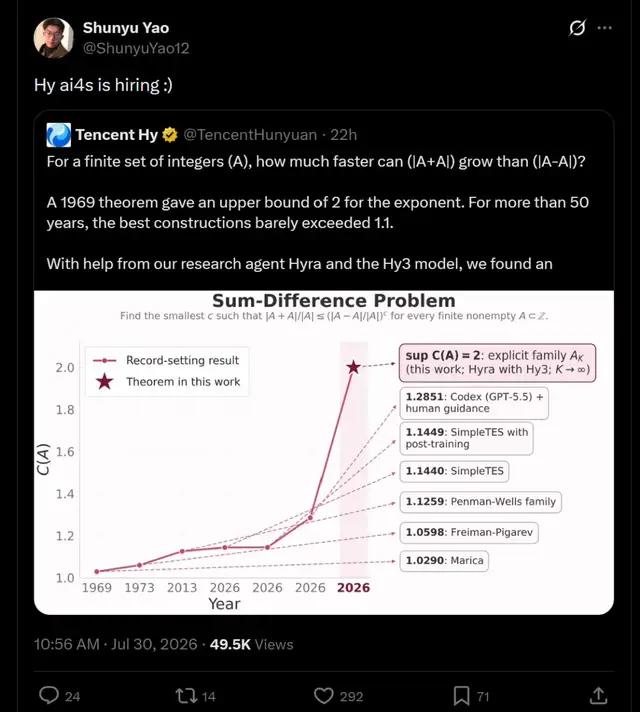
Representative image for 姚顺雨拿50年数学难题成绩单,招人了

姚顺雨拿50年数学难题成绩单,招人了

Rank 75 · Content 85 · Popularity 50

TL;DR - Tencent Hunyuan is recruiting for AI-for-Science after its Hyra research agent reportedly solved a 50-year-old additive-combinatorics problem. The result suggests agentic systems can move beyond search toward proposing and formally verifying original research.

  • Built on the 295B-parameter Hy3 model, Hyra found a scalable construction that approaches the problem’s theoretical limit of 2.
  • The agent reportedly developed the core idea in about 24 hours; researchers checked the proof and produced a Lean 4 formalization.
  • Hyra-1.0 also reported improved results across mathematics, astronomy, quantum computing, and drug design benchmarks.
  • Hunyuan is seeking expertise spanning agents, reinforcement learning, evaluation, training systems, GPU kernels, and scientific domains.
Representative image for 刚刚,DeepSeek V4 系列更新,架构没变,Agent 能力为何大涨

刚刚,DeepSeek V4 系列更新,架构没变,Agent 能力为何大涨

Rank 71 · Content 80 · Popularity N/A

TL;DR - DeepSeek released V4-Flash-0731 in API public beta, improving official agent benchmarks through renewed post-training without changing model architecture or parameter count. The update also adds native Responses API and Codex workflow support, though independent validation remains limited.

  • Official scores reached 82.7 on Terminal Bench 2.1, 54.4 on DeepSWE, and 68.7 on DSBench-FullStack.
  • Gains target multi-step software-engineering tasks involving repository inspection, terminal use, code modification, and iterative testing.
  • Results depend partly on an unreleased DeepSeek Harness, high reasoning budgets, and internal benchmarks, limiting reproducibility.
  • Responses API support simplifies tool calls and agent integration but does not itself increase model intelligence.
Representative image for 卡帕西力推的 LLM Wiki,会淘汰传统 RAG 吗?

卡帕西力推的 LLM Wiki,会淘汰传统 RAG 吗?

Rank 68 · Content 75 · Popularity N/A

TL;DR - LLM Wiki precompiles source documents into agent-oriented, structured Markdown knowledge bases, reducing repeated retrieval and reasoning costs. It complements rather than replaces RAG, especially at larger scales or when source-level detail matters.

  • Unlike query-time RAG, LLM Wiki performs summarization, classification, and semantic linking during document ingestion.
  • Cognition, Factory, LangChain, and GBrain have implemented variants for code documentation, personal knowledge, and agent retrieval.
  • Pure wiki navigation suits roughly 100 sources; larger collections require hybrid keyword, vector, and LLM-ranked retrieval.
  • Wikis risk lossy summaries, stale content, and wasted ingestion costs, and they do not replace user-specific interaction memory.
Representative image for AI 正在变成一门制造业 | WAIC 2026 Agent 产品观察

AI 正在变成一门制造业 | WAIC 2026 Agent 产品观察

Rank 64 · Content 70 · Popularity N/A

TL;DR - WAIC 2026 showed an Agent market booming in supply but constrained by weak demand, high inference and delivery costs, and limited verification. Competitive advantage is shifting from building Agents to controlling distribution, mastering industry workflows, and delivering reliable, governable systems.

  • Major vendors are pursuing Agent entry points across search, office software, cloud platforms, and mobile operating systems.
  • Startups are concentrating on vertical workflows, low-code development tools, and infrastructure such as document parsing, sandboxes, and hosting.
  • Consumer margins remain thin, while enterprise deployments often require costly customization and risk becoming project-based services.
  • Testing, monitoring, permissions, auditing, and functional validation are emerging as critical infrastructure for production deployment.

千问已在特斯拉车机内测

Rank 54 · Content 55 · Popularity N/A

TL;DR - Alibaba’s Qwen is reportedly undergoing extensive testing in Tesla vehicles in China, although neither company has confirmed a launch. Its planned capabilities extend beyond voice assistance to vehicle control, navigation, and transaction-oriented tasks.

  • Tests reportedly cover understanding and answering, vehicle controls, navigation, and task execution.
  • Qwen’s automotive stack supports complex intent understanding and multi-step planning.
  • Planned workflows could connect ordering, fulfillment, and payment.
  • The system reportedly uses an edge-cloud architecture spanning content, services, and transactions.

LLMs & Foundation Models 1

Representative image for Kimi K3 已提前亮相?神秘模型「Kivine」现身,百万上下文能力惊艳全球

Kimi K3 已提前亮相?神秘模型「Kivine」现身,百万上下文能力惊艳全球

Rank 57 · Content 60 · Popularity N/A

TL;DR - An anonymous LMArena model called Kivine is rumored, but not confirmed, to be Moonshot AI’s forthcoming Kimi K3. Reported long-context and complex-task capabilities suggest a potentially competitive flagship model, though latency and commercialization remain challenges.

  • Testers claim Kivine supports a 1M-token context window and performs well on long, multi-step tasks.
  • Leaked beta interface data reportedly references K3, a K3 Agent cluster, and K2.6 as a faster-response model.
  • Rumored specifications include over 2.5 trillion parameters, native multimodality, and a new attention architecture; none are officially verified.
  • Some generations reportedly took about 35 minutes, indicating a major quality-versus-latency tradeoff.

Multimodal & Generative 4

Representative image for 视频后期,危!MiniMax H3手绘即特效,多模态的「Coding时刻」来了

视频后期,危!MiniMax H3手绘即特效,多模态的「Coding时刻」来了

Rank 75 · Content 85 · Popularity N/A

TL;DR - MiniMax launched H3, its first open-weight video model, designed to generate publication-ready 2K videos with editing, typography, effects, music, and voice integrated end to end. Its multimodal inputs and private-deployment potential could make AI video more practical for commercial production.

  • H3 accepts text, images, audio, and video as contextual inputs and supports targeted semantic editing.
  • Its H3-Omni Transformer and customized captioning pipeline model relationships among multimodal references and target video.
  • The model can generate animated text, transitions, visual effects, music, and emotionally synchronized dialogue within the output.
  • The article reports H3 ranked first for video editing on Artificial Analysis and costs less per second than mainstream alternatives.
Representative image for 字节跳动发布 Seedance 2.5,徐工、小鹏等企业官宣合作

字节跳动发布 Seedance 2.5,徐工、小鹏等企业官宣合作 🔗 2 sources

Rank 71 · Content 80 · Popularity N/A

TL;DR — 字节跳动通过即梦 AI 发布 Seedance 2.5,强化长视频生成、多模态素材引用和局部精准编辑,并接入专业制作工具。徐工、小鹏及机器人企业的合作表明,生成式视频正从影视、广告和游戏制作扩展至工业培训、设计仿真与具身智能数据生成。

  • 原生生成最长 30 秒视频,并提升人物、场景和镜头间的时序一致性;扩展模式最长可达 3 分钟。
  • 最多支持 50 个多模态参考素材,包括绿幕素材、3D 白模和白盒预览,以增强生成可控性。
  • 支持通过文本局部替换、修改、插入或删除背景、商品及人物,同时尽量保持整体视频节奏。
  • 提供时间戳控制,据称精度可达 1 秒以内,并通过 Maya、Blender 插件融入现有专业制作流程。
  • 徐工、小鹏及机器人企业正将其用于培训视频、设计可视化、仿真和具身智能合成数据。

注: 雷峰网更强调工业与机器人应用,量子位更关注影视、广告、游戏制作及专业工具集成。

Representative image for 1/8 参数,跑赢 80B 大模型:Boogu-Image 是黑马还是鸡肋?

1/8 参数,跑赢 80B 大模型:Boogu-Image 是黑马还是鸡肋?

Rank 68 · Content 75 · Popularity N/A

TL;DR - Open-source Boogu-Image-0.1 outperforms larger image models on Qwen-Image-Bench with 10B parameters, but hands-on testing finds it not yet reliable for production delivery. Its strongest value is as a low-cost, frequently invoked image module in agent workflows.

  • It scores 53.58 on Qwen-Image-Bench, ahead of 20B Qwen-Image-2512 and 80B Hunyuan-Image-3.0.
  • Base, Turbo, Edit, and FP8 variants target dense text rendering, 3–4-step generation, localized editing, and lower-memory deployment.
  • Tests showed strong photorealism, composition, and simple edits, but persistent weaknesses in text accuracy, physical consistency, complex edits, and cinematic polish.
  • The 10B/FP8 combination could enable private deployment and high-volume agent sampling, where latency and cost matter more than best-in-class single-image quality.
Representative image for 长音频不丢词,行业词不用教,阿里发布Qwen-Audio-3.0-ASR-Flash

长音频不丢词,行业词不用教,阿里发布Qwen-Audio-3.0-ASR-Flash

Rank 64 · Content 70 · Popularity N/A

TL;DR - Alibaba released Qwen-Audio-3.0-ASR-Flash, an ASR model designed to improve long-audio consistency, specialized-term recognition, and custom hotword accuracy. It also converts speech directly into polished, structured text, reducing downstream processing.

  • Long-audio context helps preserve names, terminology, and mixed Chinese-English expressions across segments.
  • Specialized-term recall improved across internal evaluations, reaching 95.36% in medical scenarios.
  • Hotword customization exceeded 90% accuracy on all test sets and 99% in most scenarios.
  • The model removes filler words, resolves spoken corrections, and structures transcripts during recognition; it is available through Alibaba Cloud Model Studio.

Embodied AI 1

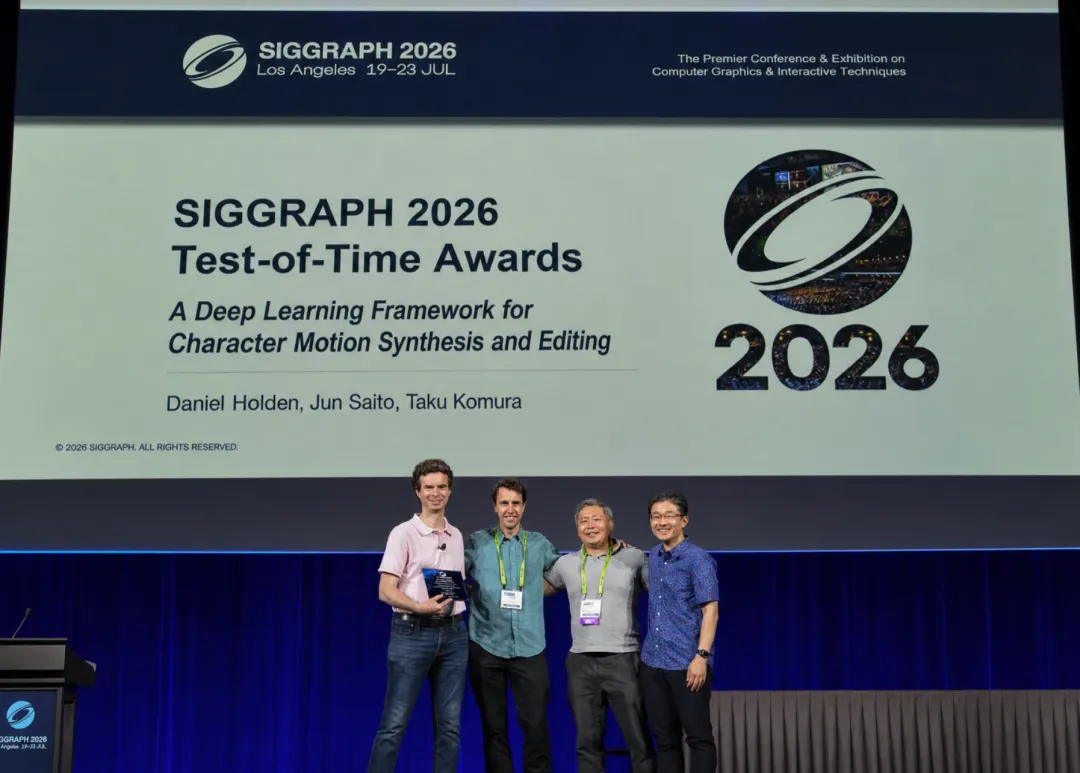
Representative image for SIGGRAPH时间检验奖揭晓:这项研究,提前十年押中了物理AI

SIGGRAPH时间检验奖揭晓:这项研究,提前十年押中了物理AI

Rank 61 · Content 65 · Popularity N/A

TL;DR - SIGGRAPH honored a 2016 deep-learning framework for character motion synthesis with its Test-of-Time Award. Its learned human-motion representations now underpin work on scalable embodied-AI data collection and physically grounded world models.

  • The original framework used a convolutional autoencoder to learn a reusable low-dimensional motion space from motion-capture data, then generated natural movement from high-level controls.
  • Follow-up systems modeled scene-aware interactions, multi-contact coordination, and temporal motion phases; the related AI4Animation project has over 8,000 GitHub stars.
  • Human-motion priors let the team reconstruct hands, objects, and scenes from noisy consumer-device data, reportedly reducing error by 60% on a public first-person hand-reconstruction benchmark.
  • Current work combines egocentric video, reconstructed 3D state, eye tracking, and electromyography to predict physical outcomes such as contact, force, and object-state changes.