🛰️ Daily AI Frontier
42 works · 2 categories · 15 topics · blog 12 journal 10 wechat 15 generated 2026-08-14 14:32:45 UTC
Top highlights — Research

Medical/Healthcare AI 3

From pixels to patterns: the AI revolution in stem cell-derived models

Rank 76 · Content 80 · Popularity 66

TL;DR - This Nature Methods Perspective examines AI-based image analysis for stem cell-derived models. It highlights how computational analysis can help turn imaging pixels into biologically meaningful patterns, though the provided abstract gives no specific methods or results.

  • Focuses on image analysis of stem cell-derived experimental models.
  • Discusses AI’s role in identifying patterns within complex imaging data.
  • Presented as a Perspective rather than a report of new experimental findings.

Representative image for 唯一通讯单位!上海交通大学李茜/王黎/窦红静团队,最新Nature Methods!

唯一通讯单位!上海交通大学李茜/王黎/窦红静团队,最新Nature Methods!

Rank 68 · Content 80 · Popularity 39

TL;DR - A Nature Methods study introduces kpiCells, programmable biomimetic artificial cells that independently tune membrane organization, internal mechanics, and ligands to study immunological synapses. The platform enables multiscale force measurements and may improve CAR-T activation and expansion.

  • kpiCells reproduce physiologically relevant stiffness, viscoelasticity, deformability, and surface-ligand organization.
  • Artificial antigen-presenting kpiCells recreate key stages of T-cell interaction, including contact, migration, stable adhesion, and detachment.
  • DNA tension probes and AFM quantify piconewton-scale TCR forces and single-cell contact-force signatures.
  • The platform demonstrates mechanically and chemically coordinated CAR-T stimulation with potential translational value.

Trump wants MMR vaccine split up: the science behind why it’s a bad idea

Rank 59 · Content 65 · Popularity 45

TL;DR - Nature reports that splitting the combined MMR vaccine into separate childhood injections is unsupported by evidence and could delay protection while increasing families’ costs.

  • Numerous studies support keeping measles, mumps, and rubella vaccination combined.
  • Separate injections would leave children unprotected for longer.
  • Additional appointments and doses could raise costs for families.
  • The provided excerpt does not include specific study designs or quantitative results.

Bioinformatics AI 2

Lessons learned from a Kaggle challenge for particle picking in cryo-electron tomography

Rank 84 · Content 90 · Popularity 70

TL;DR - A Kaggle challenge produced machine-learning methods for particle picking in experimental cryo-electron tomography that surpassed existing state-of-the-art software. The challenge also establishes a reference benchmark for future annotation tools.

  • Focuses on automated particle detection in experimental cryo-electron tomography data.
  • Challenge submissions yielded improved machine-learning algorithms.
  • The leading methods outperformed established particle-picking software.
  • The results provide a baseline for evaluating future annotation approaches.

Aligning protein-generative models to experimental fitness with ProteinDPO

Rank 84 · Content 100 · Popularity 45

TL;DR - ProteinDPO uses direct preference optimization to align a structure-conditioned protein language model with experimental biophysical fitness. It delivers stability predictions competitive with task-specific models while outperforming unsupervised and fine-tuned baselines.

  • Applies DPO to protein generation using experimental fitness information.
  • Aligns an unsupervised, structure-conditioned language model with biophysical properties.
  • Demonstrates that preference optimization can improve protein stability prediction.
  • Consistently surpasses the model’s unsupervised and conventionally fine-tuned versions.

LLMs & Foundation Models 1

Towards principled knowledge editing methods for large language model reasoning

Rank 69 · Content 80 · Popularity 43

TL;DR - Chen et al. examine limitations in current methods for editing knowledge in large language models and outline three research directions better suited to the complexity of real-world knowledge representation.

  • Focuses on how knowledge editing affects LLM reasoning.
  • Argues that existing techniques inadequately capture complex knowledge representations.
  • Proposes three promising directions for developing more principled editing methods.
  • The provided summary does not specify the directions or experimental results.

Multimodal & Generative 2

Towards general auditory intelligence for machine listening and speaking

Rank 66 · Content 75 · Popularity 45

TL;DR - Wang et al. review progress toward general-purpose auditory intelligence spanning machine listening, speaking, speech interaction, and audio–visual understanding. The work highlights the convergence of these capabilities into more unified AI systems.

  • Covers advances in both audio perception and speech generation.
  • Examines speech-based human–machine interaction.
  • Includes audio–visual understanding as a cross-modal capability.
  • The provided abstract does not specify architectures, benchmarks, or quantitative results.
Representative image for 5篇论文被ACM MM 2026录用

5篇论文被ACM MM 2026录用

Rank 62 · Content 75 · Popularity 33

TL;DR - ACM MM 2026 accepted five highlighted papers spanning multimodal scene-text spotting, robust watermarking, social-media prediction, visual-token compression, child-oriented AIGC video safety, and explainable continual learning.

  • SPaTS/SPaSO uses single-token grounding and reinforcement-optimized patch selection to improve scene-text localization and recognition.
  • DualAlign jointly aligns watermark embedding and extraction, achieving robustness after training with only two distortion types.
  • VisionSelector learns adaptive visual-token selection, reporting 90% compression, a 12-point gain over heuristic baselines, and 1.44× faster prefill.
  • Other work introduces relation-enhanced RAG for popularity prediction, a child-focused AIGC video-risk benchmark and agentic evaluator, and explainable class-incremental learning.

Battery Materials 2

Representative image for 万立骏院士领衔!中科院化学所「国家杰青」郭玉国&郭玉洁,最新Nature Nanotechnology!

万立骏院士领衔!中科院化学所「国家杰青」郭玉国&郭玉洁,最新Nature Nanotechnology!

Rank 64 · Content 75 · Popularity 39

TL;DR - A Nature Nanotechnology study identifies iron migration and dissolution as the main degradation mechanism in iron-rich layered sodium-ion cathodes. Multi-element nanoscale doping stabilizes iron coordination, enabling durable ampere-hour-scale cells.

  • Fe migration into sodium layers and subsequent dissolution trigger microcracks, dislocations, uneven stress, and capacity loss.
  • Al, Co, and Y dopants respectively strengthen Fe–O bonding, reduce magnetic frustration, and stabilize surface interfaces.
  • The doped cathode suppresses cracking, layer slipping, and iron dissolution while retaining its O3 structure.
  • A 2.7 Ah pouch cell achieved 121 Wh kg⁻¹ initially and retained 83.4% capacity after 2,000 cycles.
Representative image for 崔屹院士领衔!美国斯坦福大学李钰琦,最新Nature Chemical Engineering!

崔屹院士领衔!美国斯坦福大学李钰琦,最新Nature Chemical Engineering!

Rank 61 · Content 70 · Popularity 39

TL;DR - A Nature Chemical Engineering study directly repurposes zeolite-production wastewater as an aqueous zinc-battery electrolyte solvent. Its nanoscale aluminosilicate fragments form a protective interfacial layer that improves zinc deposition while reducing waste-treatment and purified-water demands.

  • Negatively charged zeolite fragments self-assemble into a roughly 6–10 nm interfacial layer during zinc deposition.
  • A gradient of oxygen defects creates local electric fields that promote Zn²⁺ transport, uniform deposition, and dendrite suppression.
  • Zn||Cu cells achieved 99.92% average Coulombic efficiency at 20 mA cm⁻²; anode-free Zn||MnO₂ cells exceeded 500 cycles at 5C.
  • The effect persisted across wastewater batches, preparation conditions, zeolite structures, and industrial samples.

Neuroscience Imaging 1

Voltage imaging of neurons distributed across entire brains of larval zebrafish

Rank 66 · Content 75 · Popularity 45

TL;DR - Researchers achieved voltage imaging across much of the larval zebrafish brain at 200.8 Hz by optimizing a remote-scanning light-sheet microscope. This enables high-speed observation of neuronal electrical activity distributed across the brain.

  • Uses voltage imaging to monitor distributed neuronal activity.
  • Covers much of the larval zebrafish brain.
  • Achieves an imaging rate of 200.8 Hz.
  • Relies on an optimized remote-scanning light-sheet microscope.

Science Metrics 1

Dataset artefacts can partially drive the measured decline in disruption

Rank 65 · Content 65 · Popularity 66

TL;DR - This Nature paper examines whether dataset artefacts partly explain the measured decline in disruptive research. Only the title is provided, so the specific methods and findings are unavailable.

  • Focuses on potential measurement bias in disruption metrics.
  • Suggests the observed decline is at least partially attributable to dataset construction or quality.
  • Matters for interpreting claims that scientific innovation is becoming less disruptive.
Top highlights — Industry & News

LLM Agents 10

The builder’s guide to GPT‑5.6

Rank 78 · Content 90 · Popularity N/A

TL;DR - OpenAI’s guide describes how startups can build AI agents faster and more cost-effectively with GPT-5.6, smarter model selection, and new Responses API capabilities.

  • Focuses on agent-building workflows for startups.
  • Emphasizes selecting models based on capability and cost.
  • Highlights Responses API features intended to streamline development.
  • Specific technical details or measured results are not provided in the excerpt.
Representative image for 深度体验DeepSeek Harness,我原谅它涨价了

深度体验DeepSeek Harness,我原谅它涨价了

Rank 75 · Content 85 · Popularity N/A

TL;DR - DeepSeek released and open-sourced DeepSeek Harness (DSH), a developer-focused coding-agent runtime with a highly modular plugin architecture. Its openness could enable extensive customization and a community ecosystem around agent tooling and self-improvement.

  • Models, tools, policies, storage, and context management are replaceable plugins; more than 100 plugins are included.
  • Four presets cover full coding, TypeScript-composed operations, minimal benchmarking, and runtime/plugin development.
  • Event-level trajectory replay exposes agent actions, failures, token usage, and cache performance for debugging.
  • The reviewer found DSH stronger than Codex on some long-running tasks, but this was anecdotal testing rather than a formal benchmark.
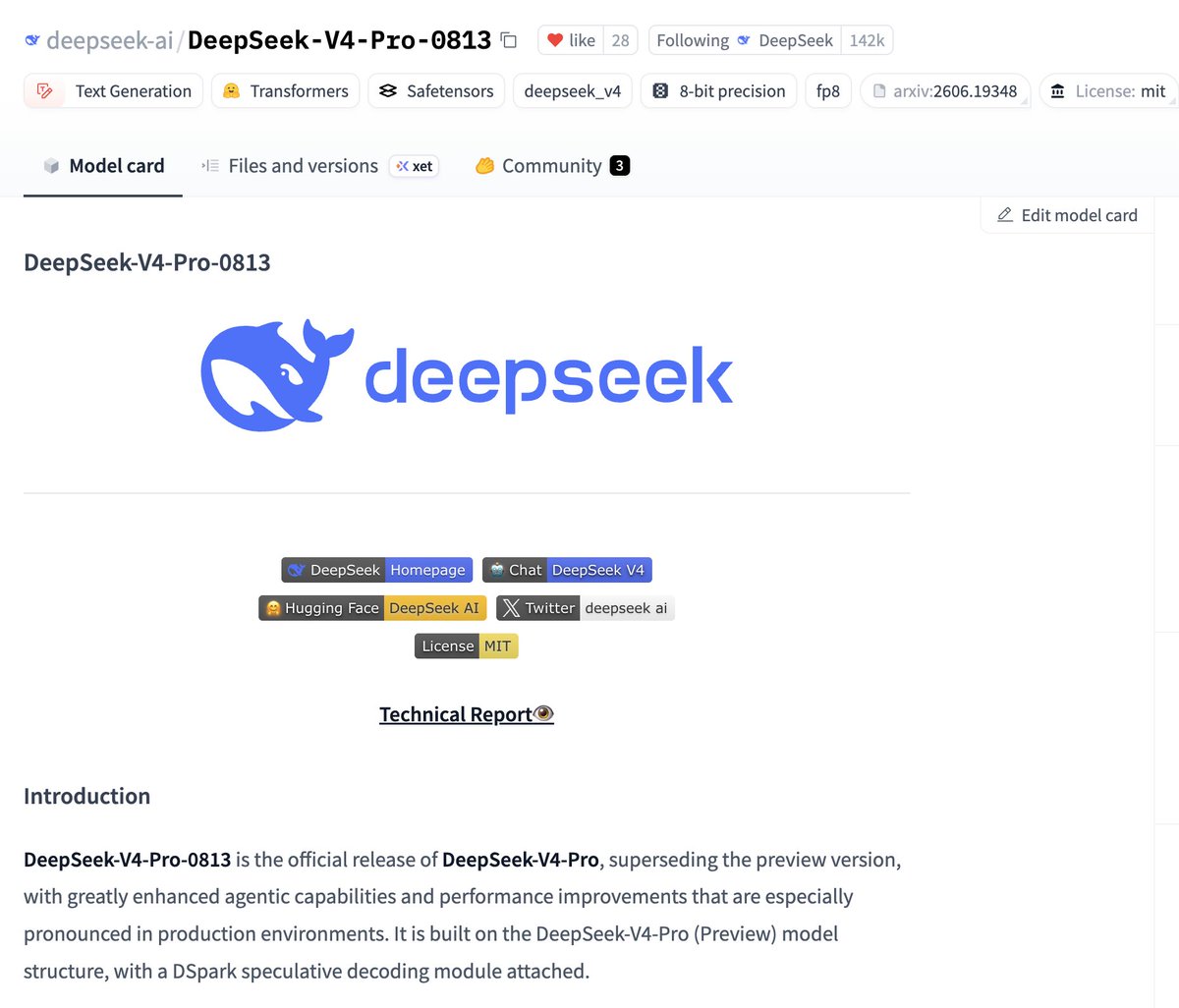
Representative image for RT by @huggingface: new deepseek v4 pro is now open weight on hugging face (mit license) "v4" is a…

RT by @huggingface: new deepseek v4 pro is now open weight on hugging face (mit license) "v4" is a…

Rank 75 · Content 85 · Popularity N/A

TL;DR - DeepSeek launched V4-Pro as an MIT-licensed open-weight model on Hugging Face, emphasizing stronger agent capabilities and production performance.

  • Supports low, high, and max reasoning-effort settings for different task complexities.
  • Adds native OpenAI Responses API compatibility and one-click Codex setup.
  • V4-Pro is available through Hugging Face, DeepSeek’s app/web “Expert Mode,” and its API.
  • DeepSeek says this release received substantially more training than the earlier V4 preview.
Representative image for GLM-5.3 来了:底座没换,编程暴涨 50%,还顺手揪出潜伏 40 年的世界级漏洞

GLM-5.3 来了:底座没换,编程暴涨 50%,还顺手揪出潜伏 40 年的世界级漏洞

Rank 71 · Content 80 · Popularity N/A

TL;DR - Zhipu launched GLM-5.3, emphasizing major gains in coding agents and defensive cybersecurity without replacing the base model. The company attributes the improvements to post-training innovations spanning sparse attention, asynchronous reinforcement learning, and distributed training infrastructure.

  • Coding gains target long-horizon software engineering, terminal operations, multi-tool workflows, and real-world agent tasks.
  • IndexShare shares an indexer across four Transformer layers, reportedly reducing per-token FLOPs by 2.9× at a 1M-token context length.
  • The SAO algorithm supports asynchronous, trajectory-level updates and reportedly extends stable long-horizon RL training from roughly 160 to over 1,000 steps.
  • Zhipu says GLM models helped identify 2,436 vulnerabilities across 269 projects, including 1,097 medium- or high-severity issues and a decades-old DNS amplification risk.
Representative image for 刚刚,GLM-5.3发布:Coding更接近Fable 5!潜伏40年的bug都被揪出来了

刚刚,GLM-5.3发布:Coding更接近Fable 5!潜伏40年的bug都被揪出来了

Rank 71 · Content 80 · Popularity N/A

TL;DR - Zhipu released the open-source GLM-5.3 model with stronger coding-agent and cybersecurity capabilities. It reportedly approaches Claude Fable 5 on coding while emphasizing auditable, production-oriented software delivery and vulnerability remediation.

  • GLM-5.3 scored 84.5% on CyberGym white-box code review, up from GLM-5.2’s 77.2%.
  • Pre-release red teaming reportedly found 2,404 vulnerabilities across 220 projects, including 1,088 medium- or high-severity issues.
  • In demonstrations using ZCode, the model autonomously built a full-stack game with authentication, persistence, permissions, tests, and Docker deployment.
  • It identified all 12 planted vulnerability classes in a Node.js application, implemented fixes, and produced regression tests that passed 54/54 checks.
Representative image for 重磅!Manus官宣脱离Meta独立,真能重回原样吗?

重磅!Manus官宣脱离Meta独立,真能重回原样吗?

Rank 71 · Content 80 · Popularity N/A

TL;DR - General-purpose AI agent company Manus will separate from Meta and resume independent operations after Chinese regulators prohibited the acquisition. The split entails deleting and restoring some post-acquisition user data, while Manus faces renewed competition without Meta’s ecosystem support.

  • Data created by affected users after December 29, 2025 will be deleted on August 23–24, 2026, with backup and restoration tools provided.
  • Manus says the deletion is a regulatory requirement, not a security incident; future data will be stored in the US and Singapore.
  • Reported annual recurring revenue increased from $100 million at acquisition to $400–500 million in July.
  • Tencent and other prior investors are reportedly considering repurchasing equity, potentially preserving Manus’s independent operations and future listing prospects.
Representative image for 刚刚,Manus恢复独立运营

刚刚,Manus恢复独立运营

Rank 64 · Content 70 · Popularity N/A

TL;DR - Manus is separating from Meta and resuming operations as an independent Singapore-based AI-agent company. The transition requires deleting some post-acquisition user data, while Manus prepares new general-agent features.

  • Affected data created on or after December 29, 2025, will be deleted during August 23–24, 2026, for regulatory compliance.
  • Affected users must back up their data before August 23 and can begin restoring it on August 25.
  • Future user data will be stored in the United States and Singapore.
  • Manus says it serves millions of users and has developed dedicated backup and restoration tools for the migration.
Representative image for 百度文库网盘GenFlow官宣中文名「库库AI」,推出「库库AI」办公独立端

百度文库网盘GenFlow官宣中文名「库库AI」,推出「库库AI」办公独立端

Rank 57 · Content 60 · Popularity N/A

TL;DR - Baidu renamed its GenFlow general-purpose agent “Kuku AI” and launched standalone consumer and enterprise office products. The agent coordinates specialized tools to create, edit, and manage multimodal work products across devices.

  • Parallel Office agents generate PPT, Excel, and Word files from a single instruction, alongside videos, podcasts, webpages, and other formats.
  • Its architecture includes MoE, long-term memory, multimodal editors, reusable skills, specialist sub-agents, and cloud-device coordination.
  • The initial professional mode targets finance with integrated market data, research reports, financial-modeling skills, and continuous automated tasks.
  • The enterprise edition combines public and private organizational knowledge with shared task context, identity controls, and auditable data governance.
Representative image for 百度文库网盘「库库AI」AI办公MAU超2500万,新推办公独立端

百度文库网盘「库库AI」AI办公MAU超2500万,新推办公独立端

Rank 57 · Content 60 · Popularity N/A

TL;DR - Baidu launched standalone versions of its “Kuku AI” office agent after reporting more than 25 million monthly active AI-office users. The product coordinates specialized agents and enterprise data to automate complex, cross-format workflows.

  • Kuku AI can invoke Word, Excel, PowerPoint, video, and other agents in parallel from a single instruction.
  • New offerings include PC, web, mini-program, and enterprise editions, with cross-device and cloud-based task continuation.
  • Its finance-focused mode integrates market data, filings, research reports, financial-modeling skills, and specialized AI experts.
  • The enterprise edition combines public and private knowledge with shared task context, reusable workflows, identity controls, and auditing.

Record, train, and deploy from one place with Strands Agents, LeRobot, and Hugging Face Storage Buckets

Rank 54 · Content 55 · Popularity N/A

TL;DR - Hugging Face presents an integrated workflow combining Strands Agents, LeRobot, and Storage Buckets to record robotics data, train models, and deploy them from one place. Only the title was provided, so implementation details and results are unavailable.

  • Strands Agents appears to orchestrate the end-to-end workflow.
  • LeRobot provides the robotics data collection and model-training components.
  • Hugging Face Storage Buckets support data storage and streaming across the pipeline.

Medical/Healthcare AI 2

Will the mRNA flu shot work better than a regular seasonal one? What the science says

Rank 63 · Content 70 · Popularity 45

TL;DR - Moderna’s newly approved mRNA influenza vaccine could help manufacturers adapt seasonal shots more rapidly as circulating strains change. The provided excerpt does not report comparative efficacy against conventional flu vaccines.

  • The vaccine uses mRNA technology for seasonal influenza.
  • Its key stated advantage is faster responsiveness to changing flu strains.
  • Whether it works better than conventional seasonal vaccines cannot be determined from the limited content provided.
Representative image for 从发现研究缺口到锁定选题方向,「氢离子」如何助力中国医生的科研?

从发现研究缺口到锁定选题方向,「氢离子」如何助力中国医生的科研?

Rank 47 · Content 45 · Popularity N/A

TL;DR - Alibaba Health’s medical AI platform “氢离子” now provides authorized access to full-text NEJM, JAMA Network, and BMJ content in China. It combines licensed literature with evidence-linked AI tools for clinical decision support and research workflows.

  • Includes NEJM content since 1990, all published JAMA Network content, and a decade of articles from 70 BMJ journals, including figures and supplements.
  • AI answers cite original passages and data, with links that let clinicians verify claims against source papers.
  • Supports medically optimized bilingual reading, multi-turn clinical queries, and structured literature reviews.
  • Targets workflows such as multidisciplinary case preparation, difficult-case analysis, and research evidence synthesis.

Bioinformatics AI 2

Representative image for 肺腺癌单细胞数据集GSE189357复现系列之九:SCENIC转录调控网络

肺腺癌单细胞数据集GSE189357复现系列之九:SCENIC转录调控网络

Rank 64 · Content 70 · Popularity N/A

TL;DR - A practical SCENIC workflow reproduces transcriptional regulatory-network analysis for malignant epithelial cells in the GSE189357 lung adenocarcinoma single-cell dataset. It enables identification of subtype-specific transcription-factor programs beyond differential gene expression.

  • SCENIC combines GENIE3 co-expression inference, RcisTarget motif enrichment, and AUCell regulon-activity scoring.
  • The tutorial analyzes four malignant cell subtypes, using balanced downsampling for network inference to reduce computational cost.
  • Regulon activity is then scored across all tumor cells and visualized by subtype.
  • Regulon specificity scores (RSS) rank candidate subtype-specific transcription factors, but no biological findings are reported.
Representative image for Seurat老用户上手sclet:还用 PBMC3k 跑通单细胞基础分析全流程

Seurat老用户上手sclet:还用 PBMC3k 跑通单细胞基础分析全流程

Rank 57 · Content 60 · Popularity N/A

TL;DR - A hands-on tutorial ports the standard PBMC3k single-cell RNA-seq workflow from Seurat to sclet. It shows that sclet offers familiar APIs while using Bioconductor’s SingleCellExperiment data model.

  • Covers QC, normalization, variable-feature selection, PCA, clustering, UMAP, marker detection, and annotation.
  • The workflow retained 2,638 cells, identified nine clusters, and recovered canonical PBMC markers.
  • sclet stores assays as layers and automatically uses logcounts rather than scaled data for marker testing and SingleR.
  • Manual marker-based annotation remains primary; SingleR is presented as supporting evidence, with 31 low-confidence cells pruned.

LLMs & Foundation Models 5

Introducing Gemini 3.7 Flash

Rank 71 · Content 80 · Popularity N/A

TL;DR - Google DeepMind announced Gemini 3.7 Flash, apparently a new Gemini model release. No article content was provided, so its capabilities, performance, availability, and technical details cannot be verified here.

  • The title identifies the model as part of Google DeepMind’s Gemini family.
  • “Flash” indicates its product/model tier, but no specific efficiency or latency claims are provided.
  • No benchmarks, architecture details, pricing, or release scope are available in the supplied material.
Representative image for 「用初中数学讲明白AI」第6章:从"自说自话"到"有问必答"——微调与对齐

「用初中数学讲明白AI」第6章:从"自说自话"到"有问必答"——微调与对齐

Rank 57 · Content 60 · Popularity N/A

TL;DR - An educational explainer describes how instruction tuning, RLHF, and DPO turn pretrained language models into useful assistants aligned with human preferences. It argues that post-training quality—not parameter count alone—was central to ChatGPT’s usability and adoption.

  • Instruction tuning uses curated question-answer examples to shift models from text completion toward following user requests.
  • RLHF trains a reward model from ranked responses, then optimizes the LLM against that learned preference signal.
  • DPO learns directly from preferred and rejected responses, avoiding RLHF’s separate reward-model and reinforcement-learning stages.
  • Human-feedback alignment can introduce reward hacking, evaluator bias, and difficulty judging outputs that exceed annotators’ expertise.
Representative image for 「用初中数学讲明白AI」第4章:搭积木——Transformer是怎么拼出来的

「用初中数学讲明白AI」第4章:搭积木——Transformer是怎么拼出来的

Rank 57 · Content 60 · Popularity N/A

TL;DR - An accessible tutorial explains how attention, feed-forward networks, residual connections, and layer normalization combine into Transformer blocks. It connects these stacked blocks to autoregressive next-token generation in GPT-style models.

  • Attention gathers contextual information; feed-forward layers transform it through expansion, GELU activation, and compression.
  • Residual connections preserve signals and gradients, while layer normalization stabilizes activations in deep networks.
  • Dimension-preserving blocks can be stacked repeatedly, with each layer sharing the architecture but learning distinct parameters.
  • GPT models generate text token by token by converting the final hidden state into vocabulary probabilities and repeating the forward pass.
Representative image for 「用初中数学讲明白AI」第3.5章:神经网络——机器是怎么把信息"吃进去消化掉"的

「用初中数学讲明白AI」第3.5章:神经网络——机器是怎么把信息"吃进去消化掉"的

Rank 50 · Content 50 · Popularity N/A

TL;DR - A beginner-friendly explainer uses middle-school mathematics to show how neural networks learn, why nonlinear activation functions are essential, and how feed-forward networks process information inside Transformers.

  • Training adjusts model parameters to minimize prediction error while aiming to generalize beyond memorized examples.
  • Without nonlinear activations, stacked linear layers collapse into a single linear transformation and cannot model problems such as XOR.
  • ReLU introduces nonlinear “bends,” enabling multilayer networks to approximate complex functions and learn hierarchical representations.
  • In Transformers, attention gathers contextual information, while the feed-forward network nonlinearly transforms that information for each token.
Representative image for 「用初中数学讲明白AI」第1章:一道填空题值一万亿美元

「用初中数学讲明白AI」第1章:一道填空题值一万亿美元

Rank 47 · Content 45 · Popularity N/A

TL;DR - An introductory explainer uses basic probability to describe LLMs as next-token predictors. It argues that their capabilities—and limitations—emerge largely from scaling this simple objective across vast models and datasets.

  • LLMs produce text iteratively by predicting a probability distribution over possible next tokens.
  • Scale distinguishes modern LLMs from basic autocomplete: far more parameters, training data, vocabulary, and usable context.
  • The article situates LLMs within AI ⊃ machine learning ⊃ deep learning ⊃ large models.
  • Next-token prediction can generate fluent text but does not guarantee factual accuracy, mathematical reasoning, memory, or tool access.

Multimodal & Generative 1

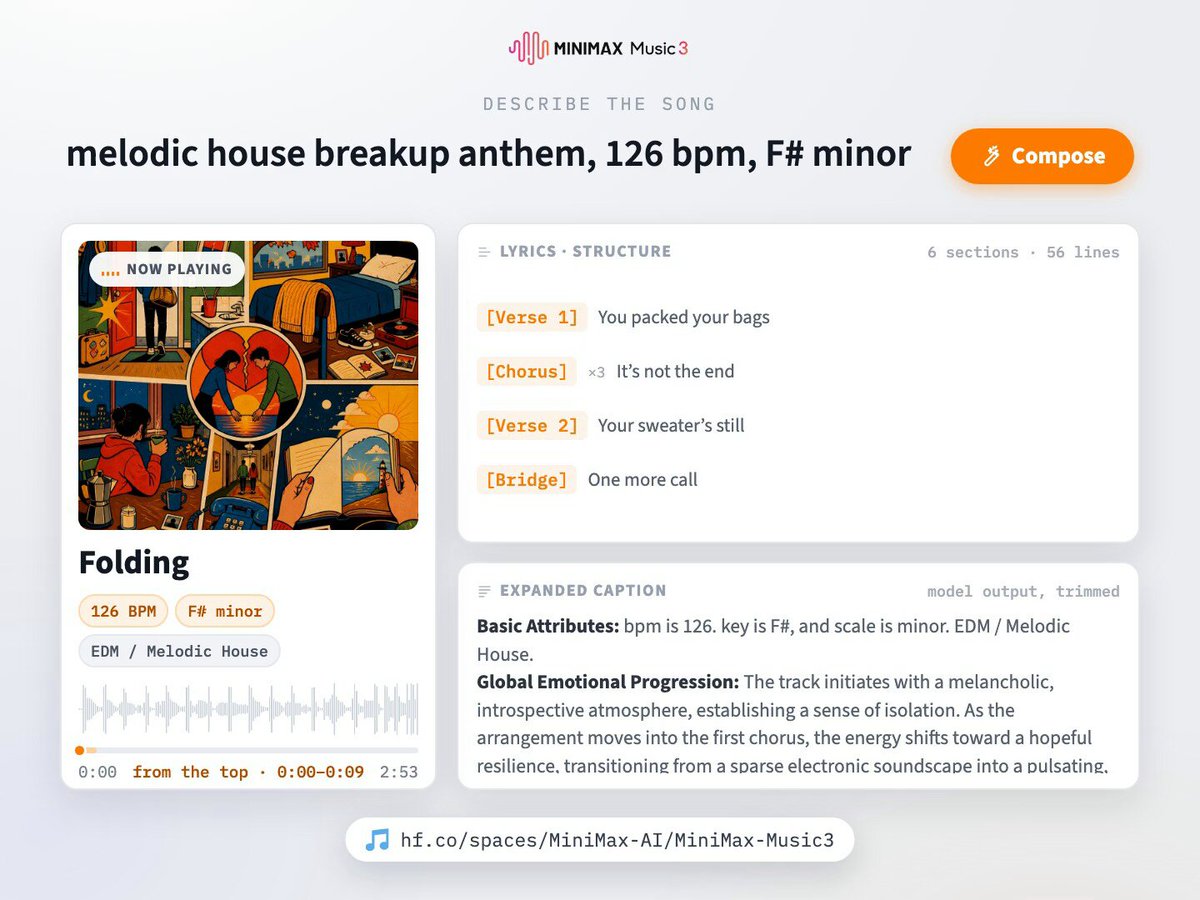
Representative image for RT by @huggingface: MiniMax Music 3 is just out on @huggingface 🎶🎵 SoTA song generation, now open…

RT by @huggingface: MiniMax Music 3 is just out on @huggingface 🎶🎵 SoTA song generation, now open…

Rank 75 · Content 85 · Popularity N/A

TL;DR - MiniMax Music 3 is an open-weight song-generation model that turns prompts and lyrics into complete songs. Its consumer-GPU support makes advanced music generation more accessible.

  • Combines an 8B-parameter LLM with a 2.7B-parameter diffusion transformer (DiT).
  • Supports full-song generation from text prompts and lyrics.
  • Available through Diffusers, Comfy-compatible weights, and a Hugging Face Spaces app.
  • The post claims state-of-the-art performance but provides no supporting benchmarks.

Efficiency & Systems 4

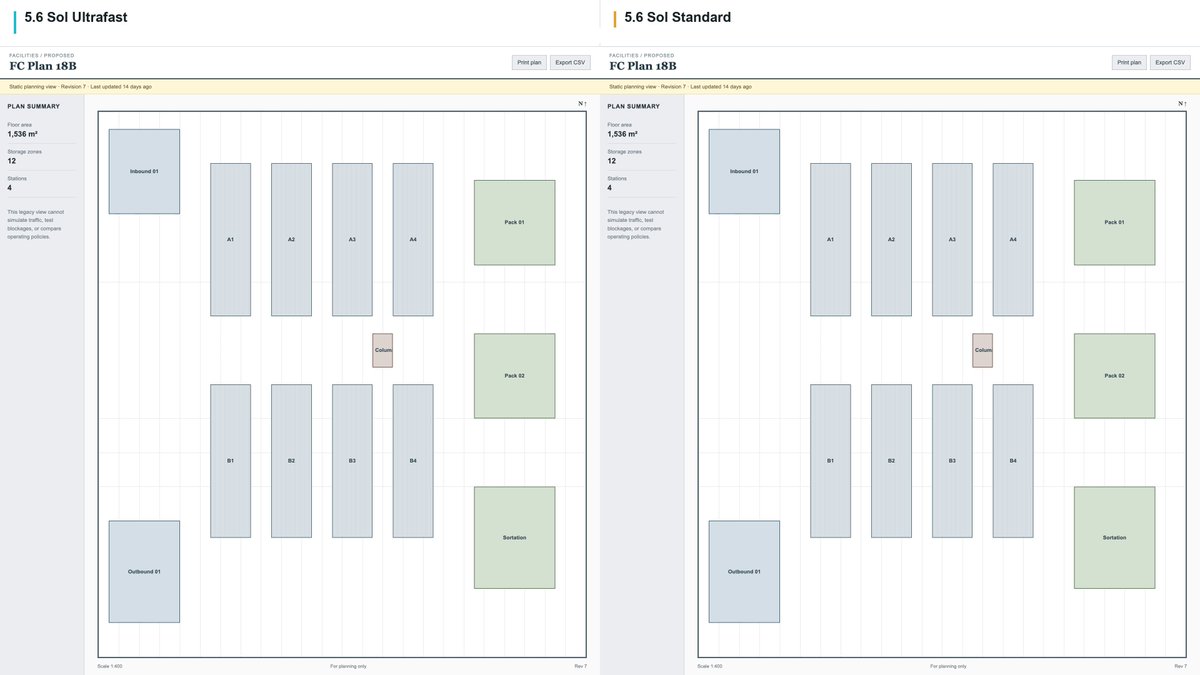
Previewing Ultrafast mode: GPT-5.6 Sol at up to 14X the speed

Rank 78 · Content 90 · Popularity N/A

TL;DR - OpenAI previewed Ultrafast, an API service tier that runs GPT-5.6 Sol up to 14× faster. Powered by Cerebras, it targets latency-sensitive applications with output speeds up to 750 tokens per second.

  • Supports GPT-5.6 Sol through the OpenAI API.
  • Delivers up to 750 output tokens per second.
  • Advertises speed improvements of up to 14×.
  • Uses Cerebras infrastructure for accelerated inference.
Representative image for R to @OpenAI: Powered by @Cerebras, Ultrafast generates up to 750 tokens per second, bringing our…

R to @OpenAI: Powered by @Cerebras, Ultrafast generates up to 750 tokens per second, bringing our…

Rank 78 · Content 90 · Popularity N/A

TL;DR - OpenAI previewed Ultrafast, an API service tier running GPT-5.6 Sol at up to 750 output tokens per second—up to 14× faster—on Cerebras infrastructure. It targets latency-sensitive enterprise applications where response speed directly affects utility.

  • Supports real-time use cases such as voice, customer support, coding, design, and security response.
  • Extends to commerce and financial research workflows requiring rapid model output.
  • The announcement specifies generation speed, but provides no details on pricing, availability, or benchmark methodology.
Representative image for Previewing Ultrafast mode: GPT-5.6 Sol at up to 14x the speed. Launching first in the OpenAI API to…

Previewing Ultrafast mode: GPT-5.6 Sol at up to 14x the speed. Launching first in the OpenAI API to…

Rank 78 · Content 90 · Popularity N/A

TL;DR - OpenAI is previewing an Ultrafast API mode that runs GPT-5.6 Sol at up to 14× its standard speed, potentially enabling lower-latency applications.

  • Initial access is limited to select OpenAI API customers.
  • Availability will expand to more businesses as capacity grows.
  • The announcement does not provide latency benchmarks, pricing, or implementation details.
Representative image for 3D存算一体芯片领军企业谦合益邦完成超20亿元B轮融资

3D存算一体芯片领军企业谦合益邦完成超20亿元B轮融资

Rank 61 · Content 65 · Popularity N/A

TL;DR - Chinese 3D compute-in-memory chip startup Qianhe Yibang raised over RMB 2 billion in Series B funding to advance its 3D DRAM architecture and commercialization. The technology targets the memory-wall bottleneck by tightly integrating computation and storage.

  • Its architecture stacks 3D DRAM to improve bandwidth and latency beyond conventional compute-memory separation.
  • The company develops chips alongside a co-designed system software stack.
  • Funding will support R&D, product iteration, and commercial deployment.
  • Investors include national and industry funds, with NetEase Youdao and China Mobile-linked capital providing deployment and validation opportunities.

AI Content Provenance 1

Can Anthropic’s invisible watermarks curb ‘AI slop’? Researchers remain sceptical

Rank 70 · Content 80 · Popularity 45

TL;DR - Anthropic’s new Claude models will watermark generated text and tag generated images in response to EU AI regulations. Researchers remain sceptical that these measures can meaningfully curb low-quality AI-generated content.

  • Text outputs will carry invisible watermarks.
  • Images will be tagged as AI-generated.
  • The changes reflect growing regulatory pressure for identifiable AI content.
  • The limited source does not describe the techniques or provide evidence of their effectiveness.

AI Cybersecurity 1

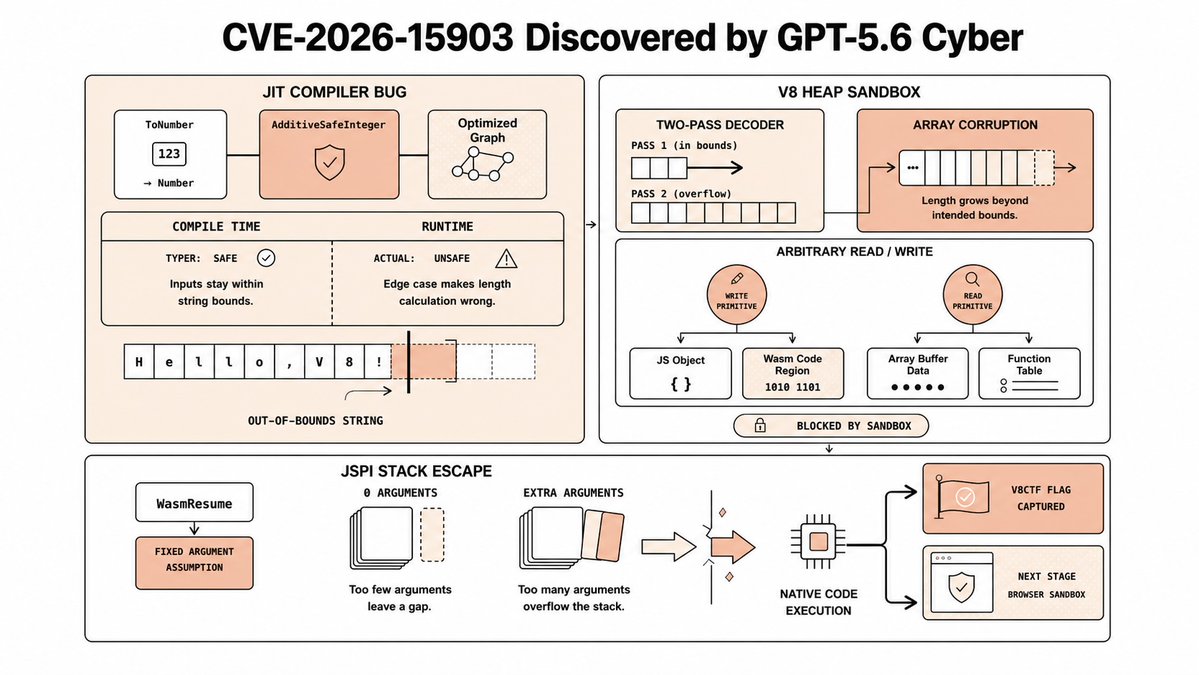
Representative image for R to @OpenAI: We've used GPT-5.6-Cyber extensively in real-world vulnerability research, including…

R to @OpenAI: We've used GPT-5.6-Cyber extensively in real-world vulnerability research, including…

Rank 78 · Content 90 · Popularity N/A

TL;DR - OpenAI says GPT-5.6-Cyber has been used in real-world vulnerability research, including discovering previously unknown flaws in popular open-source software. This suggests specialized AI models can assist practical security research on complex codebases.

  • OpenAI reports extensive use of GPT-5.6-Cyber for vulnerability research.
  • The work reportedly uncovered previously unknown vulnerabilities.
  • Chrome’s V8 JavaScript engine is cited as one investigated project.
  • No technical methodology, benchmarks, or vulnerability details are provided.

AI for Science 1

Representative image for 2026 GOAI 世界人工智能开源大赛「AI for Research 前沿探索」赛道报名中

2026 GOAI 世界人工智能开源大赛「AI for Research 前沿探索」赛道报名中

Rank 68 · Content 75 · Popularity N/A

TL;DR - The 2026 GOAI competition opened registration for an AI for Research track focused on applying agents to real scientific questions. It emphasizes problem formulation, reproducible exploration environments, and verifiable evidence—not just benchmark performance.

  • Two independent paths cover defined algorithm challenges and open-ended, participant-designed research problems.
  • Algorithm tasks include virtual cells, molecule–protein binding trajectories, and literature-driven materials discovery agents.
  • Open projects must define a real unresolved question, an actionable agent environment, and discovery signals in advance.
  • Submissions require reproducible evidence such as code, data sources, baselines, seeds, environments, and exploration logs.

Embodied AI 1

Representative image for AI引力场·合肥站|2026长三角(芜湖)算力算法创新应用大赛走进中科大

AI引力场·合肥站|2026长三角(芜湖)算力算法创新应用大赛走进中科大

Rank 47 · Content 45 · Popularity N/A

TL;DR - A university outreach event introduced Wuhu’s 2026 computing and algorithm competition, which targets commercialization through five real-world AI challenges, policy incentives, and post-competition pilots. USTC researchers also demonstrated spatial intelligence and embodied-AI systems spanning robotic manipulation and language-controlled robot dogs.

  • The competition covers government and tourism agents, industrial digital humans, agricultural remote sensing, and embodied-AI data governance.
  • Wuhu reports 54,000P of intelligent-computing capacity and subsidies covering up to 75% of computing costs.
  • USTC presented cross-modal localization, 3D detection, adverse-weather positioning, and a humanoid chemical-lab simulation platform.
  • ArtiBench and ArtiBrain target generalizable articulated-object manipulation across simulation and physical robots.

Geospatial AI 1

Introducing OlmoEarth embeddings: Custom embedding exports from OlmoEarth Studio for downstream analysis

Rank 57 · Content 60 · Popularity N/A

TL;DR - Hugging Face and AllenAI introduce custom embedding exports from OlmoEarth Studio for downstream analysis. With only the title provided, specific capabilities, methods, and results cannot be verified.

  • The update centers on exporting OlmoEarth embeddings.
  • Exports are intended for user-defined downstream analytical workflows.
  • No technical benchmarks, supported formats, or demonstrated applications are available in the provided content.

Research Reproducibility 1

What We Learned by Reproducing 2,200 papers from ICML

Rank 82 · Content 95 · Popularity N/A

TL;DR - Hugging Face reports lessons from an effort to reproduce 2,200 ICML papers. With only the title provided, specific findings and methods cannot be verified.

  • The reported effort covers 2,200 ICML papers.
  • Its focus is large-scale reproducibility of machine-learning research.
  • No concrete success rates, technical barriers, or recommendations are available in the provided content.