🛰️ Daily AI Frontier
37 works · 2 categories · 14 topics · blog 12 journal 10 arxiv 15 generated 2026-09-11 14:19:39 UTC
Top highlights — Research

LLM Agents 3

Representative image for COBRA-Skills: Contextual Bandit-Guided Evolution for Agent Skill Optimization

COBRA-Skills: Contextual Bandit-Guided Evolution for Agent Skill Optimization

Rank 87 · Content 95 · Popularity 67

TL;DR - COBRA-Skills optimizes reusable LLM-agent skills by combining contextual-bandit prioritization with execution-feedback-driven skill evolution. It reports leading average performance across multiple benchmarks while cutting optimization costs and data requirements.

  • Treats skill optimization as budgeted sequential optimization over a dynamically evolving candidate pool.
  • Selectively evaluates promising or informative skills rather than exhaustively testing candidates.
  • Across six agent benchmarks and three target models, it achieves the strongest average performance among compared methods.
  • Reduces optimization cost by 55–58% versus SkillOpt while using 50 unique optimization examples per benchmark.
Representative image for Mr.LHDR: A Benchmark for Multimodal Real-World Long-Horizon Deep Research Agents

Mr.LHDR: A Benchmark for Multimodal Real-World Long-Horizon Deep Research Agents

Rank 83 · Content 100 · Popularity 42

TL;DR - Mr.LHDR is a multimodal benchmark for testing deep-research agents on long, dependency-heavy evidence chains. Its results show that current systems struggle to maintain consistent reasoning across many interdependent steps, and final-answer accuracy can overstate true research success.

  • Tasks require an average of 12.1 intermediate conclusions and a mean dependency depth of 10.4.
  • The benchmark includes consequential non-text evidence such as images, maps, PDFs, charts, tables, logos, and video frames.
  • The strongest evaluated system reached 43.1% Overall Accuracy but only 34.3% Strict Accuracy.
  • Removing images lowered the Dependency-Aware Checklist Score by 12.6 points, while strict accuracy declined as reasoning chains lengthened.
Representative image for Sci-MMR: Benchmarking Multi-Step Evidence-Grounded Scientific Reasoning in Multimodal Agents

Sci-MMR: Benchmarking Multi-Step Evidence-Grounded Scientific Reasoning in Multimodal Agents

Rank 81 · Content 100 · Popularity 37

TL;DR - Sci-MMR is a 235-task benchmark for evaluating whether multimodal research agents can perform multi-step scientific reasoning with complete, traceable evidence. Results show that answer accuracy overstates evidence-grounded capability by more than 20 percentage points.

  • Tasks span four scientific disciplines and use argument graphs linking claims, citations, visual evidence, and supporting figure regions.
  • Evidence acquisition caused 57.2% of failures; cropping improved performance by 4.5 points, while gold evidence raised accuracy by up to 37.0 points.
  • Evidence integration caused 31.8% of failures, showing that models also struggle to derive correct conclusions from available evidence.
  • Even with gold evidence, the strongest evaluated model reached only 69.1% accuracy on the hardest tasks.

Medical/Healthcare AI 4

Target leakage, not model class, explains reported accuracy in survey-based cardiovascular screening: a leakage-tiered audit of glass-box and tabular foundation models

Rank 78 · Content 95 · Popularity 37

TL;DR - An audit of cardiovascular screening models finds that commonly reported high accuracy primarily reflects target leakage rather than model class. After removing post-diagnostic features, transparent glass-box models matched more complex alternatives while enabling faster inference and auditable fairness and uncertainty fixes.

  • Removing two post-diagnostic features reduced every model’s AUROC by 0.049–0.051 and compressed results into a 0.0045-wide band.
  • An explainable boosting machine was non-inferior within a 0.005 margin and scored patients about 104× faster than the strongest tabular foundation model.
  • Editing the glass-box model’s shape functions reduced the sex disparity in detection rates to 0.010.
  • Mondrian calibration repaired subgroup conformal-coverage gaps, while frozen models transferred from 2022 to 2023 within 0.002 AUROC.

Proximity-guided graph learning reveals tumour-associated proximity antigens

Rank 77 · Content 90 · Popularity 47

TL;DR - A proximity-guided graph-learning atlas maps spatially associated membrane antigens in tumours and identifies EGFR–CDCP1 as a promising co-target pair. This could improve tumour killing by enabling multispecific therapeutics to exploit disease-associated antigen communities.

  • Defines tumour-associated proximity antigens through proximity mapping and graph learning.
  • Reveals disease-linked spatial communities of membrane proteins.
  • Identifies EGFR and CDCP1 as a co-target pair for multispecific therapeutic strategies.
  • Reports enhanced tumour killing from joint targeting, though the provided summary does not include quantitative results.

TRI-611, a selective, brain-penetrant molecular glue degrader of ALK

Rank 70 · Content 80 · Popularity 47

TL;DR - TRI-611 is a selective, brain-penetrant molecular glue degrader that targets ALK fusion proteins. Its preclinical anti-tumour activity suggests a potential new treatment strategy for ALK-positive non-small-cell lung cancer.

  • TRI-611 induces ALK fusion protein degradation through a previously undescribed CRBN recruitment motif.
  • Brain penetration could be relevant to treating ALK-positive cancers involving the central nervous system.
  • The reported efficacy is preclinical, so clinical safety and effectiveness remain unestablished.

The neurons that can put a brake on a nervous-system cancer

Rank 66 · Content 75 · Popularity 47

TL;DR - A Nature research highlight reports that drugs mimicking the effects of inhibitory GABAergic neurons slowed glioma growth in mice, suggesting neural signaling could offer a therapeutic route for nervous-system cancers.

  • The study focuses on gliomas, a class of tumors affecting the nervous system.
  • GABAergic neurons appear to exert a growth-suppressing effect on these tumors.
  • Drugs that imitate this neuronal effect reduced tumor growth in mouse models.
  • The provided summary does not specify the drugs, mechanisms, effect sizes, or relevance to human treatment.

Bioinformatics AI 1

Representative image for Biology-in-the-loop: Amortized Adaptive Hit Discovery in CRISPR Screens

Biology-in-the-loop: Amortized Adaptive Hit Discovery in CRISPR Screens

Rank 88 · Content 100 · Popularity 60

TL;DR - AssayLoop combines a transformer-based acquisition policy with LLM-derived biological priors to prioritize CRISPR perturbations across sequential experiments. It discovers 27.7% of hits while testing about 5% of candidates, potentially making constrained biological screens substantially more efficient.

  • AssayBench-Loop includes 1,389 CRISPR screens spanning five phenotype categories.
  • AssayFormer learns adaptive acquisition strategies from historical screens and updates them using experimental feedback.
  • An adaptive handoff integrates LLM priors, while AssayLLM extends the approach through task-specific LLM post-training.
  • On temporally held-out screens, AssayLoop achieved 5.67× enrichment over random selection and transferred to phenotype categories excluded from training.

LLMs & Foundation Models 1

Representative image for Negative Self-Distillation: Learning to Reason by Avoiding Flaws

Negative Self-Distillation: Learning to Reason by Avoiding Flaws

Rank 86 · Content 95 · Popularity 66

TL;DR - Negative Self-Distillation (NSD) improves LLM reasoning by teaching models to diverge from self-generated flawed reasoning rather than imitate privileged, artificially confident solutions. This preserves exploratory and self-corrective behavior that conventional on-policy self-distillation may suppress.

  • NSD requires neither ground-truth answers nor external supervision; the model generates a question-specific negative persona, such as a “careless reasoner.”
  • A dynamic gating mechanism isolates reasoning-critical tokens so training targets behavioral flaws without degrading foundational language abilities.
  • The approach addresses the confounding of flawed reasoning with ordinary linguistic tokens that makes naive unlearning objectives risky.
  • NSD reportedly outperforms on-policy self-distillation and other label-free, self-bootstrapping reinforcement-learning baselines.

Multimodal & Generative 6

Representative image for Recursive Code World Models: Building Complex Worlds through Recursive Scene Programs

Recursive Code World Models: Building Complex Worlds through Recursive Scene Programs

Rank 86 · Content 95 · Popularity 65

TL;DR - Recursive Code World Models reconstruct complex, executable 3D scenes from a single image using compositional scene programs and a recursively invoked vision-language coding agent. The approach improves fine-detail reconstruction while preserving scene-wide geometry and spatial relationships.

  • Uses a global-local-global process: establish the full scene, recursively refine unresolved parts, then revisit overall composition.
  • Shares a reference-aligned camera projection across recursion levels for consistent geometry.
  • Parent-level revisitation corrects boundaries, spatial relationships, and shared errors introduced during local refinement.
  • Outperforms prior code-based image-to-scene reconstruction methods; ablations indicate deeper recursion can improve fine-scale reconstruction.
Representative image for World in World: Explore the World with World Models

World in World: Explore the World with World Models

Rank 86 · Content 95 · Popularity 65

TL;DR - World in World is a training-free control interface for frozen autoregressive video world models that enables viewpoint-controlled rerendering, long-horizon revisiting, and human-motion transfer. It matters because it unifies several control requirements without task-specific modules or additional model training.

  • Converts video observations, scene projections, geometry renderings, and retrieved generated states into camera- and time-labelled visual evidence.
  • Uses correspondence routing based on persistent point identities and geometry to align target-view queries with source-video tokens.
  • Introduces evidence-wise attention classifier-free guidance to regulate each auxiliary evidence channel independently within one denoising pass.
  • Evaluates perceptual quality, temporal consistency, and camera-following accuracy across diverse viewpoint changes.
Representative image for SenseNova-U1.5: Towards Native Unified Visual Intelligence

SenseNova-U1.5: Towards Native Unified Visual Intelligence

Rank 84 · Content 90 · Popularity 71

TL;DR - SenseNova-U1.5 is an 8B mixture-of-transformers model that unifies visual understanding, reasoning, generation, and editing without separate encoders or VAEs. It suggests that multimodal understanding can transfer directly to complex visual planning and creation in an end-to-end architecture.

  • Supports native resolutions up to 4K using spatially coherent patch reconstruction and curated generation and editing data.
  • Uses specialized post-training experts for aesthetics, bilingual text rendering, infographics, and editing, consolidated through multi-expert on-policy distillation.
  • Reported gains span image fidelity, text rendering, complex composition, multi-reference editing, instruction following, and subject and geometry preservation.
  • The authors plan to open-source code for supervised fine-tuning, reinforcement learning, and on-policy distillation.
Representative image for Prompt Revision as a Source of Cultural Bias in Text-to-Image Systems

Prompt Revision as a Source of Cultural Bias in Text-to-Image Systems

Rank 81 · Content 100 · Popularity 37

TL;DR - WORLDVIEW reveals that hidden prompt-revision layers in commercial text-to-image systems can causally introduce cultural stereotyping. This shows that bias audits must examine deployed generation pipelines—not just models or final images.

  • WORLDVIEW contains 8,960 prompts spanning 15 languages and 31 language-context pairings.
  • The audit covers prompt revision in DALL-E-3, Imagen-4, and GPT-Image-1.5.
  • Compared with a no-context English baseline, US contexts were least marked, while non-Western and non-Anglophone contexts received heavier cultural marking.
  • Revised prompts often compressed diverse contexts into narrow, stereotypical vocabularies; original-versus-revised prompt comparisons isolated revision as the cause.
Representative image for OmniHallu: Unified Hallucination Detection for Cross-Modal Comprehension and Generation in Multimodal Large Language Models

OmniHallu: Unified Hallucination Detection for Cross-Modal Comprehension and Generation in Multimodal Large Language Models

Rank 81 · Content 100 · Popularity 37

TL;DR - OmniHallu is a unified framework and benchmark for detecting hallucinations across multimodal comprehension and generation tasks involving images, video, audio, and text. It matters because prior detectors are often limited to a single modality or task type.

  • OmniHallu-Bench contains 10,000 samples with claim-level human annotations across six text-media conversion tasks.
  • A multi-agent architecture decomposes outputs into atomic claims, uses modality-specific experts for verification, and aggregates their evidence through structured reasoning.
  • A preference-optimized trainable verifier approximates the multi-agent decisions while reducing expert calls by 66% with minimal reported performance loss.
  • Experiments identify a consistent modality-dependent performance gradient and provide fine-grained analysis of cross-modal hallucination patterns.
Representative image for MindTopo: Can Foundation Models Reason in Topological Space?

MindTopo: Can Foundation Models Reason in Topological Space?

Rank 79 · Content 95 · Popularity 42

TL;DR - MindTopo is an 11,030-instance benchmark testing foundation models’ topological reasoning and closed-loop planning across continuity, separation, order, enclosure, and knots. Fourteen multimodal LLMs substantially trail humans, especially when planning requires preserving topology across actions.

  • The benchmark spans 13 procedurally generated task types with controllable difficulty and evaluates both reasoning and agentic planning.
  • Every tested multimodal LLM performed better on reasoning than planning; even the strongest remained far below observed human performance.
  • Supervised fine-tuning and reinforcement learning improved Qwen3-VL-2B-Instruct’s reasoning more than its planning.
  • Image- and video-generated observations preserved local cues and plausible endpoints but often violated environment dynamics or topology between transitions.

Efficiency & Systems 2

Why Does Post-Training Quantization Work?

Rank 81 · Content 100 · Popularity 37

TL;DR - This paper explains why post-training quantization preserves LLM performance despite introducing weight errors at every layer. Pretraining creates error-canceling residual interactions, while LM-head geometry protects the probabilities of highly ranked tokens.

  • Newly introduced layer errors tend to oppose inherited errors, slowing hidden-state discrepancy growth.
  • This counteracting behavior develops during pretraining and is absent in randomly initialized models.
  • LM-head geometry preferentially preserves scores and probabilities for the model’s most confident token predictions.
  • The authors verify both mechanisms across multiple models and quantization settings.
Representative image for OmniKVQuant: KV Cache Quantization for Omni-LLMs

OmniKVQuant: KV Cache Quantization for Omni-LLMs

Rank 81 · Content 100 · Popularity 37

TL;DR - OmniKVQuant is a training-free KV-cache quantization framework for multimodal LLMs that accounts for differences across audio, video, and text representations. It enables 2-bit caches while substantially preserving performance, reducing memory demands without reconstructing a dense FP16 cache during decoding.

  • Identifies temporal key drift and heterogeneous value geometry as key limitations of applying text-oriented TurboQuant to multimodal caches.
  • Sets key quantization ranges over short input-stream windows and applies separate value rotations for each modality.
  • Demonstrates 2-bit KV caches on Qwen2.5-Omni and Qwen3-Omni across seven audio-visual benchmarks.
  • Provides a fused Triton decoding kernel that unpacks quantized values directly during attention.

Ancient Proteomics 1

Ancient proteins identify various Denisovan remains from Southwest China

Rank 70 · Content 70 · Popularity 70

TL;DR - Proteomic analysis of excavated bone fragments and teeth identified multiple Denisovan remains in Southwest China. The findings expand the documented geographic distribution of Denisovans and offer evidence about their evolution and phenotype.

  • Ancient protein analysis enabled identification of otherwise fragmentary remains.
  • The studied material includes both bone fragments and teeth from a Southwest China excavation.
  • The discoveries fill a geographic gap in the known Denisovan record.
  • Further details or specific proteomic results are not provided in the excerpt.

Cellular Imaging 1

Imaging cellular activity across all organs reveals body-wide circuits

Rank 73 · Content 75 · Popularity 67

TL;DR - Researchers developed a whole-body imaging system that records cellular activity across all zebrafish organs. It enables simultaneous observation of organ dynamics and reveals distributed circuits spanning the body.

  • Captures cellular activity throughout the entire zebrafish body.
  • Records dynamics across multiple organs within a unified imaging framework.
  • Identifies multiple distributed, body-wide cellular circuits.
  • The provided summary does not specify the imaging modality, resolution, or individual circuits discovered.

Conflict Monitoring 1

Advancing conflict research and response through satellite-derived data

Rank 69 · Content 70 · Popularity 67

TL;DR - This Nature study combines satellite-derived war-damage observations with text-based fatality records to provide a more complete picture of armed conflict. Case studies in Ukraine and Myanmar show how integrating these complementary sources can reveal violence dynamics missed by fatality-focused analysis alone.

  • Improves and enriches satellite damage data and textual fatality records before fusing them.
  • Mitigates source-specific limitations by combining physical-damage evidence with reported deaths.
  • Expands conflict analysis beyond fatality-centric measures.
  • Demonstrates the approach through case studies from Ukraine and Myanmar.

LLM Security 1

SpecGuard: Inference-Time Backdoor Detection For Free

Rank 78 · Content 95 · Popularity 37

TL;DR - SpecGuard detects backdoor-triggered LLM behavior by reusing token-acceptance signals already produced during speculative decoding, adding no model-computation overhead. This enables always-on runtime monitoring without assumptions about trigger structure or extra generation passes.

  • Backdoor activation creates a prediction mismatch between a clean draft model and the compromised target model, changing draft-token acceptance rates.
  • The authors formalize this signal and argue that attackers cannot suppress it without weakening the backdoor.
  • SpecGuard reportedly works across multiple backdoor types and model families, including stealthy attacks missed by input-level filters.
  • The approach repurposes an existing inference optimization rather than adding separate detection computation.

Neural Interfaces 1

Wireless neural recordings from groups of mice inside and outside the laboratory

Rank 77 · Content 90 · Popularity 47

TL;DR - Researchers developed a miniaturized wireless platform for recording and manipulating neural and physiological activity in groups of small animals. It enables studies of the brain mechanisms underlying natural rodent social behaviors in both laboratory and outdoor environments.

  • Supports wireless neural and physiological monitoring without confining animals to conventional laboratory setups.
  • Combines activity recording with experimental manipulation in a miniaturized platform.
  • Accommodates multiple mice, enabling investigation of group social behavior.
  • Extends controlled neuroscience experiments into outdoor, naturalistic environments.

Neurotechnology 1

A wireless modular platform for neuro-behavioral recording and closed-loop manipulation in small animals

Rank 77 · Content 90 · Popularity 47

TL;DR - WILD is a wireless modular platform for recording neural activity and behavior while delivering closed-loop optogenetic stimulation in freely moving small animals. It enables brain studies in both laboratory and naturalistic environments.

  • Records neuronal activity, animal movement, and video of the environment or eye movements.
  • Integrates onboard data analysis with triggered optogenetic stimulation.
  • Supports closed-loop experiments without restricting animals through wired equipment.
  • Targets studies in freely moving small animals such as mice.

Optogenetic Tools 1

An ultralow-background far-red light-responsive optogenetic tool based on an engineered biliverdin-binding domain

Rank 70 · Content 80 · Popularity 47

TL;DR - Researchers developed FenixS and Ash1, a compact engineered protein pair that heterodimerizes under far-red light with ultralow background activity, offering a new tool for optogenetic control.

  • FenixS is based on an engineered biliverdin-binding domain.
  • Far-red light triggers heterodimerization between FenixS and Ash1.
  • The system is designed for low background activation when illumination is absent.
  • The provided summary does not report quantitative performance or application results.
Top highlights — Industry & News

LLM Agents 8

Introducing the Agents API

Rank 78 · Content 90 · Popularity N/A

TL;DR - OpenAI introduced the Agents API, a managed service for building and deploying cloud-based agents. Powered by the Codex harness, it supports orchestration, persistent long-running sessions, and tool use.

  • Provides managed infrastructure for launching cloud agents.
  • Uses the Codex harness to orchestrate agent workflows.
  • Supports long-running sessions for tasks that extend beyond a single interaction.
  • Enables agents to use tools while executing tasks.
Representative image for AI新经济走向真实商业,蚂蚁APASS构建Agent信任基础设施

AI新经济走向真实商业,蚂蚁APASS构建Agent信任基础设施

Rank 71 · Content 80 · Popularity N/A

TL;DR - Ant Group launched APASS, a trust infrastructure for AI agents conducting commercial activities such as service calls, business processes, and payments. It aims to make agent transactions accountable by continuously verifying identity, authorization, intent, and behavior.

  • APASS uses a “Know Your Agent” model to establish linked identity and behavioral trust chains.
  • Its capabilities include identity registration, continuous verification, intent-security checks, dynamic risk controls, evidence preservation, and post-incident traceability.
  • Ant says APASS has connected more than 1 million agents, including 110,000 activated agents across 442 service providers.
  • More than 50 organizations are participating in its standards ecosystem, while integrations with Alipay+, Mastercard, and Visa protocols target cross-border interoperability.
Representative image for 让智能体自主探索而不越界,蚂蚁密算开源可信原生智能体HOP 3.0

让智能体自主探索而不越界,蚂蚁密算开源可信原生智能体HOP 3.0

Rank 71 · Content 80 · Popularity N/A

TL;DR - 蚂蚁密算开源可信原生智能体框架 HOP 3.0,通过“智能体原生语言”和受控执行机制,让智能体在明确边界内自主探索,并提升复杂行业任务的可审计性与可靠性。

  • HOP 3.0 将结构化业务逻辑与大模型推理统一表达,使任务目标、流程、数据依赖、边界条件和核验要求可读、可评审。
  • “探索—核验—提交”机制将可逆试验与删除数据等不可逆操作隔离,只有通过独立核验后才能提交真实变更。
  • 语言与执行引擎承担长任务的状态、分支和上下文管理,让模型专注于受约束节点内的推理,从而降低对超大模型的依赖。
  • 蚂蚁密算称,在其复杂规格驱动研发实践中,HOP 3.0 实现三项质量指标均达 100%、Token 消耗降低约 13%,并使普通模型故障率下降约 91.7%。
Representative image for 金融领域首个智能体安全标准发布

金融领域首个智能体安全标准发布

Rank 71 · Content 80 · Popularity N/A

TL;DR - China’s first group standard focused on AI-agent security in finance requires third-party mobile agents to obtain authorization from both users and financial institutions before operating financial apps. It matters because it limits high-privilege GUI automation that could bypass institutional controls and endanger accounts or funds.

  • The standard covers input handling, model reasoning and decisions, identity verification and operations, data privacy, and risk management and compliance.
  • Unauthorized agents may not use system permissions to read or manipulate financial-app interfaces; microphone, screenshot, recording, and screen-sharing access must follow the app provider’s security policies.
  • The “dual authorization” model favors institution-approved interfaces such as MCP, GUI-MCP, or agent-to-agent integrations over screen reading, OCR, and simulated clicks.
  • Banks, payment networks, technology companies, and a national fintech certification center jointly developed the standard for financial institutions and agent developers.
Representative image for 豆包工作新增本地Office编辑、浏览器录制与回放等功能

豆包工作新增本地Office编辑、浏览器录制与回放等功能

Rank 71 · Content 80 · Popularity N/A

TL;DR - 豆包工作新增本地 Office 编辑、浏览器操作录制回放和任务执行环境切换功能,强化了 AI 代理在真实办公场景中处理复杂、跨设备任务的能力。

  • 用户可直接调用豆包编辑本地 PPT 和 Excel,修改结果在本地与线上同步;Word 支持将后续上线。
  • 浏览器录制功能可学习点击、填写、上传等操作,并生成包含调用条件、输入要求和结果验证方式的可复用 Skill。
  • 任务执行期间可在本地电脑与云电脑之间切换而不中断对话或丢失上下文。
  • 跨设备调度允许用户调用其他已登录设备的文件与算力,实现多台电脑间的任务接力。
Representative image for Agent商业化驶入深水区,蚂蚁推出APASS补上“信任基础设施”

Agent商业化驶入深水区,蚂蚁推出APASS补上“信任基础设施”

Rank 71 · Content 80 · Popularity N/A

TL;DR - Ant Group launched APASS, a trust infrastructure for AI agents conducting commercial activities such as service access, business operations, and payments. It matters because agents acting autonomously on behalf of people or companies require persistent identity, authorization, risk monitoring, and auditability beyond conventional account verification.

  • APASS applies “Know Your Agent” principles through trusted agent identities and risk-control services, addressing who an agent is, whom it represents, and what it may do.
  • Its core capabilities cover identity registration, continuous verification, intent security, and tamper-resistant records for post-incident audits and accountability.
  • The system checks authorization before transactions, detects abnormal behavior or intent drift during execution, and preserves evidence afterward.
  • Ant says APASS has connected over 1 million agents, with 110,000 activated, while more than 50 organizations are participating in standards and ecosystem development.
Representative image for 阿里云Token Plan个人版升级:加量不加价,新增12类Agent Harness工具

阿里云Token Plan个人版升级:加量不加价,新增12类Agent Harness工具

Rank 68 · Content 75 · Popularity N/A

TL;DR - 阿里云升级 Token Plan 个人版,在价格和 Credits 不变的情况下,为 Standard 和 Pro 套餐增加多类 Agent Harness 工具额度,将订阅从单纯模型调用扩展为“模型+Agent 服务”。

  • 新增能力通过 MCP 协议开放,覆盖搜索、网页解析、代码执行、语音识别与合成、图像生成等常见 Agent 工作流。
  • Standard 和 Pro 套餐分别保持 139 元/月和 499 元/月,并提供不同额度的搜索、解析、代码解释器及多模态工具调用。
  • 视频生成、Managed Agent、RAG 知识库、Memory 记忆库和 Sandbox 也纳入支持,但采用后付费模式。
  • 订阅可在千问桌面端、Qoder、Qwen Code、Codex 和 OpenClaw 等 Agent 应用中复用。
Representative image for OpenAI这是拿千禧年难题当Benchmark刷啊。。。

OpenAI这是拿千禧年难题当Benchmark刷啊。。。

Rank 68 · Content 75 · Popularity N/A

TL;DR - OpenAI says a system of thousands of AI agents made substantial progress on Millennium Prize problems, reportedly completing a Navier–Stokes proof and potentially targeting the Hodge conjecture next. The claims remain under review and raise unresolved questions about verification, research priority, data use, and credit for human mathematicians.

  • OpenAI reportedly used about 10,000 parallel agents on Navier–Stokes, generating 2.7 million messages and 130 billion output tokens before GPT-6 Astra performed Lean formalization and verification.
  • The broader experiment reportedly produced 4.9 million agent messages and roughly 300 billion output tokens across several unsolved problems.
  • OpenAI states that recent Codex prompts from mathematician Tristan Buckmaster could not have influenced the internal model, but no public technical evidence independently verifies that claim.
  • Reports that OpenAI has made progress on the Hodge conjecture—and that the internal model is code-named “Aeon”—remain unconfirmed rumors.

Bioinformatics AI 1

How a researcher uses Codex and ChatGPT to search for new antimicrobial molecules

Rank 71 · Content 80 · Popularity N/A

TL;DR - César de la Fuente’s lab is using OpenAI’s Codex and ChatGPT to search living and extinct genomes for potential antimicrobial molecules. The approach could support efforts to identify candidates against drug-resistant infections.

  • Codex and ChatGPT assist researchers in exploring genomic data for antimicrobial candidates.
  • The search covers genomes from both living and extinct organisms.
  • The work targets antimicrobial resistance, but the provided content does not specify methods, validation results, or discovered molecules.

Multimodal & Generative 2

Representative image for 不堆 Transformer,斯坦福吴佳俊如何用物理重新定义多模态融合?|ECCV 2026

不堆 Transformer,斯坦福吴佳俊如何用物理重新定义多模态融合?|ECCV 2026

Rank 82 · Content 95 · Popularity N/A

TL;DR - Stanford’s Jiajun Wu outlined a physics-grounded approach to multimodal perception that aligns vision, sound, and touch through shared properties such as geometry, material, and stiffness. This could improve generalization when audio and tactile data are scarce, rather than relying only on end-to-end Transformer fusion.

  • PhysDreamer distills physical properties such as spatially varying Young’s modulus from video diffusion models by matching differentiable simulations to generated reference videos.
  • WonderPlay uses coarse 3D physics simulations—represented through depth or optical flow—to condition video generation for controllable, action-driven physical interactions.
  • DiffImpact and RealImpact apply differentiable acoustic rendering and measured sound fields to infer impact and material-related properties from audio.
  • DexSkin extends the framework to low-cost tactile sensing for robotic manipulation, treating touch as another observation of the same underlying physics.

Build more natural voice experiences with GPT‑Live‑1 in the API

Rank 75 · Content 85 · Popularity N/A

TL;DR - OpenAI introduced GPT‑Live‑1 for building more natural voice applications through its API. It adds full-duplex conversation, improved instruction following, customizable voices, and telephony support.

  • Supports simultaneous speaking and listening for more fluid voice interactions.
  • Offers stronger adherence to developer instructions.
  • Enables custom voices for tailored user experiences.
  • Includes telephony support for voice applications operating over phone networks.

Efficiency & Systems 1

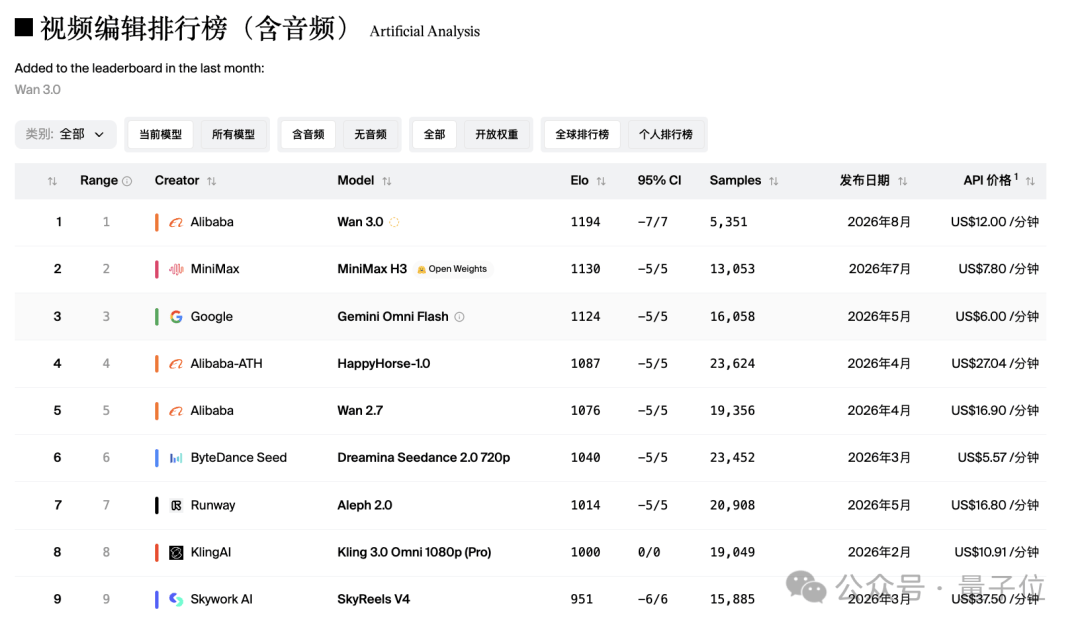
Representative image for 吹爆开源!RunningHub让MiniMax H3满血提速12倍,本地部署照样起飞

吹爆开源!RunningHub让MiniMax H3满血提速12倍,本地部署照样起飞

Rank 68 · Content 75 · Popularity N/A

TL;DR - RunningHub open-sourced H3 Lightning, an inference stack that accelerates MiniMax H3 video generation by about 12× while retaining BF16 precision. It targets locally deployable, PCIe-connected multi-GPU systems, reducing the cost and iteration time of AI video production.

  • On four RTX 6000D GPUs, a 5-second 1344×768 video took 28.7 seconds, versus 348.8 seconds for the original BF16 50-step setup.
  • A post-trained acceleration model cuts denoising to 4–9 steps; SageAttention2, Cache-DiT, and torch.compile further optimize attention, reuse intermediate results, and reduce execution overhead.
  • For eight GPUs without NVLink, TP2 plus Ulysses4 was reportedly 12% faster and used about 14 GiB less memory than TP4 plus Ulysses2.
  • RunningHub integrated the optimizations into SGLang’s multimodal generation engine and published deployment instructions and code for local use.

AI for Mathematics 1

Daily briefing: OpenAI claims a huge maths breakthrough

Rank 66 · Content 75 · Popularity 47

TL;DR - Nature’s daily briefing reports OpenAI’s claim that it solved a particularly difficult mathematics problem. The potential breakthrough is significant, but questions remain about attribution and who deserves credit.

  • The item describes OpenAI’s result as a claim rather than an independently established breakthrough.
  • The provided excerpt does not identify the mathematical problem, method, or supporting evidence.
  • The briefing also highlights a human DNA-mutation atlas and barriers to moving bioengineered microorganisms beyond the laboratory.