🛰️ Daily AI Frontier
36 works · 2 categories · 14 topics · blog 12 journal 9 arxiv 15 generated 2026-08-28 14:35:29 UTC
Top highlights — Research

LLM Agents 5

Representative image for UrbanGround: From Local Perception to Spatial Agency in a Real-Scale City

UrbanGround: From Local Perception to Spatial Agency in a Real-Scale City

Rank 87 · Content 95 · Popularity 69

TL;DR - UrbanGround is a closed-loop benchmark for testing whether multimodal LLM agents can turn street-level perception into reliable navigation in a physically constrained 3D replica of Hong Kong. Current agents handle basic visual recognition and short-range spatial reasoning, but struggle to sustain and correct goal-directed behavior over longer routes.

  • Built from territory-wide 3D geospatial data, the sandbox supports first-person exploration and interactive-map navigation.
  • Evaluates active spatial grounding, navigation to increasingly distant or ambiguous destinations, and robustness to route changes and pedestrian motion.
  • Orientation and pedestrian-aware movement remain unreliable despite useful local perception capabilities.
  • During extended exploration, errors accumulate because agents fail to compose local skills into sustained behavior or recover effectively.


WikiSkill: Compiling Agent Experience into Persistent Knowledge for Skill Evolution

Rank 86 · Content 95 · Popularity 65

TL;DR - WikiSkill is a framework that consolidates agents’ execution experience into a persistent wiki used to evolve reusable skills. It improves agent performance and enables skills to transfer across models and model families.

  • Separates raw execution histories, accumulated knowledge, and executable skills while continuously updating the shared wiki.
  • Consistently outperforms prior skill-evolution methods across diverse benchmarks and models, and beats no-skill baselines in most tested settings.
  • Evolved skills complement model scaling: larger models generally gain more, while smaller skill-equipped models can outperform substantially larger models without skills.
  • Ablations identify persistent knowledge accumulation as critical; skills can also transfer effectively and sometimes outperform skills evolved by the target model itself.
Representative image for SWE-Prime: Fewer Trajectories, Better Performance

SWE-Prime: Fewer Trajectories, Better Performance

Rank 85 · Content 95 · Popularity 61

TL;DR - SWE-Prime is a two-stage data-selection method for supervised fine-tuning of software-engineering agents that filters successful trajectories by quality and representativeness, then selects useful segments for loss computation. Using only 10% of trajectories outperformed training on the full resolved dataset, showing that cleaner supervision can beat greater data volume.

  • Screens trajectories using process quality, result quality, and dataset representativeness.
  • Evaluates semantic step segments for solution contribution, learnability, and potential risks.
  • Retains all segments as context during training but computes loss only on selected segments.
  • Achieved relative gains of up to 12.2% on SWE-Bench Pro and 24.2% on SWE-Bench Verified.

RedEvoAgent: Automatic Red-Teaming Agent with Experience-Driven Skill Evolution

Rank 81 · Content 100 · Popularity 37

TL;DR - RedEvoAgent is a black-box red-teaming agent that converts prior jailbreak trajectories into compact, interpretable attack skills that evolve with experience. It aims to expose dangerous tool use and persistent state changes in deployed LLM agents more efficiently and reliably.

  • Profiles tool effectiveness and uses Deciding-Tool Attribution to determine which tools deserve credit for successful attacks.
  • Applies a validation ratchet that retains skill updates only when they improve validation performance.
  • Avoids the context overhead, retrieval bias, and limited interpretability associated with reusing full attack trajectories.
  • Outperforms fixed and agentic baselines across multiple benchmarks, models, and execution harnesses, while improving tool efficiency and transferability.
Representative image for INTENT-AS-A-TOOL Makes it Easy to Track Agentic Misalignment

INTENT-AS-A-TOOL Makes it Easy to Track Agentic Misalignment

Rank 78 · Content 95 · Popularity 37

TL;DR - INTENT-AS-A-TOOL gives autonomous LLM agents a dedicated channel for signaling behavioral intent, enabling fine-grained tracking of agentic misalignment during reasoning. It could support earlier online intervention before harmful actions occur.

  • Harmful actions under goal conflicts are often preceded by detectable intent signals in chain-of-thought reasoning.
  • Intent-targeted tools let models explicitly indicate commitment toward a behavior during generation.
  • Tool-call probabilities provide judge-free, dense trajectories of behavioral tendencies, unlike coarse post-hoc chain-of-thought labels.
  • The method complements chain-of-thought monitoring and helps identify critical reasoning steps for intervention.

Medical/Healthcare AI 2

This pulsating muscle graft mimics benefits of exercise

Rank 66 · Content 75 · Popularity 46

TL;DR - A surgically implanted, pulsating muscle graft reportedly mimicked some benefits of exercise in mice. The animals developed greater muscle mass and strength as well as increased bone density, suggesting potential therapeutic value for patients unable to exercise.

  • The study used a muscle graft designed to contract or pulsate after implantation.
  • Implanted mice showed improvements in muscle mass and physical strength.
  • Bone density also increased, indicating effects beyond the grafted muscle.
  • The provided summary does not specify the graft’s mechanism, effect sizes, durability, or relevance to humans.

Does the shingles vaccine cut heart-disease risk? Mounting evidence suggests a link

Rank 56 · Content 60 · Popularity 46

TL;DR - A large study reports an association between receiving the recombinant shingles vaccine and a lower risk of cardiovascular problems. The finding adds to evidence of a possible heart-health benefit, but the provided summary does not establish causality.

  • The study examined the recombinant vaccine used to prevent shingles, a viral condition.
  • Vaccinated people had a lower observed risk of cardiovascular problems.
  • The result suggests vaccination could have benefits beyond preventing shingles.
  • Effect sizes, study design, and potential mechanisms are not included in the provided content.

Bioinformatics AI 3

Large language models as uncertainty-calibrated optimizers for experimental discovery

Rank 84 · Content 100 · Popularity 47

TL;DR - Rankovic and colleagues present a method for training large language models as uncertainty-calibrated optimizers for experimental molecular discovery. Accounting for uncertainty in the underlying data could make model-guided design decisions more reliable.

  • Targets a key limitation of language models in molecular design: poorly calibrated uncertainty.
  • Incorporates data uncertainty directly into language-model training.
  • Frames language models as optimizers for selecting or proposing experimental discoveries.
  • The provided summary does not specify benchmarks, molecular tasks, or quantitative results.

A FAIR road to a bioAFM databank

Rank 63 · Content 70 · Popularity 47

TL;DR - This Nature Methods Comment describes early efforts to build bioAFM-DB, a high-quality databank for biological atomic force microscopy data. Applying FAIR data principles could improve data reuse, comparison, and computational analysis across bioAFM research.

  • The proposed resource focuses on organizing and preserving biological AFM datasets.
  • The authors assess the initiative’s current state and identify challenges in establishing the databank.
  • The Comment outlines potential courses of action rather than reporting experimental results.
  • Details on specific standards, infrastructure, or benchmark results are not provided in the excerpt.

Author Correction: OrthoFinder: improved phylogenetic orthology inference with enhanced accuracy and scalability

Rank 31 · Content 25 · Popularity 46

TL;DR - This is an author correction to the Nature Methods article on OrthoFinder, a method for scalable phylogenetic orthology inference. The provided content does not specify what was corrected or whether the changes affect the original findings.

  • Published online in Nature Methods on 26 August 2026.
  • The corrected article concerns improved accuracy and scalability in orthology inference.
  • Orthology inference supports comparative genomics by identifying genes related through speciation.
  • No technical details, corrected values, or revised results are included in the provided excerpt.

LLMs & Foundation Models 4

TTPO: Test-Time Policy Optimization

Rank 87 · Content 95 · Popularity 68

TL;DR - TTPO is a label-free test-time policy optimization method that combines self-distillation on majority-agreeing rollouts with grouped reinforcement learning on disagreeing ones. It matches label-supervised OPSD across five competition-level mathematical reasoning benchmarks while improving Qwen3-1.7B test-time accuracy from 38.0% to 45.2%.

  • Uses an asymmetric objective designed to remain useful even when majority-vote pseudo-labels are incorrect.
  • Distills agreeing rollouts via on-policy self-distillation and penalizes disagreeing rollouts through grouped reinforcement learning.
  • Applies token-level selection to down-weight converged positions and penalize only confident errors.
  • Reports strong label-free gains, including 25.2%–36.4% improvements without thinking and cross-task generalization.

CritICL: Inference-Time Weak-to-Strong Generalization from Small Language Model Failure Modes

Rank 85 · Content 95 · Popularity 61

TL;DR - CritICL is an inference-time framework that uses structured failure patterns from smaller models as critique-based in-context guidance for stronger models. It improves reasoning with fewer generations and lower token costs than conventional test-time scaling approaches.

  • Exploits the observation that failure modes recur across model scales within the same model family.
  • CritICL-dynamic predicts input-specific failure modes and retrieves relevant critiques.
  • CritICL-static applies a global failure-mode profile for consistent guidance.
  • Experiments report gains over standard in-context learning and performance competitive with or better than test-time scaling methods.

Scaling Model-Generated Distillation Data Can Make Latent Teacher Traits More Recoverable

Rank 83 · Content 100 · Popularity 42

TL;DR - Scaling model-generated distillation datasets can amplify subtle teacher-specific traits in students, even when the training examples are off-task and never explicitly mention those traits. This creates a latent behavior-transfer risk that conventional data screening may miss.

  • Larger independent off-task datasets made an induced teacher trait more detectable in students compared with matched no-trait controls.
  • Scaling either amplified an already favored target trait or shifted behavior from a related alternative toward the intended trait.
  • Learned LoRA updates showed a parallel scaling trend, with effects observed across model families, trait types, multi-trait settings, and cross-model transfer.
  • The findings motivate trait-aware curation and evaluation of synthetic distillation data, including data that appears benign.

Consolidating RLVR Capabilities Across Domains: A Deep Dive into Fusion Paradigms

Rank 79 · Content 95 · Popularity 42

TL;DR - This paper compares three paradigms for consolidating domain-specific RLVR capabilities into one language model: expert task-vector merging, mixed-domain RL, and multi-teacher on-policy distillation. Their average performance is similar, but substantial benchmark-level differences make the best choice dependent on cost, data balance, and capability-preservation priorities.

  • Average performance differs by at most 1.4 points across paradigms, while individual benchmark gaps reach 8.6 points.
  • Cross-domain relationships reflected in task-vector geometry help explain domain-level performance variation.
  • Mix RL is sensitive to domain proportions, MOPD is bounded by teacher performance, and Merge compresses expert updates into a single model update.
  • All three improve single-sample accuracy without measurable solution-coverage gains or degradation of held-out capabilities.

Multimodal & Generative 2

Representative image for Self-OPD: On-Policy Distillation for Flow Matching Models without Teacher

Self-OPD: On-Policy Distillation for Flow Matching Models without Teacher

Rank 84 · Content 90 · Popularity 71

TL;DR - Self-OPD is a teacher-free on-policy distillation framework that uses a flow matching model’s own stochastic exploration to generate step-wise supervision. It aims to reduce teacher-training costs and distribution mismatch while improving single- and multi-objective alignment.

  • At each timestep, the method creates multiple stochastic SDE branches, rolls them out with an ODE sampler, and evaluates their rewards against a deterministic self-reference.
  • A pull-push objective attracts the model toward high-advantage branches and repels it from low-advantage ones, with direction-aware attenuation and variance normalization.
  • Multi-objective alignment combines normalized scores at the reward level to avoid direct gradient conflicts.
  • Reported experiments show improvements over prior reinforcement-learning and OPD methods without task-specific teachers.
Representative image for Aphanta: Diagnosing Task-Aligned Image-Edited Intermediates for Multimodal Reasoning

Aphanta: Diagnosing Task-Aligned Image-Edited Intermediates for Multimodal Reasoning

Rank 84 · Content 90 · Popularity 69

TL;DR - Aphanta is a diagnostic framework for testing whether image-edited intermediates improve multimodal reasoning. It finds that image editing is useful as a specialized visual workspace for certain tasks, but not as a universal reasoning mechanism.

  • Compares direct reasoning, editor-assisted reasoning, and reasoning with idealized reference intermediates to distinguish theoretical headroom from current editor utility.
  • Across 20 candidate tasks, gains were concentrated in visual cue injection, grounding, and counterfactual state realization.
  • Symbol-sensitive construction and structural extrapolation were substantially less reliable.
  • On selected positive tasks, a consolidated Qwen pipeline improved mean score from 0.343 to 0.445, a 10.2-point absolute and 29.7% relative gain.

Efficiency & Systems 1

Beyond Parallel Blindness: Information Floors and Model Gaps in Block Drafting

Rank 83 · Content 100 · Popularity 42

TL;DR - This paper decomposes block-drafting rejection into an unavoidable “information floor” caused by missing within-block context and a “model gap” caused by imperfect proposals. The results show that revealing just one preceding token removes most of the information floor, while current drafters still have substantial room for improvement.

  • On Qwen3-4B, the all-parallel information floor reaches 0.286 at the final block position, capping optimal per-slot acceptance at 71%.
  • Realizing one earlier token removes 86–100% of the floor, indicating that the missing information is highly local.
  • Mutual-information analysis independently supports this short-range conditioning effect.
  • Proposal quality remains a major bottleneck: the final-slot model gap causes 43–64% of DFlash rejection and 85–92% of DSpark’s oracle-conditioned rejection.

AI Code Review 1

Representative image for From Static to Dynamic: Benchmarking Real-World Code Review with MCR-Bench

From Static to Dynamic: Benchmarking Real-World Code Review with MCR-Bench

Rank 78 · Content 95 · Popularity 37

TL;DR - MCR-Bench evaluates LLMs on realistic, multi-round code review with defect lifecycle tracking. Results show current models struggle increasingly as reviews lengthen, exposing weaknesses in temporal alignment and long-range memory.

  • Contains 2,269 real-world review tasks across five programming languages.
  • Annotates defect descriptions, types, severity levels, and state changes across review rounds.
  • Mainstream LLMs perform poorly at both defect detection and lifecycle tracking, with performance degrading over additional rounds.
  • Semantically complex and low-salience defects are missed more often; errors are linked to cross-round temporal misalignment and inadequate long-range memory.

Biocatalytic Synthesis 1

A practical recycling strategy for making thiophosphate molecules with enzymes

Rank 63 · Content 70 · Popularity 46

TL;DR - Researchers developed an enzymatic platform for constructing thiophosphate molecular motifs while avoiding large quantities of expensive reagents. The approach could enable more practical enzymatic synthesis cascades for drug development.

  • Uses enzymes to construct thiophosphate-containing molecules.
  • Reduces reliance on costly reagents required in large amounts.
  • Establishes a foundation for multi-step enzymatic synthesis of drug-relevant thiophosphate motifs.

Earth System AI 1

Enhancing reproducibility in hybrid Earth system models

Rank 66 · Content 65 · Popularity 67

TL;DR - This Perspective proposes a framework for assessing reproducibility in hybrid Earth system models that integrate AI with traditional modelling. It matters because AI can improve prediction while introducing additional barriers to validating and reproducing model results.

  • Identifies reproducibility as a growing challenge when AI components are incorporated into Earth system models.
  • Introduces a framework for evaluating reproducibility in these hybrid modelling systems.
  • Provides practical recommendations for strengthening reproducible research and modelling workflows.
  • Focuses on methodological guidance rather than reporting new predictive results.

LLM Evaluation 1

Difference-in-Differences on a Censored Rating Scale Can Manufacture an Effect: Evidence from a Pre-Registered LLM-Judge Audit

Rank 81 · Content 100 · Popularity 37

TL;DR - A pre-registered audit shows that difference-in-differences analyses on bounded rating scales can falsely suggest bias in LLM judges because censoring at scale limits creates spurious interactions. This calls into question preference effects reported without accounting for differential attenuation near rating floors or ceilings.

  • The registered learner-profile effect on scaffolding preference was null: +0.085 points (95% BCa CI: −0.167 to +0.353; p = 0.684).
  • A nominally significant +0.378 interaction (p = 0.002) was not identifiable as a genuine preference difference.
  • A zero-differential-preference construction reproduced 79–85% of that interaction using the observed severity shift and rating-scale floor alone.
  • The paper derives the censoring mechanism in closed form and shows its contribution can be estimated from an audit’s own ratings.

Mechanistic Interpretability 1

Representative image for Circuit Condensation: Post-Training that Concentrates a Behavior's Causal Circuit

Circuit Condensation: Post-Training that Concentrates a Behavior's Causal Circuit

Rank 81 · Content 100 · Popularity 37

TL;DR - Circuit Condensation post-trains models so a target behavior is carried by a smaller causal circuit, making mechanistic explanations easier to inspect and verify. Across eight models and four behaviors, it reduced circuits by 8.1× on average versus the strongest frozen-model baseline while preserving task performance and general capabilities.

  • Each round prunes low-attribution edges and trains a low-rank adapter to reproduce the original behavior through the remaining graph.
  • Condensed circuits were smaller in 30 of 32 settings, with reductions reaching 316×; control searches without weight updates produced larger circuits in 29 of 32 settings.
  • Exhaustive subset testing found 11 of 19 circuits irreducible, while pair ablations showed that edge effects can depend on one another.
  • For indirect object identification, condensation isolated 24 attention heads, including 17 with documented roles, versus 61 heads in the matched frozen circuit.

Robotics & Embodied AI 1

Representative image for 一段视频,让机器人学会开门并穿越:Video2DoorTraversal 如何打通 Real-to-Sim-to-Real

一段视频,让机器人学会开门并穿越:Video2DoorTraversal 如何打通 Real-to-Sim-to-Real

Rank 68 · Content 85 · Popularity 30

TL;DR - Video2DoorTraversal is a preprint describing a single-video Real-to-Sim-to-Real framework that reconstructs a door as a simulated digital twin, generates valid trajectories, and trains a wheeled-legged robot to open and pass through it. It reduces real-world data collection and achieved a 96.57% average success rate on five reconstructed doors.

  • A standard RGB video provides geometry, scale, camera motion, and articulated components for a simulation-ready DoorTwin with visual and physical properties.
  • A simulation agent searches parameterized approach, grasp, handle-turning, pushing, and traversal skills, retaining trajectories that pass task, collision, and kinematic checks.
  • The ArticuACT policy uses two depth-camera views and robot state to jointly control the base, arm, and gripper; domain randomization improves transfer robustness.
  • The robot succeeded in 169 of 175 trials across five doors and averaged 80.95% zero-shot success on three unseen, structurally similar doors, with each traversal taking about 13 seconds.

Structural Biology 1

Evolutionary mystery revealed by structures of a key enzyme in the synthesis of glycolipids

Rank 58 · Content 65 · Popularity 43

TL;DR - Structural studies of a key glycolipid-synthesis enzyme reveal an unexpected reaction mechanism and an intrinsic regulatory “brake” that arose during primate evolution. The findings connect enzyme architecture with both biochemical control and evolutionary history.

  • The enzyme produces crucial sugar-carrying lipids.
  • Its structures uncover a previously surprising catalytic mechanism.
  • A built-in feature limits enzyme activity, functioning as a regulatory brake.
  • The available summary attributes this brake to primate evolution but provides no experimental details.
Top highlights — Industry & News

LLM Agents 7

Representative image for GPT、Claude 遭遇窃听门:换个模型就能让思维链不再隐身?

GPT、Claude 遭遇窃听门:换个模型就能让思维链不再隐身?

Rank 88 · Content 95 · Popularity 70

TL;DR - Researchers reportedly recovered hidden reasoning from Claude, GPT, and Gemini APIs by passing encrypted reasoning blocks to compatible, more easily bypassed models. The finding matters because weak context binding could expose secrets, enable low-cost reasoning distillation, and carry invisible instructions into later agent runs.

  • The attack does not break encryption; it exploits reasoning blocks that are insufficiently bound to the originating model, session, or account.
  • Recovered-text lengths closely matched reported thinking-token counts, while agent traces revealed credentials and private information absent from visible conversation histories.
  • Cross-model access could let inexpensive models extract reasoning produced by stronger models, reducing the cost of collecting high-value distillation data.
  • In agent workflows, migrated reasoning can preserve hidden behavioral instructions, creating an opaque prompt-injection channel that influences future actions.
Representative image for 大晓联合香港大学发布StreamPI,让 VLA 真正理解时间,迈向连续物理智能

大晓联合香港大学发布StreamPI,让 VLA 真正理解时间,迈向连续物理智能

Rank 78 · Content 90 · Popularity N/A

TL;DR - ACE Robotics and the University of Hong Kong introduced StreamPI, a streaming temporal-modeling method that gives vision-language-action models persistent multimodal context without adding model parameters. It improves robotic memory, spatial reasoning, and long-horizon task execution by reusing cached history instead of repeatedly processing frame windows.

  • StreamPI anchors instructions to each observation, restructures attention across time, and uses key-value caching so inference processes only new observations while retaining historical representations.
  • Random-interval streaming training exposes the model to variable observation gaps and incomplete histories, improving robustness to real-world timing and latency variations.
  • On LIBERO, five-frame average success rose from 97.0% to 98.3%; on CALVIN, average completed task-chain length increased from 4.313 for π0.5 to 4.547.
  • In real-robot tests, StreamPI improved shell-game success from 46.7% to 80.0%, rolling-object grasping from 26.7% to 63.3%, and cup-sleeve insertion from 60.0% to 92.0%.
Representative image for 深度拆解 Muse Glimmer,24GB 显存跑 30B Agent,Meta 到底做了什么?

深度拆解 Muse Glimmer,24GB 显存跑 30B Agent,Meta 到底做了什么?

Rank 78 · Content 90 · Popularity N/A

TL;DR - Meta’s Muse Glimmer is an open 30B multimodal agent model designed for sustained local operation with 128K context on consumer GPUs. Its system-level combination of memory-efficient attention, quantization, agent-focused training, and speculative decoding aims to make private local agents more practical.

  • GQA with two KV heads and alternating local/global attention sharply reduces long-context KV-cache requirements; 4-bit quantization enables a roughly 17GB variant targeting 24GB GPUs.
  • A separate 1.8B vision encoder processes screenshots and documents, while runtime context management remains necessary to prevent visual-token growth and stale screenshots from overwhelming long tasks.
  • On-policy distillation trains the model on states produced by its own rollouts, improving recovery from failed tool calls and deviations during multi-step workflows.
  • The DFlash block-diffusion drafter accelerates speculative decoding; Meta reports RTX 5090 throughput rising from about 74.9 to 233.4 tokens/s for the 17GB quantized model, though results vary across agent benchmarks.
Representative image for Claude开始接管物理世界!能用机械臂阻拦5000万美元打款了

Claude开始接管物理世界!能用机械臂阻拦5000万美元打款了

Rank 78 · Content 90 · Popularity N/A

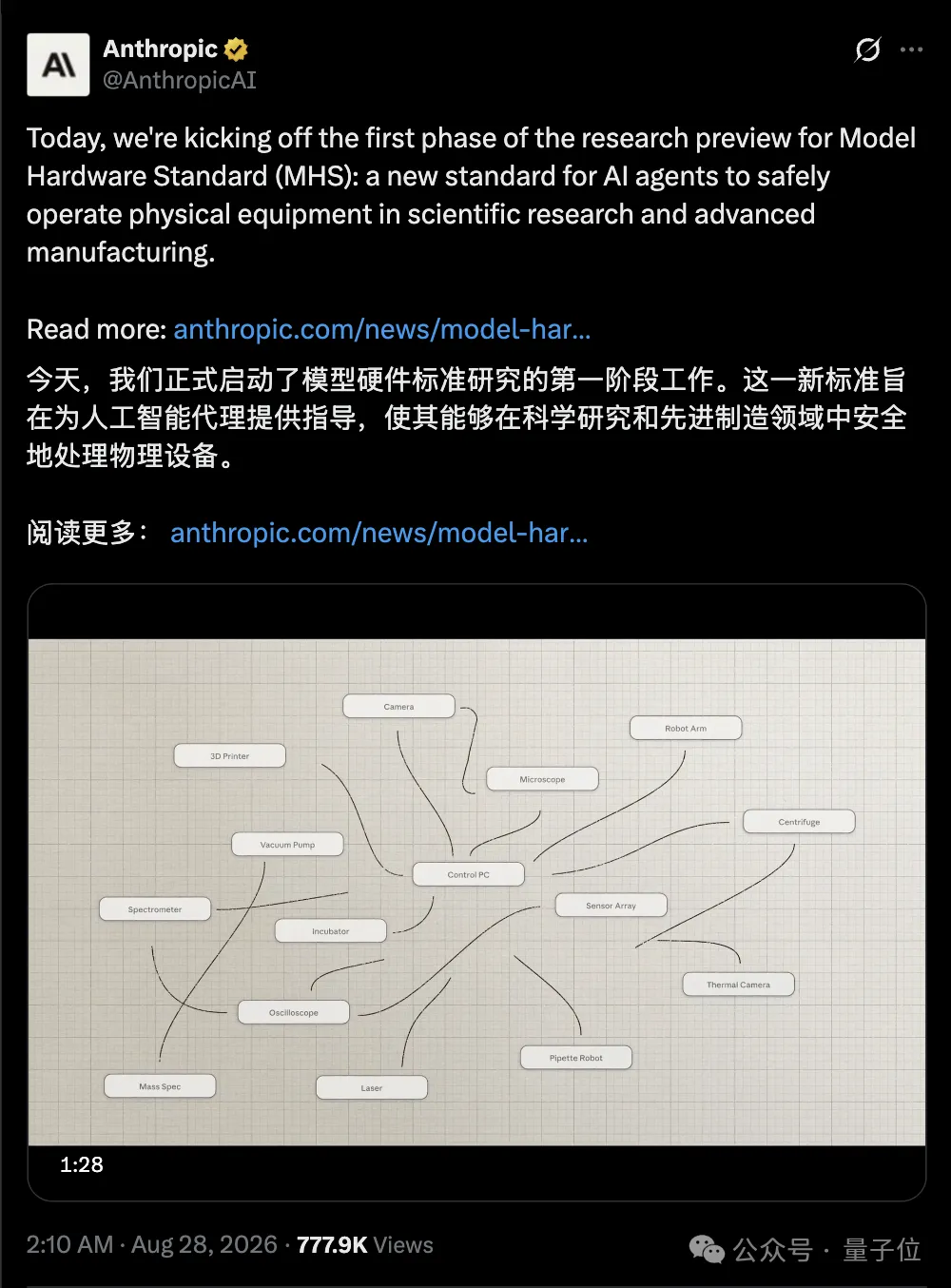
TL;DR - Anthropic introduced the Model Hardware Standard (MHS), a research-preview interface that lets agents such as Claude discover, inspect, and control hardware through standardized drivers and machine-readable device descriptions. Positioned as a “physical-world MCP,” it could reduce custom integration work for robotics and scientific equipment.

  • MHS exposes device capabilities, real-time state, physical constraints, and safety boundaries through consistent read/write operations.
  • Claude demonstrated control of a low-cost SO-ARM101 robotic arm without pretrained robot policies, teleoperation, or human demonstrations, including workspace measurement and calibration.
  • Anthropic and HHMI Janelia used the approach to coordinate heterogeneous laboratory equipment, including cameras, microscopes, lasers, and motorized focus systems.
  • MHS remains a limited research preview for selected research institutions and hardware vendors; Anthropic plans further safety evaluation before open-sourcing it.
Representative image for Anthropic 再定统一标准:MHS,打通 AI 与物理世界的统一接口

Anthropic 再定统一标准:MHS,打通 AI 与物理世界的统一接口

Rank 75 · Content 85 · Popularity N/A

TL;DR - Anthropic introduced a research preview of Model Hardware Standard (MHS), a unified interface for AI agents to operate heterogeneous laboratory and industrial equipment. It aims to reduce custom integration work while enabling safe, closed-loop experimentation across physical devices.

  • MHS adds a translation layer that exposes simplified commands and reference files containing device capabilities, parameters, sensor data, and real-time state.
  • Hardware-enforced limits constrain parameters such as power and motion range, while model reasoning remains separated from deterministic device execution.
  • MHS supports stepwise online control and locally executed Python scripts for latency-sensitive, repeatable action sequences.
  • Reported deployments include a roughly 3× laboratory workflow speedup and a QuEra laser relocking system that reduced recovery from 150 seconds to about 6 seconds with 99.3% success across 700 blind tests.
Representative image for 深度拆解 Claude 新功能:多个 Session 如何实现直接「对话」?

深度拆解 Claude 新功能:多个 Session 如何实现直接「对话」?

Rank 75 · Content 85 · Popularity N/A

TL;DR - Anthropic’s experimental Claude Code cross-session messaging lets independent sessions exchange targeted text updates without sharing their full contexts. It adds a coordination layer for parallel coding agents while preserving session, filesystem, and permission boundaries.

  • Sessions discover peers through registered metadata and ListAgents, then communicate via SendMessage; local delivery uses inbox sockets, while remote sessions rely on Anthropic infrastructure.
  • Messages enter idle sessions as new turns or are read between tool calls during active turns, avoiding interruption of in-progress tool execution.
  • The channel is intended for transient results, dependency updates, and status changes—not durable storage—with rate limits and bounded message buffers.
  • Peer messages cannot grant user authorization, approve permission prompts, alter protected configuration, or bypass operations previously denied by the permission system.
Representative image for 哈佛教授 David Parkes:全球化生产一支铅笔后,世界的目光看向了 AI | IJCAI 2026

哈佛教授 David Parkes:全球化生产一支铅笔后,世界的目光看向了 AI | IJCAI 2026

Rank 75 · Content 85 · Popularity N/A

TL;DR - In his IJCAI 2026 John McCarthy Award lecture, Harvard professor David C. Parkes argues that AI’s next frontier is designing rules for societies of specialized agents, rather than relying on a single general-purpose agent. Mechanism design could make decentralized multi-agent systems efficient, fair, incentive-compatible, and robust to strategic behavior.

  • Strategy-proof mechanisms encourage agents to report private information truthfully, enabling reliable coordination in auctions, resource allocation, and dynamic environments.
  • Computational mechanism design combines economic objectives with practical constraints, including limited preference elicitation and continually changing participants and resources.
  • Parkes describes using neural networks and differentiable economics to discover mechanisms while structurally enforcing properties such as strategy-proofness and menu compatibility.
  • As AI agents increasingly act on behalf of people or organizations, contract design and moral-hazard controls become important when their actions cannot be directly observed.

Bioinformatics AI 1

Representative image for Anthropic、Moderna先后引爆舆论场,AI制药到底该奖励什么?

Anthropic、Moderna先后引爆舆论场,AI制药到底该奖励什么?

Rank 78 · Content 90 · Popularity N/A

TL;DR - Anthropic’s protein-binder results and Moderna’s successful phase III cancer-vaccine trial highlight AI’s growing role in drug development, but the article argues that algorithms are only a small part of the value chain. Proprietary data, wet-lab validation, manufacturing, clinical development, and regulatory execution remain decisive.

  • Anthropic used Claude and existing protein-design toolchains to generate binders for 14 of 15 targets, with independently validated hit rates of 22.6%–35.1%; its main advantage was large-scale engineering and experimental coordination rather than a wholly new methodology.
  • Moderna and Merck’s personalized mRNA melanoma vaccine met its phase III primary endpoints, but AI mainly integrated established prediction and simulation methods atop mature mRNA, delivery, manufacturing, clinical, and regulatory infrastructure.
  • Current models perform well on narrow tasks such as sequence design and static-structure prediction, while expression, stability, immunogenicity, toxicity, molecular dynamics, and clinical translation remain major limitations.
  • As open models reduce algorithmic barriers, defensible value is shifting toward full-stack capabilities that can turn designs into validated drug pipelines; market enthusiasm may still overprice “AI” narratives.

Multimodal & Generative 1

Representative image for 高德发布首个无长程依赖的万帧级流式3D重建模型ABot-Recon,以12帧重建万帧3D场景

高德发布首个无长程依赖的万帧级流式3D重建模型ABot-Recon,以12帧重建万帧3D场景

Rank 82 · Content 95 · Popularity N/A

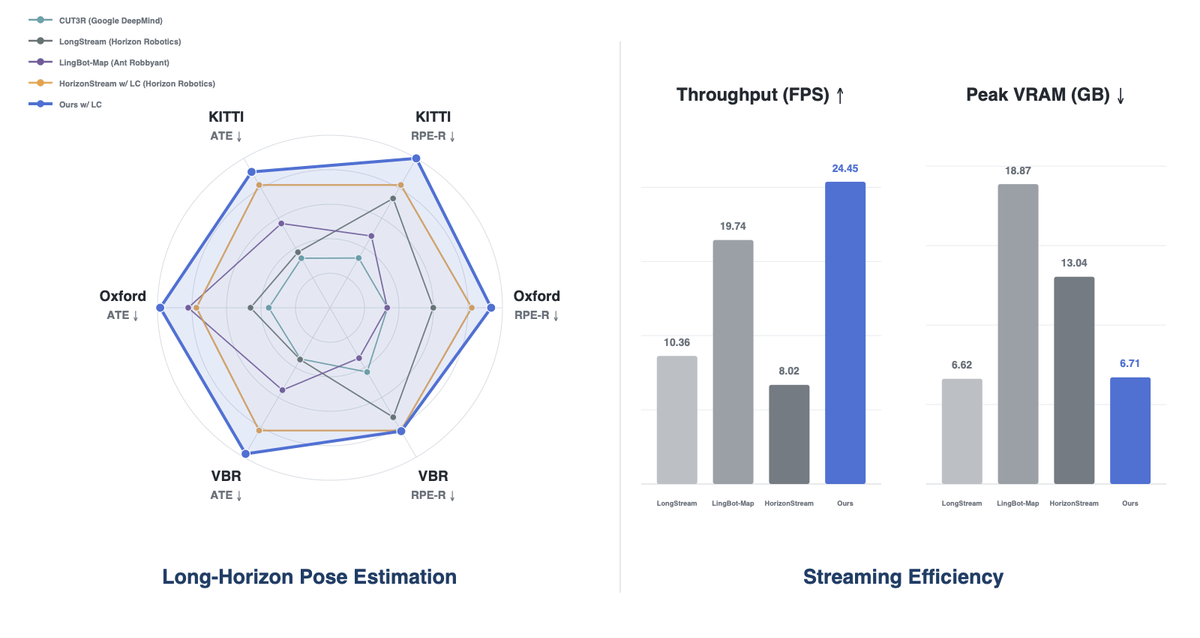
TL;DR - Amap released ABot-Recon, an open-source streaming 3D reconstruction model that uses only the latest 12 monocular RGB frames to reconstruct sequences exceeding 10,000 frames in real time. Its fixed local context avoids the growing memory and compute costs of long-term memory while reporting state-of-the-art accuracy on several benchmarks.

  • ABot-Recon predicts local point clouds and relative camera poses, then incrementally composes them into a global trajectory and 3D scene.
  • On Oxford Spires, it reduced average trajectory error by 40.6% versus LingBot-Map and achieved a 0.12° relative rotation error.
  • On KITTI-02, it reached 24.45 FPS while peak GPU memory usage was approximately 6.71 GB.
  • It requires neither depth sensors nor known camera parameters; inference code, evaluation code, and model weights are available on GitHub.

Efficiency & Systems 2

Representative image for 103μs 降到 18μs 背后,Cursor 为何剑指英伟达,重写 GPU?

103μs 降到 18μs 背后,Cursor 为何剑指英伟达,重写 GPU?

Rank 82 · Content 95 · Popularity N/A

TL;DR - Cursor open-sourced Mixture-of-Kittens (MoK), a specialized MoE GPU megakernel that integrates token routing, inter-GPU communication, and expert computation. On 512 GB300 GPUs, it reportedly increased per-GPU training throughput by about 41% over Cursor’s prior DeepEP-based production system.

  • MoK uses Pull-based forward dispatch, improving NVLink utilization by up to 29% and reducing signaling latency from roughly 103 μs to 18 μs in Cursor’s benchmarks.
  • A single megakernel partitions GPU SMs between communication and expert FFN computation, enabling fine-grained overlap without relying solely on competing CUDA streams.
  • Minibatching and a fixed-size ring token buffer balance early computation, GEMM efficiency, dynamic expert loads, and memory reuse without repeated CPU intervention.
  • Against the fastest public baselines tested on GB300 NVL72, MoK achieved up to 2.37× faster MXFP8 forward execution and 1.78× faster backward execution, though Cursor did not publish a complete component-level ablation.
Representative image for 老黄把CPU机柜搬上台,一场五年混战开始了

老黄把CPU机柜搬上台,一场五年混战开始了

Rank 75 · Content 85 · Popularity N/A

TL;DR - Agent workloads are driving renewed demand for server CPUs because orchestration, databases, tool calls, and sandbox execution often run outside GPUs. This is opening a five-year competitive window across x86, Arm, and RISC-V, with ecosystem and system-level integration likely to matter more than instruction set alone.

  • Some observed agent workflows place over 80% of their workload on CPUs, potentially shifting CPU-to-GPU ratios from roughly 1:8 toward 1:4 or even 1:1.
  • Mass-produced Arm vendors are best positioned for near-term orders, while high-performance RISC-V firms still face substantial software, tooling, and customer-adoption gaps.
  • Agent-oriented CPUs may split into high-single-core-performance designs for orchestration and many-core, multithreaded designs for concurrent sandboxes and scheduling.
  • Competition will span instruction sets, CPU architecture, software ecosystems, and integration with GPUs, memory, interconnects, operating systems, and schedulers.

AI Workforce Skills 1

What employers are looking for in the age of AI — and four ways to provide it

Rank 38 · Content 35 · Popularity 47

TL;DR - Nature examines what employers expect from job applicants in the AI era and outlines four ways early-career researchers can strengthen their AI knowledge. The provided excerpt does not specify the four recommendations.

  • Draws on perspectives from academics, employers, and early-career researchers.
  • Targets applicants whose AI familiarity does not extend beyond basic awareness of tools such as ChatGPT.
  • Emphasizes developing broader AI understanding to meet evolving workplace expectations.
  • No technical methods, data, or detailed findings are included in the excerpt.