🛰️ Daily AI Frontier
93 works · 3 categories · 33 topics · wechat 29 blog 24 journal 20 arxiv 15 generated 2026-08-21 02:10:51 UTC
Top highlights — Research

LLM Agents 10

SkillGate: Training In-Policy Skill Selection in Long-Horizon Agents

Rank 89 · Content 100 · Popularity 63

TL;DR - SkillGate trains long-horizon agents to select the right procedural skill by separating selection credit from execution credit. This raises a 9B policy’s trial success from 40.8% to 53.2% across five agentic benchmarks while reducing misleading skill exposure.

  • Identifies “selector credit starvation,” where sequence-level rewards give skill-selection tokens vanishing and increasingly wrong-signed credit as trajectories lengthen.
  • Uses disjoint credit channels: outcome rewards train execution tokens, while an action-local advantage trains only skill-naming tokens.
  • Evaluates selection from a 16-skill candidate slate across five benchmarks.
  • Outperforms outcome-reward-only training at the same budget, cuts exposure to misleading candidates by two thirds, and reads fewer skills.
Representative image for RTPO: Reverse-Turn Policy Optimization for Stabilizing Agentic RL Training

RTPO: Reverse-Turn Policy Optimization for Stabilizing Agentic RL Training

Rank 89 · Content 100 · Popularity 62

TL;DR - RTPO is a reinforcement-learning method that trains multi-turn, tool-using LLM agents by updating turns in reverse temporal order. It aims to stabilize agentic RL by improving credit assignment and preventing context mismatch and policy drift across trajectories.

  • Represents multi-turn rollouts as sparse reverse trees and aligns each decision with its downstream continuation.
  • Unifies three instability sources: rollout-training context mismatch, sparse-reward turn-level credit assignment, and asynchronous policy drift.
  • Theoretical results claim elimination of context mismatch and asynchronous drift, reduced credit bias, and convergence to recursive optimality.
  • On multi-turn agentic RL benchmarks, RTPO improves over trajectory-level and turn-level baselines by 21.50% and 10.76%, respectively.

SPADE: Self-Play in Adaptive Synthetic Executable Environments

Rank 88 · Content 95 · Popularity 70

TL;DR - SPADE is a self-play reinforcement-learning framework in which one LLM alternates between designing executable, long-horizon environments and learning to solve them. Adaptive environment generation targets the learner’s capability frontier and outperforms fixed-environment training across reasoning, tool-use, and game evaluations.

  • The Environment Designer produces stateful OpenAI Gym-style environments with transitions, rewards, and verification code.
  • A hint-based regret signal steers generation toward tasks that are challenging but feasible for the Reasoning Agent.
  • Document grounding and accumulated environment memory are identified as critical design components.
  • At 30B parameters, SPADE improves over the strongest fixed-environment baseline by 5.3 points across eight held-out benchmarks, 5.7 on BFCL-v4 multi-turn, and 13.9 on ACEBench-Agent.

SkillForge: Self-Distilling Agents for Project-Specific Issue Resolution

Rank 86 · Content 95 · Popularity 66

TL;DR - SkillForge is a self-distillation framework that teaches coding agents repository-specific knowledge before they encounter real issues. It matters because it improves downstream issue resolution without requiring historical repair data or costly per-issue exploration.

  • Synthesizes project-specific issues by reimplementing test-covered core repository functionality.
  • Resolves these synthetic issues to distill reusable, entity-grounded skills linked to relevant repository entities.
  • Proactively addresses repository knowledge gaps rather than discovering them during real issue resolution.
  • Experiments with open- and closed-source models consistently outperform strong baselines.
Representative image for What is Missing from AI Post-Training AI: An Empirical Analysis

What is Missing from AI Post-Training AI: An Empirical Analysis

Rank 84 · Content 95 · Popularity 59

TL;DR - An empirical study finds that LLM agents can execute post-training workflows effectively but rarely reconsider the training strategy chosen at the outset. This limits AI-for-AI systems because they optimize locally rather than adapting their high-level approach as evidence accumulates.

  • Agents consistently locked in an initial strategy and spent subsequent budgets on local adjustments.
  • Experience-driven scaffolding improved execution by 12.6 points on GSM8K and 40.8 points on HumanEval, but did not induce strategy changes.
  • Human guidance redirected initial choices, yet agents reverted to local adjustment loops once training began.
  • Additional inference compute helped on easier tasks but produced almost no gain on the hardest task, suggesting the missing capability is spontaneous strategy reevaluation.

DeepWeaver: Bridging the Evidence Synthesis Gap in Open-Ended Question Answering

Rank 83 · Content 95 · Popularity 56

TL;DR - DeepWeaver is an evidence-synthesis framework for open-ended question answering that structures retrieved material into Thought Block Chains before generating an answer. It improves evidence coverage, citation grounding, and preservation of detail across multiple LLMs.

  • Thought Block Chains group claims, salient information, keywords, and supporting evidence into a structured intermediate representation.
  • Subordinate chains inspect residual evidence, revise existing chains, and identify additional claims before final generation.
  • The paper introduces LoQA, a high-density benchmark designed to evaluate evidence synthesis.
  • DeepWeaver improves content sufficiency and citation grounding on LoQA, alongside insight depth and citation quality on DeepResearch Bench.
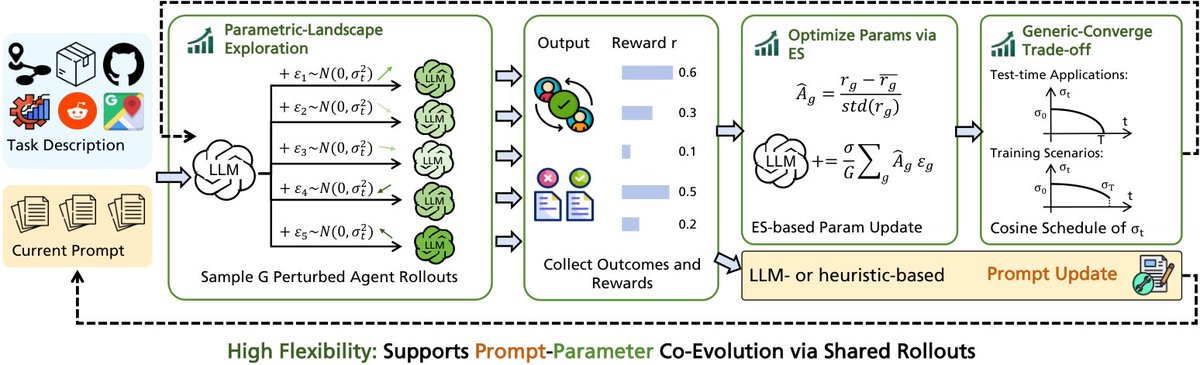
Representative image for RT by @_akhaliq: Agentic ESOpt: fine-tuning long-horizon LLM agents with minimal GPU memory This…

RT by @_akhaliq: Agentic ESOpt: fine-tuning long-horizon LLM agents with minimal GPU memory This…

Rank 82 · Content 95 · Popularity N/A

TL;DR - Agentic ESOpt is a framework for fine-tuning long-horizon LLM agents using evolution strategies rather than backpropagation. It enables full-parameter optimization at inference-level GPU memory and reports strong improvements on WebArena-Lite and other unspecified evaluations.

  • Replaces gradient-based backpropagation with evolution-strategy optimization.
  • Reduces training memory requirements to approximately those of inference.
  • Supports full-parameter optimization rather than limiting updates to a small adapter.
  • Targets long-horizon agent tasks and reports gains on WebArena-Lite.

MemFuse: Multi-Source Memory Fusion from Fragmented Observations

Rank 77 · Content 95 · Popularity 35

TL;DR - MemFuse introduces a benchmark and structured memory system for agents that must combine fragmented, source-tagged observations into coherent long-term memories. It matters because realistic agent memory requires cross-source reasoning without losing evidence provenance.

  • MemFuseBench uses a Scene-to-Sensor pipeline to generate controllable observations, evidence-grounded questions, adversarial distractors, and source metadata.
  • The benchmark evaluates temporal reasoning, cross-source evidence fusion, and robustness to noise.
  • MemFuse stores source-level evidence as atomic events, then organizes related events into fused memories through a causal fusion graph.
  • Across three LLM settings, MemFuse achieved the best overall performance among the evaluated memory systems and consistently improved cross-source fusion tasks.
Representative image for Reinforced Planning with Latent World Models

Reinforced Planning with Latent World Models

Rank 77 · Content 95 · Popularity 35

TL;DR - Reinforced Planning trains a neural planner to evaluate imagined outcomes and directly improve multi-step plans using offline rollouts from latent world models. Its RP1 implementation outperforms hand-designed search across navigation and robotics tasks while requiring far fewer rollouts and less inference time.

  • RP1 jointly learns a critic for evaluating imagined outcomes and an optimizer for revising plans.
  • Training is fully offline and uses imagined rollouts rather than environment interactions.
  • The planner can be trained independently and attached to different pretrained latent world models.
  • Across two world-model backbones, RP1 used 1,000× fewer rollouts and was up to 67× faster than the strongest alternative under concurrent inference.
Representative image for RT by @_akhaliq: Large Discovery Models: learning where to search next An LLM proposes, a Bayesian…

RT by @_akhaliq: Large Discovery Models: learning where to search next An LLM proposes, a Bayesian…

Rank 75 · Content 85 · Popularity N/A

TL;DR - Large Discovery Models combine LLM-generated proposals with a Bayesian uncertainty-scoring surrogate in an iterative search loop. The approach reports gains across program discovery, proteins, and molecules, suggesting more efficient exploration of large candidate spaces.

  • The LLM proposes candidates while the Bayesian surrogate estimates uncertainty and guides where to search next.
  • The iterative loop reportedly cuts validation error by 2.4×.
  • Reported domain gains include an 18% improvement in binding energy and more than 60% improvement in molecular objectives.
  • Results span multiple discovery settings, though the provided content does not specify methods, baselines, or datasets.

Medical/Healthcare AI 9

Representative image for Nat Biotechnol | 单核多模态空间转录组技术解析肿瘤新抗原与同源T细胞原位空间互作

Nat Biotechnol | 单核多模态空间转录组技术解析肿瘤新抗原与同源T细胞原位空间互作

Rank 87 · Content 100 · Popularity 56

TL;DR - A Nature Biotechnology study introduces Slide-GoTags, a single-nucleus multimodal spatial transcriptomics platform that maps neoantigen-expressing tumor cells and cognate T cells in situ. It could help identify therapeutic TCRs and spatial biomarkers of immunotherapy response.

  • Slide-GoTags jointly captures nuclear transcriptomes, somatic mutations, full-length TCR CDR3 sequences, and spatial barcodes from one frozen tissue section.
  • Mouse and human studies found that cognate T cells selectively colocalize with neoantigen-bearing tumor cells, with proximity linked to T-cell activation and exhaustion.
  • Across nine samples from four cancer types, the study identified interferon-driven immunogenic niches enriched for expanded T-cell clones and neoantigen–TCR pairings.
  • Current limitations include frozen-tissue dependence, reduced detection of low-abundance transcripts, small clinical cohorts, and the need to functionally validate inferred TCR specificity.

Moderna cancer vaccine stops melanoma returning: what’s next for personalized treatments?

Rank 82 · Content 90 · Popularity 63

TL;DR - A Nature news item reports promising trial results for Moderna’s personalized cancer vaccine in preventing melanoma recurrence. The findings suggest cancer vaccines could potentially be adapted to target other tumour types.

  • The treatment is personalized to an individual patient’s cancer.
  • Trial results indicate that vaccination may reduce melanoma recurrence.
  • The report highlights possible expansion to other cancers, but provides no efficacy figures or trial-design details.
Representative image for Cell Stem Cell | 刘昭飞团队构建SMART平台:将肿瘤硬度转化为可识别的放射性药物靶点

Cell Stem Cell | 刘昭飞团队构建SMART平台:将肿瘤硬度转化为可识别的放射性药物靶点

Rank 80 · Content 90 · Popularity 56

TL;DR - Researchers developed SMART, an engineered mesenchymal stem-cell platform that senses abnormal tissue stiffness and locally creates synthetic targets for existing radiopharmaceuticals. The approach could extend PET imaging and targeted radionuclide therapy to solid tumors—and potentially fibrotic diseases—that lack suitable natural molecular targets.

  • SMART uses YAP/TAZ-mediated mechanosensing to trigger local expression of targets such as PSMA or SSTR2 in stiff diseased tissue.
  • Engineered MSCs enabled PSMA-targeted PET imaging across PSMA-negative breast, colorectal, lung, and pancreatic tumor models, including metastatic lesions.
  • After synthetic PSMA target formation, the albumin-binding radiopharmaceutical ^177Lu-AB-PSMA-617 accumulated in tumors and suppressed tumor growth in treatment experiments.
  • The platform also visualized lung fibrosis and worked with iPSC-derived MSCs, suggesting potential beyond cancer and toward standardized cell production.

Safety and security of large language models in healthcare

Rank 80 · Content 95 · Popularity 44

TL;DR - This Nature Review presents an integrated framework for understanding safety and security risks arising from rapid LLM adoption in clinical care. It matters because managing these risks requires protections and clearly assigned responsibilities throughout the development and deployment lifecycle.

  • Maps emerging LLM safety and security risks across development stages.
  • Organizes protective measures into key layers within a unified framework.
  • Highlights threats specifically relevant to clinical environments.
  • Examines current responsibilities for mitigating healthcare LLM risks.
Representative image for MedUAG: Unified Understanding and Generation for Medical Multimodal Models

MedUAG: Unified Understanding and Generation for Medical Multimodal Models

Rank 79 · Content 95 · Popularity 40

TL;DR - MedUAG is a unified medical multimodal model designed to handle both image understanding and generation. It is paired with a 6-million-instance training corpus and a standardized 12-task benchmark, providing a foundation for developing and evaluating unified medical AI systems.

  • MedUAGCorpus spans more than 6 million instances across 14 medical imaging modalities.
  • MedUAGBench evaluates medical generation across 12 diverse tasks under standardized protocols.
  • MedUAG is trained end to end for both multimodal understanding and generation.
  • Experiments report strong performance across varied tasks, establishing a competitive baseline for future medical multimodal research.
Representative image for Mol Cell | 朱广李等揭示尤文肉瘤中EWS-FLI1通过双重机制摧毁POLQ剪接与功能,导致MMEJ缺陷

Mol Cell | 朱广李等揭示尤文肉瘤中EWS-FLI1通过双重机制摧毁POLQ剪接与功能,导致MMEJ缺陷

Rank 77 · Content 80 · Popularity 71

TL;DR - A Molecular Cell study identifies Ewing sarcoma as an MMEJ-deficient cancer and shows that EWS-FLI1 disables POLQ/Pol θ through defective exon 25 splicing and impaired DNA-repair foci formation. This creates targetable dependencies on alternative DNA-repair pathways and may provide a biomarker for treatment selection.

  • EWSR1, FUBP1, and KHSRP normally bind a six-nucleotide enhancer in POLQ exon 25 to preserve correct splicing and functional Pol θ expression.
  • EWS-FLI1 sequesters EWSR1 away from this enhancer, causing exon 25 skipping, while independently disrupting Pol θ recruitment to mitotic DNA-break sites.
  • Correcting POLQ splicing restored MMEJ activity and reversed sensitivity to DNA-repair inhibitors, establishing a direct causal link.
  • Ewing sarcoma models were selectively vulnerable to RBM39 degraders, CDK12 inhibitors, and DNA-PK inhibition combined with etoposide.
Representative image for EVADE: Evidence-Verified Agentic Diagnosis with Escape

EVADE: Evidence-Verified Agentic Diagnosis with Escape

Rank 77 · Content 95 · Popularity 35

TL;DR - EVADE is a training-free diagnostic framework that makes a frozen medical vision-language model compare answers from full and self-localized zoomed image views, abstaining when they disagree. It improves calibration and selective safety without sacrificing accuracy.

  • On VQA-RAD, SLAKE, and PathVQA with Qwen2.5-VL-7B, EVADE reduced expected calibration error by up to 45% versus zero-shot.
  • Cross-view consistency avoids relying on textual self-verification, which can itself hallucinate.
  • EVADE was the only evaluated method to improve both calibration and selective risk while maintaining accuracy.
  • Self-proposed crops localized diagnostic structures better than center or random crops, but reliability gains came from agreement gating and abstention rather than answer revision.

To shield the fetus, link a protein to these drugs

Rank 76 · Content 90 · Popularity 44

TL;DR - A study reports that linking albumin to antibody-based medicines can reduce their passage across the placenta, potentially limiting fetal drug exposure during pregnancy.

  • The approach modifies antibody-based drugs by adding albumin.
  • The modification helps block placental transfer of these medicines.
  • The work could inform the design of pregnancy-compatible biologic therapies.
  • The provided summary does not specify the drugs tested, mechanism, or quantitative results.

Functional role of skull lymphoid structures in CNS immunosurveillance

Rank 62 · Content 70 · Popularity 44

TL;DR - A Nature study reports that functional lymphoid structures in skull bone marrow support central nervous system immunosurveillance and influence immune responses to brain disease. This identifies the skull marrow as an important component of brain–immune interactions.

  • Skull bone marrow contains functional lymphoid structures.
  • These structures enable immune surveillance of the central nervous system.
  • They shape immune responses associated with brain disease.
  • The provided abstract does not specify the experimental methods, disease models, or detailed mechanisms.

Bioinformatics AI 7

Representative image for Cell:生成式AI真正理解生命,还要解决的十五大挑战

Cell:生成式AI真正理解生命,还要解决的十五大挑战 🔗 2 sources

Rank 85 · Content 100 · Popularity N/A

TL;DR — A Cell perspective identifies 15 challenges generative AI must overcome to move from molecular modeling toward reliable cellular and clinical predictions. The supplied DeLiriuMAgents summary describes a separate clinical AI system and cannot be confidently merged into the same work.

  • The 15 challenges cover molecular networks, synthetic biology, cell-state control, biomarkers, drug safety and efficacy, immune responses, and clinical-trial outcomes.
  • Key barriers include scarce perturbation data, complex biological interactions, sequence-centric model architectures, limited clinical data sharing, and insufficient cohort diversity.
  • Proposed directions include embedding biological priors—such as protein-interaction and gene-regulatory networks—into models and creating datasets tailored to individual challenges.
  • Evaluation should shift from retrospective, largely solved benchmarks toward prospective experiments and blind CASP- or DREAM-style assessments.
  • Progress requires sustained collaboration among computational scientists, experimentalists, clinicians, and ethicists.

Note: The second source focuses on DeLiriuMAgents for delirium prediction and appears unrelated to the titled Cell perspective, despite being grouped with it.

Representative image for Training Chemical Plausibility-Aware Large Language Models for Single-Step Retrosynthesis

Training Chemical Plausibility-Aware Large Language Models for Single-Step Retrosynthesis

Rank 84 · Content 90 · Popularity 69

TL;DR - C3LM is a chemical-plausibility-aware language model for single-step retrosynthesis, trained on roughly 45.6 million verified reactions with a Top-K prediction paradigm. It achieves state-of-the-art results on an out-of-distribution benchmark and supports more diverse, plausible synthesis planning.

  • Top-K prompting addresses retrosynthesis’s one-to-many nature by producing multiple plausible reaction predictions rather than optimizing for one answer.
  • Training combines fine-tuning with ChemCensor-based chemical-plausibility rewards and novelty-oriented rewards.
  • C3LM achieves state-of-the-art performance on the OOD URSA-expert-2026 benchmark.
  • LLMs and conventional models explore complementary reaction spaces, suggesting potential gains from ensemble systems.
Representative image for R to @AnthropicAI: For more on how Claude ran this experiment and the full results, see our blog…

R to @AnthropicAI: For more on how Claude ran this experiment and the full results, see our blog…

Rank 78 · Content 90 · Popularity N/A

TL;DR - Anthropic reports experiments using Claude to support protein design and analytical chemistry, suggesting LLMs could help life scientists accelerate parts of their research workflows. The provided excerpt does not include the full methods or quantitative results.

  • One experiment tested Claude’s ability to design protein binders from scratch.
  • A second result involved applying Claude to analytical chemistry.
  • Anthropic frames both as evidence that Claude can increase the pace of life-science research.
  • Technical details and full results are available in the linked Anthropic research post but are not present here.

An Icelandic pangenome reference

Rank 76 · Content 90 · Popularity 44

TL;DR - New methods construct Icelandic haplotypes and map population-scale short reads to a pangenome reference. This reduces reference bias and improves variant discovery, including detection of novel pathogenic alleles.

  • Improves mapping in genomic regions with low mappability.
  • Reveals many variants missed by conventional reference-based approaches.
  • Demonstrates the value of population-specific pangenomes for more comprehensive genetic analysis.

Monroe: A Molecular Foundation Model for In-Context Probabilistic Inference

Rank 76 · Content 95 · Popularity 31

TL;DR - Monroe is a molecular foundation model pretrained on more than 81 million molecules and paired with TabPFN for in-context bioassay activity prediction. It matches or exceeds prior models on established benchmarks and significantly improves performance on activity-cliff tasks relevant to molecular discovery.

  • Introduces richer stereochemistry-aware graph representations, conformer-denoising and embedding-decorrelation losses, and improved multi-task learning.
  • Uses a prior-data-fitted network as the downstream predictor, targeting data-scarce drug-discovery settings without conventional task-specific adaptation.
  • Applies statistically principled pairwise comparisons on Polaris and activity-cliff benchmarks.
  • The PFN strategy also improves MiniMol and CheMeleon, indicating that the downstream approach generalizes beyond Monroe.

Artefacts in single-cell mtDNA analyses misinform phylogenies

Rank 75 · Content 80 · Popularity 63

TL;DR - This Nature publication reports that artefacts in single-cell mitochondrial DNA analyses can produce misleading phylogenies. Because only the title and citation are provided, the affected methods, artefact sources, and proposed remedies cannot be determined.

  • Focuses on phylogenetic inference from single-cell mitochondrial DNA data.
  • Warns that analytical artefacts may be mistaken for genuine evolutionary relationships.
  • Highlights the need to identify and control technical biases before interpreting mtDNA-derived lineage trees.

Family genetic designs in MoBa provide insights into health and functioning

Rank 73 · Content 75 · Popularity 68

TL;DR - The Norwegian Mother, Father and Child Cohort Study shows how family-based genomic designs can distinguish direct genetic effects from confounding in research on health and human development. This can make genetic associations more reliable and interpretable.

  • Uses genomic data collected across families rather than unrelated individuals alone.
  • Helps separate direct genetic influences from familial and environmental confounding.
  • Strengthens causal interpretation in studies of health, development, and functioning.
  • The provided summary does not specify particular traits, methods, or effect sizes.

LLMs & Foundation Models 4

Representative image for DeepMind又改Transformer了:深层激活回流,小模块反超全量微调

DeepMind又改Transformer了:深层激活回流,小模块反超全量微调

Rank 82 · Content 95 · Popularity N/A

TL;DR - DeepMind’s Recirculation method feeds deep-layer Transformer activations back into shallower layers so later tokens can reuse more mature contextual states. A small adaptive controller improved Gemma3 language modeling beyond full fine-tuning while keeping the base model frozen.

  • Adaptive Recirculation reduced average perplexity by 23.0% across nine language-modeling datasets, versus 21.6% for full fine-tuning and 8.5% for fixed recirculation.
  • The method mixes norm-aligned deep- and shallow-layer states; a token-conditioned MLP dynamically predicts per-dimension mixing coefficients.
  • Improvements appeared across several Transformer families, but were strongest on Gemma3 and less consistent on downstream tasks.
  • Generation latency was reportedly negligible because computations can run in parallel, while sequential state updates make prefill slower for long contexts.
Representative image for Test-Time Scaling in the Wild: Why Exploitation, Not Exploration, Is the Bottleneck

Test-Time Scaling in the Wild: Why Exploitation, Not Exploration, Is the Bottleneck

Rank 80 · Content 100 · Popularity 35

TL;DR - A compute-normalized study of test-time scaling on open-ended tasks finds that generating better candidate pools is not the main limitation; reliably selecting or combining their best outputs is. Current reward models correlate weakly with true quality, making exploitation the bottleneck.

  • Across medicine, law, finance, general chat, and creative writing, the best candidate improved steadily as inference compute increased.
  • Reward models correlated with true quality at only about (ρ_v \approx 0.12), leaving candidate selection nearly random regardless of budget.
  • Tree search worsened the problem through diversity collapse, while refinement produced a clear benefit on only one of five benchmarks.
  • Candidate synthesis via Fusion was the only consistently effective approach, but recovered only about 40% of the available quality.

Learned, Then Lost: A Measured Single-Example Counterfactual in Pre-training

Rank 77 · Content 95 · Popularity 35

TL;DR - A controlled GPT-2 pre-training study directly measures the effect of replacing one batch row with a single 194-token passage. The passage is briefly learned and later forgotten, while its injection leaves a substantial weight displacement that remains within the same loss basin.

  • Across eight seeds, injected models predicted the passage 0.039–0.044 nats better after 50 steps, but no significant advantage was detected at training’s end.
  • The study trained 32 GPT-2 124M models on OpenWebText, comparing real-subject prose, gradient-matched fabricated-subject prose, random characters, and uninjected twins.
  • Final models showed no detectable condition differences in interpolation loss barriers, held-out cross-entropy, or per-layer centered kernel alignment.
  • Weight displacement reached 44.1% of seed-to-seed Euclidean distance, yet the loss barrier was only 3.0% of its seed-to-seed counterpart, suggesting relocation within—not escape from—the existing basin.

R to @AnthropicAI: We're also publishing a technical report…

Rank 64 · Content 70 · Popularity N/A

TL;DR - Anthropic is releasing a technical report alongside the prompts and data used in the work. The open artifacts should make the methodology easier to inspect and reproduce, although the provided excerpt does not identify the report’s subject or results.

  • A technical report provides additional methodological documentation.
  • Prompts and data are being open-sourced through Hugging Face.
  • No model details, benchmarks, or findings are stated in the excerpt.

Multimodal & Generative 2

Representative image for ICML 2026 | 从专才到通才,OmniShow极简干预统一多模态视频生成

ICML 2026 | 从专才到通才,OmniShow极简干预统一多模态视频生成

Rank 80 · Content 85 · Popularity 68

TL;DR - OmniShow is an ICML 2026 paper proposing a unified 12.3B video model conditioned jointly on text, reference images, audio, and pose. It preserves the base model’s generation priors through minimal architectural changes while achieving strong multimodal control and competitive benchmark results.

  • Visual conditions reuse Waver 1.0’s native channel-concatenation path, with pseudo-frame reference tokens and a reconstruction loss improving identity and object fidelity.
  • Gated local-context attention aligns audio with video frames; near-zero gate initialization limits disruption, and the added audio components increase parameters by only about 2.5%.
  • A decoupled-then-joint training strategy merges reference-video and audio-video specialists before joint refinement, producing zero-shot reference-and-audio control immediately after weight interpolation.
  • On HOIVG-Bench, OmniShow reports leading or highly competitive reference consistency, audiovisual synchronization, pose accuracy, and video-quality metrics across R2V, RA2V, and RP2V settings.
Representative image for CL4D: Contrastive Language-4D Pretraining for Vision-Language Reasoning in Dynamic Scenes

CL4D: Contrastive Language-4D Pretraining for Vision-Language Reasoning in Dynamic Scenes

Rank 77 · Content 95 · Popularity 35

TL;DR - CL4D is a contrastively pretrained vision encoder that aligns dynamic 4D point clouds with language, enabling geometric and temporal reasoning without relying on images or video. Its companion model, 4DVLM, uses these representations for language generation and reportedly surpasses prior 4D methods and frontier video VLMs on evaluated tasks.

  • CL4D jointly models spatial geometry and motion evolution directly from dynamic point clouds.
  • Contrastive language-4D pretraining supports zero-shot motion-to-text and text-to-motion retrieval.
  • The authors introduce DynAction4D, a dataset covering human motions, object interactions, and varied environments.
  • Across multiple 4D action benchmarks, CL4D reports an approximately 16.75% improvement over prior methods; 4DVLM also outperforms Gemini and GPT-5 given corresponding RGB videos.

Efficiency & Systems 2

Representative image for ECCV 2026 | 长视频Token剪枝新范式:从关键帧到证据链

ECCV 2026 | 长视频Token剪枝新范式:从关键帧到证据链

Rank 74 · Content 85 · Popularity 47

TL;DR - SemVID is a training-free visual-token pruning method for long-video temporal grounding that preserves an “evidence chain” rather than isolated keyframes. It reduces inference cost while maintaining accurate event-boundary localization under aggressive token compression.

  • SemVID allocates per-frame token budgets using both query relevance and inter-frame changes, retaining evidence across the event timeline.
  • It preserves complementary object, motion, and context tokens to capture relevant entities, temporal transitions, and scene continuity.
  • Motion tokens serve as cross-frame relay nodes, while MMR selection prevents redundant object patches from consuming the token budget.
  • On Charades-STA and ActivityNet-Grounding with Qwen3-VL and Qwen2.5-VL, SemVID outperformed existing pruning methods in localization and evidence-retention/connectivity metrics at equal budgets, particularly at low retention rates.
Representative image for CVPR 2026 | Diffusion开始瘦身:TinySR提速5.68倍,走向手机端部署

CVPR 2026 | Diffusion开始瘦身:TinySR提速5.68倍,走向手机端部署

Rank 73 · Content 85 · Popularity 44

TL;DR - TinySR is a lightweight, one-step diffusion-transformer system for real-world image super-resolution, designed around practical mobile deployment. It reports up to 5.68× faster inference than its TSD-SR teacher while reducing parameters by 83% and MACs by 84%, with competitive perceptual quality.

  • Uses learnable probabilistic masks, Dynamic Inter-block Activation, and an Expansion-Corrosion strategy to identify and progressively prune recoverable transformer blocks.
  • Compresses the VAE through channel pruning, attention removal, and depthwise separable convolutions, yielding about 10× VAE inference acceleration and 22× fewer VAE MACs.
  • Removes low-value text- and time-conditioning modules for the specialized one-step super-resolution task, further reducing model size and latency with limited metric changes.
  • Pre-caches stable modulation parameters to eliminate repeated inference-time computation and improve end-to-end deployment efficiency.

AI Control Systems 1

Computational ‘gym’ trains AI models to control turbulence

Rank 73 · Content 85 · Popularity 44

TL;DR - HydroGym is a computational environment that trains AI agents to control turbulent fluid flows. Its key promise is enabling learned control strategies to transfer to previously unseen flow scenarios.

  • Provides a training environment focused on fluid-flow control.
  • Uses AI agents to learn control strategies in simulated turbulent systems.
  • Emphasizes generalization beyond scenarios encountered during training.
  • The provided summary does not specify the model architecture, benchmarks, or quantitative results.

AI Peer Review 1

Representative image for 今年ICLR有救了!120篇论文实测,换种写法AI真会涨分

今年ICLR有救了!120篇论文实测,换种写法AI真会涨分

Rank 75 · Content 85 · Popularity N/A

TL;DR - A controlled study of 120 ICLR 2026 submissions finds that AI reviewers can assign meaningfully different scores when the underlying research stays fixed but its rhetoric changes. Quantitative-evidence presentation, novelty framing, and claim scope had the strongest and most consistent effects.

  • The study generated 4,200 paper variants and collected 42,396 reviews from five AI reviewer models under standard and strict review prompts.
  • Strengthening the presentation of existing quantitative evidence raised scores by up to 0.93 points in one configuration; positive versus negative framing changed weak-accept-or-better rates by 13 percentage points.
  • Positive framing outscored negative framing for novelty, evidence, and scope in 117, 116, and 113 of 120 papers, respectively, while lexical and syntactic complexity showed little consistent benefit.
  • Stricter prompts lowered average scores by 1.36 points but did not systematically reduce rhetorical sensitivity; gains also varied substantially by rewriting–reviewer model pairing.

Brain Organoids 3

Human brain organoids record the passage of time over multiple years

Rank 83 · Content 90 · Popularity 68

TL;DR - Human brain organoids cultured for more than five years continued to mature and track elapsed time through human-specific endogenous developmental programs. This suggests that aspects of long-term brain-cell development persist outside the organism.

  • The organoids were maintained in culture for over five years.
  • Their brain cells continued to mature throughout the extended culture period.
  • The observed timing followed intrinsic, human-specific programs despite the absence of the organismal context.
  • The work supports brain organoids as models for studying long-term human neural development.
Representative image for Nature:哈佛团队把「人脑类器官」培养了创纪录的5年时间,发现它们记录了时间的流逝

Nature:哈佛团队把「人脑类器官」培养了创纪录的5年时间,发现它们记录了时间的流逝

Rank 82 · Content 95 · Popularity N/A

TL;DR - Harvard researchers maintained human brain organoids for more than five years and found that their molecular and epigenetic maturation closely tracked elapsed culture time. The model could enable studies of later-stage human brain development, aging, disease, and drug responses that short-lived organoids cannot capture.

  • Single-cell RNA sequencing across eight time points covered 34 organoids; combined datasets included 110 organoids and nearly 425,000 cells.
  • Organoid DNA-methylation age closely matched actual time in culture, recapitulating developmental steps observed in prenatal and early postnatal human brains.
  • Fusion experiments showed older neural progenitors retained their developmental identity despite exposure to younger tissue, producing later-stage rather than early neurons.
  • An optimized medium improved neuronal survival, synaptic density, morphology, and electrical activity, with strong activity bursts sustained for over two years.

Human organoids that mimic brain development grown for years in lab

Rank 62 · Content 70 · Popularity 44

TL;DR - Researchers have grown human organoids that mimic brain development for years in the laboratory. These long-lived models could help scientists study how aging-related changes influence diseases that emerge later in life.

  • The organoids are designed to model human brain development over extended periods.
  • Multi-year growth could enable research into biological changes that shorter-lived models cannot capture.
  • The models may help clarify how diseases affect the brain later in life.
  • The provided summary does not specify experimental methods or disease-specific findings.

Computational Chemistry 1

Synthesis of pyrroles from isoxazoles by an O-to-C skeletal edit

Rank 69 · Content 80 · Popularity 44

TL;DR - Researchers developed a one-pot skeletal-editing reaction that converts isoxazoles into otherwise challenging pyrroles by replacing a ring oxygen atom with carbon. A computational model helps predict the reaction’s outcomes.

  • The transformation performs an oxygen-to-carbon skeletal edit rather than rebuilding the heterocycle from scratch.
  • The reaction proceeds through an N-propargylic enaminone intermediate.
  • The one-pot method provides access to pyrroles that are difficult to synthesize using existing approaches.
  • Computational prediction complements the reaction design by forecasting outcomes.

Drug Discovery 1

A biased allosteric modulator is a molecular glue for β 2 AR dimerization

Rank 76 · Content 80 · Popularity 65

TL;DR - A Nature study reports that AP-7-168, an optimized β-arrestin-biased negative allosteric modulator, acts as a molecular glue that stabilizes β2-adrenergic receptor (β2AR) homodimers. This links biased allosteric modulation with direct control of receptor assembly.

  • AP-7-168 is derived from a β-arrestin-biased negative allosteric modulator of β2AR.
  • The compound promotes and stabilizes β2AR homodimerization.
  • The finding identifies a molecular-glue mechanism for modulating a G-protein-coupled receptor.
  • The provided summary does not specify downstream functional effects or therapeutic outcomes.

Hypercomputation 1

Representative image for 超图灵计算?纯粹理性计算?呼唤一种动态逻辑|超越经典逻辑的计算:非结合 Dickson 代数中的奇异值分解

超图灵计算?纯粹理性计算?呼唤一种动态逻辑|超越经典逻辑的计算:非结合 Dickson 代数中的奇异值分解

Rank 43 · Content 40 · Popularity N/A

TL;DR - This translated book chapter argues that nonassociative Dickson algebras yield “nonclassical” singular values that appear incorrect at one algebraic level but become exact at the next. The author uses this result to motivate a dynamic logic beyond classical computation, while acknowledging that the leap to beyond-Turing computation is speculative.

  • Nonassociativity creates multiple SVD derivation paths whose outputs can differ, despite sharing the same mean.
  • Some anomalous singular values for vectors in (A_k) correspond exactly to singular values of related vectors in (A_{k+1}), with doubled multiplicities.
  • The interpretation depends on algebraic level and observational perspective: a value can be invalid locally yet encode valid higher-dimensional information.
  • The chapter connects this inductive hierarchy to hypercomputation and biological information processing, but does not establish a practical model that surpasses Turing machines.

Neuroscience AI 1

Psychedelics align brain activity with context

Rank 70 · Content 70 · Popularity 71

TL;DR - A Nature study reports that psilocybin reorganizes brain activity into structured patterns aligned with context, integrating internal and external processing. This may help explain both the perceived continuity between self and world during psychedelic states and subsequent psychological change.

  • Psilocybin produces structured rather than merely disordered changes in brain activity.
  • The resulting activity patterns align neural processing with contextual information.
  • The reorganization integrates internally generated and externally driven processing.
  • The findings propose a neural basis linking psychedelic experience to psychological effects.

Phage Biology 1

Pervasive phosphorylation by phage T7 kinase disarms bacterial defences

Rank 68 · Content 80 · Popularity 40

TL;DR - A Nature study reports that bacteriophage T7 uses its kinase, T7K, to phosphorylate nearly all bacterial-host and phage proteins during infection. This pervasive modification disables bacterial defence systems, revealing a broad phage strategy for overcoming host immunity.

  • T7K drives extensive phosphorylation across both host and viral proteomes.
  • The phosphorylation occurs during T7 infection and deactivates bacterial defence mechanisms.
  • The findings identify proteome-wide kinase activity as a mechanism of phage immune evasion.

Phage Defense Evasion 1

Virus deploys a ‘loose cannon’ enzyme to overpower bacterial defences

Rank 59 · Content 65 · Popularity 44

TL;DR - The bacteriophage kinase T7K phosphorylates nearly all bacterial proteins, with a preference for DNA-binding proteins. This broad activity helps the virus disable host defence systems that target nucleic acids.

  • T7K acts as an unusually indiscriminate kinase across the bacterial proteome.
  • Its bias toward DNA-binding proteins gives the enzyme functional specificity despite its broad activity.
  • Phosphorylating these proteins enables the virus to counter bacterial nucleic-acid defence mechanisms.
  • The finding reveals a viral strategy that uses widespread host-protein modification to overcome immunity.

Reinforcement Learning 1

The HydroGym reinforcement learning platform for fluid dynamics

Rank 89 · Content 100 · Popularity 63

TL;DR - HydroGym is a standardized platform with more than 60 reinforcement-learning environments for fluid-flow control. It demonstrates that learned control can transfer zero-shot to a 3D wing, reducing local skin friction by 38% while cutting exploration costs by four orders of magnitude.

  • Provides a common benchmark suite for reinforcement-learning-based flow control.
  • Includes over 60 standardized fluid-dynamics environments.
  • Demonstrates zero-shot policy transfer to a 3D wing.
  • Reports substantially lower exploration costs alongside a 38% local skin-friction reduction.

Sleep Neuroscience 1

Wake-activated neuronal populations that regulate sleep drive

Rank 62 · Content 70 · Popularity 44

TL;DR - A mouse study identifies wake-activated neuronal populations that are crucial for regulating sleep drive. Manipulating these cells can persistently reduce daily sleep, offering insight into the neural mechanisms that control sleep need.

  • Researchers combined whole-brain activity mapping, targeted cell manipulation, and electrophysiology.
  • The identified neuronal populations become active during wakefulness and contribute to sleep drive.
  • Targeting these cells produced sustained reductions in mice’s daily sleep amount.
  • The findings connect specific neural populations to the accumulation and regulation of sleep need.
Top highlights — Industry & News

LLM Agents 17

Representative image for DeepSeek V4 Flash不换模型,只靠「自验证」反超Fable 5

DeepSeek V4 Flash不换模型,只靠「自验证」反超Fable 5

Rank 85 · Content 95 · Popularity 60

TL;DR - DeepSeek V4 Flash paired with LLM-as-a-Verifier reached 88.0% success on Terminal-Bench 2.1 by generating and self-ranking five agent trajectories. The system reportedly surpassed Claude Fable 5 at roughly $0.11 per task versus $1.30, though the configurations were not directly equivalent.

  • Best-of-3 raised success from 79.4% to 86.5%; Best-of-5 raised it from 78.7% to 88.0%.
  • The same DeepSeek model generated and verified candidates, using token-probability-weighted continuous scores rather than a separately trained verifier.
  • The five-candidate oracle success rate was 96.6%, indicating that better candidate selection remains a major opportunity.
  • Prefix-caching improvements increased the validation-stage cache hit rate from 5.2% to 78.4%, reducing input costs.
Representative image for 用过一次就能学会!哈工大开源自进化GUI Agent,跨App连续干活

用过一次就能学会!哈工大开源自进化GUI Agent,跨App连续干活

Rank 82 · Content 90 · Popularity 64

TL;DR - Harbin Institute of Technology has open-sourced KnowAct-GUIClaw, a self-improving GUI-agent framework for long-running workflows across apps and platforms. It matters because it turns execution traces into reusable memories and validated skills, improving reliability and efficiency rather than treating every task as new.

  • A Host Agent manages context, memory, tools, and workflow orchestration, while the pluggable GUIClaw handles real-time interface interaction across Android, iOS, HarmonyOS, and Windows.
  • Its Know–Route–Act–Reflect pipeline uses a typed Blackboard to pass structured data between apps and stops when required inputs or outputs are missing instead of guessing.
  • The system extracts textual experience and parameterized, state-validated skills from successful and failed trajectories, including verified deep links and targeted skill repair.
  • On MobileWorld GUI-Only tasks with Kimi-K2.6, success rose from 55.6% to 64.1% with Host, memory, and self-evolving skills; transferred capabilities improved Qwen3.5-35B-A3B by 16.2 percentage points, while skill reuse reduced token use by about 6%.
Representative image for 阿里把AI扔进100台真机里“军训”,玩转各种屏幕!这和AI手机还有啥区别?

阿里把AI扔进100台真机里“军训”,玩转各种屏幕!这和AI手机还有啥区别?

Rank 80 · Content 85 · Popularity 68

TL;DR - Alibaba launched Qwen-UI-Agent, a GUI foundation model that operates phones, desktops, browsers, and command-line tools to complete complex, cross-device workflows. Its real-device training infrastructure targets the simulation-to-reality gap that often causes GUI agents to fail on dynamic interfaces.

  • The 27B model ranked first on five of six reported core GUI benchmarks, including 92.2% success on MobileWorld-Real and 97.5% on AndroidDaily.
  • Training used 100+ physical phones and 150+ applications, with virtual-screen technology increasing concurrent rollout efficiency by about 20×.
  • A unified action space combines GUI interactions, CLI commands, and API calls; staged SFT, action RL, and online RL train planning, error recovery, and verification over trajectories exceeding 100 steps.
  • Alibaba also released 35B-A3B and 4B variants, alongside a technical report, project page, and GitHub repository.
Representative image for 闭源RSI的严父:18个Agent自主科研,Kimi K3靠Harness逼近Opus 5

闭源RSI的严父:18个Agent自主科研,Kimi K3靠Harness逼近Opus 5

Rank 78 · Content 90 · Popularity N/A

TL;DR - Prime Intellect reports that its multi-agent research harness lets cheaper open-weight models autonomously optimize nanoGPT training, with Kimi K3 reaching 2,930 steps—close to Opus 5’s 2,920 and ahead of GPT-5.6 Sol’s 3,042. The results suggest AI-for-AI progress may depend as much on experimental throughput and infrastructure as on the underlying model.

  • Across 153 autonomous runs involving 18 models, agents modified code, launched training, analyzed noisy results, and selected follow-up experiments without internet access.
  • The benchmark measured how quickly agents could reduce a 124M-parameter GPT’s validation loss below 3.28, starting from a 3,290-step baseline; the human record is 2,600 steps.
  • Fable 5 achieved the best agent result at 2,726 steps, capturing about 82% of the available improvement between the baseline and human record.
  • Successful agents did not invent fundamentally new methods; their advantage came from repeated validation, noise handling, revisiting discarded ideas, tool creation, and higher experimentation throughput.
Representative image for 中国信通院联合淘宝闪购发布首份即时零售智能体可信规范

中国信通院联合淘宝闪购发布首份即时零售智能体可信规范

Rank 75 · Content 85 · Popularity N/A

TL;DR - The China Academy of Information and Communications Technology and Taobao Flash Shopping released the first systematic trustworthiness standard for AI agents in instant retail. It establishes measurable performance, security, governance, and accessibility requirements across the agent lifecycle.

  • The framework evaluates functional completeness, execution accuracy, and efficiency alongside data, access, operational security, vulnerability, service, and ethics controls.
  • It requires accuracy above 95% for simple tasks and 90% for complex tasks, plus an API success rate above 99%.
  • Evaluations must include at least 100 test questions for each task category to support reproducible benchmarking.
  • The standard addresses high-constraint, multi-intent, real-time retail workflows and recommends voice interaction to improve accessibility for older users.
Representative image for RT by @_akhaliq: NEW BENCHMARK ON THE @huggingface HUB Your favorite LLM agent can write a script…

RT by @_akhaliq: NEW BENCHMARK ON THE @huggingface HUB Your favorite LLM agent can write a script…

Rank 75 · Content 85 · Popularity N/A

TL;DR - Long-Horizon Terminal-Bench (LHTB), a new benchmark on Hugging Face, evaluates whether LLM agents can reliably complete extended terminal workflows. It targets a key agent capability: maintaining coherence and producing correct system state across more than 300 steps.

  • The benchmark contains 46 tasks designed to resist contamination.
  • Hidden verifiers assess actual terminal state rather than relying on subjective output evaluation.
  • MiniMax M3 leads the reported leaderboard, followed by Kimi K2.7 Code and GLM 5.2.
  • The benchmark may also help compare smaller, locally deployable agent models, though no such results are provided.
Representative image for RT by @_akhaliq: Something super exciting happened quietly on HF over the past month: AI agents…

RT by @_akhaliq: Something super exciting happened quietly on HF over the past month: AI agents…

Rank 75 · Content 85 · Popularity N/A

TL;DR - Hugging Face reports that 1,221 participants used coding agents to verify and reproduce 2,226 papers during an ICML challenge. The effort demonstrates how agents can conduct transparent, traceable research workflows on an open collaboration platform.

  • Participants published 6,816 open reproduction logbooks on the Hugging Face Hub.
  • The challenge launched 2,962 cloud jobs and evaluated 35,908 research claims.
  • Agents wrote logs, published results, and built on prior work through shared Hub artifacts.
  • Public records make the reproduction process independently inspectable rather than dependent on closed evaluations.

AI tool lets researchers ‘vibe code’ in the quantum realm

Rank 73 · Content 85 · Popularity 44

TL;DR - An autonomous AI agent can write and execute quantum-computing code, enabling researchers to “vibe code” quantum workflows. The Nature item notes that human intervention is still sometimes required.

  • The tool combines autonomous code generation with code execution for quantum computing.
  • It could lower the programming barrier for researchers working with quantum systems.
  • Human oversight remains necessary when the agent cannot complete tasks reliably.
  • The provided summary does not specify benchmarks, supported hardware, or failure rates.
Representative image for 腾讯云发布 AI 数据底座 TDSQL Nexa,多项 AI 数据库能力进入生产环境

腾讯云发布 AI 数据底座 TDSQL Nexa,多项 AI 数据库能力进入生产环境

Rank 71 · Content 80 · Popularity N/A

TL;DR - 腾讯云发布面向 AI Agent 的统一数据底座 TDSQL Nexa,整合多源数据访问、检索分析、业务语义和权限治理。此举标志着其多项 Agent 原生数据库能力已从产品研发进入企业和内部 AI 应用的生产环境。

  • Nexa 统一事务处理、全文与向量检索、AI 计算及大规模分析,并可直接连接不宜迁移的既有数据源。
  • Nexa Knowledge 沉淀表结构、指标口径和专家经验等业务语义;腾讯云称其可让中等规模场景下生成的 SQL 基本无需人工修改,业务性能平均提升 50% 以上。
  • 平台支持 Agent 独立身份、行列级权限、操作审计及高风险操作拦截或人工确认。
  • 腾讯云称 Nexa 在 Agent 可观测性测试中较开源组合方案性能提升 10 倍以上、成本降低 60% 以上;其 Agent Memory 接入后任务成功率由 60% 升至 80%,成本下降 66.3%。
Representative image for Harness 神器 J-Space 造假案背后,思维链作者暴论,小模型 + 工具干不掉顶级大模型

Harness 神器 J-Space 造假案背后,思维链作者暴论,小模型 + 工具干不掉顶级大模型

Rank 71 · Content 80 · Popularity N/A

TL;DR - An independent reproduction found that the J-Space harness made its underlying model slower, more token-intensive, and less accurate—not dramatically better as advertised. The episode fuels debate over whether tool-heavy agent workflows can compensate for the deeper, more reliable capabilities of frontier-scale models.

  • J-Space claimed 2.53× higher speed and 2.21× better token efficiency, but a Terminal Bench retest reported lower scores, greater token use, and slower inference.
  • Jason Wei argues that tool use adds latency and error-prone coordination while failing to provide the abstraction and knowledge synthesis learned through large-scale pretraining.
  • Small models can perform competitively on constrained tasks with optimized prompts and tools, but long, open-ended workflows amplify errors and expose weaker metacognition.
  • Harnesses remain valuable for cost-sensitive applications and execution workflows, but the article concludes that they augment rather than replace strong underlying models.
Representative image for 华尔街实测8款全球主流Agent:千问办公综合排名第一

华尔街实测8款全球主流Agent:千问办公综合排名第一

Rank 64 · Content 70 · Popularity N/A

TL;DR - Jefferies tested eight mainstream AI agents on five real-world office tasks and ranked Alibaba’s Qianwen Office first overall. The results highlight agent harness engineering and per-task cost—not just underlying model quality—as key enterprise differentiators.

  • Qianwen Office was reportedly the only product scoring above 90 across every evaluation dimension, including complex office work, browser control, and multimodal generation.
  • Tasks covered annual-report summarization, web-based company comparisons, desktop browser operation, English presentation creation, and marketing-poster generation.
  • Jefferies estimated that Qianwen had the strongest “implicit harness,” encompassing instructions, context management, tool use, safeguards, feedback, and error correction.
  • Its Qwen 3.8 Max foundation model was reported to have lower API pricing than some leading overseas models, potentially improving cost per completed agent task.
Representative image for 豆包上线侧边工作台,支持对话与操作同屏进行

豆包上线侧边工作台,支持对话与操作同屏进行

Rank 61 · Content 65 · Popularity N/A

TL;DR - 豆包推出侧边工作台,将 AI 对话与文件、文档、网页、代码、应用及终端操作整合到同一界面,减少生产力任务中的窗口切换。该功能还支持网页自主操作和任务状态恢复,强化了长流程办公与开发能力。

  • 工作台以多标签形式集中展示 AI 生成的应用、文件和图片等产物,并为每个对话独立保存和恢复状态。
  • 支持打开本地文件、飞书文档、在线网页、代码、应用和终端。
  • 开发场景提供代码实时预览和网页局部编辑,无需整体重新生成。
  • 模型可直接操作网页执行搜索、点击、翻页和信息提取,并将生成内容即时更新至飞书文档、PPT 和 Excel。
Representative image for 跨境圈爆火的 AI,潜入了淘宝商家的后台

跨境圈爆火的 AI,潜入了淘宝商家的后台

Rank 61 · Content 65 · Popularity N/A

TL;DR - Alibaba’s Accio is expanding from cross-border commerce into a unified AI-agent workspace for Chinese e-commerce platforms. It matters because it combines data analysis, operational recommendations, and direct execution across channels that merchants previously managed separately.

  • The “e-commerce manager” agent connects platforms including Taobao, Tmall, JD.com, Pinduoduo, Douyin, 1688, and Alibaba.com to produce cross-platform reports on traffic, sales, profit, inventory, and advertising.
  • Accio analyzes customer chats, reviews, and competitor feedback to identify conversion barriers, product issues, sales opportunities, and differentiated positioning.
  • Its execution capabilities adapt product images, videos, descriptions, and messaging to each platform’s conventions, enabling merchants to publish one product across multiple channels.
  • The article reports merchant examples such as reducing portfolio analysis from five hours to five minutes and completing multi-platform product publication in 90 seconds; these are anecdotal claims rather than controlled evaluations.

How Much Memory Does Your Agent Actually Need?

Rank 61 · Content 65 · Popularity N/A

TL;DR - A Hugging Face post from IBM Research appears to examine how much memory an AI agent needs. Because only the title and URL were provided, its methods and findings cannot be determined.

  • The subject is agent memory, a component used to retain context or past interactions.
  • The title suggests a focus on measuring or optimizing memory requirements.
  • The URL references “ALTK,” “Evolve,” and “HMM,” but their roles are not explained in the supplied material.

Stampli cuts launch hours by 68% using ChatGPT Work

Rank 50 · Content 50 · Popularity N/A

TL;DR - Stampli reports using OpenAI’s Codex and ChatGPT Work to reduce launch-production time by 68%, compressing work planned for weeks into days.

  • The tools were applied under a fixed launch deadline.
  • Stampli used them while its design resources were committed elsewhere.
  • The provided content does not specify the workflows, technical implementation, or measurement methodology behind the reported reduction.
Representative image for 携手韶音,光帆的「AI OS 野心」已经藏不住了

携手韶音,光帆的「AI OS 野心」已经藏不住了

Rank 47 · Content 45 · Popularity N/A

TL;DR - Shokz partnered with Guangfan Technology to add an “AI Lab” productivity suite to its OpenFit 2 AI earbuds, marking the first deployment of Guangfan’s AI OS in a major third-party hardware product. The launch reflects a shift in AI wearables from isolated features toward system-level, agent-driven experiences.

  • Users can invoke the “Xiaofan” assistant to handle conversations, schedule tasks, create reminders, capture and retrieve notes, and summarize lengthy messages.
  • Guangfan’s AI OS combines device-cloud coordination, multi-model routing, and multi-agent collaboration rather than integrating a single model or feature.
  • The features will reach OpenFit 2 AI users through an upcoming update and receive continued OTA upgrades.
  • The partnership turns the earbuds into a voice interface for AI services while demonstrating that Guangfan’s platform can be supplied to external hardware manufacturers.
Representative image for 很严重了,大家别轻易离职。。

很严重了,大家别轻易离职。。

Rank 36 · Content 30 · Popularity N/A

TL;DR - This promotional article argues that developers should retrain for “Agent engineering” as enterprises adopt AI-driven workflows, then advertises a practical training course. Its claims about hiring demand, salaries, and industry transformation are presented without supporting evidence.

  • The proposed Agent stack includes autonomous task decomposition, tool calling, memory systems, RAG, and multi-agent collaboration.
  • Example projects include a RAG-based personal assistant, a web and knowledge-base research agent, and a financial research assistant.
  • The course also covers model fine-tuning, prompt engineering, LangChain, intelligent customer service, office automation, and coding agents.
  • The article frames these capabilities as increasingly valuable for embedding reliable automation into enterprise workflows.

Medical/Healthcare AI 4

Representative image for 全球首个!癌症定制疫苗来了

全球首个!癌症定制疫苗来了

Rank 78 · Content 90 · Popularity N/A

TL;DR - Moderna and Merck’s personalized mRNA cancer vaccine, intismeran autogene, achieved positive interim results in a Phase III melanoma trial—the first reported confirmatory Phase III success for a personalized neoantigen vaccine. Combined with pembrolizumab, it significantly improved recurrence-free and distant-metastasis-free survival versus pembrolizumab alone, though detailed efficacy and overall-survival data remain pending.

  • The trial enrolled 1,137 patients with resected stage IIb–IV melanoma and compared one year of vaccine-plus-pembrolizumab treatment with pembrolizumab alone.
  • The vaccine uses tumor sequencing, multi-omics, and AI-based screening to select up to 34 patient-specific neoantigens for an individualized mRNA formulation.
  • Earlier Phase IIb follow-up reported a 49% reduction in recurrence or death risk and a 59% reduction in distant-metastasis risk.
  • No new safety signals were reported, but high individualized manufacturing costs, uncertain efficacy in less immunogenic cancers, and limited evidence in advanced unresectable disease remain challenges.

Staggering 90% of biomedical papers now show signs of AI help

Rank 76 · Content 90 · Popularity 44

TL;DR - Nature reports that 90% of biomedical papers published in December and archived in PubMed show signs of AI assistance, far exceeding earlier estimates of large-language-model use. The finding suggests AI-supported writing has become widespread in biomedical publishing.

  • The reported 90% figure applies specifically to December publications indexed in PubMed.
  • The evidence indicates signs of AI help, not necessarily that AI generated entire papers.
  • The estimate is substantially higher than previous assessments of LLM use.
  • The limited item content does not specify the detection method, sample size or types of assistance measured.
Representative image for 二甲双胍、缬沙坦、阿司匹林,三种药三种停法,一个病例带你梳理清晰

二甲双胍、缬沙坦、阿司匹林,三种药三种停法,一个病例带你梳理清晰

Rank 47 · Content 45 · Popularity N/A

TL;DR - A clinical case study promotes DrSeek as an evidence-oriented assistant for translating perioperative medication guidelines into an actionable timeline. It illustrates how the tool supports—but does not replace—multidisciplinary clinical judgment.

  • Metformin is stopped on the day of elective surgery and typically resumed after about 48 hours once oral intake and renal function are stable.
  • Valsartan is withheld 24 hours preoperatively to reduce anesthesia-related hypotension and restarted when blood pressure and oral intake stabilize.
  • Aspirin management depends on its indication: primary prevention generally permits a 7–10-day hold, while secondary prevention or coronary stents require specialist consultation and earlier resumption.
  • DrSeek also flags renal function, potassium, blood pressure, glucose targets, and the acute kidney injury risk of combining NSAIDs with an ARB.
Representative image for 超越致敬,京东健康如何与中国医生同行?

超越致敬,京东健康如何与中国医生同行?

Rank 33 · Content 25 · Popularity N/A

TL;DR - JD Health is expanding its healthcare platform with an AI evidence tool for clinicians and an online care system connecting consultations, diagnostics, medication, devices, and follow-up. The initiative targets time-consuming clinical information review and gaps in chronic and rural healthcare delivery.

  • “JD Zhiyi” integrates over 50 million medical publications and guidelines, more than 160,000 drug labels, and CACA guidance covering 29 cancer types and 72 diagnostic and treatment technologies.
  • The tool supports case organization, evidence assessment, over 200 medical calculators, literature-review generation, and patient-education materials while positioning AI as decision support rather than a clinician replacement.
  • Integration with the Yunqueyi app gives three million registered primary-care doctors free access and links AI-assisted diagnosis to JD Health’s pharmaceutical supply chain.
  • JD Internet Hospital reports more than 500,000 daily consultations and supports longitudinal care through video visits, home testing, medication delivery, device guidance, data tracking, and follow-up.

Bioinformatics AI 1

Representative image for AI加持,全新改版!生信入门&数据挖掘线上直播课9月班(含codex的配置和应用)

AI加持,全新改版!生信入门&数据挖掘线上直播课9月班(含codex的配置和应用)

Rank 36 · Content 30 · Popularity N/A

TL;DR - 生信技能树推出改版后的9月线上课程,将 Codex、GitHub Copilot 等AI编程工具系统性融入生物信息学入门与数据挖掘教学。课程覆盖R、Linux、转录组和单细胞分析,重点帮助学习者用AI生成、调试和解释分析代码。

  • 课程讲解 Codex 的本地及服务器端配置、模型接入、Skills 定制和文献检索应用。
  • AI实践包括排查R/Linux报错、生成 awk/sed 脚本、优化 ggplot2 图表,以及辅助代码迁移与结果解读。
  • 生信入门班覆盖 RNA-seq 上下游流程、差异与富集分析、可变剪切、免疫组库和单细胞分析。
  • 数据挖掘班侧重公共组学数据、WGCNA、机器学习分类与生存模型、拟时序、细胞通讯及论文复现。

LLMs & Foundation Models 1

Representative image for 阿里财报:云收入增长45%创新高、利润暴增133%,模型发布全面提速

阿里财报:云收入增长45%创新高、利润暴增133%,模型发布全面提速

Rank 71 · Content 80 · Popularity N/A

TL;DR - Alibaba reported accelerating AI-cloud growth alongside rapid releases across its Qwen and Wan model families. The results suggest its investments in models, chips, and cloud infrastructure are translating into broader adoption and stronger commercial performance.

  • Alibaba Cloud’s external commercial revenue grew 45%, while AI-related product revenue rose by triple digits for the 12th consecutive quarter.
  • The open-weight Qwen3.8-Max has 2.4 trillion parameters and reportedly ranked third on CodeArena and first on Artificial Analysis’s agentic benchmark.
  • Alibaba also updated image, speech, video, and music models, including Qwen-Image-3.0, Qwen-Audio-3.0-TTS, Wan3.0, and HappyShrimp.
  • Its full-stack strategy spans proprietary chips, agent products, and cloud infrastructure; the Zhenwu AI chip is reportedly used by more than 650 customers across over 20 industries.

Multimodal & Generative 1

Representative image for RT by @_akhaliq: Today, we're introducing CaliBench, evaluating whether video world models…

RT by @_akhaliq: Today, we're introducing CaliBench, evaluating whether video world models…

Rank 78 · Content 90 · Popularity N/A

TL;DR - Odyssey introduced CaliBench, a benchmark for testing whether video world models reproduce the real-world probability distributions of random physical events. It matters because visually plausible frames do not guarantee statistically calibrated simulations.

  • Evaluates stochastic events such as rolling dice and drawing cards.
  • Compares model-generated outcome distributions with those expected in reality.
  • Focuses on probabilistic calibration rather than only frame-level physical plausibility.
  • The provided announcement describes the benchmark’s purpose but does not report results.

Efficiency & Systems 2

Up to 3.2x Faster Inference with LFM2.5-DSpark

Rank 57 · Content 60 · Popularity N/A

TL;DR - Hugging Face and Liquid AI report that LFM2.5-DSpark delivers up to 3.2× faster inference. With only the title available, the benchmark setup, comparison baseline, and underlying optimizations cannot be determined.

  • The announcement focuses on inference performance for LFM2.5-DSpark.
  • The headline claims a maximum speedup of 3.2×.
  • No latency, throughput, hardware, workload, or model-quality measurements were provided in the supplied content.
  • The practical significance of the result depends on the omitted benchmark methodology and baseline.
Representative image for 中科通量推出OmniMate移动AI数字员工,用本地智能重构线下服务场景

中科通量推出OmniMate移动AI数字员工,用本地智能重构线下服务场景

Rank 47 · Content 45 · Popularity N/A

TL;DR - 中科通量发布OmniMate移动AI数字员工,通过本地边缘算力、多模态交互和可扩展业务软件,为营业厅、展厅等线下场所提供低延迟、数据本地闭环的自动化服务。

  • 本地硬件提供240 TOPS INT8算力和128GB LPDDR5 ECC统一内存,可离线运行大模型推理、视觉识别与数字人交互。
  • 产品覆盖迎宾咨询、员工培训、直播获客和会议报告生成等多种岗位,并已在通信营业厅、科技展厅完成部署验证。
  • 边缘部署减少网络依赖和交互延迟,同时避免业务及客户数据上传云端,以满足隐私与合规要求。
  • 平台支持知识库更新、场景模型训练、数字人形象定制及业务系统接口对接。

3D Computer Vision 1

Representative image for 国内首个双目散斑3D重建系统教程[理论+源码+实践]

国内首个双目散斑3D重建系统教程[理论+源码+实践]

Rank 43 · Content 40 · Popularity N/A

TL;DR - 3D视觉工坊推出一门双目散斑3D重建实战课程及配套扫描仪,覆盖从光学测量原理、硬件搭建到算法实现和精度评估的完整流程。它旨在降低工业检测、三维扫描和相关研究的工程实践门槛。

  • 课程讲解散斑设计、相机标定、立体匹配、三维坐标计算及点云重建,并涉及2025年以来发表的方法。
  • 实践部分提供散斑生成与串行立体匹配源码,使用Python、C++和MATLAB,并通过仿真环境验证算法。
  • 可单独购买的DotCam-S1采用双目散斑结构光,输出点云、深度图和原图,支持Windows与Linux及C++源码接口。
  • 产品标称工作距离为200–800毫米,并称在550毫米深度下测量标准阶梯块的阶差精度可达0.1毫米。

AI Coding Tools 1

Replit expands access to software creation with GPT-5.6 Luna

Rank 61 · Content 65 · Popularity N/A

TL;DR - Replit has introduced Free Mode, powered by GPT-5.6 Luna, to let more people create working software from ideas without worrying about token costs. The announcement signals broader access to AI-assisted software development.

  • Free Mode removes token-cost concerns from the stated user experience.
  • GPT-5.6 Luna powers the software-creation workflow.
  • The provided content does not specify technical architecture, usage limits, or performance results.

AI Cybersecurity 1

The Defender’s Window

Rank 57 · Content 60 · Popularity N/A

TL;DR - OpenAI outlines how AI is changing cybersecurity for both attackers and defenders, while highlighting its efforts to strengthen defenses. The provided excerpt is brief and does not specify technical methods or results.

  • AI is increasing capabilities on both sides of cybersecurity.
  • OpenAI says it is strengthening its own defensive measures.
  • The article aims to identify actions security teams can take now, though none are detailed in the excerpt.

AI Governance 2

Introducing AI Futures

Rank 50 · Content 50 · Popularity N/A

TL;DR - OpenAI is launching AI Futures, a blog focused on how transformative AI could affect power, governance, the economy, and individual freedom. It matters as a new venue for examining AI’s broader societal and policy implications.

  • Covers the potential redistribution of institutional and individual power.
  • Explores governance and economic questions surrounding transformative AI.
  • Includes individual freedom as a core area of analysis.
  • The brief announcement provides no technical findings or specific policy proposals.

Strengthening democratic oversight in national security

Rank 50 · Content 50 · Popularity N/A

TL;DR - OpenAI has launched an initiative to improve democratic oversight of AI used in national security. It aims to help government institutions develop informed, accountable practices through tools, training, and technical expertise.

  • Focuses on the governance and oversight of national-security AI applications.
  • Provides institutional support through tools, training, and expert guidance.
  • Emphasizes democratic accountability as AI adoption expands in sensitive government contexts.
  • The provided content does not specify particular technologies, participating institutions, or measurable outcomes.

AI Privacy 1

Offering Zero Data Retention for frontier models

Rank 64 · Content 70 · Popularity N/A

TL;DR - OpenAI reaffirmed Zero Data Retention for eligible API customers and previewed Private Safety Processing. The initiative aims to provide advanced safety protections while preserving customer data privacy.

  • Zero Data Retention remains available only to eligible API customers.
  • Private Safety Processing is intended to separate advanced safety processing from data-retention requirements.
  • The provided announcement does not specify eligibility criteria, technical architecture, or availability dates.

AI Safety 1

Introducing ChatGPT for Teens: Built for learning, backed by protections

Rank 50 · Content 50 · Popularity N/A

TL;DR - OpenAI introduced ChatGPT for Teens, a learning-focused experience with stronger built-in protections, healthy-use features, and parental controls. It aims to help teens use AI confidently while supporting critical thinking and safer engagement.

  • Designed specifically to support teen learning and critical thinking.
  • Includes stronger protections than the standard experience.
  • Adds features intended to encourage healthy AI use.
  • Provides additional controls for parents.

AI for Science 1

Representative image for 2026 AI for Science行业研究报告案例征集 | 智局咨询

2026 AI for Science行业研究报告案例征集 | 智局咨询

Rank 36 · Content 30 · Popularity N/A

TL;DR - 智局咨询正在为《2026 AI for Science行业研究报告》征集企业、科研机构和技术平台的应用案例,旨在梳理AI赋能科研的技术进展、产业格局与商业实践。

  • 报告覆盖药物发现、生命科学、材料、化学与催化、能源、半导体及工业研发等领域。
  • 重点评估AI缩短研发周期、降低成本并加速科研成果转化落地的实际作用。
  • 将分析AI for Science企业与传统科技巨头在技术授权、联合开发、合资及并购方面的协同机会和挑战。
  • 计划研究全球市场规模、区域与细分赛道趋势,并拆解代表性案例的技术路径、合作架构和商业化模式。

Autonomous Driving 1

Representative image for 左手Momenta右手火山引擎,家越07这次能成吗?

左手Momenta右手火山引擎,家越07这次能成吗?

Rank 43 · Content 40 · Popularity N/A

TL;DR - SAIC’s Roewe Jiayue 07 is a 150,000-yuan-range SUV combining Momenta’s upgradable R7 driving system with Volcano Engine’s AI-native vehicle architecture. It matters as an example of advanced AI features moving from premium vehicles into the mass market through platform reuse and supply-chain cost reduction.

  • Momenta’s R7 reinforcement-learning world model aims to shift driving from reactive responses toward scene understanding, prediction, and proactive decisions.
  • The vehicle uses Aixin Hangtu’s XHEART X7 chip, designed for large models and claimed to support 10 times more model parameters than general-purpose chip solutions.
  • Volcano Engine’s CPP architecture connects context sensing, AI planning, and pixel-level function calling to support integrated in-cabin interactions and execution.
  • Planned OTA capabilities include parking-space-to-parking-space navigation and a roaming mode; further AI cockpit details are expected at a September launch event.

Autonomous Driving AI 1

Representative image for 秋招提前批的一些真实案例分享...

秋招提前批的一些真实案例分享...

Rank 40 · Content 35 · Popularity N/A

TL;DR - A promotional course post uses early recruiting cases to argue that autonomous-driving employers increasingly seek specialized expertise in world models, closed-loop simulation, and VLA systems rather than generic end-to-end experience.

  • Listed openings from XPeng, Xiaomi, and NIO emphasize world models, environmental perception, and large-model-based autonomous-driving algorithms.
  • The curriculum covers end-to-end and dual-system VLA architectures, world models, diffusion models, reinforcement learning, long-tail planning, simulation, datasets, and evaluation.
  • Practical work is based on models such as VAD, UniAD, DiffusionDrive, OpenDriveVLA, and Senna, using nuScenes, Waymo, and Argoverse data.
  • The article’s hiring examples are self-reported and primarily support marketing a 14-week research and paper-writing program.

Autonomous Vehicles 1

欧洲五城「落子」2000辆,小马智行跨过Robotaxi出海分水岭

Rank 57 · Content 60 · Popularity N/A

TL;DR - Pony.ai and Uber plan to deploy more than 2,000 Robotaxis across five European cities, beginning with Zagreb, bringing Pony.ai’s planned overseas fleet above 4,000 vehicles. The partnership marks a shift from small overseas pilots toward large-scale commercial operations for Chinese autonomous-driving companies.

  • Pony.ai will provide its L4 autonomous-driving system, vehicles, and operational expertise, while Uber supplies demand, payments, customer support, and its ride-hailing network.
  • Local partners may finance and operate the vehicles, creating a flexible “co-built fleet” model intended to lower market-entry costs.
  • Pony.ai says its seventh-generation Robotaxi has reached unit-economics break-even in Guangzhou and Shenzhen, with the autonomous-driving kit’s bill of materials reduced by 70% versus the prior generation.
  • The central challenge is whether Pony.ai can reproduce its domestic order density, cost structure, and operational efficiency under differing European regulations and road conditions.

Embodied AI 4

Representative image for 1×N+1:一个大脑,与更多可能相连——晨昏线科技亮相2026世界机器人大会

1×N+1:一个大脑,与更多可能相连——晨昏线科技亮相2026世界机器人大会

Rank 50 · Content 50 · Popularity N/A

TL;DR - 晨昏线科技在2026世界机器人大会展示“1×N+1”具身智能方案,以统一的世界模型和智能体系统适配不同机器人本体、合作伙伴及应用场景。其意义在于探索将感知、任务理解、规划和执行能力跨硬件与场景迁移,而非为每台机器人开发孤立系统。

  • 自研GCWM1目标因果世界模型结合GCWM-TermiVLM和GCWM-TCAM,将视觉、语言、触觉、任务目标与机器人动作连接起来。
  • 零售机器人可根据任务在端到端VLA操作与精确抓取方案间动态切换;展示覆盖约8.8平方米、30类商品,任务自主完成率为95%,单次响应时间约2分钟以内。
  • 同一具身大脑被用于工业SMT料盘上下料、零售商品抓取和钢琴演奏等不同本体与场景,以验证跨形态、跨任务迁移能力。
  • 该方案强调模型、机器人硬件、算力基础设施和场景伙伴共同形成从数据采集、训练、边缘推理到执行的闭环。
Representative image for 宇树科技上市首日大涨629%,世界机器人大会里谁是“下一个宇树”?

宇树科技上市首日大涨629%,世界机器人大会里谁是“下一个宇树”?

Rank 50 · Content 50 · Popularity N/A

TL;DR - At the 2026 World Robot Conference, Chinese robotics companies showcased commercially oriented humanoid and embodied-AI systems as Unitree’s public-market debut intensified investor interest. The sector’s valuation focus is shifting from demonstrations toward real-world deployment, repeatable delivery, and profitability.

  • Deep Robotics highlighted profitable inspection and emergency-response deployments, while RealMan demonstrated robots performing pharmacy, power-grid, and food-production tasks.
  • LimX Dynamics emphasized proprietary locomotion and whole-body control across humanoid and modular robots.
  • Galaxea AI and Variable Robotics showcased VLA, world-action, and unified world models designed for zero-shot generalization and long-horizon manipulation.
  • Several featured companies are approaching IPOs after large funding rounds, signaling a transition from private financing to public-market scrutiny.
Representative image for 首个【WAM】具身微信群

首个【WAM】具身微信群

Rank 43 · Content 40 · Popularity N/A

TL;DR - CVer is launching a WeChat group focused on World Action Models (WAM), an emerging approach to embodied AI that models how actions change an environment. The post is primarily a community announcement rather than a technical publication or product release.

  • WAMs aim to connect visual observations, actions, and predicted future states in a unified dynamic world representation.
  • Given the current environment and an action, a WAM is intended to predict or “imagine” what happens next.
  • The approach extends the trajectory from vision-language models (VLMs) and vision-language-action models (VLAs) toward more predictive embodied systems.
  • No model architecture, benchmark results, or implementation details are provided.
Representative image for 【VLA】最大微信群来了

【VLA】最大微信群来了

Rank 33 · Content 25 · Popularity N/A

TL;DR - CVer is promoting paid WeChat communities focused on embodied AI, vision-language-action (VLA) models, and world action models (WAM). The offering emphasizes curated learning resources, daily updates, and networking rather than presenting a technical advance.

  • Members receive VLA learning roadmaps, surveys, and daily technology updates.
  • Resources include directories of hundreds of embodied-intelligence companies, university laboratories, and researchers.
  • The program also provides industry reports, news, and access to dedicated VLA and VIP discussion groups.
  • No new model, benchmark, research result, or implementation detail is announced.

Embodied Robotics 1

Representative image for 攻克行业级柔性操作难题!招商局狮子山人工智能实验室首次亮相WRC 2026

攻克行业级柔性操作难题!招商局狮子山人工智能实验室首次亮相WRC 2026 🔗 2 sources

Rank 61 · Content 65 · Popularity N/A

TL;DR — 招商局狮子山人工智能实验室在 WRC 2026 首次展示面向行业级柔性物体操作的端云协同基础设施 LiOS,以及可自主折叠、整理复杂衣物的双臂机器人系统,重点突破仿真到现实迁移与系统集成难题。相关报道同时呈现了以模型、灵巧手和人体动作采集构成闭环的具身智能技术路线。

  • LiOS 集成分布式模型训练、仿真评测、机器人运行控制、远程干预和真实数据采集,形成持续迭代的数据与执行闭环。
  • 实验室称其自研视觉—语言—动作模型及基础设施可将训练吞吐提升 5 倍以上、仿真评测提速 4 倍以上;云端视频链路约 30 毫秒即可将相机数据送入 GPU 显存,兼顾云端推理与实时控制。
  • 双臂系统已适配多种机器人平台,可自主折叠衬衫和长裤,并处理缠结或严重褶皱的衣物;该系统还获得 ICRA 2026 LeHome Challenge 冠军。
  • 另一套报道中的“脑—手—数据”闭环包括可控世界模型与世界—动作模型 SYNWorld、多指协调和柔顺力控的 OctoH-Hand,以及融合头部、肌电和手套数据的 OctoSense,用于物理推理、策略生成、跨任务迁移和真实反馈学习。
  • SynapX 称其肌电采集方案可跨个体零样本泛化,并提高人类示范动作与机器人执行动作的一致性。

注: 两个来源强调的主体和系统并不一致:量子位聚焦招商局狮子山实验室的 LiOS 与衣物折叠系统,雷峰网则报道 SynapX 的“脑—手—数据”技术栈;现有信息不足以确认两者属于同一项目。

Medical Community 1

Representative image for 著名心血管病学家张美祥教授逝世

著名心血管病学家张美祥教授逝世

Rank 36 · Content 30 · Popularity N/A

TL;DR - Renowned Chinese cardiologist and medical educator Professor Zhang Meixiang died on August 14, 2026. He helped establish modern cardiovascular medicine in Guizhou through foundational clinical services, education, research, and professional leadership.

  • Zhang pioneered Guizhou’s first hypertension specialty clinic and first electrocardiography laboratory in the 1950s.
  • In 1953, he led the creation of the cardiology department at the Affiliated Hospital of Guiyang Medical College.
  • His work advanced cardiovascular diagnosis, medical training, research, and specialist development across the province.
  • He also served in leadership and advisory roles within the Chinese Medical Association’s cardiovascular branch.

Scientific Innovation Forecasting 1

Investors’ sneak peak: can this AI tool spot the science that will lead to patents?

Rank 69 · Content 80 · Popularity 44

TL;DR - Nature reports on an AI tool designed to identify research likely to produce patents, potentially accelerating science-investment decisions. The limited excerpt notes that researchers see flaws in the approach, but provides no technical details or results.

  • The tool aims to forecast which scientific work has patent potential.
  • Its intended application is faster screening and prioritization for investors.
  • Researchers caution that the method has shortcomings, although none are specified in the provided content.
Top highlights — Opinions

AI & Education 1

Representative image for 清华教授钱颖一 :人工智能很可能使中国教育优势荡然无存

清华教授钱颖一 :人工智能很可能使中国教育优势荡然无存

Rank 40 · Content 35 · Popularity N/A

TL;DR - Tsinghua professor Qian Yingyi argues that AI could erase the advantages of China’s knowledge- and exam-focused education system by outperforming students at memorization and standardized problem-solving. He calls for education reform centered on creativity, curiosity, imagination, and less short-term utilitarian thinking.

  • China’s education system excels at broad knowledge acquisition but tends to equate education with mastering and testing factual knowledge.
  • AI is especially capable of recognizing, retrieving, and applying accumulated knowledge—the same skills cultivated through memorization and repetitive exercises.
  • Qian frames creative thinking as a product of knowledge combined with curiosity and imagination, warning that rigid education can suppress the latter two.
  • Proposed reforms include giving students more autonomy, protecting curiosity, stimulating imagination, and encouraging values beyond grades, publications, patents, and other short-term rewards.

AI Mathematics 1

巴拿赫空间:为什么是理解人工智能数学本质的关键钥匙‖从“计算数字”到“洞察空间”的百年思想革命

Rank 33 · Content 25 · Popularity N/A

TL;DR - An essay presenting Banach spaces as a conceptual key to understanding AI’s mathematical foundations and the historical shift from numerical computation to reasoning about spaces. Only the title and publication metadata are available, so its specific arguments cannot be assessed.

  • Frames Banach-space theory as relevant to the mathematical interpretation of artificial intelligence.
  • Connects modern AI mathematics to a century-long transition from manipulating numbers toward analyzing abstract spaces.
  • The provided excerpt contains no technical exposition, examples, or empirical results.